

Direct answer for OEM buyers
What makes a welding torch OEM supplier suitable for repeat private-label orders? The supplier must help the buyer define one approved configuration per sellable SKU, validate a physical sample, identify compatible consumables, approve labels and packaging, and control any technical changes before the next production batch. A logo alone cannot prevent wrong connectors, mixed cable lengths or service-part confusion.
For importers and distributors, the real test of an OEM project often comes with the second shipment. The first batch may be carefully supervised; the next order must reproduce the same item without reopening every decision. This guide provides a buyer-led control system for MIG and TIG welding torches, with examples from UWELD's welding range and the company's OEM collaboration program.
1. Why the Second Welding Torch Order Is the Real OEM Test
Imagine a distributor launching a private-label MIG torch. The sample works with the intended machine, the branded carton looks good and the first 200 units reach the warehouse. Three months later, the purchasing team requests the same product. The follow-up batch arrives with a different liner, while the box still carries the original item number. Customers now expect the earlier spare parts to fit an assembly that has changed.
This is an illustrative sourcing scenario, not a documented UWELD incident. It shows why product identity has to extend beyond the printed logo. An OEM welding torch supplier and its buyer need a shared, controlled record linking the product, its approved parts, packaging and revisions. The record should survive staff changes, replenishment cycles and changes in production scheduling.
The opportunity is commercial as well as technical. Welding retailers sell an assembly once but may sell compatible contact tips, liners, nozzles, collets and other parts repeatedly. Reliable identification lowers the effort needed to answer customer questions. It also helps the distributor protect its own brand when the customer returns for an identical replacement.
2. Start With a SKU Master, Not a Logo Mockup
An OEM project starts with a specification for each product the customer can order. The manufacturer may use one model family for several configurations, but the importer should give each distinct sellable configuration an unambiguous internal SKU. Changes in connection, cooling method, cable length, controls or included accessories can justify different SKUs even if the torch family stays the same.
| SKU field | Example buyer record | Why it is needed |
|---|---|---|
| Commercial code | Brand-MIG-01-A | Connects purchase orders, cartons and sales listings. |
| Process / base family | MIG/MAG, proposed 24KD family | Prevents mixing with TIG or other process types. |
| Machine interface | Exact machine/version plus approved connector drawing | Model-family naming is not universal fit confirmation. |
| Assembly definition | Lead length, cooling, trigger, liner and front-end parts | Defines what must be replicated. |
| Approval reference | Signed sample ID, drawing revision and date | Establishes which version can be produced. |
| Service / retail data | Parts references, barcode, manual and packaging revision | Protects restocking and after-sales accuracy. |
The codes and entries above are examples for a buyer's system, not UWELD part numbers. Include a revision field and designate who has authority to approve a change. It is equally important to archive obsolete versions so customer support staff can still identify parts for torches already in use.
3. Build a Focused MIG/TIG OEM Range From Real Product References
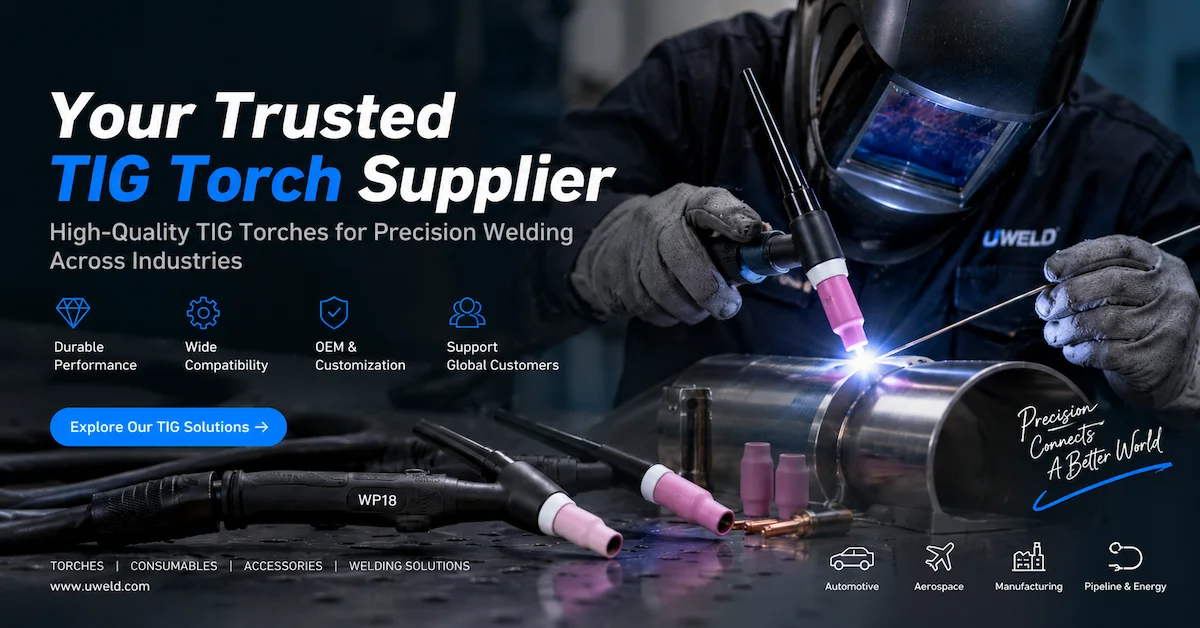
One useful starting point is to examine published torch families before adding private-label options. UWELD currently lists 15AK, 24KD and 36KD MIG/MAG torches, together with WP26 and WP18 TIG torches.
| UWELD reference | Publicly identified feature | OEM buyer's next question |
|---|---|---|
| 15AK MIG | Air-cooled; listing title identifies 150 A and MIG200. | Which exact machines, wire sizes and consumables are approved? |
| 24KD MIG/MAG | Air-cooled, 10 ft, Euro connector in the listing title. | Which connector and cable variations are available for this project? |
| 36KD MIG/MAG | Air-cooled Euro-connector configuration is listed. | What are the model-specific duty and shielding-gas conditions? |
| WP26 TIG | Listing mentions air cooling, 13 ft, M16 × 1.5 and a 2-pin socket. | Are the power, gas and control interfaces correct for our welder? |
| WP18 TIG | Water-cooled; title lists 350 A, 13.1 ft and denim cover. | What cooler, hoses and fittings must accompany this variant? |
The website titles are starting references, not blanket compatibility approvals. Verify the current specifications with UWELD before printing ratings or machine claims on a private-label carton. A useful launch assortment may consist of only two or three validated configurations plus a coordinated spares list; adding more variants too early increases purchasing and support complexity.
Send UWELD the machine models, intended torch families and quantities per configuration rather than requesting one generic OEM price.
Request a MIG/TIG OEM Proposal → Compare Welding Products →4. Separate Branding Changes From Engineering Changes
Not every customization request carries the same risk. Logo placement, carton color and a barcode layout mainly change product presentation, although mandatory warnings and accurate descriptions still need review. Altering a torch connector, cable assembly, cooling path, neck or trigger control can affect machine compatibility or safe operation. Those proposals require technical evaluation and may need fresh sample approval.
| Requested OEM change | Suggested approval route | Important boundary |
|---|---|---|
| Logo, box or insert artwork | Approve proof, placement and language. | Keep model and safety information accurate. |
| Packaging quantity or accessory kit | Approve contents list and packed sample. | Confirm each component's correct fit. |
| Cable length, connector, cooling or control | Engineering review, revised specification and functional sample. | Do not assume previous technical evidence covers the change. |
| New consumable design or torch head | New parts mapping and relevant qualification. | Existing replacement parts may no longer fit. |
Compliance boundary: IEC 60974-7:2019 addresses construction and safety requirements for arc-welding torches. UWELD also references ISO 9001 management-system certification and standards for other product categories, but neither a management-system certificate nor gas-welding documentation automatically establishes conformity of a particular MIG/TIG torch. Ask for the precise model scope and applicable technical evidence.
UWELD states that OEM/ODM cooperation may involve appearance, logo and specification adjustments subject to feasibility and order requirements. Ask for the exact scope available on the selected torch; do not assume all modifications are standard catalog options. Its solutions page describes engineering collaboration, while the FAQ explains that details are handled by project.
5. Four Approval and Handover Controls Before Bulk Supply
Technical sample gate
Record the welder version, process, interface, rated conditions, operating trial and supplied consumables. Capture any corrections against a named sample revision.
Retail-pack gate
Approve printed model identity, barcode, instructions, carton dimensions, quantities and the actual packed contents—not artwork alone.
Production-release gate
Sign off the controlled SKU specification, acceptance criteria, critical components and rules for substitutions before the bulk order is released.
Reorder-baseline record
Retain approved sample photographs, revision codes, packaging proof, inspection evidence and replacement-parts references for the next purchase cycle.
This is a recommended buyer approval framework, not a claim that UWELD automatically supplies these exact documents or operates these named gates. Define responsibilities in the RFQ and supply agreement. A sample that fits one welder is not proof of compatibility with every machine sold under a familiar series name.
6. Packaging Controls That Prevent Warehouse and Customer Errors
For private-label welding torches, packaging is both a marketing surface and an identification system. The outer box, unit label, shipping carton and online product listing should use the same sellable SKU. A simple internal checklist can prevent a 10 ft version from being boxed as a longer version or an air-cooled TIG model from being confused with a water-cooled kit.
Include the brand and model, a clear assembly description, variant-specific connection details where appropriate, contained accessories, any applicable instructions and warnings, and the barcode data agreed for the destination channel. Retail language and importer responsibilities depend on local requirements. Test the physical packaging against the shipment method: courier parcels and palletized wholesale cartons face different handling conditions.
Before printing volume quantities, compare the packaging proof with the approved hardware. It is more efficient to correct a mistaken model descriptor on one proof than on thousands of cartons. If the buyer changes accessories, update both the packed-contents record and the label revision.
7. Make Replacement Parts Part of the OEM Launch
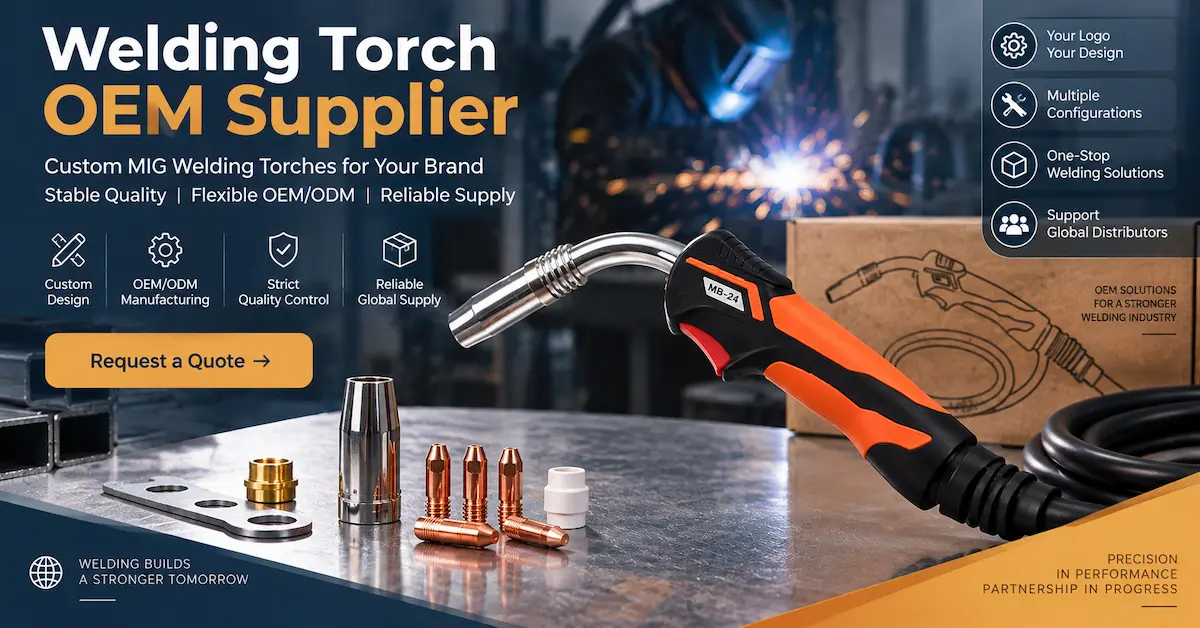
A torch line that cannot be serviced reliably is difficult to support in a professional distribution channel. MIG buyers may need contact tips, gas nozzles, diffusers, liners and replacement neck-related parts; TIG buyers may need collets, collet bodies or gas lenses, cups, back caps and other appropriate components. The exact parts depend on the approved assembly, not on the broad model family alone.
| Main OEM SKU | Required parts mapping | Useful service record |
|---|---|---|
| MIG 15AK / 24KD / 36KD variant | Contact-tip reference, wire-size fit, nozzle, liner, diffuser and other service items. | Illustrated exploded view or supplier-confirmed compatible parts list. |
| Air-cooled TIG WP26 variant | Approved electrode-holding and gas-shielding components; head/handle items as applicable. | Matched consumable family and connection record. |
| Water-cooled TIG WP18 variant | Consumables plus the specified coolant-related service items. | Cooling-unit requirements and confirmed hose/fitting references. |
Agree with the supplier which replacement references will remain available, how substitutions will be documented and how the distributor can identify a customer's earlier revision. A spares cross-reference can also help a warehouse distinguish visually similar components. Do not publish a cross-brand replacement claim without checking the physical and functional match.
8. Lock Changes Between Production Batches
One of the highest-value clauses in an OEM supply arrangement concerns engineering change notification. A supplier may need to alter a component because of availability or production needs. The buyer should know in advance whether that change affects form, fit, function, servicing, documentation or regulatory claims.
Use a change request containing the original SKU and revision, affected components, reason for change, compatibility assessment, sample requirement, proposed effective order and inventory transition plan. For critical changes, authorize the revised version only after appropriate engineering review. For purely cosmetic changes, a packaging proof may be sufficient. What matters is that the parties agree on the distinction rather than treating every revision alike.
Maintain the old revision in service records, even after new production begins. A distributor may have sold both versions into the market. Customer support needs to identify which consumables or components belong to each one. That continuity can prevent avoidable warranty confusion.
9. Plan the Reorder Cycle With Inventory and MOQ Reality
UWELD's public FAQ explains that MOQ varies between product types and standard or custom projects. It also gives general stock-item guidance of one to two weeks, with customized order lead times dependent on process and order volume. Neither statement is a guaranteed schedule for a named MIG/TIG OEM configuration.
For a realistic reorder plan, estimate sales during the entire replenishment interval: production, inspection, freight, customs handling and inbound processing. Then decide what buffer is appropriate for actual demand variability. Do not confuse factory completion time with the date stock is available to sell.
For illustration, suppose an importer sells 40 units per week of an approved torch SKU, expects six weeks from order release to warehouse availability and plans two weeks of demand buffer. The indicative reorder point is 40 × (6 + 2) = 320 units. This is an illustrative planning formula, not UWELD performance data or a fixed buffer recommendation. Adjust for demand changes, supplier-confirmed lead times and the available MOQ.
If separate connector variants sell at different rates, calculate inventory and MOQ tradeoffs by variant rather than combining all products into a single count. Also consider packaging-component minimums, custom printed cartons and the cost of holding slow-moving private-label inventory.
10. What a Comparable OEM Torch Quotation Must Contain
The cheapest unit quotation may omit artwork, sample evaluation, spares or packing details that another proposal includes. Request a line-by-line comparison on the same technical baseline. Otherwise two prices may refer to different torch assemblies.
- Technical scope: exact SKU, assembly revision, included items, connector and cable details.
- Commercial scope: quantity per variant, sample charges, customization/tooling where applicable, packaging charges and payment terms.
- Quality scope: agreed acceptance method, inspection responsibility and available model-specific documents.
- Delivery scope: production milestone, packing quantities, Incoterm, named place and dispatch assumptions.
- After-sales scope: service-part availability, claim evidence and agreed remedies.
Ask whether later replenishment orders must meet a separate MOQ and whether branded packaging has independent quantity requirements. Clarify who owns and can reuse paid artwork or tooling where relevant. A supply relationship is easier to scale when these questions are answered before the first production order.
Ask UWELD to review the proposed technical SKU, sample requirements, branding scope, intended market and estimated reorders. Details are confirmed by project.
Get an Itemized OEM Quotation → Explore UWELD OEM Partnership →11. Copy-Ready RFQ for a Welding Torch OEM Supplier
Use the following structure when contacting suppliers. It is designed to make the first response more useful than a generic catalog price.
Subject: Private-Label MIG/TIG Torch Program — SKU Approval & Repeat Supply
We are an importer/distributor serving [market/channel]. We need [MIG/TIG torch model references] for [machine make, model and version], with [connector, lead, cooling and control details]. Our launch volume is [quantity per configuration], and estimated repeat demand is [forecast]. Please quote samples, OEM logo and packaging options, MOQ for each SKU, inspection/documentation options, compatible spare parts, production lead time and Incoterms. We would also like to agree on a controlled sample revision and approval process for future component changes. Please identify any machine or operating data still required.
Include photographs of equipment connections and any current service-parts references. If an initial request is not specific enough for safe matching, invite technical questions before asking for a final price. UWELD's contact form is available for new OEM inquiries, while its FAQ outlines sample, MOQ, document and after-sales topics.
12. Welding Torch OEM Supplier FAQs
Can a welding torch OEM supplier print my brand on an existing torch?
Often yes, subject to the specific product, order volume and artwork feasibility. UWELD lists logo, appearance and specification customization as possible services. The buyer still needs approval of the exact configuration and claims printed on the packaging.
Does OEM branding mean a torch design is exclusive?
No. A private-label logo does not by itself establish exclusive ownership of the underlying design. Exclusivity, tooling ownership, intellectual-property rights and territory arrangements require explicit written agreement.
Should the same torch family have multiple OEM SKUs?
Yes, when changes such as connector, cable length, cooling or controls affect what the customer receives or how it is supported. Maintain a separate identification record for each meaningful variation.
How can buyers keep private-label torch quality consistent?
Use an approved sample and drawing revision, documented acceptance criteria, component-change notification and shipment identification. Request relevant model-specific test and inspection evidence instead of relying on a general company certificate.
Does ISO 9001 confirm every MIG/TIG torch is certified?
No. ISO 9001 concerns a quality management system, not blanket product approval. Confirm applicable product standards, the precise model scope and the required destination-market documents independently.
Can I get an exact OEM MOQ and delivery time from UWELD?
UWELD states that MOQ and custom lead times depend on the selected product and project. Request a written quote identifying quantities per variant, sample steps and the production/shipping schedule.
Conclusion
The best welding torch OEM supplier relationship is designed for the order after the launch. Importers should lock the exact MIG/TIG configuration, control sample and carton revisions, map replacement parts and agree on technical change notification before scaling a private-label program. This prevents the brand printed on the box from becoming disconnected from the product customers expect inside.
UWELD provides published MIG/TIG torch references and describes OEM/ODM and partner collaboration on its official website. The SKU framework in this article is a practical buyer recommendation, not a statement that every proposed control or modification is automatically included in a UWELD quote. Review the welding product range, discuss the appropriate OEM partnership route and send a configuration-specific inquiry to establish feasibility, documents, pricing and reorder terms.
Start Your OEM Torch Project →