

How Do You Choose a Plasma Cutting Torch Supplier? The Short Answer
A dependable plasma cutting torch supplier should supply a clearly identified torch assembly that works with your specified plasma power source, starting system, compressed-air supply, and intended cutting application. For CNC installations, the supplier should also help you establish the mounting dimensions and machine-control interfaces. For wholesale or private-label orders, the same approved configuration must be reproducible across future shipments.
Before ordering, verify six things: (1) the exact torch and power-source match; (2) operating current and duty-cycle conditions; (3) gas or air requirements; (4) ignition, trigger, and CNC compatibility; (5) electrode/nozzle and other consumable part numbers; and (6) sample approval and batch controls. A familiar model label is a useful starting point—not a technical approval.
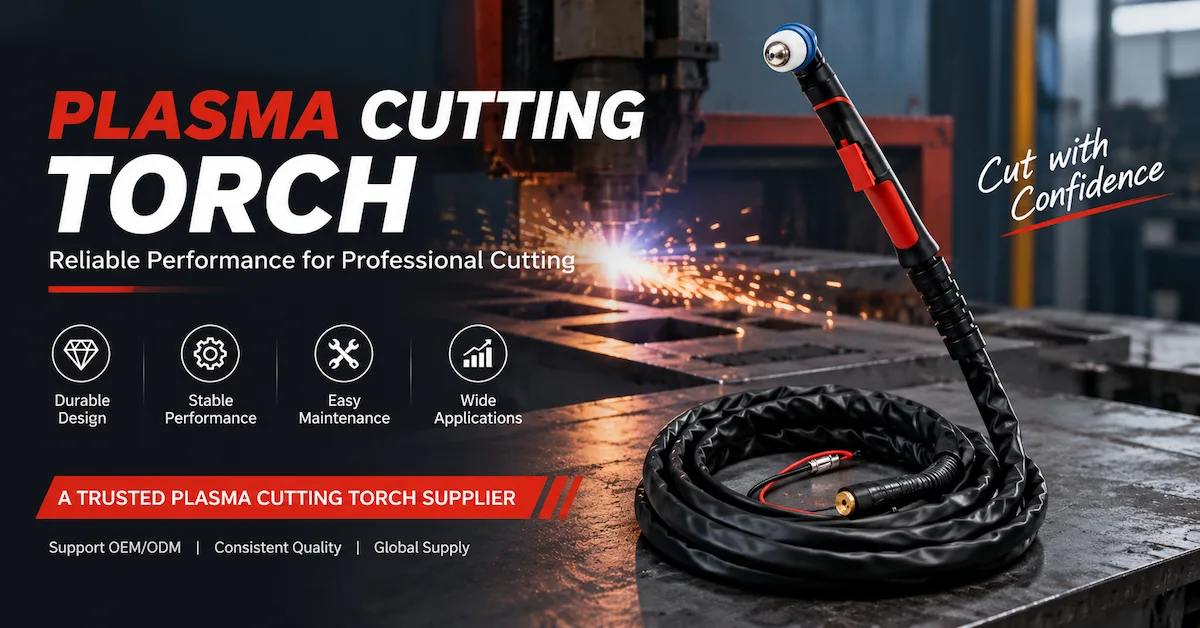
UWELD publicly lists P31 and P80 plasma cutting torch heads, describing configurable options for machine or CNC-table applications on its new-products page. The company also presents its welding products range and OEM/partner programs for distributors and industrial buyers. Those public listings establish product interest and sourcing routes; actual cutting capacity, control wiring, connector arrangements, and compliance documents must still be confirmed for the quoted assembly.
This guide translates those checks into a practical buying method. It is written for people who need the torch to work, stock, and reorder reliably—not just look convincing in a catalog.
Who Is This Buying Guide For—and When Is It Not Enough?
An independent workshop replacing one damaged torch has a relatively narrow question: “Will this specific replacement fit my machine?” A distributor importing hundreds of torches has to answer that question for every customer configuration, while also managing spare parts, warranty returns, stock accuracy, packaging, and repeat orders.
| Buyer | What makes the order difficult | What to request first |
|---|---|---|
| Welding and cutting equipment importer | Different machines and connector versions in one market | Machine-to-torch compatibility list and controlled SKUs |
| Industrial tools distributor | Replacement-part demand and return risk | Consumable exploded view and service part numbers |
| CNC plasma table builder | Mounting, ignition, control, and height-control integration | Mechanical drawing and interface documentation |
| Private-label welding brand | Product consistency across packaging and revisions | Approved specification, sample, artwork, and change procedure |
| Steel fabricator or repair contractor | Actual material, duty, and environment | Cutting application and system operating requirements |
| Service company | Fault diagnosis and replacement inventory | Wiring/connector identification and technical support path |
This article does not replace the plasma power-source manual, a certified electrician's assessment, a CNC integrator's commissioning procedure, or workplace safety instructions. It is a procurement framework for deciding which evidence to request and where to stop if the evidence is missing.
For example, if a buyer knows only the machine's advertised maximum current but cannot identify its torch connector or ignition system, the correct purchasing decision may be to pause the order and obtain those details, not to choose a seemingly larger torch.
Plasma Cutting Torch Basics: The Torch Is One Part of a System
Plasma arc cutting uses an electrical arc and a constricted, high-temperature ionized gas stream to melt and remove electrically conductive material. In typical air-plasma systems, compressed air also helps shape the arc and expel molten material from the kerf. This differs fundamentally from oxy-fuel cutting, where a fuel-gas flame and oxygen-driven reaction perform the cutting process.
A plasma torch is therefore not an oxy-acetylene cutting head, and plasma nozzles are not interchangeable with oxy-fuel cutting tips. The wider cutting system normally includes a power source, torch lead, gas supply and treatment equipment, work return circuit, consumables, control functions, and—when mechanized—a motion controller and torch height control.
What is inside a typical plasma torch assembly?
The exact construction depends on the model. Relevant parts may include the torch body and head, handle or machine-mounting body, lead assembly, power/gas connections, trigger or remote-start interface, electrode, nozzle or tip, gas diffuser/swirl component, retaining cap, and shielding or spacing components. Not all systems use the same combination or terminology.
These components interact. The electrode and nozzle are not merely cheap accessories: their geometry and condition help determine arc formation, cut quality, and operational life. A diffuser or swirl component can affect gas flow; a damaged seal can change system behavior. The correct stack-up should come from the manufacturer-approved parts diagram for the exact torch version.
What should a supplier define in one complete assembly?
At minimum, specify a unique product code, head variant, lead length and construction, connector types, start/control arrangement, applicable consumable set, intended power-source models, and operating envelope. If the quotation is for a torch head only, it must say so. Do not assume the head includes the leads, connector, hand trigger, height-sensing parts, or a complete ready-to-run assembly.
This distinction is especially important with CNC-oriented listings, where the word “customizable” may refer to a head or configuration option rather than a complete plug-and-play CNC cutting package.
P31 vs P80 Plasma Cutting Torch: Start With Compatibility, Not a Number
UWELD's current new-products list contains P31 and P80 entries described as plasma machine cutting torch heads with CNC-table customization possibilities. The P80 product page also identifies the P80 family. These are sensible reference points for an inquiry, but the labels alone do not establish interchangeability, cutting thickness, or the exact assembled specification.
Buyers may also encounter PT31 in older industry catalogs and consumables descriptions. Treat P31 and PT31 as terms that require confirmation from the supplier, not automatic proof that every tip, electrode, body, and connector fits both. Likewise, “P80” is a family label: never infer a certified 80 A rating solely from the number in its name.
| Purchase question | P31 / PT31 family | P80 family | Required decision |
|---|---|---|---|
| Exact torch identity | UWELD currently displays “P31”; older material may say “PT31” | UWELD displays “P80” | Confirm current drawing and order code |
| Current capability | Must be established for the selected assembly | Must be established for the selected assembly | Verify rating conditions with current data sheet |
| Ignition | Cannot be assumed from the family name | Cannot be assumed from the family name | Match power-source starting method |
| Air requirements | Need actual operating pressure and flow | Need actual operating pressure and flow | Check compressor delivery under load |
| Consumables | Confirm matching electrode, tip/nozzle, diffuser and cap | Confirm matching electrode, tip/nozzle, retaining/shield items | Approve an illustrated parts list |
| Manual or CNC | Confirm delivered assembly and control interface | Confirm delivered assembly and control interface | Request mounting and wiring drawings |
| Lead/connector | Varies by assembly configuration | Varies by assembly configuration | Match the target machine physically and electrically |
A useful catalog caution: UWELD search-indexed historical plasma catalog material contains more detailed PT31 and P80 figures, including amperage, duty cycle, air pressure, and lead specifications. Those older figures are not a substitute for the current approved data sheet; the historical PDF address is no longer reliably accessible on the live site. Ask UWELD to confirm which catalog version applies before using historical values in a quote, product label, marketplace listing, or compliance claim.
How should a buyer make the choice?
Start with the plasma cutter's manufacturer, full model and revision, not the new torch supplier's model title. Confirm the power source's output, start method, torch connections, required gas flow, duty limits, and any torch-recognition or safety interlock functions. Only then compare eligible torch families.
If a supplier can offer a connector adaptation, ask whether it is an approved configuration and what testing supports it. An electrical or gas adapter can solve one mismatch while introducing another. Do not bypass interlocks or change start circuitry based on connector appearance.
For distributors, the outcome should be a machine family → approved torch SKU → consumable SKU matrix. That is far easier for customers and support teams to use than a broad claim of “fits most plasma cutters.”
Seven Technical Checks Before You Request a Wholesale Quote
The most effective supplier comparison is a short engineering brief. If a vendor cannot answer a question immediately, ask for a drawing or test record rather than replacing the question with an unsupported assurance.
1. Rated current and duty cycle
An amperage value without a duty-cycle condition is incomplete. Ask for the rated current, test conditions, associated duty cycle, and relevant restrictions of the specific assembly. The power source and the torch must both operate within their intended ratings. A large number printed in a product name is not evidence of a suitable continuous-production setup.
When comparing two offers, use the same conditions. A torch sold with a different lead assembly or consumable design may require separate evaluation even if the head looks identical.
2. Starting method: high-frequency or other systems
Plasma cutters may use different arc-starting designs. High-frequency (HF) starting and non-HF arrangements should not be treated as interchangeable. The torch's electrode, head construction, wiring, and other parts must match the intended power source.
For CNC table builders, this matters beyond ignition: HF equipment may require particular attention to electromagnetic interference, cable routing, grounding/bonding, and controller integration. Follow the original equipment manufacturer's instructions and applicable electrical safety requirements rather than assuming a torch marked “CNC” solves those issues.
3. Working gas or air: pressure and flow together
Most portable plasma systems relevant to these torch families use compressed air, but the source and torch configuration determine the required gas specification. Request the specified dynamic operating pressure and required flow at the cutting system, not just a regulator gauge reading with the machine idle.
Pressure and flow are distinct. A compressor can reach a satisfactory static pressure and still fail to deliver enough air during a cut. Ask about filtration, moisture, oil contamination, hose losses, and pressure drop. These affect the real operating conditions and can shorten consumable life or compromise cut quality.
4. Electrical power, gas and control connectors
Photographs help, but drawings are stronger. Record the mating connector type, thread or plug description, cable conductor requirements, gas path, and remote-start pin functions. A similar-looking fitting does not prove compatibility.
If the supplier quotes more than one connection arrangement, assign each a different order code. Never combine several connector variations into one item description and hope they will be sorted at receiving inspection.
5. Lead length, routing and mechanical protection
Check the full lead assembly: usable length, bending and strain-relief requirements, abrasion exposure, and routing to the cutter. Long leads may be necessary for a CNC gantry or large workshop, but a longer lead is not automatically safe or electrically suitable for every machine.
The approved length must be supported by the specified power source and the delivered assembly. Ask whether any cable-cover, mounting sleeve, or protection option is included or separately quoted.
6. Electrode, nozzle and wear-part compatibility
Request a bill of materials or exploded drawing with part numbers. Identify electrode, nozzle, swirl/diffuser, retaining cap, shield or standoff components as applicable. A consumable identified only as “P80 tip” is less useful than a validated code tied to nozzle size and intended cutting current.
For repeat orders, the exact replacement-part list matters as much as the original torch. Your customer should be able to reorder a known set instead of identifying components from a photograph.
7. Manufacturer instructions and limits
Ask for instructions describing assembly, permitted operation, maintenance, and safe replacement procedures. Never operate the system with missing protective parts or defeat the manufacturer's safety devices. If the supplied documentation conflicts with the power-source instructions, resolve the conflict before testing.
CNC Plasma Torch Supplier Checklist: Integration Is More Than Mounting
CNC table projects raise a separate set of buying questions. A torch may physically fit a bracket and still fail to integrate with the motion controller or arc-start sequence. The supplier's role is to identify what it supplies; the integrator must verify the completed machine system.
Mechanical geometry and repeatability
Request the torch mounting diameter or bracket dimensions, total head length, consumable-tip position, alignment reference, cable exit direction, and any restrictions on clamp pressure. For mechanized cutting, consistent torch orientation and height help the controller maintain the intended standoff.
If the quote describes a machine torch but photographs show a modified handheld head, ask for a drawing of the actual delivered machine configuration. A visual mockup is not an engineering drawing.
Starting and motion-controller signals
Define how the CNC controller commands the cut and receives relevant system status. Trigger/start contacts, arc-established signals, and any voltage-derived torch-height input depend on the power source and controller—not simply the torch body. A “CNC compatible” marketing statement does not certify a complete interface.
Never connect raw cutting voltage directly to controller inputs unless the equipment manufacturer expressly specifies the method. Torch-height control and interface wiring should be designed and commissioned by competent personnel using the correct isolation and voltage-divider arrangements where required.
Torch height control, pierce height and standoff
Cut height and initial pierce height affect edge quality and consumable wear. Those settings come from the approved cutting process for the specific power source, material, thickness, consumables, and current; they should not be invented from the torch family name.
For a CNC application, request the intended process chart and confirm how the controller senses the plate and holds height. Ask whether the assembly supports the required sensing method; do not assume ohmic sensing or any other feature is present unless the parts and circuit support it.
Electromagnetic compatibility and cable management
Separate sensitive control wiring from high-energy power and starting circuits as recommended by the system manufacturers. Plan grounding/bonding, shielding, cabinet layout, and cable carriers with the integrator. Unexpected CNC motion, communication errors, or failed arc detection can result from a broader system integration problem rather than a defective nozzle.
A successful CNC plasma torch procurement therefore delivers two approvals: mechanical fit and electrical/process integration. Neither one can be inferred from a product photograph.
Consumables: The Real Long-Term Supply Test
For distributors, electrodes and nozzles generate recurring orders and recurring technical questions. Consumables are also a frequent source of avoidable complaints when customers mix parts across similar torch families.
| Component | Why it matters | What purchasing should confirm |
|---|---|---|
| Electrode | Participates in arc formation and wears with use | Exact part number, compatible torch/current, inspection criteria |
| Nozzle / tip | Helps constrict and direct the plasma stream | Bore/variant, matching electrode, proper current/application |
| Swirl ring / diffuser | Influences gas distribution in relevant designs | Correct material/geometry and assembly position |
| Retaining cap | Holds designated components in place | Matching thread and correct stack-up |
| Shield or standoff part | Affects permitted contact/spacing on relevant systems | Whether supplied and approved for the process |
| Torch head / lead | Determines serviceability after damage | Replacement assembly identification and configuration |
Do not claim universal compatibility because two parts share the same nominal diameter. Compare the entire consumable stack-up. Some aftermarket parts may be dimensionally similar but function differently in gas delivery or positioning.
A useful purchasing exercise is to prepare a 12-month wear-part stocking plan. Start with the number of installed torches, the expected operating hours, the cutting mix, and actual historical replacement rates if available. Ask the supplier whether it can maintain stable replacement-part codes and packaging quantities. Avoid invented “electrode lasts X cuts” claims: life varies substantially with process settings, air quality, pierces, handling, and operator practices.
For new product launches, keep a small approved service kit beside the demonstration sample. That makes it easier for a distributor to train sales staff, diagnose returns, and confirm replacement-part ordering before customers encounter problems.
What Plasma Cutting Quality Tells You—and What It Does Not
Cut edge quality is influenced by the whole cutting process: machine output, electrode and nozzle condition, air quality, travel speed, torch height, material, and work return. Not every imperfect cut indicates a poor torch.
Watch for recurring symptoms
Excessive dross, angular edges, unstable arc behavior, rough surfaces, or shortened consumable life can point to several different causes. A worn nozzle, incorrect current, wrong standoff, unsuitable travel speed, low air delivery, or contamination can produce overlapping symptoms.
The correct troubleshooting approach is to test one variable at a time against the system's approved procedure. Do not publish dramatic before/after promises unless the tests and conditions are documented.
Define a representative sample trial
Test using the power source and consumables the customer will actually use. Record material type and thickness, current, dynamic gas conditions, cut mode, travel speed, standoff, and operator or CNC settings. Keep photographs of the test coupons and note any interruption or replacement during testing.
For an importer, a controlled sample trial is more persuasive than a supplier video using unidentified machinery. For a manufacturing customer, it also makes it possible to repeat the test if a future delivery behaves differently.
Know which metrics need a defined test
If you want to compare kerf width, bevel/edge angle, dross, or cutting speed, state the procedure and measurement basis. Avoid saying one torch provides “30% better precision” unless verified under comparable conditions. A technical document should give the buyer a method, not a marketing number without context.
Manufacturing Quality Control: Evidence to Request From Your Supplier
“High quality” is a conclusion; an inspection plan is evidence. A serious plasma torch supplier should be able to explain how the quoted assembly is identified, built, and checked. Buyers should focus on the tests and records relevant to the actual design.
Incoming component and dimensional checks
Ask which critical parts are inspected: electrode/nozzle mating features, insulating parts, threaded connections, cable conductors, switch components, gas fittings, and seals where applicable. Not every dimension requires a public drawing, but acceptance criteria and a controlled revision are important for production consistency.
Assembly checks and identification
The supplier should distinguish look-alike assemblies by their approved codes. Confirm how connectors, lead lengths, consumable sets, labels, and accessories are checked before packing. If several variants are made in the same facility, ask how mix-ups are prevented.
Functional and safety checks
Agree on the checks required before release. Depending on the design and applicable standards, these may include electrical continuity/insulation, gas-path integrity, interface verification, protective interlock function, and controlled performance testing. The specific inspection method and acceptance limit must be documented rather than invented for a blog post.
Traceability, corrective action and warranty
Ask whether a batch or production identifier allows returned products to be traced to an approved specification and manufacturing period. Understand how failures are investigated and when the supplier issues replacements or corrective actions. Written warranty conditions and service responsibilities are more useful than a broad “worry-free” promise.
Company-level ISO 9001 claims, when properly evidenced, indicate a quality-management system; they do not automatically establish conformity of every plasma torch SKU. Product-specific conformity documents and destination-market requirements need separate review.
Safety Standards and Market Compliance: Verify the Exact Scope
A torch is part of a high-energy cutting system. Electrical shock, intense arc radiation, heat, fumes, fire, pressurized gas, and unexpected machine movement are real hazards. Responsible sourcing cannot replace safe system design, appropriate PPE, local exhaust or ventilation assessment, training, and the manufacturer's operating instructions.
An important reference for technical assessment is IEC 60974-7:2019, Arc welding equipment—Part 7: Torches, published by the International Electrotechnical Commission. Its stated scope covers safety and construction requirements for torches used in arc welding and allied processes, including manually and mechanically guided designs. Relevance to an exact product should be established against the standard's requirements and the intended system; citing the title alone is not a certification.
Buyers should request the relevant declaration, test report, instructions, label content, and edition details where required by the destination market. Do not treat CE as an independent third-party product certificate, and do not infer a product-specific CSA, UL, or other approval from an unrelated corporate claim.
For plasma process planning, equipment manufacturers such as Hypertherm publish detailed, model-specific consumable breakdowns that illustrate why electrodes, nozzles, shields and swirl rings must be matched to the system. Those illustrations are valuable industry references but do not authorize substituting another manufacturer's parts into a UWELD assembly without documented compatibility evidence.
OEM Plasma Cutting Torch: What Can Be Customized?
An OEM or private-label buyer may need market-specific product identification, packaging, service kits, or a different connection arrangement. The scope must be defined carefully: visual customization is not the same as engineering qualification.
UWELD describes UWELD brand distribution and custom/OEM manufacturing as two partnership paths. This supports a legitimate inquiry about private-label plasma cutting products, but it does not establish that every conceivable P31 or P80 technical modification has already been validated or is available at any order quantity.
Lower-risk commercial customization
Discuss logos, model labels, barcode content, manuals, carton artwork, language, packing quantities, and approved spare-parts kits. Even simple artwork changes require review: a label may contain electrical and safety information that must remain accurate in the destination market.
Engineering changes require a new approval decision
Changes to the torch head, connector, leads, trigger circuit, air passages, consumable dimensions, or CNC mounting geometry may affect compatibility and safety. Ask the engineering team to document the proposed change, feasibility, any tooling implications, and what needs to be retested. Do not accept a modified bulk shipment merely because its outer packaging is unchanged.
Build a controlled private-label product file
Maintain one record for each sellable SKU: approved drawing, parts list, equipment compatibility, assembly revision, instructions, packaging proof, sample identifier, inspection plan, and replacement-part mapping. Decide in writing whether substitutions require your consent and who handles claims in the target market.
An early discussion through UWELD's solutions page can establish whether the intended configuration fits the project's technical and commercial scope. Bring the machine details and expected volume; otherwise the supplier cannot quote a comparable, technically defined product.
Compare Supplier Quotes Using Total Cost and Service Risk
Unit-price comparisons often fail because the quotes are not describing the same product. One vendor may quote a bare head, another a complete 5 m torch lead assembly; one may include consumables, another may not; one might propose an adapter without providing an approval method.
Normalize the quotation first. Put head, lead length, connector, power-source compatibility, included consumables, packaging, required documents, test scope, and trade terms on the same line. Then compare price and commercial risk.
| Cost or risk element | Question for purchasing | Why it changes the decision |
|---|---|---|
| Complete torch assembly | Which parts and connectors are included? | Avoids comparing a head against a complete torch |
| Lead configuration | Is the approved length and protection included? | Prevents unexpected rework and replacements |
| Consumables | Are initial sets and future kits priced separately? | Reveals recurring operating costs |
| Sample qualification | Who pays for samples, fixtures and testing? | Captures project-start expenses |
| Branding and tooling | Are artwork, printing and tooling charges separate? | Clarifies private-label investment |
| Freight and import | Which Incoterms, dimensions and shipping assumptions apply? | Improves landed-cost comparisons |
| Returns and service | What evidence and remedies are required? | Estimates realistic after-sales exposure |
Illustrative formula: landed acquisition cost per approved assembly = product and included accessories + allocated tooling/packaging + freight/insurance + applicable import costs + receiving/inspection costs. Add an evidence-based after-sales budget where relevant. This is a decision framework, not a UWELD price quotation or promised cost reduction.
Some buyers find the second-year economics more important than the first purchase: repair support, stable consumable supply, correct connection variants, and controlled product revisions reduce avoidable disruption. Ask the supplier how it manages repeat orders rather than relying entirely on a first-shipment sample.
MOQ, Lead Time, Logistics, and Repeat-Order Consistency
Do not assume that a company's general export capability tells you the MOQ or delivery schedule for a customized plasma torch. Component availability, connector types, cable lengths, testing, branding, tooling, and order volume can all change production planning.
Request a written schedule that separates sample preparation, approval, production, quality inspection, and dispatch. Confirm whether the lead time begins after drawing sign-off, deposit, packaging approval, or another defined milestone. If buyers expect partial shipments or rolling orders, discuss them explicitly.
A repeat-order agreement should identify an approved assembly revision, not just the family name. A replacement connector or newly sourced electrode material may require reassessment. Define who authorizes technical changes and what documentary evidence accompanies the next shipment.
For export packaging, consider carton protection, readable SKU labels, handling requirements, accessory counting, and the documents the importer will need. Private-label buyers may also require multilingual instructions and market-specific importer information. None of these requirements should be assumed available until confirmed in a written quotation.
A 12-Point Plasma Torch RFQ Template for Importers and CNC Buyers
A detailed request for quotation turns a generic sourcing conversation into a testable project. You can copy this list into your email or purchasing form.
-
Buyer and market: company, role, target countries, sales channel, end-user application.
-
Power-source identity: manufacturer, full model, revision, rated output, and available documentation.
-
Torch family: P31/PT31, P80, or another approved reference; specify head-only or complete assembly.
-
Cutting application: material types, common thicknesses, expected cutting current, manual or mechanized use.
-
Starting method: power-source arc-start system, trigger logic, and relevant control functions.
-
Air/gas supply: specified operating pressure, flow, gas quality and compressor setup.
-
Connections: drawings/photos of power/gas coupling, electrical connector, and CNC interface as applicable.
-
Torch assembly: lead length, mounting geometry, handle or machine body, protective components.
-
Consumables: approved electrode/nozzle/diffuser/cap list, starting quantities and replacement pack plan.
-
Technical and safety documents: current datasheet, instructions, drawing revision, test or conformity records required for the target market.
-
Commercial scope: sample quantity, forecast order volume, branding, packing, delivery destination, Incoterms and required dates.
-
After-sales and revisions: warranty, claims process, spare-parts continuity and written change-control terms.
For an inquiry based on UWELD's catalog, refer to its P80 product information or P31/P80 new-product listings, then submit the completed specifications through the UWELD contact page. Ask for the current drawing and datasheet matching the quotation, particularly when buying a CNC or custom connector variation.
Supplier Evaluation Scorecard: Use Evidence, Not Superlatives
A buyer can compare candidates consistently with a simple internal scorecard. The weights below are an illustrative procurement tool, not an official UWELD assessment or an industry certification benchmark. Adjust them to the consequences of failure in your market.
| Category | Suggested weight | Evidence to request |
|---|---|---|
| Technical compatibility | 30% | Machine match, connector drawing, start and air-system suitability |
| Product consistency and QC | 20% | Approved sample, test/inspection criteria, revision control |
| Consumables and after-sales | 20% | Exploded parts list, stock terms, claim procedure |
| OEM and documentation | 15% | Branding scope, instructions, destination-market documents |
| Commercial and logistics | 15% | Comparable RFQ response, lead-time terms, packing and shipping |
A supplier who scores well on price but has no reliable machine compatibility evidence should not automatically win. Depending on the application, unresolved technical or safety issues are disqualifying gates, not minor points that can be offset by cheaper freight.
Use the scorecard after technical eligibility is established. It works best when multiple colleagues—purchasing, engineering, service, and sales—review the same supplier documents.
An Illustrative Buying Scenario: Why a “Compatible P80” Claim Is Not Enough
Imagine a regional distributor selling replacement torches for several older plasma cutting machines. The distributor receives a quotation for a “P80 compatible plasma torch,” a clear product photograph, and a competitive price. Customers are asking for replacement consumables as well as complete assemblies.
The quote looks promising until technical review reveals three missing facts: the control-pin wiring is unspecified, the lead connector has no approved drawing, and the consumable pack is labeled only by family name. At this point, buying a large opening inventory would transfer uncertainty directly to the distributor's customers.
The distributor asks for a machine-by-machine compatibility matrix, an illustrated consumables list, and two sample assemblies with the intended connectors. After testing those samples on the designated machines under qualified supervision, it creates separate SKUs for each connection variant. The purchasing team can now compare pricing against a stable specification and order the correct service kits.
This is a hypothetical procurement example, not a reported UWELD customer project, proof of cost savings, or a promise of compatibility. The transferable lesson is that a supplier's technical clarity makes wholesale purchasing easier to scale and service.
Why Include UWELD in a Plasma Torch Supplier Shortlist?
UWELD lists P31 and P80 plasma machine cutting torch head products and maintains a broader welding and cutting product portfolio. Its corporate materials describe two potential cooperation routes: distribution of the UWELD brand and custom/OEM manufacturing. That combination is relevant to importers evaluating a plasma accessory range or brands considering an identifiable private-label project.
The sound reason to start a sourcing conversation is access to specific catalog references and an established business inquiry route—not an unverified claim that every product passes every standard or fits every plasma cutter. Before approval, request the exact version-specific specifications, sample terms, matching consumables, manufacturing/inspection evidence, and project-level commercial offer.
You can explore UWELD's company background, welding products, and partner opportunities. When ready, provide a model-specific RFQ through Contact UWELD. The more clearly you define the machine and application, the more useful the technical response can be.
FAQ: Plasma Cutting Torch Supplier Questions From B2B Buyers
1. What makes a reliable plasma cutting torch supplier?
A reliable supplier helps verify the complete torch assembly against a known plasma power source, delivers consistent parts and documentation, supports compatible replacement consumables, and has clear repeat-order and claims procedures. Look for drawings, current data sheets, sample approval evidence, and explicit limitations rather than broad claims of “universal” fit. A detailed technical response is more useful than the lowest headline price.
2. Are P31 and PT31 exactly the same torch?
Do not assume they are identical solely because both terms appear in catalogs. UWELD currently lists a P31 machine cutting torch head, while older indexed catalog material uses PT31 for certain torch and spare-part descriptions. Ask the supplier to identify the exact drawing, body version, consumable stack-up, connectors and approved interchangeability for your machine before ordering.
3. Does P80 mean every P80 torch is rated for exactly 80 A?
No. A family identifier does not provide a complete electrical rating or duty-cycle specification. Ask for the current data sheet of the exact P80 assembly, its relevant test conditions, and the approved power-source and consumable configuration. Do not use the model number by itself as a certified current rating, and do not copy older catalog figures without current confirmation.
4. Can a handheld plasma torch be used on a CNC cutting table?
Only after the system integrator verifies mechanical mounting, start controls, required safety functions, process setup, and torch-height integration. A handheld body secured to a clamp is not automatically equivalent to a qualified machine torch. Review the power-source instructions and request drawings for any supplier-proposed machine or CNC configuration.
5. How important is compressed-air quality for plasma cutting?
Very important. Pressure, actual flow under cutting load, moisture, oil contamination, filtration, and hose losses may affect arc behavior and consumable wear. A compressor's maximum pressure alone is not enough to confirm suitability. Use the operating requirements from the specific plasma system and maintain the air treatment equipment accordingly.
6. Which consumables should distributors buy with plasma torches?
Start with the exact approved electrode, nozzle, diffuser/swirl component, retaining cap, and shield or spacing items where applicable. Their part numbers must match the torch revision and intended process. Establish reordering packs and illustrated spare-part references before launching the torch; do not promise that visually similar replacement tips are interchangeable.
7. What should I verify about HF ignition on a CNC plasma table?
Confirm the power source's starting arrangement, torch compatibility, wiring, controller interfaces, and applicable electromagnetic-compatibility practices. HF equipment can require careful installation and cable management. Do not rewire the start circuit, bypass protective controls, or connect power signals to a CNC controller without the correct equipment documentation and competent integration review.
8. Can UWELD provide OEM or private-label plasma torch products?
UWELD publicly offers a custom/OEM manufacturing partnership route and lists P31/P80 plasma torch products. Specific branding, connector changes, lead versions, minimum orders, tooling, testing, and delivery times require a project quotation. Define the approved electrical and mechanical configuration before signing off logos, packaging, or a wholesale launch.
9. Which safety standards and certifications should buyers request?
Requirements depend on the assembly, destination market, and applicable regulations. IEC 60974-7:2019 is a relevant torch safety and construction reference for arc welding and allied processes, but mentioning it does not demonstrate product compliance. Request model-specific declarations, test records, instructions, and label evidence where applicable, and distinguish company management-system certification from product conformity.
10. What is the fastest way to obtain an accurate bulk plasma torch quote?
Send the power-source model and revision, application, required torch family, starting system, operating air requirements, connector and lead information, CNC details if relevant, consumable needs, quantity, destination, and OEM requirements. Request a drawing-backed sample proposal and a quotation that identifies precisely what is included. Use UWELD's contact form to start the discussion.
Conclusion
Selecting a plasma cutting torch supplier is ultimately about controlling compatibility and repeat-order risk. Establish the exact P31/PT31 or P80 configuration, confirm machine connections and air requirements, approve consumables and CNC interfaces where relevant, and insist on an identifiable sample and specification for bulk supply. UWELD's published plasma torch listings provide a starting point for industrial importers, distributors, and OEM brands. Share your machine details and sourcing requirements with UWELD to request a configuration-specific technical review and quotation.