

Quick Answer: How to Choose a Reliable MIG Torch Supplier
A reliable MIG torch supplier should provide compatible welding torch solutions, clear specifications, stable manufacturing quality, customization support and consistent repeat-order management. Buyers should evaluate torch connection standards, current rating, cooling method, cable configuration, consumable compatibility, quality inspection and supplier support before selecting a long-term partner. The right supplier should help customers match the MIG torch with the welding system instead of only supplying a standalone component.
Introduction: Why MIG Torch Supplier Selection Matters for B2B Buyers
For welding equipment distributors, industrial suppliers and private-label brands, choosing the right MIG torch supplier affects product reliability, customer satisfaction and after-sales workload.
A MIG torch is one of the most frequently handled components in a welding system. Although it may appear simpler than a welding power source, the torch directly affects operator experience, consumable replacement, cable management and welding process stability.
Many buyers face challenges when sourcing MIG torches:
- Similar-looking torches may have different connection standards;
- Current ratings may be described differently between suppliers;
- Consumables may not match the supplied torch configuration;
- OEM buyers need stable product identification and packaging;
- Replacement orders may become difficult without clear model control.
UWELD provides MIG welding torch products as part of its wider welding equipment range, together with welding machines, TIG torches, plasma cutting torches and related welding accessories.
What Is a MIG Torch?
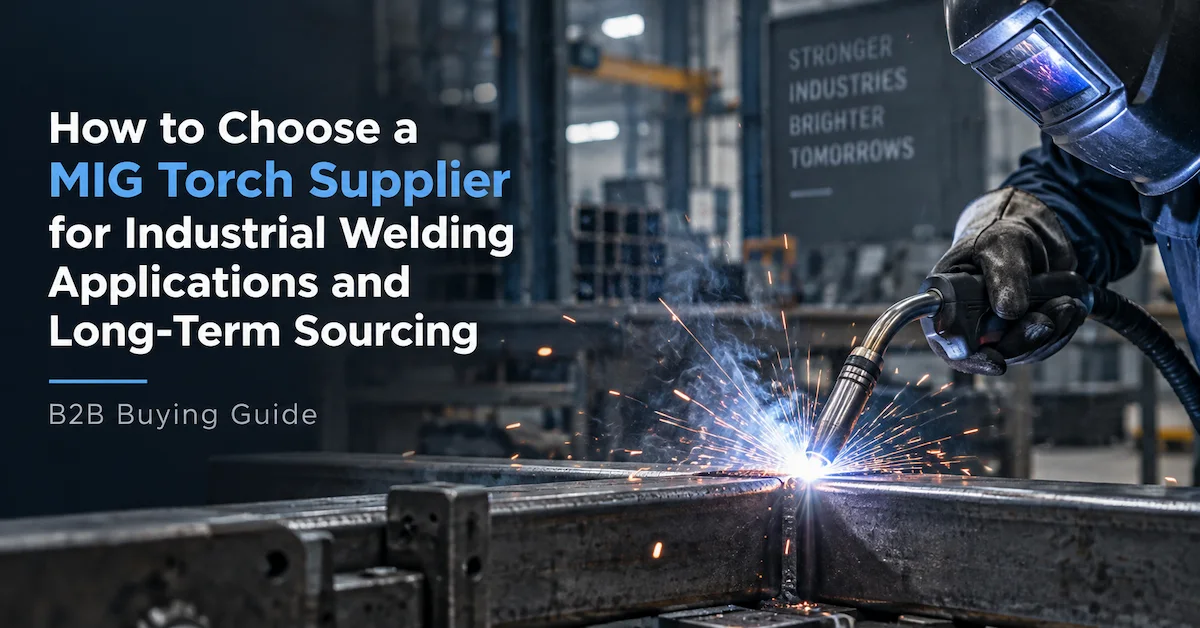
A MIG torch is a welding tool used in MIG/MAG welding systems to deliver welding wire, shielding gas and electrical current to the welding area.
A typical MIG torch system includes:
- Torch body;
- Handle assembly;
- Trigger switch;
- Cable assembly;
- Gas path;
- Wire liner;
- Contact tip;
- Nozzle and other consumable parts.
The torch works together with the welding machine, wire-feeding system and consumables. Therefore, selecting a MIG torch requires more than matching appearance or connector shape.
A supplier should help buyers confirm:
- Welding machine compatibility;
- Connection type;
- Wire diameter range;
- Cooling method;
- Cable length;
- Consumable availability.
UWELD lists the 15AK MIG welding torch as one MIG torch product example for buyer evaluation.
Why Do Buyers Source MIG Torches From Professional Suppliers?
Stable Product Quality
For distributors, inconsistent MIG torches can create customer complaints even when the original purchase price is attractive.
A professional supplier should help maintain:
- Consistent torch structure;
- Stable cable quality;
- Reliable connections;
- Repeatable consumable compatibility;
- Consistent packaging.
Quality consistency becomes especially important when buyers reorder the same product months later.
Better Product Matching
Different welding applications may require different torch configurations.
Examples include:
- Workshop welding;
- Automotive repair;
- Fabrication applications;
- Maintenance work;
- Industrial production.
A suitable MIG torch supplier should understand the application instead of recommending products only based on price.
OEM and Private Label Opportunities
Many distributors need products under their own brand identity.
OEM cooperation may include:
- Product labeling;
- Packaging design;
- Manual preparation;
- Accessory combinations;
- Product identification.
However, technical specifications should always be confirmed before branding decisions.
What Should Buyers Check Before Selecting a MIG Torch Supplier?
Before requesting quotations, buyers should prepare a clear product specification.
| Evaluation Factor | Buyer Consideration |
|---|---|
| Torch model | Is the product model clearly identified? |
| Welding machine compatibility | Does it match the intended machine system? |
| Current rating | Is the rating suitable for the application? |
| Cooling method | Air-cooled or other configuration requirements |
| Cable length | Does it fit the working environment? |
| Connector type | Is the connection standard confirmed? |
| Wire range | Are consumables compatible? |
| Consumable availability | Can customers easily replace wear parts? |
| Packaging | Is standard or OEM packaging required? |
| Documentation | Are product details available for approval? |
A complete specification makes supplier comparison more accurate.
How to Match a MIG Torch With the Welding System
Check Welding Machine Compatibility
A MIG torch should be evaluated together with the welding machine.
Important questions include:
- Does the connector match?
- Is the torch suitable for the machine output?
- Are control functions compatible?
- Are cable specifications suitable?
A MIG torch shown in a supplier catalog should not automatically be considered compatible with every welding machine from the same supplier.
UWELD’s welding products category includes different welding equipment categories. Buyers should confirm compatibility for the exact combination being purchased.
Confirm Consumable Compatibility
Consumables influence the daily operating cost of a MIG torch.
Buyers should check:
- Contact tip type;
- Nozzle type;
- Liner specification;
- Wire diameter compatibility.
For distributors, maintaining common replacement parts is often as important as selecting the torch itself.
MIG Torch Supplier Evaluation Checklist
A professional supplier evaluation should include manufacturing, product and commercial factors.
| Area | What Buyers Should Review |
|---|---|
| Engineering | Product design and technical support capability |
| Manufacturing | Production consistency and process control |
| Quality inspection | Product checking before shipment |
| Product identification | Model and version control |
| Customization | Branding and packaging options |
| Supply capability | Repeat-order stability |
| Communication | Response to technical questions |
| Documentation | Product information and approval materials |
The goal is not simply finding a low-price source. The goal is building a reliable supply relationship.
How Should Buyers Evaluate MIG Torch Quality Control?
Quality control should be connected to the actual product.
Buyers can ask suppliers about:
Component Control
Important components may include:
- Cable assembly;
- Handle parts;
- Trigger components;
- Connection parts;
- Consumables.
Assembly Consistency
A MIG torch supplier should control:
- Assembly procedures;
- Component matching;
- Product identification;
- Packaging consistency.
Final Inspection
Before shipment, buyers should understand whether products are checked for:
- Appearance;
- Connection condition;
- Product completeness;
- Packaging accuracy.
Quality claims become more valuable when they are connected to actual processes.
Air-Cooled MIG Torch vs Other Cooling Configurations
Cooling method is an important consideration when selecting MIG torches.
Air-Cooled MIG Torch
Common advantages include:
- Simpler structure;
- Easier maintenance;
- Suitable for many general welding applications.
Other Cooling Configurations
Some higher-demand applications may require different cooling approaches depending on welding conditions.
The correct choice depends on:
- Welding current;
- Duty requirements;
- Working environment;
- Operator usage patterns.
Buyers should select according to the actual welding application rather than assuming one cooling method fits all situations.
OEM MIG Torch Supplier: What Customization Can Buyers Request?
OEM buyers often require more than standard products.
Possible requirements may include:
- Brand logo;
- Product labels;
- Packaging;
- Manuals;
- Product combinations.
A professional OEM process should include:
- Requirement confirmation;
- Product specification approval;
- Sample evaluation;
- Packaging approval;
- Bulk production.
UWELD provides cooperation opportunities through its partner services.
How Should Buyers Compare Different MIG Torch Suppliers?
Price should not be the only comparison factor.
| Comparison Item | Why It Matters |
|---|---|
| Product compatibility | Prevents customer application problems |
| Quality consistency | Reduces after-sales issues |
| OEM support | Helps develop branded products |
| Documentation | Supports market approval |
| Communication | Improves project efficiency |
| Repeat supply | Protects long-term business |
A supplier with better technical communication and product control may create lower total purchasing risk.
Common Mistakes When Sourcing MIG Torches
Choosing Only by Price
A cheaper MIG torch may not include the same:
- Connection standard;
- Cable configuration;
- Consumables;
- Quality level.
Ignoring Replacement Parts
Customers need ongoing access to wear parts. A torch supplier should consider replacement support as part of the product solution.
Assuming All MIG Torches Are Universal
Different welding systems may require different configurations. Compatibility should always be confirmed before ordering.
What Information Should Be Included in a MIG Torch RFQ?
A useful inquiry should include:
- Welding machine model;
- Torch type;
- Current requirement;
- Cooling method;
- Cable length;
- Connector requirements;
- Quantity;
- Target market;
- OEM requirements.
Buyers can review UWELD’s MIG welding torch products and submit detailed requirements through the contact page.
Frequently Asked Questions
1. How Do I Choose a MIG Torch Supplier?
Evaluate compatibility, product specifications, quality control, customization ability and repeat-order support rather than comparing price alone.
2. What Information Should Buyers Provide Before Ordering MIG Torches?
Provide the welding machine model, required torch configuration, application, quantity and any OEM requirements.
3. Is Every MIG Torch Compatible With Every Welding Machine?
No. Compatibility depends on connection standards, machine configuration and product specifications.
4. Does UWELD Supply MIG Welding Torches?
Yes. UWELD lists MIG torch products including the 15AK MIG welding torch within its welding product range.
5. What Should Distributors Check Before Buying MIG Torches?
Distributors should check product consistency, replacement parts availability, packaging, documentation and repeat-order capability.
6. Can MIG Torches Be Customized for Private Labels?
OEM customization options should be discussed with the supplier based on the product model, packaging requirements and market needs.
7. Why Are MIG Torch Consumables Important?
Consumables directly affect daily operation cost and customer experience. Buyers should confirm replacement-part availability before sourcing.
8. How Do Buyers Reduce MIG Torch Quality Risks?
Use clear specifications, approve samples, maintain product records and confirm production consistency.
9. What Makes a Good MIG Torch Supplier Different?
A strong supplier provides technical understanding, stable manufacturing, communication support and long-term cooperation capability.
10. How Can I Contact UWELD for MIG Torch Supply?
Prepare your application details, product requirements and quantity information, then contact UWELD through the contact page.
Conclusion
Choosing the right MIG torch supplier requires evaluating compatibility, product quality, manufacturing capability, customization support and long-term supply reliability. For distributors, OEM brands and industrial buyers, the ideal supplier should provide more than a welding torch—it should provide a controlled product solution that supports repeat orders and customer satisfaction.
UWELD offers MIG welding torch products as part of its broader welding equipment portfolio. Explore the UWELD welding product range, review available MIG torch solutions, and contact UWELD with your application requirements, product specifications and sourcing needs for further discussion.