

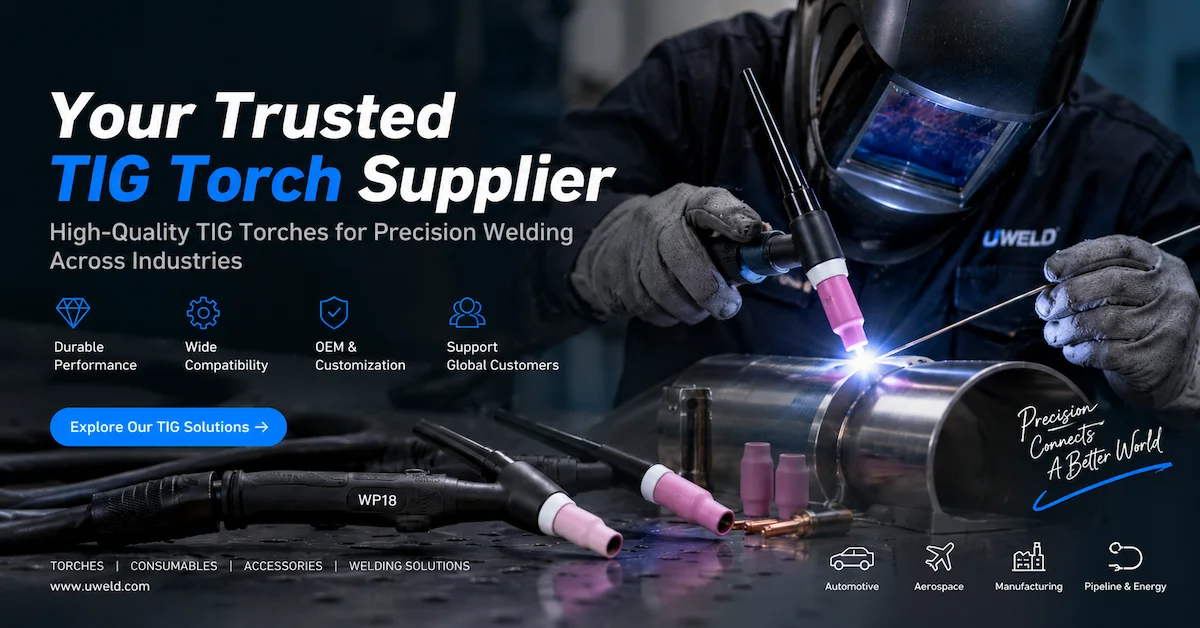
A dependable TIG torch supplier should do more than provide a torch with the right-looking handle and an attractive price. The supplier should help you identify a precise torch configuration, verify its compatibility with the intended welding equipment, document the conditions behind its electrical rating, make appropriate consumables available, and reproduce the approved specification in future orders.
For a distributor, these details determine whether a product can be sold confidently across an installed base of welding machines. For an OEM brand, they determine whether the product line is technically consistent. For a fabrication business, they affect downtime, operator comfort, service planning, and the stability of production welding.
The practical buying rule is simple: approve a defined torch assembly, not just a model name. That assembly includes the torch body, cooling arrangement, cable or hose package, power connection, gas connection, control plug, consumable setup, packaging, and supporting documents. A supplier's quote should identify which of those elements are included and which must be specified separately.
UWELD lists both an air-cooled WP26 TIG torch and a water-cooled WP18 TIG torch. These two published configurations provide a useful starting point for comparing cooling approaches, but they should not be treated as interchangeable replacements without checking the machine interface and operating conditions.
This article is a buyer's working guide. It is intended to help you ask better questions, compare quotations fairly, and request the evidence that matters before placing a wholesale or private-label order.
Who Needs a Specialist TIG Welding Torch Supplier?
Different buyers can order a visually similar TIG welding torch and still have completely different requirements. A replacement-parts wholesaler may prioritize compatibility with popular machine connections. A shipyard maintenance team may care more about accessible torch heads, protective cable covers, and the availability of spare assemblies. A new brand may need a consistent carton specification, multilingual instructions, and a clear process for approving future revisions.
| Buyer profile | Main purchasing concern | Most useful supplier evidence |
|---|---|---|
| Welding equipment importer | Market-fit products and repeatable supply | Exact model configuration, packing list, revision control |
| Industrial tool distributor | Low returns and easy replacement sales | Connector drawings, consumable compatibility, spare-parts list |
| Private-label welding brand | Consistent product identity | Approved sample, logo and packaging files, controlled bill of materials |
| Fabrication workshop | Fit for actual welding workload | Rating conditions, cooling requirements, ergonomic sample test |
| Welding machine OEM or service company | Integration with a defined power source | Power, gas and trigger-interface confirmation |
| Maintenance and project contractor | Availability and repairability | Replacement components, lead-time commitments, service process |
This guide is less relevant to someone who needs a one-off retail torch immediately and can physically test it against a machine before purchase. Industrial procurement has a broader responsibility: one incorrect specification may affect dozens or hundreds of end users.
Before contacting a manufacturer or distributor, decide whether you are buying a complete assembled torch, replacement torch bodies, or a repeatable series of customized assemblies. Those are different purchasing projects and should not share the same approval criteria.
Start With the Welding Job, Not the Torch Catalog
A model designation such as WP18 or WP26 is a useful family identifier, but it does not describe the entire welding application. Good purchasing decisions start at the workstation. Ask what metal is being welded, which current range is actually used, whether the process runs continuously or intermittently, and where the operator must reach.
Identify the material, process, and welding current
TIG welding, also called gas tungsten arc welding (GTAW), uses a nonconsumable tungsten electrode and shielding gas to protect the weld area. It is frequently selected where precise heat control and weld appearance are important. Typical applications include stainless-steel fabrication, aluminum components, pipework, maintenance parts, and certain precision assemblies.
A buyer should record the base metals, common thickness range, joint configuration, welding position, shielding gas, and relevant DC or AC operating mode. These details influence the expected current, electrode choice, gas shielding arrangement, and torch-head access. Do not assume the maximum output of a welding machine is the current used throughout the working day. Conversely, a shop that regularly works near its normal torch rating needs a realistic assessment of heat buildup and duty cycle.
If the torch is intended for an installed fleet of machines, collect the machine manufacturer and model numbers. If the target market uses several brands, group those machines by actual connector configuration rather than relying on the generic label “standard TIG compatible.”
Understand the working pattern
Ask whether the end user makes short repair welds, long production runs, repeated small batches, or work in difficult positions. Duration matters because heat is generated throughout the torch body, power connection, and cable assembly. A torch comfortable during a short demonstration may be unsuitable for repeated long welds at elevated current.
Also consider the work area. A field service vehicle may not have a practical water-cooling installation. A fixed production cell may already have a suitable cooling unit and benefit from a liquid-cooled torch. Welding inside confined spaces introduces additional hazards and requires a site-specific safety assessment, not merely a different torch model.
Turn the job description into an RFQ
An incomplete inquiry might say, “Quote 500 TIG torches, 200 amp.” A useful inquiry states the machine models, AC/DC process, typical working current, cooling choice, cable length, machine connections, torch body style, expected quantity, destination market, and required supporting documents.
That extra effort before quotation reduces later clarification, sample changes, and disputes over what was actually approved.
Air-Cooled vs Water-Cooled TIG Torches: What Changes for Buyers?
Cooling type is one of the most important distinctions in a TIG torch range. It affects heat management, portability, service parts, supporting equipment, and the final cost of the complete system. Neither design is universally better.
An air-cooled TIG torch transfers heat through its construction and surrounding environment without a separate circulating coolant system. It generally offers simpler setup and fewer cooling components to maintain. It can be attractive for general repair, mobile work, and facilities that do not have a compatible liquid cooler.
A water-cooled TIG torch uses a circulating coolant system designed for the torch and welding equipment. With a properly matched cooler and hose arrangement, it can manage heat more effectively in demanding applications. But the system introduces more connections and requires attention to coolant type, flow, leaks, pump operation, and maintenance.
| Selection factor | Air-cooled TIG torch | Water-cooled TIG torch |
|---|---|---|
| Heat management | Relies on passive heat dissipation | Uses a compatible circulating coolant circuit |
| Additional equipment | No separate torch coolant system | Normally requires a matched cooler and coolant connections |
| Main advantage | Simpler setup and portability | Potentially improved thermal management for heavier workloads |
| Main purchasing risk | Overheating when workload exceeds the rated conditions | Incorrect cooling setup, restricted flow, or incompatible fittings |
| Maintenance focus | Cable condition, connectors, insulation, consumables | All air-cooled checks plus hoses, coolant circuit, seals, and cooling unit |
| Typical buyer consideration | Service work and moderate workloads | Fixed workstations and sustained higher-current applications |
This table describes general design differences, not a guarantee of performance for every model. Actual electrical capacity depends on the manufacturer's rated test conditions and the particular assembly supplied.
Procurement question: Is the quotation for a complete torch assembly only, or does it include the coolant equipment required to use that torch? A liquid-cooled torch is not automatically ready for service just because it fits the machine's electrical connector.
UWELD WP26 vs WP18: Compare the Actual Published Options
Two identifiable products in the UWELD welding range allow buyers to begin a focused technical discussion rather than asking for an unspecified “TIG torch.” The comparison below records what their current public listings describe and, equally importantly, what still needs confirmation.
| Item | UWELD WP26 listing | UWELD WP18 listing |
|---|---|---|
| Product identity | WP26 air-cooled TIG torch | WP18 water-cooled TIG torch |
| Amperage stated in product title | 200 A | 350 A |
| Cable assembly length stated | 13 ft | 13.1 ft |
| Published connection detail | M16 × 1.5 and 2-pin socket | Machine-side connector details not established by the listing excerpt |
| Other highlighted detail | Air-cooled configuration | Denim protective cable cover |
| Important follow-up | Duty-cycle/test conditions; machine compatibility | Cooler requirements; connector details; rating/test conditions |
| Product reference | View WP26 | View WP18 |
When might a WP26-style assembly make sense?
An importer supplying repair shops, mobile technicians, and general metalworking businesses may consider a WP26-style air-cooled assembly when customers value a relatively straightforward installation and do not want to add a water cooler. That does not make every WP26 suitable for every 200 A welding application. The current rating must be read with its stated duty cycle, current type, gas conditions where relevant, and manufacturer's instructions.
The UWELD product title specifies an M16 × 1.5 connection and a 2-pin socket. Those details are helpful filters, but they do not alone prove compatibility with a particular machine. Thread identification, electrical wiring, connector gender, signal function, and the full power/gas path must still match.
When might a WP18-style assembly make sense?
A fabricator operating a liquid-cooled TIG setup for longer or higher-current work may investigate a WP18-style torch. UWELD's listing identifies a water-cooled design and a cable with a protective denim cover, while the product title states 350 A. The relevant duty-cycle and AC/DC conditions, coolant-flow requirements, and machine connections should be confirmed in the current data sheet before purchase.
The protective cover is a practical feature to examine during handling, but its presence should not be interpreted as proof of a particular abrasion-test result or service-life claim. Ask for material and construction details if those are critical to your customer's environment.
Why model names and catalog ratings sometimes disagree
Distributors often compare data from old PDFs, third-party listings, replacement-part catalogs, and current product pages. Ratings can differ because the torch package, cable size, connector assembly, measurement basis, or product revision differs. That is precisely why a current, version-specific technical sheet is essential.
For procurement purposes, make the supplier state: “This exact assembly is rated at ___ A, under ___ current type and ___ duty-cycle/test conditions.” A number without context is a preliminary marketing description, not a complete engineering acceptance criterion.
TIG Torch Connectors: The Compatibility Detail That Creates Returns
A torch can arrive in perfect condition and still be unusable on the buyer's welding machine. This is one of the most expensive preventable errors in wholesale torch sourcing, because a mismatch can be repeated across an entire shipment.
Separate three interfaces
First is the power connection, which must safely transfer welding current as designed. Second is the shielding-gas connection, which must fit the intended gas supply arrangement without leakage. Third is the control interface, where switches or remote controls communicate with the machine. A torch may have a suitable torch body and cable length while failing at any one of these interfaces.
A two-pin connector tells you the number of pins, not necessarily the control logic, polarity, plug orientation, or compatibility with every machine using two pins. Similarly, an M16 × 1.5 thread description does not establish the complete assembly interface. Request drawings or verified photographs of the actual plugs and confirm their functions against the machine documentation.
Control compatibility includes more than the plug shape
Some TIG machines use simple torch switches, while others support additional current control or specialized starting arrangements. Do not assume that a basic trigger connector will reproduce every function of the original torch. If a specific control capability matters, write it into the inquiry and approve it on the intended power source.
A practical check should record the machine model, mating connector, gas fitting, power connection, control-pin function, and whether an adapter is permitted. If an adapter is proposed, verify its suitability and responsibility for the modified interface rather than treating it as an automatic workaround.
Request a connection drawing before the sample ships
A single clear connection sheet can save a full cycle of international shipping and testing. It should show each coupling, threaded specification, overall cable assembly, and how each line connects. When purchasing for multiple welding machine families, use a machine-to-torch compatibility matrix and assign a unique part number to each approved variation.
Consumables and Spare Parts: Plan the Second Purchase Before the First
A wholesale TIG torch is not an isolated finished product. End users will replace ceramic cups, collets, collet bodies, back caps, seals, and other service components. Different electrode diameters and shielding requirements may call for different consumable sets. A distributor who cannot identify replacement parts may lose a returning customer even when the original torch performs well.
Ask the supplier for an exploded drawing with item numbers and a replacement-parts list tied to the exact torch body. The list should specify the nominal tungsten diameter or size range supported by each collet system, compatible cup sizes, and whether gas-lens components are included or optional. A familiar WP-series designation is not a substitute for an approved parts list.
Gas lenses are commonly selected when the welding procedure benefits from a more controlled shielding-gas distribution or additional electrode reach. However, the lens, collet body, ceramic cup, and torch configuration must be mechanically compatible. Do not assume any generic gas lens will fit the supplied head.
Tungsten electrode selection is a separate technical decision. Electrode composition and classification, diameter, preparation, current type, and the approved welding procedure all matter. ISO 6848 addresses classification of nonconsumable tungsten electrodes; it does not by itself certify a TIG torch assembly. The supplier should identify which consumables it offers and avoid presenting unrelated component standards as torch certification.
For distribution, consider a starter accessory pack only when every included item has been matched and approved. The fastest-moving replacement parts may vary by customer market and application; use sales and service evidence to decide what to stock.
Which TIG Torch Configuration Fits Common Industrial Applications?
The right selection depends on workload and the equipment already installed, not simply the name of the industry. Consider the following application questions when building a product assortment.
Stainless-steel and general fabrication
Stainless-steel shops often value controllable torch handling, shielding consistency, reliable consumables, and access around joints. A workshop performing intermittent repairs has different thermal demands from a production operation making repeated long welds. Determine actual current use, operator reach, and working cycle before deciding between air and water cooling.
Aluminum component production
When the process uses AC TIG welding, a supplier should verify the torch's applicable rating and setup for the required conditions. Do not carry a stated DC rating into an AC application without checking the manufacturer's documentation. Confirm compatible electrode choices and the intended welding machine interface as part of the whole setup.
Automotive repair and equipment maintenance
Repair teams may prioritize portability, cable flexibility, and convenient replacement parts. They may also use several power sources purchased over many years. In this market, an accurate connector matrix can provide more commercial value than offering an oversized product range with vague compatibility claims.
Pipe fabrication and tight-access work
For pipe joints and obstructed work areas, head shape, cable routing, operator position, and torch access may matter as much as nominal current. Ask whether a flexible-head or valve-type configuration is required; do not assume it is included in the standard listed SKU. Verify availability, change scope, and technical suitability with the supplier before describing a custom version as an existing product.
Production welding cells
Fixed industrial workstations may justify liquid cooling when the welding schedule and qualified procedure require sustained heat management. The decision should account for the whole system: cooler, hoses, fittings, machine integration, inspection, maintenance, and spare units. A water-cooled torch without dependable coolant circulation is not a workable high-duty solution.
How to Evaluate TIG Torch Manufacturing Quality
Appearance is useful, but it is only the first layer of a supplier evaluation. A clean photograph does not tell you whether a connection will stay secure, a cable assembly will tolerate repeated handling, or a future shipment will match the sample. A disciplined buyer asks for product-level controls that can be checked.
Torch head and consumable fit
Inspect assembly fit, alignment, thread condition, cup seating, back-cap engagement, and electrode holding. Parts that feel acceptable when assembled once may behave differently after repeated consumable replacement. The relevant question is whether normal service operations remain consistent without damaging the components.
Cable and hose construction
Review conductor and insulation details, strain relief, bend behavior, and the connection between handle and cable assembly. For liquid-cooled products, include coolant hoses, fittings, leakage prevention, and proper separation of circuits. The exact test methods should match the product design and documented acceptance criteria; buyers should not accept unexplained “100% tested” slogans as a substitute for a test plan.
Ergonomics under realistic handling
Invite experienced welders or a qualified technical reviewer to handle the sample during the intended work cycle. Evaluate grip comfort, switch reach, cable drag, torch-head access, and the way the hose package behaves in the workstation. An ergonomic judgment should come from representative users, not an invented numerical comfort rating.
Identification and traceability
Part labels, assembly references, carton identification, revision records, and batch information help a distributor manage complaints and repeat orders. The appropriate traceability level depends on the product and commercial agreement. For OEM projects, agree on which records will be supplied and how specification changes will be controlled.
Ask what happens when something fails
Before ordering, ask who investigates a returned torch, how evidence is collected, whether replacement consumables or assemblies are available, and what the warranty actually covers. Reliable after-sales arrangements are documented. A broad warranty headline without exclusions, claim procedures, and remedy terms offers limited protection to a distributor.
Sample Approval: A Practical Test Plan for Wholesale Buyers
An approved sample should represent the exact commercial configuration proposed for mass supply. The test plan does not need to be unnecessarily complicated, but it does need to cover the principal risks of the application.
| Approval area | Recommended buyer check | Required outcome |
|---|---|---|
| Identification | Compare sample, drawing, item code and quotation | One unambiguous assembly specification |
| Machine fit | Check all power, gas and control connections | Confirmed match on designated equipment |
| Function | Test operation within approved welding procedure | Intended functions operate correctly |
| Thermal suitability | Review rated conditions and perform qualified application trial | Suitable for the defined workload |
| Consumables | Assemble and replace specified cups, collets and caps | Verified spare-parts compatibility |
| Handling | Review grip, cable movement and switch position | Acceptable to representative professional users |
| Water cooling, if applicable | Verify coolant connections, flow requirements and leak integrity | Compatible, functioning cooling arrangement |
| Documentation | Inspect technical sheet, instructions and order specification | Records complete for procurement approval |
| Packaging | Inspect labeling, protection and carton contents | Approved presentation for target market |
Use the supplier's instructions, applicable standards, and qualified personnel for all electrical, welding, and coolant-related testing. This checklist is a purchasing framework, not a replacement for formal safety testing or a welding procedure qualification.
After approval, keep a controlled sample or an equivalent record, a signed specification sheet, and an agreed revision identifier. If the supplier proposes changing a cable, connector, switch, torch head, or consumable component, require evaluation before the change is included in a new order.
Standards, Welding Safety, and Compliance: Ask for Evidence, Not Logos
Procurement teams commonly see several standards mentioned in welding equipment marketing. Those references are useful only when their scope is correctly understood. A management-system certificate is not proof that a specific torch has passed a product safety test. Nor does an applicable technical standard automatically mean every model is certified to it.
IEC 60974-7:2019 concerns safety and construction requirements for arc-welding torches, including air-cooled and liquid-cooled designs. For a TIG torch sold into a regulated market, ask the supplier which standard edition and test evidence apply to the exact supplied assembly. ISO 6848:2015 addresses tungsten electrode classification, not the general compliance of the complete torch.
Welding-site safety also extends beyond the torch. The American Welding Society's ANSI Z49.1:2021 addresses safety in welding and allied processes, while applicable OSHA requirements address workplace protection and ventilation in the United States. Actual obligations depend on jurisdiction, workplace conditions, materials, and process. TIG arcs can present intense optical radiation, and welding work may generate hazardous contaminants; suitable PPE, ventilation, fire precautions, and competent operating procedures remain essential.
The buyer should request the documentation appropriate to the destination market and refrain from advertising unverified CE, CSA, ETL, or other conformity claims. Compliance must be established for the actual product and its intended use—not inferred from a supplier's general brand statement.
OEM and Private-Label TIG Torches: Build a Repeatable Product, Not Just a Branded Carton
A private-label welding torch line may begin with a logo, but a successful OEM purchase relies on controlled product information. A distributor needs to know what the customer will receive next year, not only what the approved sample looked like last week.
UWELD publicly presents two commercial cooperation routes: distribution of its own brand and custom/OEM manufacturing. Buyers interested in branding or product modifications can review the UWELD partnership program and discuss a specific torch requirement through its solutions page. Available changes, minimum quantities, tooling needs, and timing should be confirmed for the particular model rather than assumed.
Separate visual changes from engineering changes
Visual customization may include logo application, product labels, instruction layout, barcode presentation, carton printing, and accessory-pack organization. Even these details need approval because labels and instructions may carry safety and regulatory information.
Engineering changes are more consequential. A different connector, cable assembly, hose arrangement, handle, switch, or torch-head variant can affect machine compatibility or product performance. Request feasibility review, drawings, revised samples, and appropriate revalidation before treating an engineering change as approved.
Create one controlled specification per SKU
A distributor with three machine connector variants should maintain three distinct orderable configurations, even if all share a WP26-style torch head. The controlled record should include an item code, the complete bill of materials, drawing revision, applicable rating conditions, approved packaging, instructions, and replacement-parts references.
A private-label brand should also define who owns the artwork, who maintains technical revisions, whether a future component substitution requires written consent, and how warranty returns will be classified. These details may feel administrative, but they reduce friction once sales volumes grow.
Confirm what OEM support actually includes
Ask the supplier to specify whether it will provide drawings, packaging proofs, assembly images, sample reports, product photography, spare-parts lists, or technical training. UWELD's OEM welding equipment overview describes broader customization concepts; the precise TIG torch deliverables should be agreed as part of your project.
Pricing a Wholesale TIG Torch Order: Calculate Total Cost, Not the Lowest Unit Quote
Two torches quoted at different unit prices are not directly comparable until the configurations and commercial terms match. A cheaper assembly may omit parts that another supplier includes, use a different cable length, or require accessories that buyers have not costed. Conversely, a higher-priced option may provide unnecessary features for a simple repair market.
Build a landed-cost comparison around the same defined product configuration and shipment assumptions. Consider the unit price, accessory pack, export packaging, tooling or artwork charges, freight, duties and taxes where applicable, inspection costs, financing, and an evidence-based provision for returns and replacement parts.
Illustrative landed-cost structure: complete torch price + approved optional accessories + packaging/tooling allocation + freight/insurance + applicable import charges + receiving/inspection costs + expected after-sales support costs. This is a budgeting framework, not a statement about UWELD pricing or any guaranteed cost saving.
Compare quotations on a like-for-like basis. If one offer uses a different connector or does not include the agreed cover, ask for a revised quote. If one uses liquid cooling, account for the wider system cost when comparing it against an air-cooled solution.
For repeat orders, the economics become more important: a part-number mistake, inconsistent accessory compatibility, or delayed replacement component can cost more than a modest per-unit saving. Purchasing teams should evaluate service continuity alongside initial price.
Lead Times, MOQ, Packaging, and Repeat-Order Control
Do not assume that a general statement about fast manufacturing applies to every TIG assembly. Order quantity, tooling, connector availability, customization scope, seasonal capacity, and destination market may affect lead time and minimum order quantity. Request written terms for the selected SKU and any variants.
A complete quotation should specify sample lead time, production lead time after approval, Incoterms, packing dimensions or method, branding costs, payment milestones, inspection point, and what happens if an approved component is unavailable. Ask whether the supplier will identify any proposed substitution before production.
For export markets, establish the language and labeling requirements, spare-parts presentation, carton protection, and documentation your import process requires. Buyers planning online or retail distribution may need additional packaging consistency and barcode controls, while industrial wholesalers may prioritize robust master cartons and clear stockroom identification.
Finally, review how repeat orders will be managed. Reference the approved SKU and revision on every purchase order. A familiar model name without the approved configuration code is not enough to preserve technical consistency.
A TIG Torch Supplier RFQ Checklist You Can Copy
Send this information when you request a wholesale or OEM quotation. A well-prepared RFQ makes it easier to receive an accurate response and compare suppliers without repeated clarification.
-
Buyer profile: company name, market, intended channel, and whether this is replacement distribution, industrial use, or a private-label project.
-
Target product: WP18, WP26, or an alternative torch family; exact assembly or reference photos if available.
-
Application: base metals, AC/DC mode, normal current range, welding duration, and relevant work environment.
-
Cooling: air-cooled or water-cooled; existing cooler model and coolant requirements when relevant.
-
Machine compatibility: welding machine make/model, power connector, gas connection, control plug, and required switch functions.
-
Physical configuration: cable length, handle, head style, protective cover, and any special access requirement.
-
Consumables: tungsten sizes, collets, collet bodies, ceramic cups, back caps, and optional gas lenses.
-
Technical evidence: current product data sheet, drawing, rating conditions, instructions, and applicable conformity documents.
-
Commercial requirements: sample quantity, forecast volume, packaging, branding, delivery destination, and target purchase schedule.
-
Quality and support: sample-approval method, revision control, spare-parts plan, warranty terms, and claims handling.
Ready to source a matched TIG torch assembly? Send the list to the UWELD contact team and request a configuration-specific response. If you are still comparing product families, begin with the welding products category or the UWELD catalog overview.
An Illustrative Sourcing Decision: Two Similar Quotes, Different Risks
Consider a welding-equipment distributor preparing a new replacement-torch range. Its customers use several TIG machines, some with simple torch switches and others with different machine-side connections. The distributor receives a low unit quote for an “air-cooled 200 A WP26,” while a second proposal includes a connector drawing, control-plug specification, and a matched list of consumables.
The first offer may still be commercially attractive. But the distributor cannot determine compatibility from the model name and current label alone. If it buys immediately, it risks stocking a product that fits only some of the intended machines. The second proposal is easier to qualify because the buyer can map it against known equipment and validate an actual sample.
The disciplined response is not to automatically buy the more expensive quotation. It is to give both suppliers the same interface requirements, request complete assemblies and comparable pricing, test representative samples, and place the order against controlled configurations. That process produces a defensible decision.
This is an illustrative purchasing scenario, not a reported UWELD customer project or a claim of measured savings. Its value is the decision method: technical uncertainty should be resolved before commercial scale magnifies it.
Common Supplier Red Flags and How to Resolve Them
A TIG welding torch supplier does not need to answer every question instantly. Technical clarification is normal. The warning sign is a repeated inability or unwillingness to establish what will actually be delivered.
Be cautious when a quote gives only “200 A TIG torch” without cooling or duty conditions; a seller promises compatibility with every machine that has a similar-looking connector; product photos and the order specification disagree; consumables have no stable part numbers; or certifications are claimed without identifiable scope and supporting evidence.
Other warning signs include unexplained changes to approved components, uncertainty over replacement parts, poorly defined warranty handling, and refusal to document the sample revision. None of these concerns proves a supplier is unsuitable. They are reasons to ask for clarification and withhold final approval until the risk is controlled.
The most effective supplier conversation is specific: “Please identify the exact connector drawing and confirm it matches machine model X,” rather than “Is your quality good?” Precise questions produce evidence that purchasing and engineering teams can actually evaluate.
Why Consider UWELD for TIG Torch Wholesale and OEM Inquiries?
UWELD, associated with Ningbo United Tools Co., Ltd., offers welding and cutting equipment through a product range that includes TIG torches, MIG torches, and related industrial tools. Its public product listings identify a WP26 air-cooled assembly and a WP18 water-cooled assembly, providing concrete starting points for buyers comparing two common TIG torch approaches.
For business customers, UWELD also presents brand distribution and OEM manufacturing cooperation. Those published service models are relevant to importers expanding their welding product assortment and brands evaluating private-label opportunities. However, any requested connector version, cable modification, stocking arrangement, production quantity, certificate, or delivery commitment must be confirmed for the actual project.
A productive first inquiry is specific rather than promotional. Tell UWELD which machine models your customers use, which TIG applications matter most, how many assemblies you plan to purchase, and what you need to validate. Ask for the corresponding technical configuration, sample plan, and commercial quotation. That is the clearest path from product research to a workable purchasing discussion.
FAQ: TIG Torch Supplier Questions From B2B Buyers
1. What should I check before choosing a TIG torch supplier?
Start with the complete product configuration: cooling type, documented current rating and duty-cycle conditions, machine-side power and gas connections, control plug, cable length, torch-head version, and compatible consumables. Then evaluate sample consistency, supporting documents, order terms, replacement parts, and after-sales arrangements. A general brand statement cannot replace product-level evidence.
2. Is an air-cooled TIG torch better than a water-cooled TIG torch?
Neither is automatically better. Air-cooled torches can simplify portable and general-purpose setups, while water-cooled designs may be more appropriate for demanding thermal workloads when paired with a suitable cooling system. Choose based on actual current, welding duration, machine setup, service conditions, and the manufacturer's rated data—not only the advertised amperage.
3. What is the difference between UWELD's listed WP26 and WP18 products?
The current UWELD product titles describe a 200 A air-cooled WP26 with a 13 ft cable, M16 × 1.5 connection and 2-pin socket, and a 350 A water-cooled WP18 with a 13.1 ft cable and protective denim cover. Those are published listing descriptions. A direct engineering comparison still requires rated test conditions, connector drawings, and cooling requirements for the exact assemblies.
4. Will any WP26 TIG torch fit my welding machine?
No. The WP26 family designation does not guarantee that every assembly has the same power fitting, gas line, control plug, cable arrangement, or switch function. Verify the machine make and model, confirm the mating connectors and electrical control arrangement, and approve the intended assembly before bulk purchasing.
5. What accessories should a TIG torch wholesaler stock?
Stock parts based on the actual approved torch bodies and customers' electrode requirements. Common categories include collets, collet bodies, ceramic cups, back caps, and compatible gas-lens accessories where relevant. A reliable supplier should provide a linked item-code list so replacement components can be reordered without guesswork.
6. Can I purchase OEM or private-label TIG torches?
UWELD publicly describes a custom/OEM manufacturing cooperation route, including private-label opportunities. The specific TIG torch variants, branding methods, tooling, MOQ, development steps, and approval requirements need project-level confirmation. Begin with your technical specification; finalize branding and packaging after the functional configuration has been agreed.
7. How do I compare two TIG torch quotations fairly?
Ask both suppliers to price the same approved assembly, including cable length, cooling configuration, connector details, consumables, protective cover, packaging, and required documents. Then compare landed cost, testing arrangements, spare-parts availability, warranty terms, and repeat-order controls. A lower quoted unit price does not necessarily represent a lower delivered or supported cost.
8. Which standard is relevant to TIG torch construction and safety?
IEC 60974-7:2019 addresses safety and construction requirements for arc-welding torches. Its relevance does not prove a particular product's conformity. Ask for the appropriate product-level evidence and applicable version. Safety in welding workplaces also depends on operator protection, ventilation, training, and the applicable local requirements.
9. Can a 350 A water-cooled torch replace a 200 A air-cooled torch?
Not solely because its published current number is higher. The new torch must match the welding machine's power and control interfaces and have the correct coolant circuit. Its physical shape, accessories, rating conditions, and service arrangements also need to suit the job. Replacing one model with another requires system-level verification.
10. What information will help a supplier give me a faster, more accurate quotation?
Provide the intended machine model, connector details, cooling preference, normal welding current and operating pattern, required cable length, consumables, approximate quantity, target country, OEM or brand requirements, and requested documents. If possible, attach photographs or drawings of the existing machine connections. You can submit these requirements via UWELD's inquiry page.
Conclusion
The right TIG torch supplier is the one that can turn your application into a verifiable, repeatable torch specification—not simply offer the lowest price on a familiar model number. For wholesale and OEM sourcing, prioritize cooling suitability, electrical and gas connections, complete rating conditions, consumable availability, sample approval, and controlled repeat orders. UWELD's listed WP26 and WP18 configurations offer two useful starting points for that evaluation. Share your welding-machine details and purchasing requirements with UWELD to discuss a technically matched TIG torch quotation.