

Quick Answer
A reliable inverter welding machine supplier should provide a clearly defined machine specification, verifiable input and output ratings, duty-cycle information, controlled production, repeatable sample quality, appropriate technical documentation and practical after-sales support. B2B buyers should compare suppliers against the same application and RFQ rather than relying on maximum amperage, enclosure appearance or price alone. For OEM programs, technical configuration should be approved before branding, packaging and bulk production.
Introduction: Why Choosing an Inverter Welding Machine Supplier Requires More Than a Price Comparison
For welding-equipment distributors, maintenance-tool wholesalers and private-label brands, choosing an inverter welding machine supplier affects product performance, customer complaints, warranty workload and repeat-order stability. An attractive quotation may look competitive until the buyer discovers that the electrical version is different, required accessories are excluded, duty-cycle information is unclear or the next production batch no longer matches the approved sample.
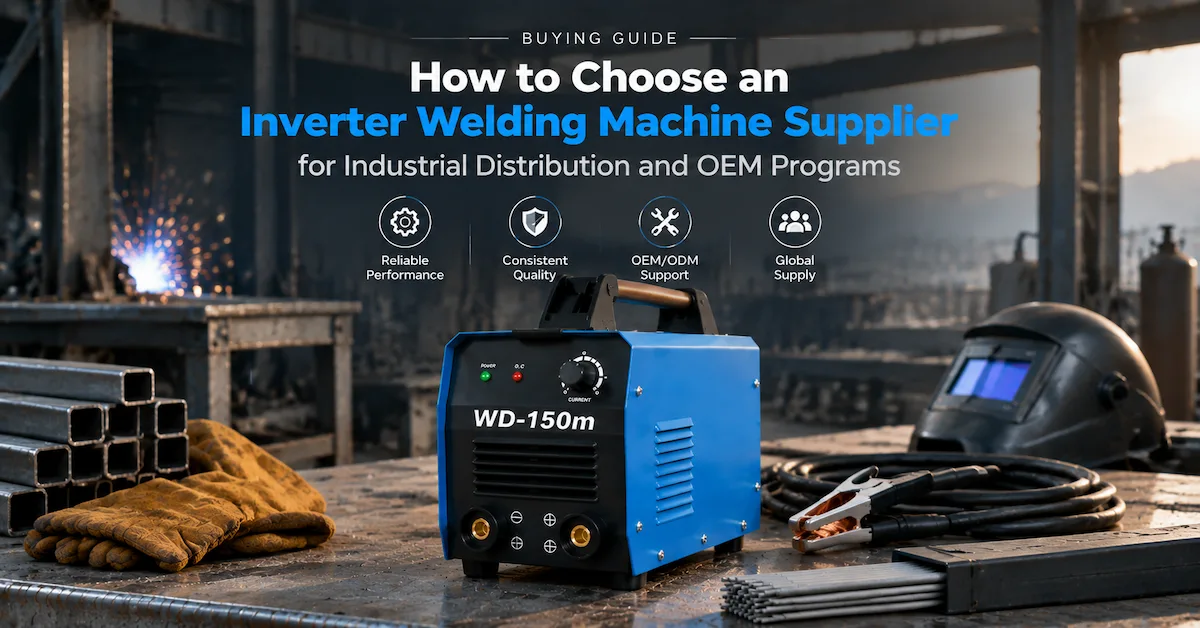
The problem is especially important with inverter welding machines because the enclosure can be compact while the technical configuration remains highly application-specific. Buyers still need to define the welding process, available power supply, required output, expected workload, consumables and accessories. UWELD currently lists the WD-150m Welding Machine 2W001-0001 as a compact portable inverter welding machine and places it within a broader welding equipment range that also includes MIG/TIG torches and related tools.
What Is an Inverter Welding Machine Supplier?
An inverter welding machine supplier provides welding power sources that use inverter-based power conversion rather than relying only on traditional low-frequency transformer architecture. From a B2B purchasing perspective, however, “inverter” is only one technical description. It does not by itself tell a buyer which welding processes are supported, what electrical supply is required, how long the machine can operate at a stated output or what equipment is included in the package.
A capable inverter welding machine supplier should therefore translate the customer’s application into a defined configuration. That means identifying the exact machine version, electrical input, supported process, output ratings, operating limits, connections, supplied accessories and documentation. UWELD’s current product center identifies the WD-150m as its Welding Machine entry, while its Solutions page describes engineering, manufacturing, quality-control and OEM/ODM support at the company level.
The distinction between company capability and product capability matters. A supplier may have broad engineering resources, but the buyer still needs evidence for the actual machine being ordered.
Who Should Use This Supplier Selection Guide?
This guide is primarily intended for welding-equipment distributors, industrial-tool importers, maintenance suppliers, automotive-repair channels, private-label brands and procurement teams that need stable repeat supply rather than a one-time machine purchase. These buyers normally care about specifications, version control, packaging, replacement accessories and after-sales handling in addition to basic welding performance.
It is less useful to treat this guide as a recommendation for automated production cells, robotic welding systems or highly specialized welding processes. Those applications usually require engineering information beyond what a general-purpose portable inverter machine can establish. Buyers should define the application first and use the supplier-selection process to eliminate unsuitable configurations.
Start With the Welding Application Before Comparing Suppliers
Before asking for a quotation, describe what the customer actually welds. Include material type, typical thickness range, joint requirements, expected working pattern and working environment. If the equipment is intended for mobile repair, include the available electrical supply and whether the machine will move between sites. If it will remain in a workshop, explain the expected production frequency.
This gives the inverter welding machine supplier something concrete to assess. A short repair weld and repeated fabrication work can place very different demands on a power source even when both applications appear to require a similar maximum current. UWELD’s earlier welding machine supplier guide follows the same principle: define the process, power supply, workload and package before comparing prices.
Which Specifications Should Buyers Request?
The strongest RFQs make every candidate supplier answer the same questions. The following table is a procurement checklist and should not be interpreted as confirmed WD-150m specifications unless UWELD provides them for the current production version.
| Specification | What to Request | Why Buyers Need It |
|---|---|---|
| Welding process | Exact supported process or processes | Prevents assumptions from the word “inverter” |
| Input supply | Voltage, phase, frequency and rated input | Confirms market and site compatibility |
| Output range | Rated welding current and voltage information | Helps match the machine to the actual job |
| Duty cycle | Percentage, rated current and applicable conditions | Shows workload capability more clearly than maximum current |
| Consumables | Supported electrode/wire range where applicable | Connects equipment to real workshop use |
| Connections | Output connectors and control interfaces | Prevents accessory mismatch |
| Cooling | Documented cooling arrangement | Helps define working and installation conditions |
| Protection | Documented overload/thermal or other functions | Avoids unsupported safety claims |
| Dimensions and weight | Current production version | Important for portable/distribution markets |
| Accessories | Exact standard package | Makes supplier quotations comparable |
| Documentation | Manual, product identification and required market files | Supports importer approval |
| Version control | Procedure for substitutions and revisions | Protects repeat-order consistency |
Do Not Evaluate an Inverter Welder by Maximum Amperage Alone
Maximum current is easy to advertise and easy to compare, which is precisely why buyers can give it too much weight. The useful question is whether the machine provides the output needed for the actual job under the stated operating conditions.
Duty cycle is an important part of that comparison. Miller describes welding duty cycle as the allowable operating period within a ten-minute reference period at the specified rating; for example, a 30% duty cycle corresponds to three minutes of operation within that reference period under the stated conditions. The practical lesson for procurement is to compare amperage and duty cycle together rather than treating the largest current number as the strongest machine.
A supplier should therefore be able to show the rated data relevant to the customer’s working current. If a quotation gives only a maximum value with no context, ask for the current specification before comparing it with another machine.
Input Power Can Determine Whether the Machine Is Saleable in Your Market
Electrical compatibility should be checked early because it can make an otherwise attractive machine unsuitable for a distributor’s target customers. Buyers should record voltage, phase, frequency and input requirements for the exact production version.
Do not assume that a compact inverter machine can run from any household outlet, generator or temporary job-site supply. “Portable” describes handling; it does not automatically establish generator compatibility or a universal input range. If generator operation matters, request the supplier’s documented requirements for that use.
For multi-country distributors, electrical variants should also receive distinct model or inventory identification. A specification that works for one market may create support problems in another if voltage, plug arrangements or applicable documentation differ.
Understand What Inverter Technology Does—and What It Does Not Prove
Inverter technology allows welding power conversion to be handled differently from conventional transformer-based equipment and is widely associated with compact equipment designs. But the term should not become a marketing shortcut for every performance characteristic.
An inverter machine is not automatically multi-process. It is not automatically high-duty-cycle, generator-compatible or suitable for continuous industrial production. It is also not automatically better for every application merely because it is lighter.
The buyer still needs a product-level specification. This distinction helps distributors avoid publishing claims that came from assumptions rather than controlled product information.
How Should Buyers Compare an Inverter Machine With a Conventional Welding Power Source?
The following table is a sourcing framework, not a claim that one architecture is universally superior.
| Decision Area | Inverter Welding Machine | Conventional Larger Power Source |
|---|---|---|
| Typical sourcing interest | Portability, compact format, modern electronic control | Fixed workshop use, familiar architecture |
| Buyer priority | Input/output specifications, electronics, cooling, portability | Rated workload, size, installation and service |
| Logistics consideration | Often easier to move and package | May require more handling space |
| Main purchasing mistake | Assuming compact size proves performance | Assuming physical size proves greater suitability |
| Correct decision basis | Application, rated data, serviceability and supplier control | Application, rated data, serviceability and supplier control |
The final row is the most important. Supplier selection should return to documented application fit rather than broad technology labels.
What Can Buyers Verify About UWELD’s WD-150m?
UWELD’s current website identifies WD-150m Welding Machine 2W001-0001 as a Welding Machine and describes it as a compact and portable product using inverter technology, suitable for tradespeople, panel-beating, refrigeration work and general welding tasks. The public description also mentions arc performance and overload protection.
Buyers can use the WD-150m product page as the starting point for a technical inquiry. The current public site does not provide enough detail to responsibly invent a complete table of input voltage, duty cycle, electrode range, machine weight or certification coverage. Those fields should remain to be confirmed until UWELD supplies the current approved specification.
| WD-150m Purchasing Item | Current Public Information | Before Bulk Ordering |
|---|---|---|
| Product type | Inverter welding machine | Confirm exact welding process |
| Positioning | Compact and portable | Confirm dimensions and weight |
| Applications listed | Tradespeople, panel beating, refrigeration and general welding | Match to buyer’s actual workload |
| Overload protection | Mentioned publicly | Request exact functional description |
| Rated output | Not sufficiently established here | Request current specification |
| Duty cycle | Not sufficiently established here | Request current rating |
| Input supply | Not sufficiently established here | Confirm destination-market version |
| Standard package | Not sufficiently established here | Confirm accessory list |
| Product compliance | Must be confirmed by exact model/market | Request relevant documents |
This evidence-first approach is more useful for B2B content than filling every field with an estimated value.
Supplier Capability Should Include Repeat-Order Control
The first sample is only the beginning of a distributor relationship. A reliable inverter welding machine supplier should also explain what happens when a component needs to change, a packaging revision is requested or a later batch is produced months after the original approval.
Ask who controls the product specification, how important component substitutions are approved and how the finished version is identified. Keep the approved specification, sample photographs, nameplate information, accessory list, manual and packaging version together in one purchasing record.
This is also where direct manufacturing and engineering access can matter. UWELD’s manufacturing and customization solution describes co-development, manufacturing control and an OEM quality process, while its current site presents branded distribution and custom-development paths. Buyers should still translate those company-level capabilities into requirements for the exact machine program.
What Should Be Checked During Sample Approval?
A sample should answer defined questions rather than simply prove that an arc can be struck. First verify the model, electrical version, front-panel identification, connectors, supplied cables, holder or other accessories, manual and packaging against the quotation.
Next, qualified personnel can evaluate the machine using a repeatable test plan based on the target application. Record the material, consumables, settings, working sequence and acceptance observations. If something differs from the agreed configuration, resolve it before making the sample the production reference.
Finally, save the approval evidence. A sample has little supply-chain value if the buyer cannot later identify what was approved.
How Should Buyers Evaluate Manufacturing and Quality Control?
Instead of asking only “Do you test every machine?”, ask what the supplier controls at each stage. Depending on the product, useful questions can cover incoming critical components, assembly identification, electrical/functional checks, connection verification, product marking, accessory completeness and packaging inspection.
The supplier should state its real control process. The buyer should not insert imaginary test steps merely because they sound sophisticated.
UWELD’s public Solutions page states that its broader operation includes R&D, manufacturing and quality inspection, while its product-center manufacturing flow lists engineering design, manufacturing, testing, assembly/integration and global support. These are useful company-level signals, but the buyer should still obtain the machine-specific inspection plan applicable to the ordered inverter welder.
Certifications and Standards Must Be Checked at Product Level
For professional arc-welding power sources, IEC 60974-1:2021 specifies safety and performance requirements for welding power sources and plasma cutting systems within its stated scope. That makes it a relevant reference point when buyers discuss technical requirements, but mentioning the standard does not establish that a particular UWELD machine is certified to it.
When sourcing, separate company-level quality-system certificates from model-level product evidence and shipment inspection records. Ask which standards apply to the exact electrical version and destination market, which organization issued any relevant documents, and whether the model on the document matches the product being supplied.
UWELD’s welding machine manufacturer guide likewise recommends evaluating specification, manufacturing control, sample consistency and documentation together rather than using a company certificate as a substitute for product evidence.
A Supplier Should Support the Complete Machine Package
A distributor does not sell a power source in isolation if the customer needs cables, an electrode holder, return clamp, torch or other accessories to use it. Ask which components are standard and which are optional.
This is especially important because UWELD’s Welding product category contains MIG torches, TIG torches, plasma torches, holders and a Welding Machine category. Their appearance in the same catalog should not be interpreted as automatic compatibility with the WD-150m.
For purchasing, create a package BOM or accessory list. That single document reduces ambiguity when pricing samples, bulk orders and repeat shipments.
How Do You Compare Two Inverter Welding Machine Suppliers Fairly?
Normalize the specification before comparing the commercial offer.
| Comparison Point | Supplier A | Supplier B | What Must Match |
|---|---|---|---|
| Welding process | Confirm | Confirm | Same intended process |
| Electrical version | Confirm | Confirm | Same market requirement |
| Rated output | Confirm | Confirm | Same stated conditions |
| Duty cycle | Confirm | Confirm | Same relevant current/conditions |
| Standard accessories | List | List | Comparable package |
| Documentation | List | List | Same destination-market need |
| Sample status | Approved/not approved | Approved/not approved | Comparable verification |
| Packaging | Standard/OEM | Standard/OEM | Same scope |
| Warranty/support | Written terms | Written terms | Comparable responsibility |
| Change control | Documented/not documented | Documented/not documented | Repeat-order risk |
This removes a common sourcing distortion: the lowest quote sometimes looks lower because it is not quoting the same product package.
Cost Should Include More Than the Machine Price
For an importer, total purchasing cost can include the machine, required accessories, private-label packaging, sample validation, freight, import costs, spare parts and warranty handling. A very low unit price can lose its advantage if missing accessories have to be purchased separately or if repeat-order inconsistency creates after-sales work.
Do not invent a universal “30% lower cost” or “50% longer life” figure without real comparative evidence. Instead, calculate the costs for your own order and market. That creates a commercial decision that can be audited later.
OEM and Private-Label Requirements Should Follow Technical Approval
Private-label buyers often want logos, carton design, manuals, color schemes and bundled accessories. Those can be useful differentiators, but they should come after the machine configuration has been approved.
UWELD describes custom/OEM manufacturing in its OEM welding equipment sourcing guide and Solutions content. Its custom-welding guidance also discusses items such as logo branding, packaging, product kits and accessory combinations.
For an inverter welding machine program, use this sequence: technical requirement → sample/version approval → branding and packaging → final document approval → bulk production. A logo change and an electrical redesign are not the same type of customization and should not be treated as if they require the same validation.
MOQ, Capacity and Lead Time Should Be Quoted for the Exact Project
A supplier’s overall manufacturing capability does not establish the delivery time for a particular machine. Ask for commercial terms based on the exact model, electrical version, quantity, packaging and customization scope.
Break the project schedule into sample preparation, technical approval, artwork approval, production, inspection and shipment readiness. This makes delays easier to diagnose and prevents the buyer from treating “30-day lead time,” for example, as meaningful before the configuration has even been approved.
UWELD publicly presents direct manufacturing and OEM/ODM capabilities, but those pages do not establish one universal MOQ or welding-machine lead time. Request project-specific terms through the UWELD contact page.
What Should an RFQ to an Inverter Welding Machine Supplier Include?
A useful RFQ can be concise, but it should be specific. Include the welding process, material/application, typical thickness range, electrical supply, expected workload, output requirement, portability requirement, accessories, target market, order quantity and any OEM or documentation needs.
If the WD-150m is the reference product, identify it by WD-150m / 2W001-0001 and ask UWELD to confirm the latest electrical and performance specification instead of reconstructing those figures from the model name or product photograph.
Buyers can review the UWELD Welding range, study its existing welding machine sourcing guide, and then submit the final project specification through Contact UWELD.
Frequently Asked Questions
1. How Do I Choose an Inverter Welding Machine Supplier?
Start with your application and electrical requirements. Then compare the supplier’s rated product data, sample consistency, production control, documentation, accessory support, change-control process and after-sales terms. Price should be compared after the configurations are aligned.
2. What Is the Main Advantage of an Inverter Welding Machine?
Inverter technology is commonly used in compact modern welding power sources and can support portable equipment design. Buyers should still evaluate the actual machine rather than assume inverter technology automatically proves process capability, workload suitability or electrical compatibility.
3. Is a Higher-Amp Inverter Welder Always Better?
No. Maximum current should be considered with the required welding current, duty-cycle information, input requirements and application. Buying unused capacity can add cost without solving the actual welding requirement.
4. What Duty Cycle Should B2B Buyers Request?
Request the duty-cycle data applicable to the current range your customers actually expect to use, together with its stated test conditions. Avoid comparing percentages when they refer to different current levels or conditions.
5. Does UWELD Supply an Inverter Welding Machine?
UWELD currently lists the WD-150m Welding Machine 2W001-0001 and describes it as a compact portable inverter welding machine. Buyers should confirm its current specification and availability for the intended project.
6. Can an Inverter Welding Machine Be Used With Any Generator?
Do not assume so. Generator suitability depends on the exact machine and power source. Ask the supplier for documented input and generator requirements before promoting the machine for that application.
7. What Should Be Checked in an Inverter Welding Machine Sample?
Verify the product version, electrical identification, controls, connectors, included accessories, instructions and packaging, then perform a documented application evaluation with qualified personnel before approving bulk production.
8. Can an Inverter Welding Machine Supplier Provide OEM Packaging?
UWELD publicly offers OEM/custom manufacturing cooperation. The feasible logo, labeling, carton, manuals, accessories and technical changes should be confirmed for the exact welding-machine project rather than assumed from the general OEM program.
9. How Can a Distributor Reduce Repeat-Order Quality Risk?
Maintain an approved specification, sample record, accessory list and packaging version, and require supplier notification before important components or technical configurations change. This gives later shipments a controlled reference.
10. What Information Should I Send UWELD for a Quotation?
Send the required welding process, application, electrical supply, output/workload expectations, target market, quantity, accessories and OEM requirements. If you are evaluating the WD-150m, identify the model explicitly and request its current approved specification through the UWELD contact page.
Conclusion
Choosing an inverter welding machine supplier is a technical, manufacturing and supply-chain decision—not simply a search for the lowest unit price or the largest advertised amperage. Buyers should define the welding application first, verify input and rated output data, compare duty cycle under relevant conditions, approve the exact accessory package, review model-specific documentation and establish how production changes will be controlled across repeat orders. UWELD currently lists the WD-150m as its inverter welding-machine reference and supports broader engineering and OEM discussions through its welding and customization resources. Review the UWELD Welding equipment range, explore OEM and custom manufacturing solutions, and contact UWELD with your application, electrical requirements, target market and order plan for project-specific confirmation.