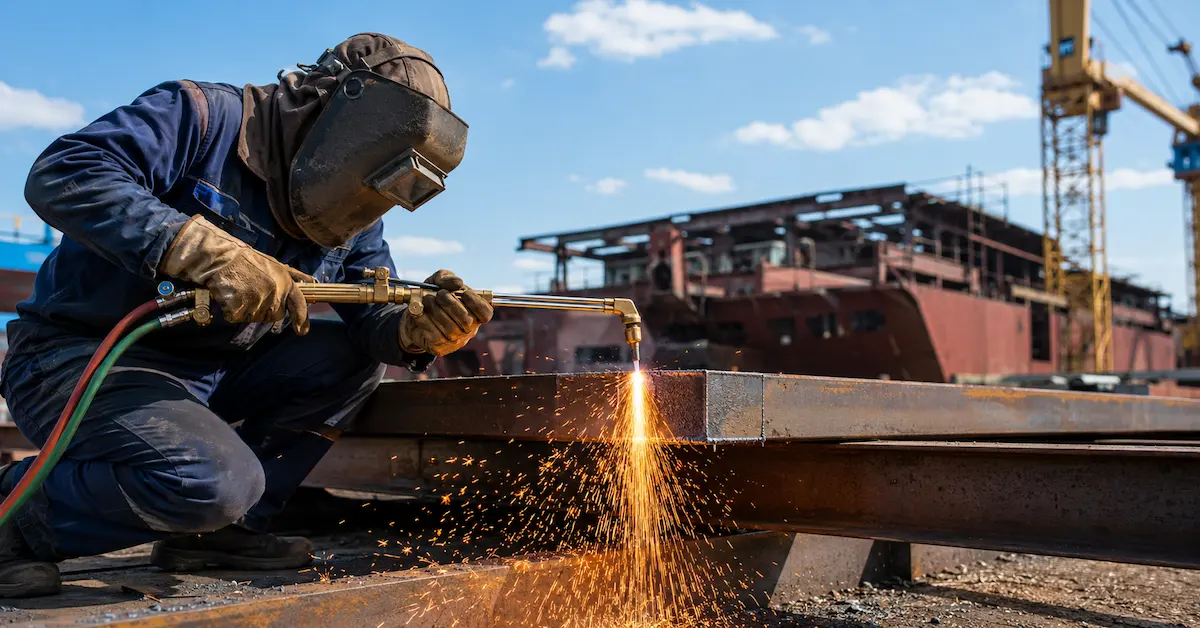


THE SHORT ANSWER
How should a B2B buyer evaluate a welding torch manufacturer? Start with the welding process, machine interface and duty conditions. Then verify the proposed torch assembly, inspect representative samples, request relevant test documentation, agree on OEM changes, and compare the total landed cost of a repeatable SKU—not merely a model name or an advertised amperage. A reliable factory relationship creates traceable specifications for first orders, spare parts and future replenishment.
UWELD, the welding and cutting tools brand of Ningbo United Tools Co., Ltd., presents MIG/MAG and TIG torch models alongside a wider industrial product range, engineering collaboration and OEM/ODM support. Buyers can review the company's background and explore its manufacturing and solution capabilities before initiating technical approval.
1. What Does a Welding Torch Manufacturer Actually Do?
A welding torch manufacturer develops, produces, assembles or controls the manufacture of welding torch products against a defined specification. For industrial buyers, its value is not limited to providing finished assemblies. The important question is whether the company can explain the construction of the torch, identify critical components, review changes, evaluate product suitability and reproduce the approved version in later batches.
The distinction matters because a catalogue photograph cannot tell a buyer who controls cable construction, how connectors are qualified, which consumables fit, or what happens when a component must be substituted. Some suppliers distribute products made by other factories; others operate their own manufacturing and engineering functions. Either arrangement can support a legitimate business, but the buyer needs to know which organization is responsible for design decisions, production records, quality claims and corrective action.
UWELD describes itself as a welding and cutting tools company serving both its own brand distribution network and customized manufacturing projects. Its partner program presents separate paths for UWELD-branded distribution and custom/OEM cooperation. Its solutions information describes R&D, production, inspection and global support. These are useful starting points for factory qualification; model-specific production scope, inspection results and capacity still need to be confirmed during supplier review.
Practical rule: do not approve a manufacturer on the basis of a company profile alone. Approve a defined welding torch assembly, a production-control plan and a commercial replenishment arrangement. This approach is especially important when a distributor has to keep the same replacement parts available for several years.
2. Which Buyers Need a Manufacturing Partner—and What Must Each One Verify?
Different buyers can purchase the same torch family and still have very different acceptance requirements. A maintenance workshop may prioritize immediate machine compatibility and handling comfort. An importer may prioritize assortment design, carton markings and spare-parts replenishment. A private-label brand must also control approved graphics, trademarks and claims printed on the product.
| Buyer segment | Underlying purchasing problem | What to verify first |
|---|---|---|
| Industrial tool importer | Mixed torch configurations create stock errors and customer returns. | SKUs by interface, length, consumable set and destination market. |
| Welding equipment distributor | Customers need matching torches and affordable replacement consumables. | Machine-to-torch matrix, parts diagrams and reorder availability. |
| OEM or private-label brand | A sample may differ from later bulk production or packaging claims. | Approved drawings, sample revision, branding scope and change control. |
| Fabrication plant buyer | Long welding shifts put greater demand on leads, cooling and ergonomics. | Current rating under stated conditions, workload and workstation trial. |
| Welding machine integrator | Apparently matching connectors may have different electrical or control functions. | Complete interface drawings and machine-specific validation. |
| Regional maintenance supplier | Field replacement and repair may depend on local parts access. | Installed equipment base, spare assemblies and service documentation. |
A responsible welding torch manufacturer can answer these application-specific questions before recommending SKUs. A common mistake is to begin with a list of generic torch model names. Instead, segment the intended customers by the actual machines they operate, their welding processes, usage intensity and preferred replacement-parts system. Only then should the assortment be narrowed to a manageable initial number of configurations. A smaller, fully specified range is usually easier to sell and support than a large selection with uncertain compatibility.
This distinction also helps qualify inquiries. A one-off replacement request requires different commercial handling from a recurring order for a private-label range. The latter may justify dedicated packaging and engineering effort, but it also requires forecasts, responsibility for approvals and a process for updates when equipment versions change.
3. Welding Torch Categories: Match the Process Before You Compare Products
The phrase “welding torch” covers several tools in ordinary buying conversations. In procurement documents, however, MIG/MAG, TIG, plasma cutting and oxy-fuel equipment must be separated by process. Their operating principles, consumables, supply requirements and applicable standards differ. A plasma cutting torch is not a substitute for a MIG welding gun, and a gas-welding tip does not define a complete arc-welding assembly.
| Product family | Operating context | Major buying criteria | UWELD reference |
|---|---|---|---|
| MIG/MAG torches | Wire-fed fabrication, workshop production and repair. | Wire range, gas-specific rating, Euro/machine connection, liner, contact tip, cable. | 15AK MIG Torch |
| TIG torches | Precision welds, stainless components, thin sections and demanding joints. | AC/DC conditions, cooling, torch control, electrode consumables, power/gas connections. | WP26 TIG Torch |
| Plasma cutting torches | Mechanized or manual thermal cutting, including CNC systems. | Power-source compatibility, pilot-arc arrangement, consumable geometry, mounting and airflow. | P80 Plasma Torch |
| Oxy-fuel welding and heating tools | Gas welding, brazing, heating and site maintenance. | Fuel-gas compatibility, tip/mixer match, regulator, hose and safety component specification. | Welding Tips Range |
MIG/MAG torch assemblies
For gas metal arc welding, the torch carries welding current, shielding gas and a continuously fed wire to the joint. A distributor therefore needs more than a current rating. The wire diameter, liner, contact tip, diffuser, nozzle, neck, trigger, rear connection and cable length must be compatible as a system. The 15AK, 24KD and 36KD families can form a practical starting point for a commercial product range, provided each offered configuration has a documented operating envelope and machine interface.
TIG torch assemblies
For gas tungsten arc welding, the head, tungsten holding parts, shielding-gas path and operator controls become particularly important. Air-cooled configurations can simplify support for suitable workstations, while water-cooled assemblies introduce coolant lines and dependence on a correctly matched cooling unit. A buyer should not infer that a larger advertised ampere figure guarantees suitability for every welding procedure or for extended operation.
Adjacent cutting, brazing and HVAC equipment
UWELD's wider product center also covers gas cutting, welding tips, heating tools, regulators and associated equipment. This breadth can simplify multi-category purchasing, especially for industrial distributors and HVAC service suppliers. However, categories should remain separate on RFQs, labels, technical literature and compliance records. Combining them under one commercial purchase order does not make their connections or safety requirements interchangeable.
4. Welding Torch Technical Specifications That Should Govern Approval
Technical qualification begins with a defined operating case: equipment manufacturer and exact model, welding process, intended materials, approximate working current, shielding gas where relevant, welding frequency, lead routing and required operator controls. Without this information, two quotations for a similarly named torch may describe materially different products.
Current rating is incomplete without its conditions
A quoted 200 A or 350 A headline is useful only with the conditions under which it applies. For MIG/MAG torches, ask about shielding gas, duty cycle and the offered assembly. For TIG torches, request the relevant AC/DC, duty-cycle and cooling information. The torch must be assessed together with the power source and any cooling system. A brief weld trial cannot establish that an assembly is suitable for a full production shift.
For example, a 60% duty-cycle statement refers to a defined duty period under stated conditions; it does not mean every torch is rated identically in all environments. The manufacturer should provide the correct specification for the exact variant being ordered. The buyer's application must remain inside the documented limitations of each component of the installation.
Connector shape is not proof of functional compatibility
A Euro-style rear connector may narrow the choice of MIG torches, but the machine-side interface still needs confirmation. For TIG, power, gas and control interfaces may be separate; pin count or thread size alone does not identify functions. UWELD's published WP26 product title mentions an M16 × 1.5 connection and a 2-pin socket. Those descriptors are useful quotation fields, not a universal compatibility guarantee.
Cooling method must match real usage
Air-cooled and water-cooled assemblies solve different operating problems. Air-cooled torches avoid external coolant circuits but have product-specific thermal limitations. Water-cooled torches can support demanding operations when used with properly specified equipment, yet also require verified fittings, hoses, coolant flow and supporting systems. Buyers should ask how cooling performance is documented and what commissioning responsibilities remain with qualified personnel.
Lead length, flexibility and protection affect operator acceptance
A longer lead can improve reach but also creates additional routing, handling and maintenance considerations. Specify the actual cable length, connector orientation, strain relief and protective cover requirements. Sample handling should be evaluated in real working positions with normal protective equipment. Workers may reject an assembly that meets its electrical specification but is awkward around fixtures or difficult to manipulate during repetitive work.
Consumables must be standardized, not guessed
For MIG, document contact tips by wire diameter, thread, length and approved reference, plus the matching liner, holder/diffuser and gas nozzle. For TIG, document collets, collet bodies or gas lenses, cups, back caps and electrode diameters. Replacement-parts compatibility should be established for the specific torch configuration. A customer should not have to discover after purchase that commonly required service parts use an unexpected interface.
Before releasing a bulk PO, obtain one controlled specification that connects the machine identity, connector, rated conditions, cooling, cable length, supplied consumables, packaging description and approved sample reference.
5. Materials and Critical Components: What Belongs in a Supplier Specification?
A welding torch is an assembly of components with different electrical, thermal and mechanical jobs. A statement such as “premium copper and strong plastic” is not a sufficiently precise manufacturing specification. Ask about materials by component and about the relevant acceptance criteria. Component selection affects resistance, heat transfer, gas sealing, durability and serviceability—but performance still needs to be demonstrated under appropriate conditions.
| Component | Why it matters | Useful approval evidence |
|---|---|---|
| Current-carrying cable and terminals | Electrical continuity, handling and temperature behavior. | Cross-section or approved cable specification, termination construction and relevant test record. |
| Contact tip or TIG head parts | Stable serviceable interface at the hot end. | Dimensioned part reference, material description and matching-component list. |
| Gas passages and seals | Gas delivery, leak control and repeatable assembly. | Approved drawings and applicable leak/function assessment. |
| Neck, handle and trigger | Operator access, switching and mechanical robustness. | Physical samples, interface review and agreed functional checks. |
| Liner, nozzle and diffuser | Wire feeding, shielding and consumable maintenance. | Compatible wire/material range, dimensions and service parts list. |
| Cover and strain relief | Lead routing, abrasion exposure and handling. | Defined construction, fit evaluation and change-controlled version. |
Material substitutions may be necessary during a product's commercial life, but they should not silently change an approved SKU. A buyer should specify which dimensions and components are critical-to-fit and which changes require written authorization. A responsible manufacturing partner can propose alternatives while keeping their evaluation and approval status clear. This is more useful than a blanket promise that no component will ever change.
6. How to Audit Manufacturing Capability and Production Consistency
When assessing a welding torch manufacturer, the most useful factory question is not simply “How large is the plant?” It is “How does the factory ensure that order number five matches the assembly approved on order number one?” Site area, machine count and marketing claims cannot replace controlled product specifications and evidence of consistent production.
UWELD describes an integrated workflow involving engineering, precision production, inspection, assembly and delivery. It also references a multi-stage quality-control system. Such company statements justify a deeper technical conversation, but they should not be mistaken for an independently witnessed audit or a published per-model test report. Buyers should request the production and inspection records appropriate to the torch they intend to order.
Stage 1 — Engineering feasibility and version definition
The factory should establish what is already available and what must be engineered. A standard connector-and-length variant may be commercially straightforward; a custom neck, handle, trigger interface or cooling arrangement may demand additional validation. Document the drawing revision, model designation and any dependencies on buyer-supplied equipment information. Agree who can authorize engineering changes.
Stage 2 — Incoming component control
Incoming control can address critical dimensions, cable construction, molded parts, connectors, seals and front-end consumables. Ask which parts are purchased or made internally, how they are identified, and what happens when an incoming lot does not match requirements. Do not assume that every component is produced in-house merely because a supplier operates a factory.
Stage 3 — Assembly and process controls
Assembly quality depends on correct parts and repeatable procedures. Buyers may ask how cable ends, control connections, gas paths, neck assemblies and protective covers are assembled and verified. An approved work instruction and controlled parts list help avoid changes caused by personnel turnover or shifting suppliers. The exact checks should reflect the design and risks of the selected torch family.
Stage 4 — Finished-product verification
A sensible quality plan includes checks related to appearance, configuration identity, electrical or functional performance, connection fit and any applicable leakage or cooling characteristics. The inspection method, sampling frequency and pass criteria should be agreed in writing, not invented after a defect appears. A factory may offer various testing capabilities, but a buyer should request the evidence for the specific model, revision and order.
Stage 5 — Traceability, packing and release
Finished goods should be identifiable by the configuration actually packed. A 24KD torch with a 10 ft lead must not be confused with an alternate lead length or connection version under a vague warehouse code. Agree on box labels, carton labels, quantities, inspection release records and the level of batch tracking available. Such controls can reduce receiving mistakes and speed up investigation if customers later report an issue.
The purpose of a factory audit is not to demand unnecessary paperwork. It is to find the smallest reliable evidence set that proves the product can be made, checked, shipped and reordered as approved. For a high-volume OEM program, this may involve supplier audits and formal quality plans. For a small initial order, controlled specifications, representative samples and appropriately scoped documents may be a more proportionate starting point.
7. Quality Control, Welding Torch Standards and Certification Evidence
Standards matter because they clarify which product and risks are being evaluated. IEC 60974-7:2019 addresses safety and construction requirements for torches used in arc welding and allied processes, including air- and liquid-cooled configurations. ISO 5172:2006, with its applicable amendments, covers blowpipes for gas welding, heating and cutting. ISO 2503:2009 addresses gas-cylinder pressure regulators used for welding, cutting and related work. These are different product scopes; a certificate for one category does not qualify all the others.
UWELD's public company and FAQ pages describe an ISO 9001:2015 management-system certification and refer to EN ISO 2503, EN ISO 5172 and CSA-related product coverage. This should be presented accurately: a company quality-system certificate is not a model-specific safety test result, and gas-burner documentation must not be presented as certification of a MIG or TIG torch. Request the applicable documentation for the actual product and destination market.
| Evidence | What it can establish | What it cannot establish by itself |
|---|---|---|
| ISO 9001 certificate | Scope and validity of a certified quality management system. | That every torch model meets every product-specific requirement. |
| Model-specific test report | Result for the tested version, method and recorded conditions. | Performance of an untested configuration or later design revision. |
| Declaration or certificate for an applicable standard | A stated compliance or assessment basis within its identified scope. | Universal market access without reviewing local legal requirements. |
| Approved sample and drawing | What the buyer accepted as the physical and technical reference. | Automatic evidence that every unit in a shipment was inspected. |
| Shipment inspection record | Checks performed on the stated lot or sampling plan. | Compatibility with machines not covered by the approval criteria. |
Before accepting a compliance claim, check the legal manufacturer or certificate holder, certificate number, product model or family, edition of the standard, issuing organization, dates and scope. If a standard is relevant but the supplier has no qualifying evidence for the offered item, treat that as an unresolved approval question. Product markings and instructions should reflect the destination country's applicable requirements.
UWELD states that technical datasheets and certain test reports can be requested through its team, depending on the product. Buyers can consult the official FAQ and then specify the requested model, standard and document type when contacting sales.
Send the target torch family, machine model, operating conditions and documentation requirements for review.
8. Real UWELD MIG and TIG Models: A Manufacturer Shortlist
Actual product references make a buying guide more useful than an abstract feature list. The models below are drawn from UWELD's published product pages. The details shown are identified in the public product titles; final ratings, supplied accessories and compatible machine versions must be confirmed against the current quotation and technical sheet. Model naming by itself is not evidence of cross-brand fit.
| Published UWELD model | Published configuration cue | Best starting application to investigate | Before ordering, confirm |
|---|---|---|---|
| 15AK MIG Torch | Air-cooled; product title states 150 A and references MIG200. | Common workshop replacement and lighter MIG applications. | Exact machine version, gas-specific rating, wire range, connector and lead length. |
| 24KD MIG/MAG Torch | Air-cooled; 10 ft lead; Euro connector in title. | Mid-range fabrication and distributor assortment planning. | Rating basis, liner, wire range, complete connector and spares. |
| 36KD MIG/MAG/CO₂ Torch | Air-cooled; Euro connector in title. | Demanding MIG/MAG workstation evaluation. | Gas-specific rating, duty cycle, cable specification and machine fit. |
| WP26 TIG Torch | Air-cooled; title states 200 A, 13 ft, M16 × 1.5 and 2-pin socket. | TIG workstations that can use the specified air-cooled configuration. | Power/gas/control connections, AC/DC conditions and included collets/cups. |
| WP18 TIG Torch | Water-cooled; title states 350 A, 13.1 ft and denim cover. | TIG applications requiring evaluation of an external cooler. | Current version's length, rating conditions, cooling system and connections. |
This comparison does not declare one torch universally better than another. A 36KD will not automatically solve a problem caused by a wrong contact tip, and a WP18 cannot be installed safely without checking the specified cooling arrangement. Instead, start with the intended machines and workload, shortlist the compatible families and evaluate the offered configuration under representative working conditions.
For a new distribution program, it can be sensible to stock a limited selection of well-defined MIG and TIG assemblies with their associated consumables. Keep separate stock codes for meaningful differences in connector, lead, controls, included items and cooling method. Request a current illustrated spare-parts list so a sales team can support repeat customers after the original torch is sold.
9. OEM and Private Label Welding Torches: From Concept to Repeat Orders
An OEM welding torch manufacturer should help a buyer distinguish commercial customization from technical redesign. Putting a logo on an existing approved assembly is not the same project as changing its cooling system, trigger wiring, cable construction or front-end components. The latter changes may require additional engineering, qualification and documentation.
UWELD publicly offers OEM/ODM support involving appearance, logo and specification changes, with feasibility and MOQ requirements dependent on the project. Its partnership page describes both private-label manufacturing and broader custom development. Buyers should treat these as possible collaboration pathways and obtain written confirmation of what their particular project can include.
Define the market and product brief
Identify destination countries, target machines, welding tasks, desired product families, annual demand and expected after-sales responsibilities. Supply photos or drawings of existing machine interfaces when available.
Assess technical feasibility
Separate standard configurations from proposed changes. Ask which interfaces, head designs, lead constructions and packaging elements can be offered, and what validation would be required.
Receive an itemized quotation
List exact variants, quantities, included consumables, sample costs, tooling if applicable, packaging, documents, trade terms and schedule assumptions. Unresolved items should be called out explicitly.
Approve samples and documentation
Evaluate the sample with the identified machine and procedures. Record the sample revision and observations, plus any required test reports, drawings and component list.
Approve branding and instructions
Confirm logo use, label placement, model descriptions, multilingual instructions, carton design and product claims. Do not print unsupported compatibility or certification statements.
Freeze the bulk-production configuration
Issue the purchase order against the approved product description and agreed acceptance criteria. Define how engineering changes and component substitutions will be proposed and authorized.
Manage shipment and replenishment
Reconcile labels and quantities with the order, retain available lot information and review service feedback. Use the resulting data to refine the next replenishment order, not to improvise new product definitions.
Brand owners also need an agreement on intellectual property, tooling ownership where relevant, artwork rights, confidentiality and responsibility for changes. These terms are commercial and legal matters to negotiate; the existence of an OEM service does not automatically establish a particular exclusivity or IP arrangement.
The most valuable OEM outcome is a reproducible bill of requirements. A documented product revision can be re-quoted, sampled, packed and supported without starting from ambiguous product descriptions every time. This is the foundation of a scalable private-label welding tool line.
Share your target market, model shortlist, annual volume, connection drawings and branding needs with the UWELD team.
10. MOQ, Production Lead Time and True Landed Cost
Wholesale welding torches are often compared by unit price, yet the invoice price is only one part of procurement cost. A cheaper quote may exclude spare tips, protective packaging, documentation or connector details covered by another offer. A product with the wrong connection can become expensive before it ever reaches a welding bench.
Ask for MOQ by configuration, not by vague product family
UWELD's FAQ says minimum order quantities vary by product and by whether the item is standard stock or custom-made. Therefore, it would be misleading to publish one universal MOQ for the brand. Buyers should ask separately about standard assemblies, each connector or cable variant, custom logos, printed packaging and engineering changes. If a project includes several sizes or plug options, confirm whether quantities can be combined or must be met individually.
Separate production time from arrival time
UWELD states that stock items normally take one to two weeks, while custom-order timing depends on the processes and volume. Treat this as general website guidance, not a guaranteed date for a particular torch. A complete schedule should separate technical clarification, sample preparation, approval, production, inspection, dispatch, transport and final warehouse receipt.
The quotation should name the event that starts the clock. “Four weeks” is ambiguous if artwork, deposits, tooling and sample acceptance have not yet been completed. Ask the manufacturer to identify capacity constraints or component dependencies that could affect repeat orders. Also confirm the availability of replacement parts when the initial shipment sells through.
Illustrative landed-cost comparison
Consider two hypothetical offers for 200 technically equivalent and properly approved torch assemblies. These figures are examples for calculation only; they are not UWELD prices, quotations, shipping estimates or measured return rates.
| Cost item for 200 units | Offer A | Offer B |
|---|---|---|
| Unit purchase price | $45.00 | $42.00 |
| Goods value | $9,000 | $8,400 |
| Illustrative freight and destination expenses | $800 | $1,000 |
| Illustrative expected corrective/service cost | $200 | $900 |
| Illustrative total | $10,000 | $10,300 |
| Illustrative unit cost | $50.00 | $51.50 |
Despite its lower purchase price, Offer B costs more in this scenario. Actual comparisons should include only costs relevant to the buyer and based on credible estimates. Match the specification first, then compare the same Incoterm and named place, included accessories, freight assumptions, destination taxes where applicable, warranty remedies and expected support burden.
Do not automatically assign a cost advantage to direct manufacturing. A vertically integrated or factory-direct model can improve communication and change control, but whether it reduces landed cost depends on the negotiated price, manufacturing efficiency, shipping method and the buyer's own service requirements. Request an itemized quote and evaluate the entire arrangement.
11. Applications and Working Environments That Change Torch Requirements
Welding demands vary substantially between a controlled production bench and a construction site.The same broad torch family can face different cable abrasion, temperature, access, cleaning and duty conditions. Application information should be documented before suppliers recommend a configuration.
Metal fabrication and production welding
Production shops need predictable fit with wire feeders or TIG equipment, repeatable consumable availability and practical cable routing around fixtures. Evaluate thermal limits under the plant's actual cycle, operator comfort during repeated work, nozzle accessibility and the effort needed to replace service parts. A lower unit cost has limited value if standard consumables are frequently unavailable.
Automotive repair and vehicle restoration
Vehicle repair may include thin panels, exhaust components and restricted access. Teams often value manageable torch size, flexible leads and precise handling. However, process selection and settings must be determined by qualified personnel for the material and repair procedure. A workshop buyer should evaluate the proposed assembly against the actual machine installed, not against the marketing name of the welder.
Construction, shipyards and on-site maintenance
Field conditions can introduce more movement, long cable routes, rough surfaces and constrained access. Buyers should state expected handling and environmental conditions when specifying covers, connections and strain relief. Shipping replacement torches to multiple service locations also makes clear labeling and an organized spare-parts catalog especially valuable.
Stainless fabrication and precision work
Precision TIG work emphasizes suitable torch geometry, appropriate gas shielding and electrode holding components. A water-cooled torch might be considered where the documented operating conditions demand it; a well-matched air-cooled assembly can also be appropriate within its limits. Sample evaluation should focus on access, balance, machine controls and the specified consumable system.
HVAC/R brazing and other gas-tool buyers
HVAC service suppliers frequently require brazing, heating, gas regulators and portable kits rather than MIG/TIG assemblies alone. UWELD offers a broader gas-heating selection and welding application information. Keep gas-tool specifications and compliance reviews distinct from arc-welding torch qualification, even when sourced from one partner.
12. A Practical 100-Point Manufacturer Approval Scorecard
A welding torch manufacturer evaluation should rely on evidence, not adjectives. Using a weighted scorecard makes factory discussions more consistent across purchasing, engineering and sales teams. The following is a proposed buyer evaluation tool, not a published UWELD audit result or an industry certification. Set minimum safety and compatibility requirements as mandatory gates; a high commercial score must never override a failed technical or regulatory requirement.
| Evaluation category | Suggested weight | Evidence worth requesting |
|---|---|---|
| Machine and process compatibility | 25 points | Controlled interfaces, application data, successful relevant sample review. |
| Manufacturing and change control | 20 points | Approved version, component management and revision process. |
| Inspection, testing and compliance | 20 points | Applicable reports, certificate scope, inspection criteria. |
| Consumables and after-sales continuity | 15 points | Illustrated spares references, availability and claim process. |
| OEM and documentation support | 10 points | Feasibility response, sample approval and label/artwork process. |
| Commercial delivery and landed cost | 10 points | Itemized quotation, variant MOQ, schedule and trade terms. |
| Total | 100 points | Review technical pass/fail gates before ranking suppliers. |
Where evidence is missing, mark the category as unresolved rather than awarding full credit based on a sales promise. It can be helpful to review the completed matrix with a representative of the end-user workshop as well as the purchasing team, especially where ergonomics, service access or control-function compatibility is material.
13. The Welding Torch Manufacturer RFQ: What to Send for a Useful Quote
A welding torch manufacturer can prepare a more accurate proposal when the RFQ defines the product. Clear inquiries reduce the back-and-forth that often delays industrial sourcing. “Please quote 1,000 welding torches” leaves too many open decisions. It does not identify the process, equipment, connector, included parts or how those 1,000 units are split across variants. A good inquiry can be concise, but it must be technically complete enough for the factory to identify an offer.
Application: MIG/MAG or TIG, target materials, operating environment, approximate working current and expected duty.
Installed equipment: machine make, model, version, nameplate photo and connection photographs or drawings.
Requested assembly: model shortlist, connector, lead length, cooling arrangement, handle/control requirements and included accessories.
Consumables: wire or tungsten diameter, approved tip/liner/collet/nozzle families and requested spare quantities.
Commercial details: units per configuration, destination country, desired shipment date, packaging, Incoterm and named place.
OEM brief: artwork, marking locations, packaging language, requested engineering changes and needed approvals.
Evidence: current specification, applicable documentation, available test reports, sample terms and warranty process.
COPY-READY RFQ MESSAGE
Subject: MIG/TIG Welding Torch OEM or Wholesale RFQ
We are sourcing [torch family and model] for [application / target market]. Our equipment is [make, exact model and version]; the required connection is [description or attached drawing]. Please quote [quantity per variant] with [cable lengths, cooling, controls and included consumables]. We also require [branding and packaging], [technical documents], sample terms, MOQ by version, production schedule, shipping terms and a spare-parts list. Please identify any compatibility information still needed for technical approval.
Send this brief with clear machine photos and any existing approved parts references. A manufacturer can then propose a documented option or identify information still needed, instead of guessing which configuration will fit. UWELD's contact page is the appropriate starting point for quotation, sample and customization requests.
14. Seven Sourcing Mistakes That Raise Welding Torch Purchase Risk
- Choosing by amperage alone. A current figure without gas, cooling and duty conditions does not define the operating envelope.
- Assuming a familiar connector name means universal fit. Verify mechanical, electrical, gas and control interfaces for the installed machine.
- Approving only the torch head. The delivered product includes the lead, rear fittings, protective parts and consumables specified in the order.
- Ordering without a spare-parts strategy. Distributors need orderable tip, liner and electrode-holding components for the approved variants.
- Confusing company certification with model approval. ISO 9001, a gas regulator standard and an arc-torch test report answer different questions.
- Allowing undocumented OEM revisions. A different cable or connector can alter fit and support responsibilities even if the branded carton looks identical.
- Comparing EXW prices with landed quotations. Include logistics, packaging, support and the same complete assembly scope before selecting a supplier.
These mistakes share one cause: decisions are made before the product configuration has been written down. A supplier relationship becomes more dependable when each stage—quotation, sample, technical approval, production and replenishment—refers to the same controlled description.
15. Frequently Asked Questions About Welding Torch Manufacturing
1. How do I find a reliable welding torch manufacturer for wholesale orders?
Start with the intended welding process and exact machine models. Compare manufacturers by documented compatibility, repeatable assembly specifications, applicable quality evidence, replacement-parts support and itemized commercial terms. Evaluate a representative sample before committing to repeat purchases.
2. What is the difference between a MIG torch and a TIG torch?
A MIG/MAG torch feeds consumable welding wire and shielding gas to the arc. A TIG torch holds a nonconsumable tungsten electrode and delivers shielding gas; filler metal, when used, is typically added separately. Their connections, front-end parts and welding processes differ.
3. Are 15AK, 24KD and 36KD MIG torches interchangeable?
No universal interchangeability should be assumed. Even where families appear familiar, the complete rear connector, wire-feed components, rated conditions, cable length and machine version must be checked. UWELD lists these three families, but final compatibility is installation-specific.
4.Should I buy air-cooled or water-cooled TIG torches?
Choose from the documented workload and available equipment. An air-cooled model may suit an appropriately rated installation without a coolant system. A water-cooled model requires compatible cooling equipment and connections, and its rating must be verified for the intended welding conditions.
5. Does UWELD offer private-label or OEM welding torches?
UWELD publicly describes OEM/ODM services that can cover logo, appearance, specifications and custom manufacturing projects. The availability of a proposed change, its MOQ, sample requirements and technical qualification need to be confirmed with UWELD for the specific request.
6. What is the minimum order quantity for UWELD welding torches?
There is no single published MOQ that applies to every model and customized configuration. UWELD states that the minimum varies by product and order type. Ask for quantities separately for standard stock, technical variants and branded packaging.
7. How long does welding torch production and delivery take?
UWELD's FAQ says stock items normally take one to two weeks, while custom projects depend on processes and volume. Buyers should separately confirm sample approval, production readiness, dispatch and transit dates for their exact order.
8. Which certification should I ask for when importing welding torches?
Ask for the standards and documentation applicable to the actual torch category and destination market. IEC 60974-7 concerns arc-welding torches; ISO 5172 concerns gas blowpipes. Verify the document's model scope and edition rather than relying on a general compliance claim.
9. Can I request samples, technical datasheets and test reports?
UWELD's FAQ states that samples and technical datasheets can be requested, and reports may be available for qualifying mass-produced models. It also states that sample applicants normally pay sample and shipping costs. Availability and exact documents should be confirmed by model.
10. What information helps get an accurate welding torch quotation?
Provide the welding process, machine make/model, interface photographs, desired torch model, lead length, cooling, consumables, order quantity per variant, destination, required certifications and branding brief. Ask the manufacturer to list outstanding compatibility questions instead of silently assuming an answer.
Conclusion
Choosing a welding torch manufacturer is ultimately a decision about compatibility, quality evidence and repeatability. The strongest procurement process starts with the customer's equipment and working conditions, defines the entire torch assembly, checks samples and documentation, and protects the approved configuration through OEM development, bulk production and replenishment.
For distributors and private-label brands, that discipline helps build a product range that can be explained, stocked and supported with confidence. UWELD offers MIG/MAG and TIG torch references within a broader welding and cutting portfolio, alongside stated engineering, OEM/ODM and international supply services. Explore UWELD welding products, review its manufacturing-focused solutions, and send your exact application and project requirements to obtain an appropriate proposal.