

What Should Buyers Look for in a Welding Consumables Supplier?
A reliable welding consumables supplier should provide more than a long product list or a low quotation.
For distributors, importers, welding equipment wholesalers, fabrication companies, and OEM brands, consumables become part of an ongoing supply chain. Customers may return to purchase the same tips, nozzles, rods, wire, fittings, or replacement parts long after the original welding equipment has been sold.
That makes consistency especially important.
A practical supplier evaluation should cover:
- Product range and application coverage
- Material and dimensional consistency
- Torch and equipment compatibility
- Quality-control procedures
- Sample approval
- Repeat-order capability
- Packaging and labeling
- OEM/private-label support
- Delivery reliability
- Technical communication
UWELD's current product structure covers welding, gas cutting, safety, gas heating, HVAC, and medical categories, while its welding-related range includes welding tips, nozzles, rods, and associated equipment.
For B2B buyers, the key question is therefore not simply:
“Who sells welding consumables?”
It is:
“Which supplier can consistently provide the right consumables for my market, equipment, and repeat-order requirements?”
Who Buys Welding Consumables in Bulk?
The search term welding consumables supplier has a strong commercial and procurement component. The buyer is often not looking for a single replacement part; they may be evaluating a supplier for an ongoing product line.
Welding Equipment Distributors
Distributors need consumables that are easy to identify, stock, sell, and reorder.
Their purchasing priorities often include:
- Popular models
- Multiple sizes
- Stable quality
- Clear specifications
- Competitive wholesale pricing
- Consistent packaging
- Replacement availability
Consumables can also create repeat sales after the original torch or welding equipment has been sold.
Welding Equipment Importers
Importers may need to build a broader catalog covering both equipment and replacement parts.
A potential sourcing basket can include:
- Welding tips
- Welding nozzles
- Cutting nozzles
- Contact tips
- Welding rods
- Welding wire
- Torches
- Regulators
- Hoses
- Fittings
- Safety accessories
A supplier that can support several related categories may reduce procurement complexity.
Metal Fabrication Companies
Fabricators use consumables continuously rather than occasionally.
Their concerns are more operational:
- Consistent welding performance
- Correct product fit
- Consumable life
- Availability
- Production downtime
- Replacement speed
For these buyers, an inexpensive consumable that causes frequent interruptions may cost more than a slightly higher-priced product with reliable batch consistency.
Repair and Maintenance Companies
Maintenance teams often need different consumables for different equipment and working conditions.
They may prioritize:
- Compatibility
- Fast replacement
- Portable welding solutions
- Common models
- Product availability
- Technical support
OEM and Private-Label Brands
OEM customers have a different purchasing objective.
They may require:
- Private-label packaging
- Product marking
- Model coding
- Customized packaging
- Product combinations
- Stable repeat production
The exact customization scope should be confirmed against the product and order requirements.
What Are Welding Consumables?
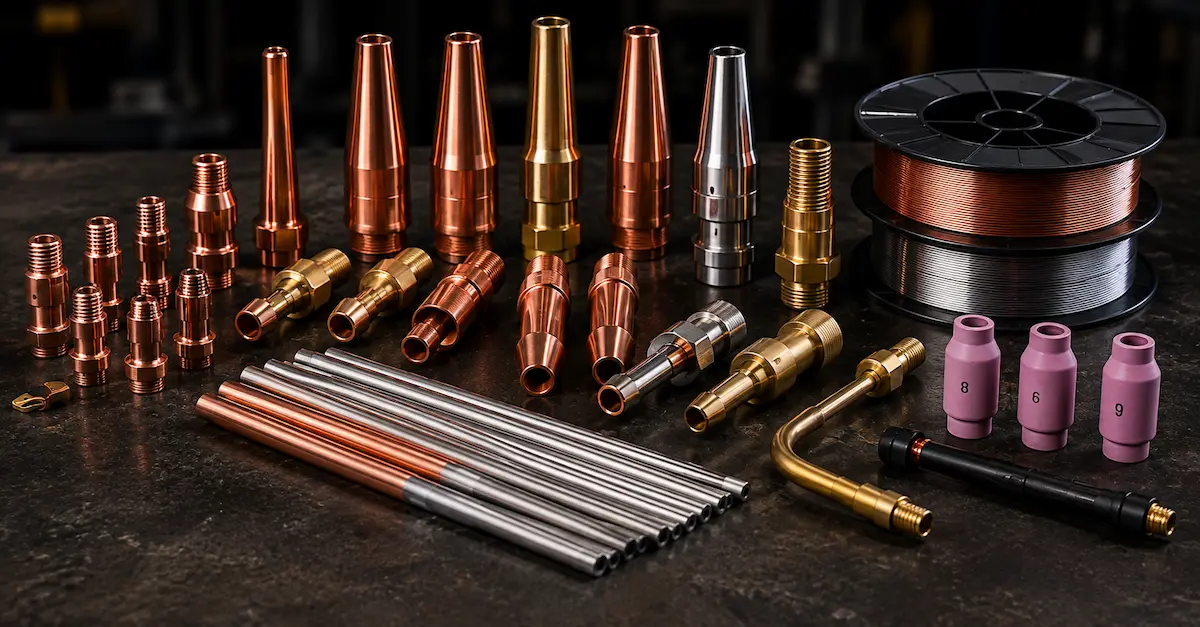
Welding consumables are replaceable products used during welding, brazing, cutting, or related fabrication processes.
Depending on the welding system,the category may include:
| Consumable Type | Typical Function |
|---|---|
| Welding tips | Control or deliver the working flame in applicable torch systems |
| Welding nozzles | Direct or shape gas/flame around the working area |
| Contact tips | Transfer current to welding wire in MIG/MAG systems |
| Welding rods | Provide filler material in applicable welding processes |
| Welding wire | Continuous filler/electrode material for compatible systems |
| Cutting nozzles | Control preheating and cutting oxygen in oxy-fuel systems |
| Fittings | Connect or adapt components |
| Torch accessories | Support equipment operation and replacement |
The important point for buyers is that not all consumables belong to the same welding process.
An oxy-acetylene welding tip should not be treated as interchangeable with a MIG/MAG contact tip simply because both are described as welding consumables.
Why Does Consumable Compatibility Matter?
Compatibility is one of the easiest purchasing issues to overlook.
A consumable may appear physically similar to another model but still have different:
- Dimensions
- Threads
- Gas requirements
- Torch interfaces
- Material specifications
- Operating ranges
- Application requirements
UWELD's current product information illustrates this product-family approach. For example, its current welding-tip range includes dedicated oxy-acetylene welding tips, copper welding/brazing tips, heating tips, and other configurations rather than treating every tip as a universal component.
For buyers, a safer sourcing process is:
Application → Welding system → Torch model → Consumable model → Size → Material → Quantity
This sequence reduces the risk of purchasing a large quantity of incompatible products.
What Types of Welding Consumables Should Buyers Source?
Oxy-Fuel Welding Tips
Oxy-fuel welding tips are used in applications involving oxygen and a fuel gas.
Typical applications include:
- Welding
- Brazing
- Heating
- Repair
- Metal fabrication
UWELD currently lists 1C003-0026 Oxy-Acetylene Welding Tip Series Size #0 #2 #4 for Light Duty, described for light-duty welding and brazing with copper and brass construction.
This type of product is relevant for buyers serving workshops, repair businesses, HVAC-related applications, and general fabrication markets.
Acetylene Welding Tips
Acetylene-specific products require attention to torch compatibility and operating specifications.
UWELD also lists 1C003-0028 Acetylene Swaged Welding Tips, described as pure-copper products for oxy-acetylene welding with enhanced heat dissipation.
For a buyer sourcing this category, the quotation should clearly identify:
- Product model
- Tip size
- Fuel gas
- Orifice
- Material
- Torch compatibility
Welding and Brazing Tips
Some products are intended for both welding and brazing.
UWELD's current product range includes products such as:
1C003-0010 Medium Duty Premium Copper Welding Nozzle Brazing Tip
and
1C003-0016 23A90 Welding & Brazing Tip, Tellurium Copper.
These products are particularly relevant when building a product range for customers who perform both welding and brazing.
Heating Tips
Heating tips belong to the wider consumables ecosystem but should not automatically be marketed as welding tips.
UWELD currently lists oxygen-acetylene and propane/natural-gas heating products, including MFA and rosebud-style heating configurations.
This distinction matters when organizing a distributor catalog because accurate product classification reduces customer confusion.
How Should Buyers Compare Welding Consumables?
Price alone is a poor comparison method.
A better comparison considers technical suitability + consistency + total procurement cost.
| Evaluation Factor | What to Check | Procurement Impact |
|---|---|---|
| Material | Copper, alloy, or specified material | Heat and wear performance |
| Dimensions | Length, diameter, thread, orifice | Equipment compatibility |
| Application | Welding, brazing, heating,cutting | Prevents wrong selection |
| Fuel/process | Acetylene, propane, MIG/MAG, etc. | Determines product family |
| Quality consistency | Batch-to-batch variation | Reduces complaints |
| Packaging | Bulk or retail | Supports distribution |
| Availability | Repeat production | Reduces stock risk |
| OEM support | Marking and packaging | Supports private-label sales |
A supplier should be able to explain why a particular consumable is suitable instead of simply sending a product catalog.
Why Does Material Quality Matter?
The material used in a welding consumable can influence its thermal behavior, durability, machining characteristics, and service life.
Copper
Copper is commonly used in heat-intensive torch components because of its thermal conductivity.
For welding and brazing consumables, buyers should still confirm the actual material specification instead of assuming that all copper products have identical performance.
Tellurium Copper
Tellurium copper appears in specific welding-tip applications.
UWELD currently lists 1C003-0003 Swaged Welding Nozzles Type 2/3 Tellurium Copper and 1C003-0016 23A90 Welding & Brazing Tip, providing examples of products where the material is part of the product specification.
If a buyer requires tellurium copper for a particular product, the material should be included in the approved specification.
What Quality Controls Should a Welding Consumables Supplier Have?
For bulk orders, quality control is more important than a good-looking sample.
A supplier should have a process for controlling the product from incoming material through final shipment.
Material Inspection
The supplier should verify incoming materials against the agreed specification.
Dimensional Inspection
Depending on the product, critical dimensions may include:
- Diameter
- Length
- Thread
- Orifice
- Internal passage
- Connection geometry
Machining Inspection
For precision consumables, buyers should consider:
- Burr control
- Surface condition
- Thread quality
- Internal passage consistency
- Dimensional tolerance
Functional Verification
Where applicable, the supplier should verify product function against the relevant specification.
Batch Consistency
This is particularly important for distributors.
A buyer may approve one sample, but the real commercial test is whether subsequent production remains consistent with the approved sample.
The independent-site quality standard specifically emphasizes that content should provide substantive, trustworthy information rather than merely summarize existing material. The same principle applies to supplier evaluation: buyers should look for evidence rather than relying only on broad claims.
What Problems Can Poor Welding Consumables Cause?
Incorrect Fit
An incompatible consumable may not fit the torch correctly.
Inconsistent Welding Performance
Variations in geometry or material can affect operating consistency.
Shorter Service Life
Poor material quality or manufacturing variation can increase replacement frequency.
Production Downtime
When a common consumable is unavailable, a small component can interrupt an entire job.
Customer Complaints
For distributors, inconsistent products can lead to:
- Returns
- Replacement costs
- Technical complaints
- Lost repeat business
This is why a welding consumables supplier should be evaluated as part of the buyer's long-term supply chain.
How Can Buyers Reduce Welding Consumables Procurement Risk?
A practical sourcing process can be divided into six stages.
Step 1: Define the End Application
Specify:
- Welding process
- Material
- Working environment
- Required output
- Expected operating frequency
Step 2: Identify the Equipment
Provide:
- Torch model
- Welding machine model where applicable
- Existing consumable reference
- Connection information
Step 3: Confirm the Product Specification
Review:
- Material
- Dimensions
- Size
- Orifice
- Thread
- Application range
Step 4: Request Samples
Sample evaluation should focus on actual use rather than appearance alone.
Check:
- Fit
- Dimensional accuracy
- Operating performance
- Durability
- Packaging
Step 5: Approve the Specification
Document the approved:
- Model
- Material
- Dimensions
- Marking
- Packaging
- Quality requirements
Step 6: Establish Repeat Supply
For distributors and industrial users, define how future orders will be reproduced.
This is especially useful for high-volume consumables because the buyer should not need to re-qualify an equivalent product every time an order is placed.
How Should Distributors Build a Welding Consumables Product Range?
A good product range should reflect how customers actually buy.
Instead of creating dozens of overlapping SKUs, distributors can organize products by application.
Oxy-Fuel Welding
- Welding tips
- Welding nozzles
- Brazing tips
- Heating tips
Gas Cutting
- Cutting nozzles
- Cutting torches
- Regulators
- Flashback arrestors
MIG/MAG
- Contact tips
- Gas nozzles
- Diffusers
- Torch accessories
General Welding Accessories
- Welding rods
- Wire
- Fittings
- Clamps
- Replacement components
UWELD's current product architecture supports this broader approach, with separate Welding, Gas Cutting, Safety, Gas Heating, HVAC, and related product categories.
This can make the product catalog easier for distributors to manage and easier for end users to navigate.
When Should You Choose a Welding Consumables Manufacturer?
A manufacturer or manufacturing-focused supplier may be particularly useful when the buyer needs consistent specifications across repeated orders.
This becomes more important when:
- Annual purchasing volume is increasing
- Multiple distributors use the same SKU
- Private labeling is required
- Product packaging must remain consistent
- Replacement parts are a major revenue stream
- Customers expect the same product repeatedly
However, buyers should verify actual manufacturing and quality capabilities rather than selecting a supplier solely because it uses the word “manufacturer.”
Useful evidence can include:
- Product specifications
- Samples
- Quality procedures
- Production information
- Inspection records where applicable
- Packaging examples
- Relevant certifications
The quality-assessment framework also emphasizes expertise, trustworthiness, originality, completeness, and whether the content provides enough value for the reader to avoid having to search elsewhere.
What Should You Include in a Welding Consumables RFQ?
A detailed RFQ helps suppliers provide a more accurate quotation.
Product Information
Provide:
- Product name
- Product model
- Existing reference
- Required size
- Material requirement
Application Information
Include:
- Welding process
- Fuel gas where applicable
- Torch or machine model
- Material being processed
- Working conditions
Commercial Information
Specify:
- Sample quantity
- Trial order quantity
- Expected bulk quantity
- Packaging requirements
- Private-label requirements
- Target market
A useful RFQ might look like this:
| RFQ Item | Example Information |
|---|---|
| Product | Welding tip |
| Application | Oxy-acetylene welding |
| Torch | Existing torch model |
| Size | Required tip size |
| Material | Copper |
| Sample | 10 pcs |
| Bulk order | To be confirmed |
| Packaging | Private label |
| Market | Distributor sales |
The more precise the RFQ, the easier it becomes to compare supplier quotations on an equal basis.
How Can OEM Buyers Work With a Welding Consumables Supplier?
OEM cooperation should begin with product requirements, not packaging design.
A typical process is:
Product selection → Sample → Specification approval → Packaging/marking → Trial order → Bulk production → Repeat supply
Potential customization areas may include:
- Product marking
- Packaging
- Labels
- Product combinations
- Model coding
- Private-label presentation
For an OEM project, the buyer should keep the approved sample and specification as the reference for future production.
This reduces the possibility of specification drift between the first and later orders.
Why Is a Complete Welding Product Supplier Valuable?
For many distributors, consumables are more useful when they can be purchased alongside the equipment they support.
For example:
Welding torch + welding nozzle + welding tip + regulator + safety accessory
can form a more practical sourcing package than purchasing each component from unrelated suppliers.
UWELD currently positions itself as a supplier of welding and cutting equipment and related accessories, with product categories spanning welding, gas cutting, safety, gas heating, HVAC, and medical products. Its website also highlights stable long-term supply, product development, and support for distributors.
This broader range can be useful for B2B buyers looking to consolidate procurement.
What Makes UWELD Relevant to Welding Consumables Buyers?
UWELD's current product range includes dedicated welding-tip products such as:
- 1C003-0026 Oxy-Acetylene Welding Tip Series
- 1C003-0028 Acetylene Swaged Welding Tips
- 1C003-0003 Tellurium Copper Welding Nozzles
- 1C003-0010 Copper Welding Nozzle Brazing Tip
- 1C003-0016 Tellurium Copper Welding & Brazing Tip
- Heating-tip and related oxy-fuel products
This means buyers can evaluate consumables according to their actual application instead of treating “welding consumables” as one generic product.
You can review the UWELD Welding Tip product range to identify relevant welding and oxy-fuel consumables.
For broader sourcing, the UWELD Products page provides access to its welding, gas cutting, safety, heating, and related product categories.
Welding Consumables Supplier Selection Checklist
Before placing a bulk order,buyers can use this checklist:
| Question | What a Good Supplier Should Provide |
|---|---|
| Does the product match my process? | Clear application information |
| Is it compatible? | Torch/equipment matching |
| What is it made from? | Defined material specification |
| Are dimensions controlled? | Consistent production specifications |
| Can I test samples? | Sample-order support |
| Can quality be repeated? | Batch-control process |
| Can I reorder the same SKU? | Stable product supply |
| Can packaging be customized? | OEM/private-label options |
| Can multiple products be sourced? | Broader product range |
| Can I get technical assistance? | Responsive product support |
Welding Consumables Cost: What Should Buyers Actually Compare?
The cheapest unit price does not necessarily produce the lowest purchasing cost.
Consider:
Total procurement cost = purchase price + replacement cost + downtime + logistics + returns + inventory risk
For example, if an inexpensive consumable requires frequent replacement or generates compatibility complaints, its actual cost may be higher.
For distributors, another factor matters:
Customer retention.
A customer who receives consistent replacement consumables is more likely to return for future orders.
That makes product consistency commercially important, not just technically desirable.
FAQ About Welding Consumables Suppliers
What are welding consumables?
Welding consumables are replaceable components or materials used during welding, brazing, cutting, heating, or related fabrication processes. Depending on the system, they can include welding tips, nozzles, contact tips, rods, wire, cutting nozzles, and accessories.
What should I look for in a welding consumables supplier?
Look at product compatibility, material quality, dimensional consistency, quality control, sample support, repeat-order capability, delivery, packaging, and OEM options.
What types of welding consumables can a supplier provide?
Depending on the supplier, the range may include welding tips, welding nozzles, contact tips, welding rods, wire, cutting nozzles, fittings, and replacement accessories.
How do I choose the right welding consumable?
Start with the welding process, application, torch or machine model, material, required size, connection, and operating requirements.
Are all welding tips interchangeable?
No. Different welding systems and torch models may require different tip designs, dimensions, materials, or connections.
Why is copper commonly used in welding consumables?
Copper offers good thermal conductivity and is widely used in heat-intensive torch components. The exact material specification should still be confirmed for the particular product.
What is tellurium copper used for?
Tellurium copper is used in certain welding and brazing components where the combination of copper-based thermal properties and suitable machinability is beneficial. The appropriate application depends on the specific product design.
Should I order samples before a bulk purchase?
Yes. Samples allow buyers to verify compatibility, dimensions, operating performance, appearance, and packaging before committing to larger quantities.
Can welding consumables be customized for OEM buyers?
Depending on the product and order requirements, OEM cooperation may include private-label packaging, product marking, model coding, and customized presentation. The available options should be confirmed before production.
How can distributors reduce welding consumables sourcing risk?
Use an approved sample and written specification, verify compatibility before bulk purchasing, evaluate batch consistency, and establish a repeat-order process with the supplier.
Conclusion
Choosing a welding consumables supplier is a long-term procurement decision rather than a simple product-price comparison.
For distributors, importers, fabrication companies, and OEM brands, the most important factors are:
- Correct application matching
- Equipment compatibility
- Material consistency
- Dimensional accuracy
- Quality control
- Sample verification
- Stable repeat supply
- Packaging capability
- OEM/private-label support
- Technical communication
A strong supplier should also help buyers build a practical consumables range around their existing welding and cutting equipment.
UWELD's current product portfolio includes welding tips, welding nozzles, oxy-acetylene products, heating tips, gas-cutting equipment, regulators, safety products, and related accessories.
For a quotation, buyers should provide the product type, application, torch or equipment model, required specification, quantity, packaging requirements, and target market. This gives the supplier enough information to recommend the appropriate product and prepare a more useful commercial offer.
You can view UWELD's welding tip products or contact UWELD for wholesale and OEM sourcing.