

What Should Buyers Look for in a Gas Cutting Nozzle Supplier?
A reliable gas cutting nozzle supplier should provide more than a low quotation. For B2B buyers, the right supplier needs to deliver compatible nozzle designs, consistent dimensions, appropriate fuel-gas configurations, stable quality, replacement availability, and practical support for repeat orders.
The most important purchasing factors are:
- Fuel-gas compatibility
- Torch and nozzle compatibility
- Cutting thickness
- Nozzle design
- Material and heat resistance
- Orifice and gas-flow requirements
- Dimensional consistency
- Quality control
- Replacement availability
- Wholesale and OEM support
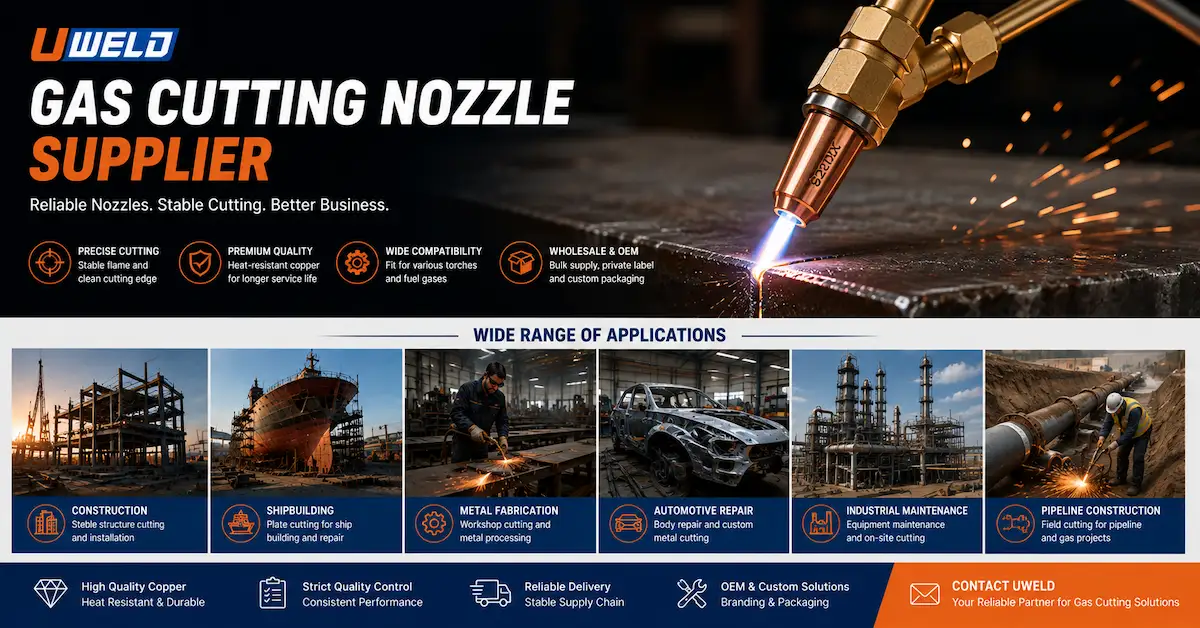
UWELD's gas-cutting product system covers cutting torches, cutting nozzles, regulators, flashback protection, cylinders, accessories, and welding/cutting kits, allowing buyers to evaluate the nozzle as part of a complete oxy-fuel system rather than as an isolated consumable.
What Is a Gas Cutting Nozzle?
A gas cutting nozzle is the working-end component of an oxy-fuel cutting torch. It helps control the preheating flame and cutting oxygen stream used to heat and remove metal during thermal cutting.
In a typical oxy-fuel cutting process:
- Fuel gas and oxygen create a preheating flame.
- The flame raises the metal to the required ignition temperature.
- A concentrated oxygen jet is introduced.
- The oxygen reacts with the heated metal.
- The resulting molten material is expelled from the cut.
Therefore, nozzle design influences flame formation, gas flow, cutting performance, and the operating range of the torch.
A suitable nozzle must be matched with the torch, fuel gas, pressure requirements, and material thickness. Buyers should not select a nozzle only because its external dimensions appear similar to an existing part.
Why Is Nozzle Selection Important for Industrial Cutting?
The nozzle is a consumable, but its performance affects the complete cutting operation.
An unsuitable nozzle can contribute to:
- Unstable preheating
- Inconsistent cutting
- Excessive oxygen consumption
- Poor cut quality
- Increased slag
- Shorter consumable life
- Frequent replacement
- Compatibility problems
For industrial buyers, these issues can become more expensive than the original nozzle price.
For example, UWELD's published cutting equipment information shows that different torch configurations use different fuel-specific nozzle families. The NM250 heavy-duty hand cutting torch is specified for acetylene or propane service, with different nozzle configurations for each fuel.
This illustrates an important sourcing rule:
Choose the nozzle according to the complete gas-cutting system, not according to appearance or price alone.
Who Buys Gas Cutting Nozzles in Bulk?
The search intent behind gas cutting nozzle supplier is strongly commercial. The typical buyer is evaluating product compatibility, supplier reliability, specifications, and long-term purchasing risk.
Welding Equipment Distributors
Distributors need products that can be sold across different customer segments.
Their priorities usually include:
- Multiple nozzle sizes
- Popular torch compatibility
- Stable product quality
- Competitive wholesale pricing
- Replacement availability
- Clear specifications
- Consistent packaging
Welding Equipment Importers
Importers often need to establish a complete product range rather than purchase a single SKU.
They may source:
- Cutting torches
- Cutting nozzles
- Oxygen regulators
- Fuel-gas regulators
- Hoses
- Flashback arrestors
- Cutting and welding kits
A supplier capable of supporting multiple related categories can simplify procurement.
Metal Fabrication Companies
Fabricators are more concerned with:
- Cutting performance
- Appropriate thickness range
- Consumable life
- Gas efficiency
- Replacement availability
Construction and Maintenance Suppliers
These buyers often need portable and versatile cutting equipment for field work, repair, and maintenance.
OEM and Private-Label Buyers
OEM customers may require:
- Product identification
- Customized packaging
- Logo branding
- Product combinations
- Market-specific documentation
The specific customization scope should be confirmed with the supplier according to the product and order requirements.
How Do Different Fuel Gases Affect Nozzle Selection?
Fuel gas is one of the first specifications a buyer should confirm.
Oxygen-Acetylene Cutting Nozzles
Oxygen-acetylene systems are widely used for cutting and heating applications.
Buyers should confirm:
- Torch compatibility
- Acetylene nozzle type
- Cutting thickness
- Oxygen pressure
- Acetylene pressure
- Nozzle size
UWELD's published cutting-torch specifications identify acetylene-specific nozzle families such as ANM and ANME for certain cutting torches.
Oxygen-Propane Cutting Nozzles
Propane-compatible systems require an appropriate nozzle design rather than simply substituting an acetylene nozzle.
UWELD's published catalog identifies propane nozzle configurations such as PNM and PNME for compatible torch models.
Propane and Natural Gas Applications
Some UWELD nozzle models are specifically designed for propane/natural-gas service.
For example, the 6290-000NX product is listed as a propane/natural-gas cutting tip, with a two-piece chrome-plated brass design.
View the UWELD 6290-000NX Propane/Natural Gas Cutting Tip
How Should Buyers Match Nozzle Size to Cutting Thickness?
Nozzle size should correspond to the intended cutting range.
A basic purchasing mistake is to select a nozzle solely according to the outside diameter or model number.
Instead, confirm:
- Material type
- Material thickness
- Cutting speed
- Preheating requirement
- Oxygen pressure
- Fuel-gas pressure
- Required cutting quality
UWELD's published 6290NX data demonstrates that nozzle sizes are associated with different cutting-thickness ranges and pressure requirements. For the 6290NX family, published sizes range from 000 through 6, with cutting-thickness ranges increasing as the nozzle size increases.
| Nozzle Size | Typical Selection Principle |
|---|---|
| Small size | Thin-material applications |
| Medium size | General fabrication |
| Larger size | Thicker steel and heavier work |
| Heavy-duty configuration | Demanding industrial cutting |
The exact operating parameters should always be confirmed against the relevant nozzle specification and torch configuration.
What Materials Are Used for Gas Cutting Nozzles?
Material selection affects thermal behavior, durability, and service life.
Copper
Copper is widely used in gas-cutting components because of its thermal conductivity and suitability for heat-intensive applications.
UWELD's product range includes copper cutting tips and nozzles. One published product, 1C001-0003, is described as a copper acetylene cutting tip optimized for oxygen cutting of 10–20 mm plate.
Copper Alloys
Copper alloys may be selected where additional mechanical durability or wear resistance is required.
The correct material depends on:
- Working temperature
- Cutting frequency
- Application
- Nozzle geometry
- Expected service life
Buyers should request the supplier's actual material specification rather than assuming material composition from the product appearance.
What Nozzle Design Features Should Buyers Evaluate?
Orifice Geometry
The orifice is critical to controlled gas flow.
Dimensional variation can affect:
- Flame characteristics
- Oxygen flow
- Cutting performance
- Repeatability
Nozzle Mixing Design
Some cutting systems use different mixing principles.
UWELD's NM250 documentation, for example, specifies a nozzle mix principle and identifies the torch as suitable for both acetylene and propane service when paired with the appropriate nozzle.
Connection and Torch Fit
Confirm:
- Thread
- Seating geometry
- Torch model
- Nozzle family
- Fuel-gas compatibility
A nozzle with the wrong connection or geometry should not be treated as interchangeable.
Gas Cutting Nozzle Specifications Buyers Should Request
Before asking a gas cutting nozzle supplier for a quotation, prepare a specification sheet.
| Specification | What to Confirm |
|---|---|
| Product model | Exact nozzle reference |
| Fuel gas | Acetylene, propane, natural gas, etc. |
| Torch model | Compatible torch or system |
| Nozzle size | Required size range |
| Cutting thickness | Target material thickness |
| Orifice | Published orifice specification |
| Material | Copper or specified alloy |
| Pressure | Required oxygen/fuel pressure |
| Connection | Thread and fitting requirements |
| Application | Fabrication, repair, heavy cutting, etc. |
| Packaging | Bulk, retail, or private label |
| Replacement supply | Long-term SKU availability |
This information makes supplier quotations easier to compare and reduces the risk of receiving products that cannot be used with the buyer's existing equipment.
What Quality Control Should a Gas Cutting Nozzle Supplier Have?
A supplier should control the product from material input through finished-product inspection.
Material Control
The supplier should have a defined method for controlling incoming materials and maintaining consistent product specifications.
Dimensional Inspection
Critical dimensions can include:
- Overall dimensions
- Orifice diameter
- Thread dimensions
- Seating surfaces
- Nozzle geometry
Appearance Inspection
Finished products should be checked for:
- Surface defects
- Machining damage
- Deformation
- Burrs
- Inconsistent finishing
Functional Verification
Where applicable, suppliers should verify gas-flow and operating performance according to the product specification.
Batch Consistency
For wholesale customers, one good sample is not enough.
The approved sample should represent future bulk production.
This is particularly important for distributors because inconsistent batches can lead to customer returns, compatibility complaints, and additional after-sales costs.
What Are the Most Common Gas Cutting Nozzle Problems?
Wrong Fuel-Gas Nozzle
Using a nozzle that does not match the fuel system can produce poor operating performance.
Solution: Confirm the fuel gas before ordering.
Incorrect Nozzle Size
A nozzle designed for a different cutting range may not provide the desired performance.
Solution: Match nozzle size with material thickness and the manufacturer's specification.
Torch Compatibility Problems
A physically similar nozzle may have different dimensions or connections.
Solution: Provide the exact torch model when requesting a quotation.
Clogged Orifice
Contamination can affect gas flow and flame characteristics.
Solution: Follow suitable cleaning and maintenance procedures and replace damaged consumables.
Inconsistent Bulk Production
A sample may work correctly while later production varies.
Solution: Establish approved specifications and quality-control requirements before bulk production.
Gas Cutting Nozzle Supplier vs Low-Cost Nozzle Sourcing
The lowest unit price is not always the lowest total cost.
For B2B buyers, a better comparison is:
Total cost = purchase price + replacement cost + downtime + returns + inventory risk + after-sales cost
For example, a slightly higher-quality nozzle may make commercial sense if it provides:
- More consistent dimensions
- Better compatibility
- Lower replacement frequency
- Fewer customer complaints
- More predictable repeat orders
This is especially important for distributors building a long-term welding-equipment product line.
How Can Distributors Build a Better Nozzle Product Range?
Instead of purchasing many overlapping models, organize the range according to customer applications.
General-Purpose Nozzles
For:
- Workshops
- General fabrication
- Repair
Heavy-Duty Nozzles
For:
- Thick steel
- Structural fabrication
- Shipbuilding
- Industrial cutting
Fuel-Specific Nozzles
For:
- Acetylene
- Propane
- Natural gas
Complete Torch and Nozzle Combinations
For distributors,offering a matched torch and nozzle combination can reduce compatibility questions and make the product easier for customers to purchase.
UWELD's current gas-cutting range includes cutting torches, cutting nozzles, regulators, flashback arrestors, and cutting/welding kits, supporting this system-level sourcing approach.
What Makes UWELD a Suitable Supplier for Gas Cutting Nozzles?
For B2B buyers, supplier selection should be based on product-system capability rather than a single SKU.
UWELD's current product structure includes:
- Gas cutting
- Cutting torches
- Cutting nozzles
- Gas regulators
- Flashback arrestors
- Welding and cutting kits
- Accessories
Its published catalog also covers multiple cutting torch and nozzle configurations for acetylene and propane applications.
This broader product structure can be useful for distributors that want to source compatible components from one supplier instead of managing multiple unrelated vendors.
Explore UWELD Gas Cutting Products
Wholesale and OEM Sourcing Process
For a new bulk order, a practical process is:
Step 1: Define the Application
Provide:
- Fuel gas
- Material
- Cutting thickness
- Torch model
- Target market
Step 2: Confirm Product Compatibility
The supplier should identify suitable nozzle models and specifications.
Step 3: Review Samples
Test:
- Fit
- Cutting performance
- Flame stability
- Dimensions
- Packaging
Step 4: Approve Specifications
Confirm the final:
- Model
- Material
- Dimensions
- Marking
- Packaging
- Quantity
Step 5: Bulk Production and QC
Production should follow the approved specifications.
Step 6: Repeat Supply
For distributors, establish a repeat-order process for high-volume SKUs and replacement consumables.
If OEM/private-label requirements are involved, define the customization requirements before production rather than after the order has been placed.
FAQ About Gas Cutting Nozzle Suppliers
What is a gas cutting nozzle supplier?
A gas cutting nozzle supplier provides nozzles used with oxy-fuel cutting torches and may also supply related torches, regulators, hoses, safety devices, kits, and replacement parts.
How do I choose the right gas cutting nozzle?
Match the nozzle to the fuel gas, torch model, material thickness, cutting requirements, pressure, and required nozzle specification.
Can an acetylene nozzle be used with propane?
Do not assume that it can. Fuel-specific nozzle configurations may be required. Confirm compatibility with the torch and complete gas-cutting system.
What materials are commonly used for cutting nozzles?
Copper and copper-based materials are commonly used.The appropriate material depends on the product design, heat exposure, durability requirements, and application.
Does nozzle size affect cutting thickness?
Yes. Nozzle size and design are related to gas flow and the intended cutting range. Buyers should use the manufacturer's published specifications rather than selecting by size alone.
Why is nozzle orifice accuracy important?
The orifice influences controlled gas flow and flame behavior. Dimensional inconsistency can affect cutting stability and repeatability.
How can I reduce cutting nozzle replacement costs?
Select the correct fuel-specific nozzle, match it to the torch and application, maintain the nozzle properly, and work with a supplier capable of maintaining consistent production quality.
What should distributors ask a gas cutting nozzle supplier?
Ask about fuel compatibility, torch compatibility, nozzle sizes, material, specifications, QC procedures, sample approval, packaging, replacement availability, and OEM options.
Can gas cutting nozzles be supplied under a private label?
OEM/private-label arrangements may be available depending on the product and order requirements. Buyers should confirm packaging, marking, quantity, and customization requirements before production.
Can UWELD supply complete gas-cutting solutions?
Yes. UWELD's product range includes cutting torches, cutting nozzles, regulators, safety devices, kits, and related accessories, allowing B2B buyers to source multiple components within a gas-cutting system.
Conclusion
Choosing a gas cutting nozzle supplier should begin with application and compatibility rather than price.
For professional B2B procurement, buyers should evaluate:
- Fuel-gas compatibility
- Torch compatibility
- Cutting thickness
- Nozzle size
- Orifice and geometry
- Material
- Quality control
- Batch consistency
- Replacement availability
- OEM and wholesale support
UWELD's gas-cutting product range covers cutting nozzles alongside torches, regulators, safety products, kits, and accessories, giving distributors and industrial buyers the opportunity to source a broader compatible system.
For buyers developing a gas-cutting product line, the next step is to provide the fuel gas, torch model, cutting thickness, required nozzle type, quantity, and target market so the appropriate configuration can be evaluated.