

What Should You Look for in a Welding Nozzle Supplier?
A reliable welding nozzle supplier should provide more than a competitive unit price. For professional buyers, nozzle consistency, material quality, torch compatibility, application suitability, quality control, and long-term supply are usually more important than the initial purchase price.
The right supplier should be able to help buyers answer five practical questions:
- Which nozzle type matches the welding or brazing application?
- Is the nozzle compatible with the existing torch and fuel-gas system?
- What material and manufacturing process are used?
- Can the supplier maintain consistent quality in bulk production?
- Can the supplier support repeat orders, OEM requirements, and replacement demand?
For B2B procurement, this makes welding nozzle supplier selection a combination of technical evaluation and supply-chain risk management.
The content framework used for this article follows the B2B SEO model of combining search intent, buyer questions, technical information, product evidence, supplier evaluation, OEM/ODM considerations, FAQ, and conversion-oriented content.
Who Needs a Welding Nozzle Supplier?
The keyword welding nozzle supplier has a strong commercial investigation and procurement intent. Different buyers, however, have different priorities.
Welding Equipment Distributors
Distributors need a product range that can serve different customer applications while remaining easy to stock and reorder.
Their priorities commonly include:
- Stable product quality
- Multiple nozzle sizes
- Consistent dimensions
- Competitive wholesale pricing
- Reliable replacement supply
- Clear product specifications
- Packaging options
Welding Equipment Importers
Importers often need to build a complete welding and gas-cutting product portfolio rather than source one consumable.
A broader supplier relationship may include:
- Welding nozzles
- Cutting nozzles
- Welding tips
- Cutting torches
- Gas regulators
- Hoses
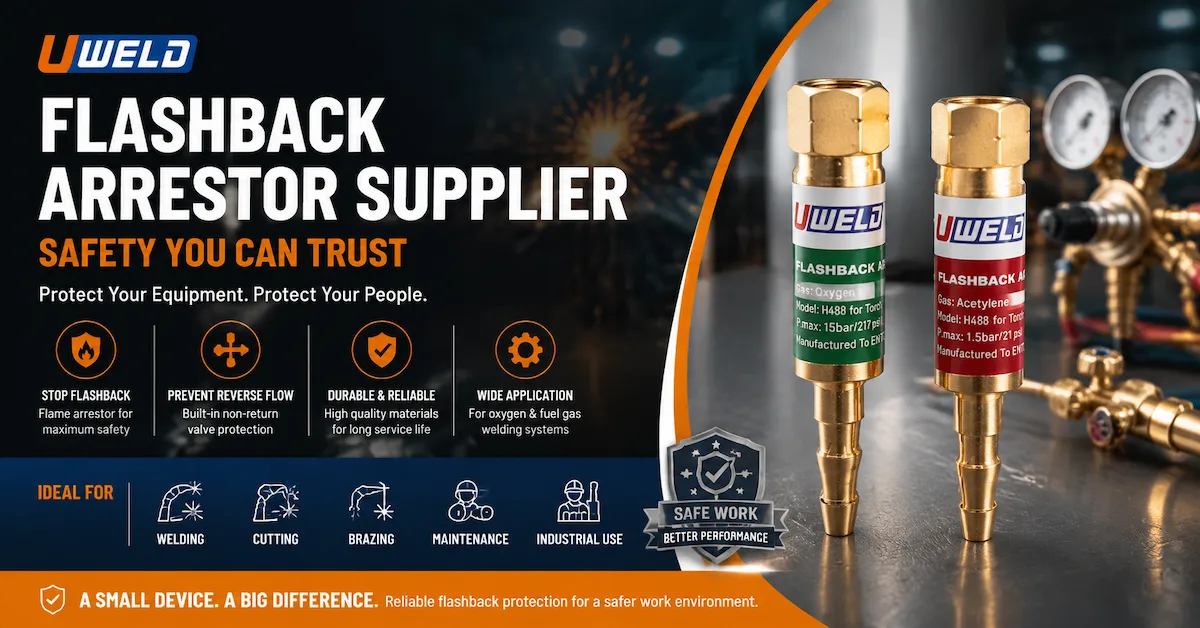
- Flashback protection
- Welding and cutting kits
This type of buyer benefits from a supplier that understands the relationship between individual consumables and the complete gas system.
Metal Fabrication Companies
Fabricators normally focus on actual operating performance.
Their priorities include:
- Stable flame or heat distribution
- Correct torch compatibility
- Appropriate nozzle size
- Consistent welding results
- Consumable service life
- Easy replacement
Repair and Maintenance Companies
Maintenance buyers may need multiple nozzle types for different repair environments.
Portability, availability, compatibility, and fast replacement can therefore become important purchasing factors.
OEM and Private-Label Buyers
OEM buyers have additional requirements such as:
- Product identification
- Packaging
- Product marking
- Model organization
- Private-label presentation
- Consistent repeat production
Customization requirements should be confirmed with the supplier according to the actual product and order volume.
What Is a Welding Nozzle?
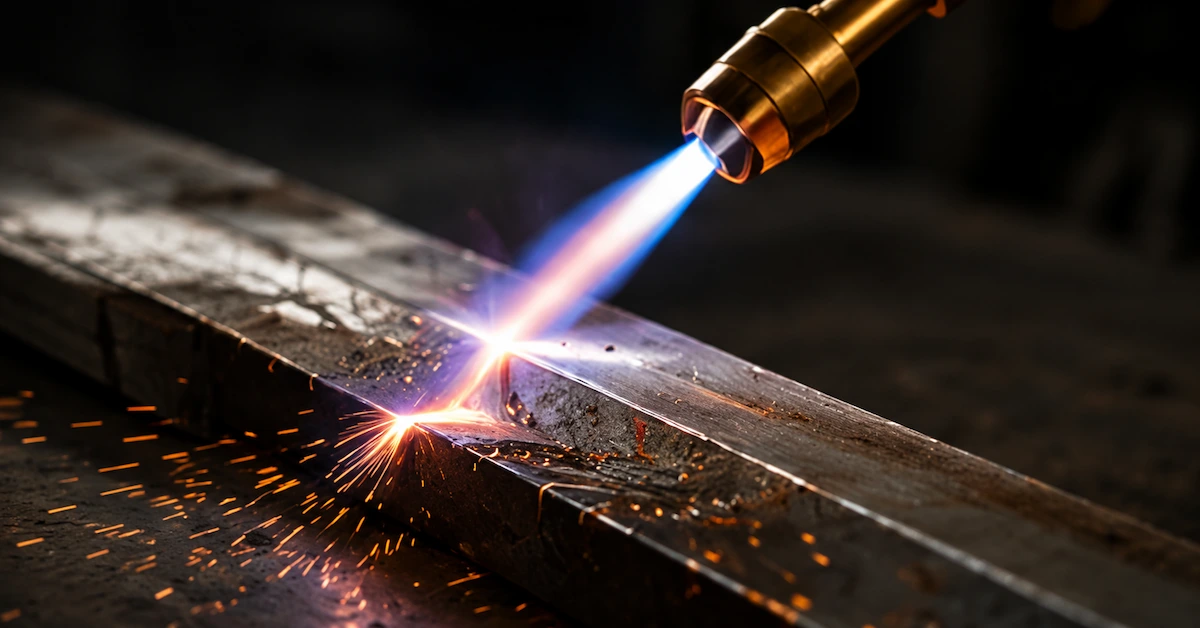
A welding nozzle is a working-end component used with certain welding or oxy-fuel torch systems to help direct and control the gas or flame around the working area.
Depending on the application, the nozzle can influence:
- Flame shape
- Heat concentration
- Gas distribution
- Working distance
- Welding or brazing efficiency
- Operator control
For oxy-fuel welding and brazing, nozzle selection needs to consider the fuel gas, torch design, nozzle geometry, material, and required heat output.
This is why buyers should not select a nozzle simply because it looks similar to an existing product.
Welding Nozzle vs Welding Tip: Are They the Same?
The terminology can vary by product family and application.
In some oxy-fuel systems, terms such as welding tip, welding nozzle, and brazing tip may refer to related components with different functions or configurations.
A buyer should therefore confirm the manufacturer's actual product definition rather than relying only on terminology.
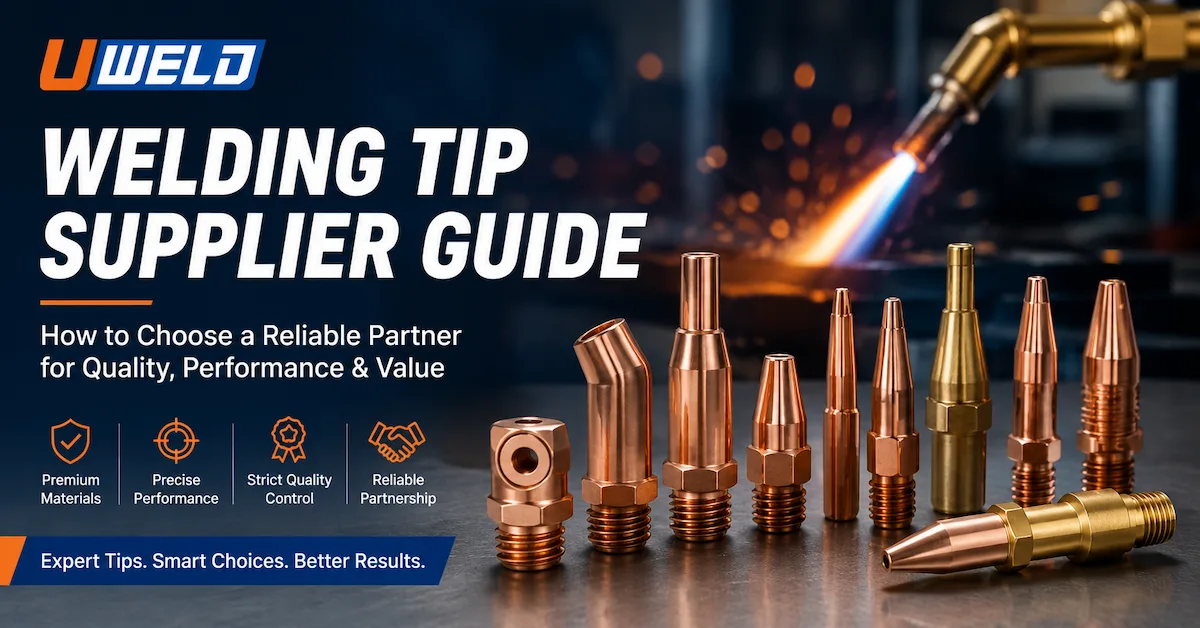
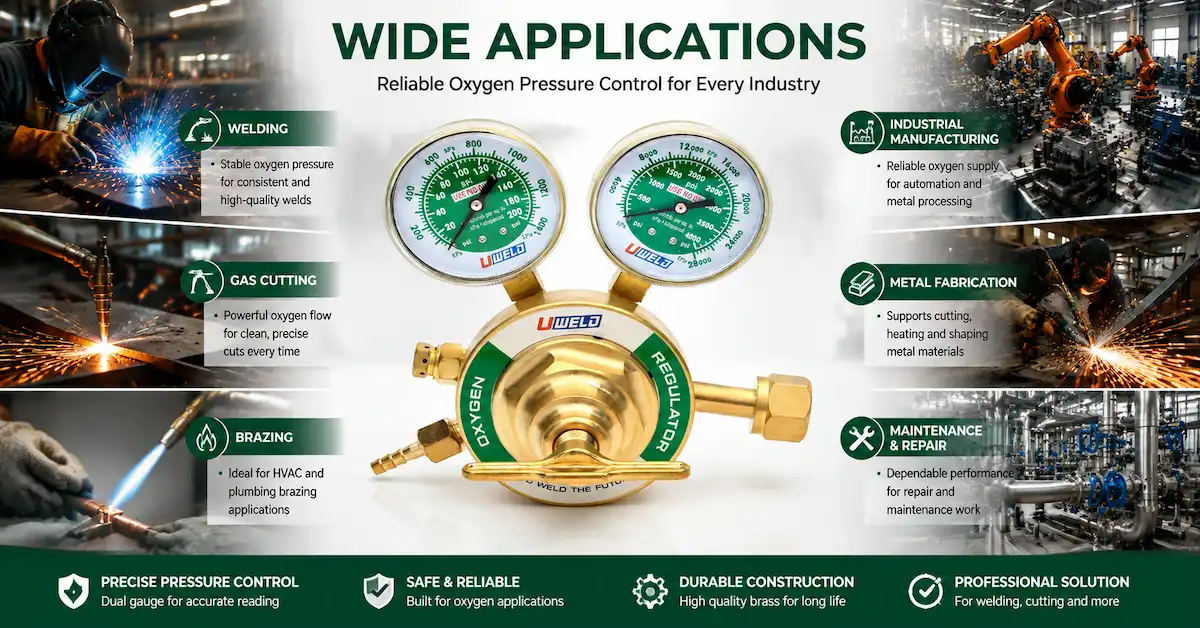
For example, UWELD's product materials include welding tips and brazing-related nozzle products, including copper products and oxy-fuel configurations. The supplied UWELD product reference materials show welding-tip products presented with different sizes, application descriptions, and material information.
For procurement, the safer approach is:
Torch model → Fuel gas → Application → Nozzle/tip model → Size → Material → Connection
This chain significantly reduces compatibility mistakes.
What Types of Welding Nozzles Should Buyers Consider?
The correct product category depends on the welding process and application.
Oxy-Fuel Welding Nozzles
Oxy-fuel welding nozzles are used with oxygen and fuel-gas systems for applications such as:
- Metal welding
- Heating
- Repair
- Fabrication
- Maintenance
Buyers should verify the fuel gas and torch configuration before selecting the nozzle.
Oxy-Acetylene Welding Tips
Oxygen-acetylene systems are commonly associated with welding, brazing, heating, and repair applications.
For these products, buyers should evaluate:
- Tip size
- Orifice
- Fuel-gas compatibility
- Oxygen requirement
- Torch connection
- Application thickness
UWELD's product materials include dedicated oxygen-acetylene welding-tip configurations, making this an important product family when evaluating an oxy-fuel welding nozzle supplier.
Brazing Nozzles and Tips
Brazing applications require controlled heat rather than conventional arc-welding operation.
Typical applications include:
- HVAC
- Refrigeration piping
- Plumbing
- Copper pipe joining
- Maintenance
The nozzle should provide a suitable flame and heat distribution for the joint size and material.
Copper Welding Nozzles
Copper and copper-based products are common in heat-intensive torch applications because material selection influences thermal performance and durability.
For B2B buyers, however, the important question is not simply whether a product is called “copper.” The supplier should be able to provide the relevant material specification for the product being quoted.
How Does Nozzle Size Affect Welding Performance?
Nozzle size is one of the most important purchasing variables.
A larger nozzle is not automatically better.
The appropriate size depends on:
- Material thickness
- Required heat output
- Fuel gas
- Oxygen supply
- Welding or brazing application
- Torch design
A nozzle that is too small may not provide the required heat output, while an unsuitable larger nozzle may make flame control less efficient for the application.
Buyer Specification Checklist
| Item | What Buyers Should Confirm |
|---|---|
| Application | Welding, brazing, heating, repair |
| Fuel gas | Acetylene, LPG, propane, etc. |
| Torch | Compatible torch model |
| Nozzle size | Required tip/nozzle size |
| Orifice | Published orifice specification |
| Material | Copper or specified alloy |
| Connection | Thread or fitting |
| Operating range | Required gas/pressure range |
| Packaging | Bulk, retail,or OEM |
| Quantity | Sample and production quantity |
This type of structured information is particularly valuable for AI search because tables, definitions, steps, and FAQ content make technical answers easier to extract and understand. The GEO workflow specifically recommends question-oriented titles, direct answers, H2/H3 sections, tables, steps, and FAQ structures.
Why Does Welding Nozzle Material Matter?
Material selection influences heat resistance, dimensional stability, wear, and service life.
Copper
Copper is commonly used for heat-intensive welding and brazing components.
Potential advantages include:
- Good thermal conductivity
- Effective heat dissipation
- Established use in torch components
Copper Alloys
Copper alloys may be selected where a balance of thermal performance and mechanical durability is required.
For industrial buyers, material claims should be supported by an actual product specification rather than generic marketing language.
Tellurium Copper
Tellurium copper can be used in certain welding-nozzle applications where machinability and copper-based thermal properties are important.
If a buyer specifically requires tellurium copper, the quotation should clearly identify the requested material and product model.
This is particularly important for private-label buyers because material substitutions between production batches can create performance and customer-service problems.
What Manufacturing Quality Should a Welding Nozzle Supplier Control?
A professional supplier should control the product throughout manufacturing rather than inspect only the finished appearance.
Material Inspection
Incoming material should be controlled against the approved product specification.
Dimensional Control
Important dimensions may include:
- Orifice diameter
- Overall length
- Connection dimensions
- Seating surfaces
- Nozzle geometry
Small dimensional differences can affect product compatibility and gas-flow characteristics.
Machining Quality
The supplier should control:
- Burrs
- Surface defects
- Thread quality
- Internal passages
- Dimensional consistency
Finished-Product Inspection
Before shipment, products should be checked against approved specifications.
For B2B buyers, the objective is not simply to receive one good sample. The goal is repeatable quality across production batches.
This aligns with the B2B content framework's emphasis on technical depth, QC, certifications, factory capability, risk mitigation, and commercial logic.
How Can Poor Welding Nozzles Affect Your Business?
The cost of a low-quality nozzle goes beyond the purchase price.
Inconsistent Welding Performance
Variations in nozzle geometry can create inconsistent operating conditions.
Shorter Consumable Life
Poor material or manufacturing quality can increase replacement frequency.
Compatibility Problems
Incorrect dimensions may prevent the nozzle from fitting correctly.
Higher Gas Consumption
An unsuitable nozzle can contribute to inefficient gas use.
Customer Complaints
For distributors, inconsistent nozzle performance can result in:
- Returns
- Replacement costs
- Negative customer feedback
- Lost repeat orders
Therefore, supplier selection should focus on total procurement risk, not simply unit cost.
How Should Buyers Compare Welding Nozzle Suppliers?
A practical supplier comparison should include at least six areas.
| Evaluation Area | What to Check | Why It Matters |
|---|---|---|
| Product range | Sizes and applications | Reduces sourcing gaps |
| Compatibility | Torch and fuel-gas matching | Prevents incorrect orders |
| Materials | Copper/alloy specifications | Supports consistent performance |
| QC | Inspection process | Reduces batch variation |
| Supply | Repeat-order capability | Supports inventory planning |
| OEM | Packaging/marking options | Supports private-label business |
Supplier vs Trading Company
A trading company may provide access to multiple products, while a manufacturer or manufacturing-focused supplier may provide greater control over product specifications and production consistency.
However, buyers should verify the actual capabilities of any supplier rather than assuming that a “factory” label automatically means better quality.
Ask for evidence such as:
- Product specifications
- Quality-control procedures
- Product samples
- Production information
- Inspection records where applicable
- Packaging examples
- Relevant certifications or compliance documentation
What Should You Ask Before Requesting a Welding Nozzle Quote?
A high-quality RFQ can significantly reduce back-and-forth communication.
Provide the supplier with:
1. Application
Welding, brazing, heating, repair, or another use.
2. Fuel gas
For example, oxygen-acetylene or another compatible fuel-gas configuration.
3.Torch model
The exact torch or handle model is preferable.
4. Existing nozzle reference
If replacing an existing component, provide its model or specification.
5. Required quantity
Separate sample quantity from expected annual or repeat-order demand if known.
6. Packaging requirements
Bulk packaging, retail packaging, or private-label packaging.
7. Target market
Different markets may have different product, packaging, or compliance requirements.
This approach makes supplier comparison much more precise and improves the probability of receiving a commercially useful quotation.
When Should You Choose an OEM Welding Nozzle Supplier?
OEM sourcing becomes attractive when a distributor or brand wants to build a differentiated product line.
Potential OEM requirements include:
- Private-label packaging
- Product labeling
- Customized product combinations
- Packaging design
- Model coding
- Product documentation
The supplier should confirm which customization options are practical for the requested product and order volume.
For a long-term OEM relationship, buyers should establish an approved sample and specification before mass production.
The GEO framework also recommends making OEM/ODM, MOQ, lead time, packaging, customization, and other procurement information visible on appropriate product and supplier pages because these details help AI and buyers understand the commercial offer.
How Does UWELD Fit a Welding Nozzle Sourcing Strategy?
For buyers evaluating UWELD, the relevant product ecosystem should be considered rather than looking at one welding nozzle in isolation.
UWELD's available product materials cover:
- Welding
- Gas cutting
- Welding tips
- Cutting nozzles
- Gas regulators
- Safety products
- Welding and cutting kits
- Related accessories
The UWELD reference materials also show dedicated welding-tip and oxy-fuel product configurations, including copper and tellurium-copper-related products.
This broader product structure can be valuable for distributors and importers that want to source multiple related welding and gas-cutting components.
You can review the UWELD Welding Tip product range when matching a welding nozzle or tip to your application.
Recommended Welding Nozzle Supplier Selection Process
For a distributor, importer, or OEM buyer, a six-step process can reduce sourcing risk.
Step 1: Define the Application
Identify:
- Welding or brazing process
- Material
- Thickness
- Fuel gas
- Working environment
Step 2: Identify the Torch
Provide the exact torch model and existing nozzle reference where possible.
Step 3: Confirm the Technical Specification
Compare:
- Material
- Size
- Orifice
- Connection
- Application range
Step 4: Request Samples
Evaluate:
- Fit
- Dimensions
- Flame behavior
- Welding/brazing performance
- Appearance
- Packaging
Step 5: Establish the Approved Specification
Record the final:
- Model
- Material
- Dimensions
- Marking
- Packaging
- Quality requirements
Step 6: Move to Repeat Supply
Once the product is approved, establish a repeat-order process for the high-volume SKUs.
This process is more reliable than selecting a supplier solely from a price comparison.
Welding Nozzle Supplier Comparison: What Matters Most?
| Factor | Low-Priority Approach | B2B Best Practice |
|---|---|---|
| Price | Choose the lowest quotation | Compare total procurement cost |
| Product | Choose by appearance | Match specification and application |
| Material | Assume material from appearance | Confirm material specification |
| Quality | Inspect one sample | Control repeat production |
| Compatibility | Test after bulk purchase | Confirm before ordering |
| Supply | Order only when stock runs out | Plan repeat supply |
| OEM | Discuss after ordering | Define before production |
| Support | Focus on sales contact | Evaluate technical response |
The best supplier is not necessarily the cheapest supplier.
For B2B buyers, the better question is:
Which supplier can provide the right welding nozzle consistently, with acceptable quality, compatibility, commercial terms, and long-term support?
FAQ About Welding Nozzle Suppliers
What does a welding nozzle supplier provide?
A welding nozzle supplier provides welding or oxy-fuel nozzle products and may also supply welding tips, cutting nozzles, torches, regulators, safety components, and related accessories.
How do I choose the right welding nozzle?
Match the nozzle to the application, fuel gas, torch model, material thickness, required heat output, nozzle size, and connection specification.
Are welding nozzles and welding tips the same?
Not necessarily. Terminology varies by product family and application. Buyers should confirm the exact product function and specification with the supplier.
What material is best for a welding nozzle?
There is no single material that is best for every application.Copper and copper-based materials are used in many heat-intensive torch components, but the appropriate material depends on the product design and operating conditions.
Can I use the same nozzle for different fuel gases?
Do not assume that a nozzle is interchangeable between fuel gases. Confirm fuel-gas compatibility with the torch and nozzle manufacturer.
Why is nozzle size important?
Nozzle size influences gas flow and heat characteristics. It should be selected according to the torch, fuel gas, material, and application rather than simply choosing the largest available size.
What should I provide when asking a supplier for a quotation?
Provide the application, fuel gas, torch model, existing nozzle reference, required size, quantity, packaging requirements, and target market whenever possible.
Should I request samples before a bulk order?
Yes. Sample approval allows buyers to check fit, dimensions, operating performance, appearance, and packaging before committing to larger quantities.
Can a welding nozzle supplier support OEM orders?
Depending on the supplier and product, OEM support may include private-label packaging, product marking, customized product combinations, and other agreed requirements. Confirm the available options before production.
How can I evaluate a reliable welding nozzle supplier?
Evaluate product range, technical specifications, material consistency, quality control, sample performance, repeat-order capability, delivery reliability, OEM support, and technical communication.
Conclusion
Choosing a welding nozzle supplier should be treated as a technical and commercial decision, not simply a price comparison.
For distributors, importers, fabricators, and OEM buyers, the most important factors are:
- Application compatibility
- Fuel-gas compatibility
- Torch compatibility
- Nozzle size and geometry
- Material quality
- Manufacturing consistency
- Quality control
- Sample verification
- Stable repeat supply
- OEM and private-label capability
A structured sourcing process helps reduce compatibility problems, quality variation, unnecessary replacement costs, and customer complaints.
For buyers evaluating UWELD, the next practical step is to provide the torch model, fuel gas, nozzle/tip reference, application, required quantity, and packaging requirements. This gives the supplier enough information to identify a suitable product configuration and prepare a more accurate quotation.
You can start with the UWELD Welding Tip product category or contact UWELD for product and wholesale inquiries.