

Why Welding Tip Quality Matters More Than Its Size Suggests
A welding tip is one of the smallest components in a welding system, yet its geometry, material, dimensional accuracy, and compatibility can directly affect process stability and consumable life.
For industrial buyers, this makes selecting a reliable welding tip supplier more important than simply finding the lowest unit price.
Poorly matched or inconsistent tips can contribute to:
- Unstable welding performance
- Premature tip wear
- Irregular flame or wire behavior
- Increased replacement frequency
- Higher production downtime
- More customer complaints for distributors
The reference technical framework for MIG/MAG contact tips highlights how a small consumable can influence current transfer, arc stability, wear, and machine availability. It also emphasizes geometry, bore accuracy, material selection, and matching the tip to the welding process as key considerations.
For UWELD buyers, the same purchasing principle applies: the correct tip must be matched to the torch, gas, application, dimensions, and working load rather than selected by price alone.
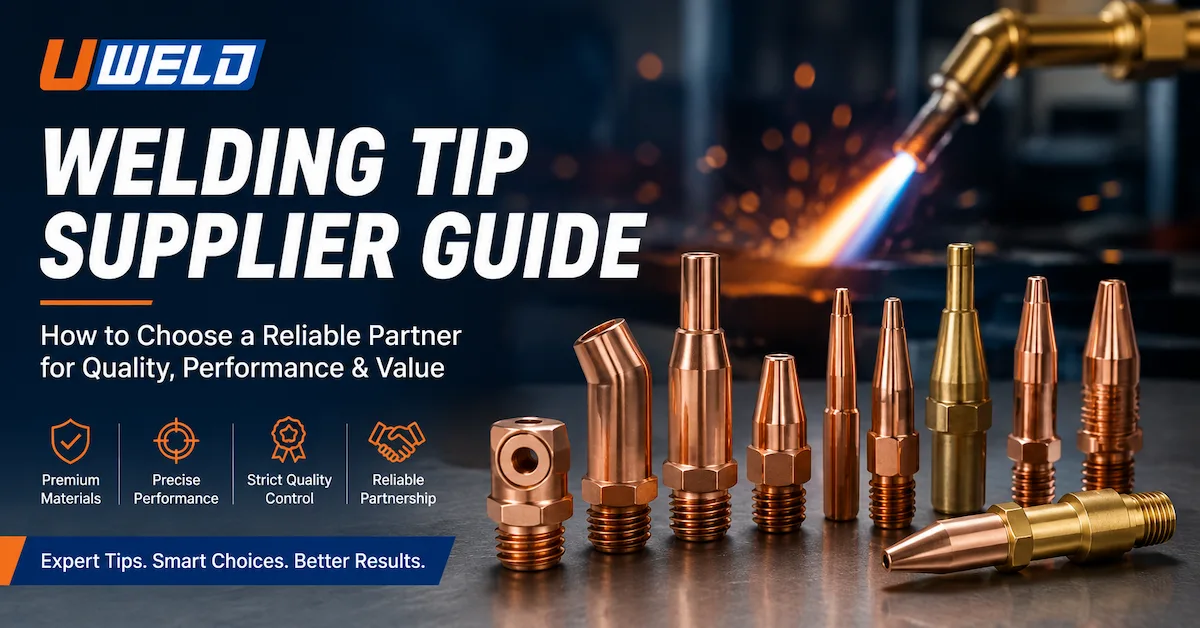
UWELD currently lists multiple welding, brazing, and heating tips in its welding tip product range, including swaged welding nozzles, copper welding tips, tellurium-copper tips, oxy-acetylene heating tips, and propane/natural-gas heating tips.
First Clarify What “Welding Tip” Means
Before requesting a quotation from a welding tip supplier, buyers should clarify which type of tip they actually need.
The term can refer to different components depending on the welding process.
MIG/MAG Contact Tips
In MIG/MAG welding, the contact tip guides the welding wire and transfers electrical current to it.
Important variables include:
- Wire diameter
- Tip bore
- Thread size
- Tip length
- Material
- Welding amperage
- Duty cycle
- Torch compatibility
The welding wire continuously passes through the contact tip, meaning friction, heat, debris, and electrical loading all contribute to wear.
Oxy-Fuel Welding and Brazing Tips
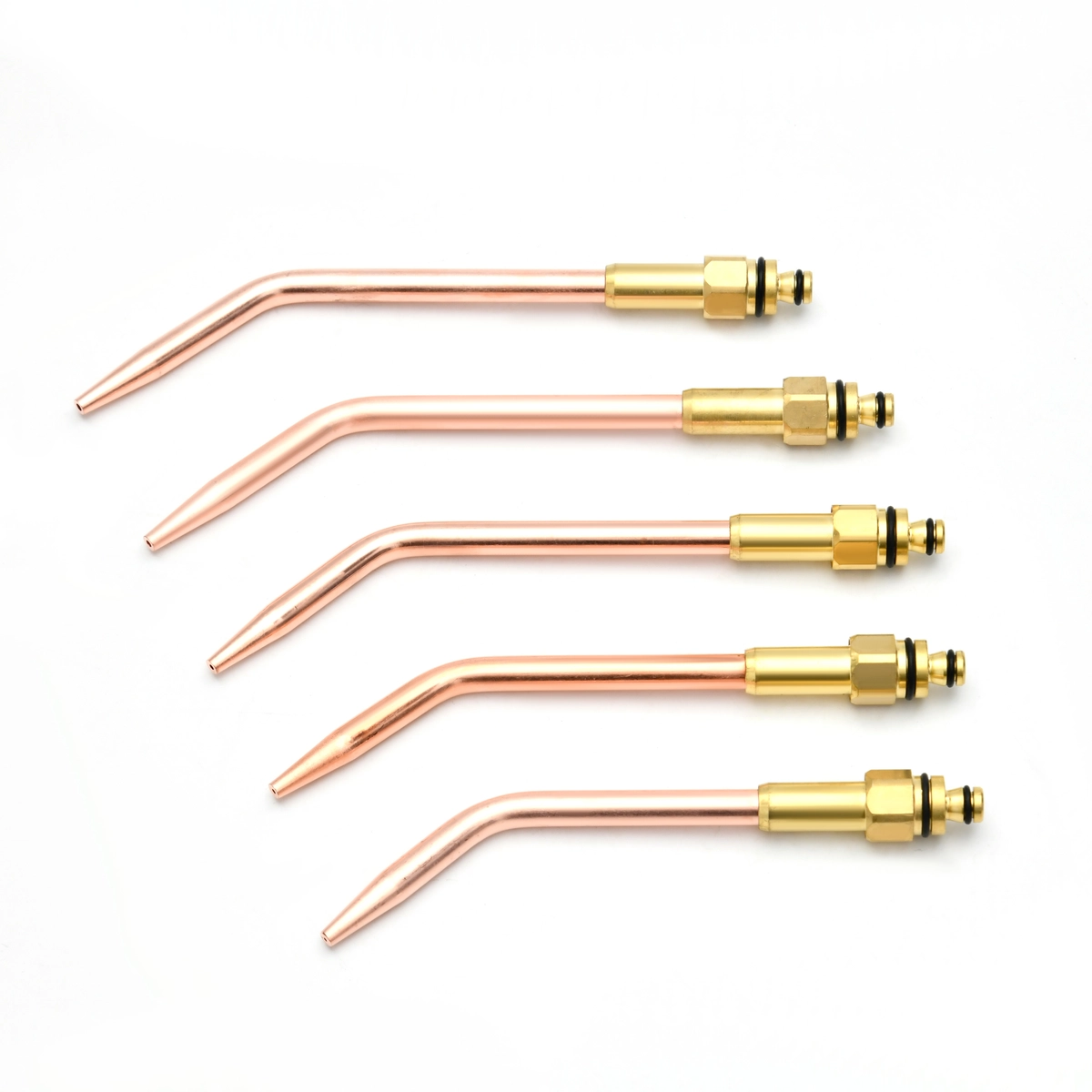
For oxy-fuel welding and brazing systems, the tip or nozzle helps control gas flow and flame characteristics. Selection should consider fuel gas, oxygen supply, tip size, orifice diameter, torch compatibility, and the required heat output.
For example, UWELD’s 1C003-0010 Medium Duty Premium Copper Welding Nozzle Brazing Tip is designed for welding and brazing applications and is available in multiple sizes to support different operating requirements. Buyers can select from Size 2, 4, 6, 9, and 12, with published orifice sizes ranging from 0.4 mm to 1.4 mm.
What Does a Welding Tip Actually Do?
Understanding tip function helps buyers define meaningful specifications.
For MIG/MAG Contact Tips
A contact tip performs two critical jobs:
- It guides the welding wire toward the weld.
- It transfers welding current to the wire.
The relationship between wire and bore must therefore be controlled carefully.
If the bore is too tight, wire feeding can become restricted as heat, debris, or dimensional variation increases.
If it is too loose, electrical contact can become less consistent, potentially increasing instability and wear.
The reference technical article also identifies abrasion, process heat, micro-arcing, burnback, and tip-hole wear as common mechanisms that shorten contact-tip life.
For Oxy-Fuel Welding Tips
An oxy-fuel welding tip performs a different function.
It helps establish the gas flow and flame needed for:
- Welding
- Brazing
- Heating
- Metal fabrication
- Repair work
Here, the key considerations shift toward:
tip geometry + orifice size + gas type + pressure + torch compatibility.
A welding tip supplier serving oxy-fuel customers should therefore provide clear model and size information rather than simply identifying products as “small,” “medium,” or “heavy duty.”
How Tip Size and Orifice Affect Selection
Tip dimensions should correspond to the actual working process.
UWELD's published catalog shows how one welding-tip family may contain several sizes rather than one universal model.
For example, the 1C003-0006 MFA (80V) family is listed with tip sizes from 000 through 7, with published orifice sizes ranging from 0.4 mm to 3.2 mm and a 3/8"-24 connection thread.
Other UWELD tip families such as 1C003-0010, 1C003-0011, 1C003-0012, and 1C003-0013 include sizes 2, 4, 6, 9, and 12 with published orifice options from 0.4 mm to 1.4 mm.
For a distributor, this means the purchasing question should not be:
Which welding tip is the cheapest?
It should be:
Which tip sizes cover the most common applications of my customers, and can the supplier maintain those dimensions consistently between orders?
Material Selection: Why Copper Quality Matters
Material is another major selection factor.
MIG/MAG Contact Tip Materials
The reference technical guide distinguishes three material approaches commonly used for contact tips:
- Electrolytic copper
- Copper-chromium-zirconium alloy
- Heavy-duty heat-resistant designs
The main trade-off is between:
- Electrical conductivity
- Thermal resistance
- Hardness
- Wear resistance
Pure copper-type materials offer strong electrical and thermal conductivity, while harder copper alloys can provide greater resistance to heat and mechanical wear under demanding welding conditions.
This becomes especially important in:
- High-current welding
- High-duty-cycle production
- Automated welding
- Abrasive wire applications
UWELD Welding Tip Materials
UWELD's current product listings include copper and tellurium-copper tip products.
Examples include:
- Swaged welding nozzles
- Tellurium copper welding tips
- Copper heating tips
- Oxy-acetylene tips
- Welding and brazing tips
For buyers, the practical lesson is straightforward:
Do not purchase welding tips based only on exterior appearance.
Ask the supplier to confirm the actual material, product family, application, size, and compatibility.
Why Manufacturing Tolerance Matters
Two welding tips may look identical while performing differently.
Critical dimensions can include:
- Internal bore
- Orifice diameter
- Thread dimensions
- Tip length
- Concentricity
- Seating surfaces
For MIG/MAG contact tips, even small differences between wire diameter and bore dimensions can influence wire feeding and electrical contact.
For oxy-fuel tips, dimensional consistency can influence flame characteristics, gas flow, torch fit, and repeatability.
This is why a professional welding tip supplier should control manufacturing consistency across production batches.
Wholesale buyers should ask:
- How are critical dimensions inspected?
- Are production tolerances defined?
- Are samples representative of bulk production?
- Can the supplier maintain the same dimensions on repeat orders?
- Are model numbers traceable to specific specifications?
What Causes Welding Tips to Wear Prematurely?
Tip wear is not always caused by poor product quality.
Understanding the root cause helps buyers distinguish between a product problem and an application mismatch.
Heat
High operating temperatures can soften or accelerate the deterioration of copper-based consumables.
In MIG/MAG welding, high current and long duty cycles increase thermal stress on the contact tip.
Abrasion
Wire passing through a MIG/MAG contact tip continuously creates friction.
Surface condition, wire construction, contamination, and feed alignment can influence wear.
Incorrect Tip Size
An incorrectly sized bore or orifice may increase operating problems.
This is why tip selection must match:
- Wire diameter for MIG/MAG
- Gas and application for oxy-fuel
- Required torch family
- Working load
Contamination
Debris inside the tip can interfere with correct operation.
Industrial users should follow suitable cleaning and replacement practices rather than continuing to use damaged consumables.
Incorrect Torch Compatibility
A tip that physically resembles the correct model may still have the wrong:
- Thread
- Length
- seating geometry
- orifice
- torch compatibility
For distributors, standardized compatibility data reduces costly returns.
Welding Tip Selection Checklist for B2B Buyers
| Selection Factor | What Buyers Should Confirm |
|---|---|
| Welding process | MIG/MAG, oxy-fuel welding, brazing, or heating |
| Torch compatibility | Exact torch handle or torch family |
| Tip size | Appropriate for the required application |
| Bore/orifice | Correct wire or gas-flow requirement |
| Material | Suitable conductivity and wear performance |
| Connection thread | Correct mechanical fit |
| Fuel gas | Acetylene, propane, natural gas, or specified gas |
| Working load | Suitable for expected heat and duty cycle |
| Replacement supply | Stable long-term availability |
| Manufacturing QC | Consistent dimensions across batches |
Cheap vs Quality Welding Tips: What Should Importers Compare?
Unit price matters in wholesale sourcing, but the cheapest consumable does not necessarily provide the lowest operating cost.
Instead of comparing only price per tip, buyers should evaluate:
Tip cost + replacement frequency + downtime + welding consistency + customer complaints + inventory complexity
For distributors, a very inexpensive tip that wears rapidly may result in weaker repeat business.
For production users, frequent tip replacement can interrupt work and reduce equipment availability.
The reference technical framework specifically emphasizes that material quality and manufacturing precision influence tip wear and operating consistency.
A professional sourcing comparison should therefore test competing samples under the same application conditions.
Which Welding Tip Is Best for Which Application?
There is no universal best tip.
| Application | Main Selection Priority |
| General welding workshop | Compatibility and cost balance |
| High-current MIG/MAG | Heat resistance and wear |
| Automated welding | Dimensional consistency and life |
| Oxy-acetylene welding | Gas, orifice and torch compatibility |
| Brazing | Flame control and tip size |
| Heavy heating | Heat output and robust tip design |
| Fabrication | Availability of multiple sizes |
| Maintenance | Easy replacement and common compatibility |
UWELD's public product range includes several welding-tip families for different oxy-fuel applications rather than treating one tip as suitable for every job.
For example, the range includes copper welding/brazing tips, oxy-acetylene heating tips, and propane/natural-gas heating tips.
What Should Distributors Look for in a Welding Tip Supplier?
For B2B procurement, product quality is only one part of the decision.
Broad Tip Range
A distributor benefits from a supplier capable of covering several:
- Sizes
- gases
- torch systems
- applications
- replacement requirements
UWELD's current new product range lists multiple Welding Tip models covering welding, brazing, heating, oxy-acetylene, propane, and natural-gas applications.
Clear Technical Specifications
A supplier should provide enough information for buyers to identify:
- Model
- size
- orifice
- connection
- gas
- application
The UWELD product catalogs provide detailed model information for welding and cutting products.
Repeat Supply
Consumables create repeat demand.
Buyers should confirm whether popular tip models can remain available after the first shipment.
Quality Control
Useful supplier questions include:
- How are tip dimensions inspected?
- How is material consistency controlled?
- How are samples approved?
- How is bulk production checked?
OEM and Private Label Support
For distributors and welding brands, possible requirements may include:
- Customized packaging
- Logo branding
- Product labeling
- Mixed tip assortments
- Market-specific kits
Specific customization should be confirmed according to the product and order quantity.
Safety Considerations for Oxy-Fuel Welding Tips
Tip selection should always be considered as part of the complete oxy-fuel system.
This includes:
- Torch
- Tip
- Oxygen regulator
- Fuel-gas regulator
- Hoses
- fittings
- applicable safety devices
For U.S. workplaces, OSHA's oxygen-fuel welding and cutting requirements cover approved apparatus, gas handling, regulators, hoses, and operating procedures.
Buyers should verify applicable local requirements for their own market rather than assuming one configuration is suitable worldwide.
FAQ About Choosing a Welding Tip Supplier
What does a welding tip supplier provide?
A welding tip supplier provides consumable tips or nozzles for welding, brazing, heating, or related torch systems. The exact product range depends on whether the supplier specializes in MIG/MAG contact tips, oxy-fuel welding tips, or both.
How do I choose the correct welding tip size?
Match the tip to the welding process, torch model, wire diameter or gas requirement, operating load, and manufacturer's specification.
Why does welding tip material matter?
Material influences electrical conductivity, heat resistance, hardness, and wear performance. The most suitable material depends on the welding process and operating load.
Why do MIG contact tips wear out?
Common causes include heat, wire abrasion, debris, poor alignment, incorrect bore size, and high-duty-cycle operation.
Are all welding tips interchangeable?
No. Differences in thread, geometry, bore or orifice, torch model, and gas application can prevent correct interchangeability.
How important is orifice size for oxy-fuel tips?
Orifice size affects gas flow and the tip's intended working range. Buyers should follow the specified size and torch compatibility rather than selecting by appearance.
What should distributors test before a bulk welding tip order?
Test dimensional fit, torch compatibility, operating performance, durability, packaging, model identification, and consistency between samples.
Can welding tips be supplied for different fuel gases?
Yes, depending on the product family. UWELD's published range includes tips for oxy-acetylene as well as propane and natural-gas applications.
Should buyers choose tips only by price?
No. Replacement frequency, operating stability, dimensional consistency, and long-term supply can be more important than the initial unit price.
How can I source welding tips from UWELD?
Buyers can review UWELD welding and cutting products, check the latest welding tip range, or contact UWELD with required models, sizes, applications, quantities, and OEM requirements.
Conclusion
Choosing the right welding tip supplier requires understanding what the tip must do in the actual welding process.
For MIG/MAG applications, buyers should focus on wire compatibility, bore accuracy, electrical contact, material, heat resistance, and wear.
For oxy-fuel welding and brazing, buyers should evaluate gas compatibility, tip size, orifice diameter, connection, torch compatibility, and required heat output.
For B2B buyers, the supplier must also provide dimensional consistency, repeat supply, clear product specifications, and practical technical support.
UWELD offers a broad range of welding, brazing, and heating tips alongside welding and cutting equipment for industrial buyers. Explore the UWELD product range or contact UWELD to discuss wholesale, replacement tip, and OEM sourcing requirements.