

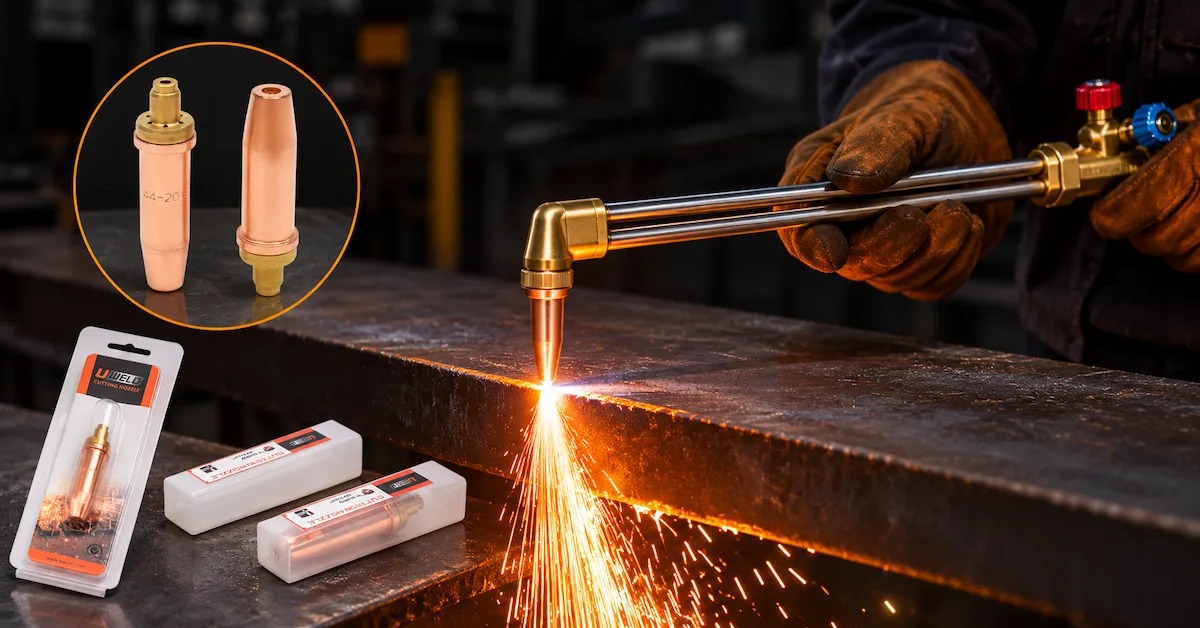
Quick Answer: The UWELD 1C001-0051 Type 44 propane cutting nozzle is a two-piece oxy-LPG cutting tip designed for compatible oxygen-propane steel cutting systems. Its published design includes a copper outer component, brass inner component, tapered two-seat sealing arrangement, and slotted preheating passages. UWELD lists eight nozzle sizes covering different steel thickness ranges. Buyers should match nozzle size, torch seating, gas supply, and cutting requirements before purchasing.
For metal fabrication workshops, industrial cutting equipment distributors, and replacement-parts importers, choosing the correct propane cutting nozzle can directly affect equipment compatibility, cutting quality, and consumable costs.
A nozzle may appear suitable based on its external shape but use an incompatible seating design or internal gas-flow arrangement.
Similarly, selecting a nozzle only because it has a large cutting oxygen orifice does not guarantee better cutting performance.
The Type 44 propane cutting nozzle from UWELD is designed for oxy-LPG applications and is identified by product number 1C001-0051.
Its technical features include a two-seat design, copper-and-brass construction, slotted preheating passages, and multiple nozzle sizes for different steel cutting requirements.
This guide explains the published specifications, material construction, cutting-thickness chart, equipment compatibility, quality considerations, and purchasing requirements for wholesale and OEM customers.
Explore the UWELD Type 44 Propane Cutting Nozzle for product information and customization inquiries.
Key Takeaways: What Makes the UWELD Type 44 Different?
-
Two-seat sealing design: The product literature describes a two-seat arrangement intended to support correct nozzle seating and gas delivery.
-
Two-piece construction: The nozzle consists of a copper outer component and a brass inner component.
-
Propane fuel compatibility: Type 44 is identified for approved oxygen-LPG cutting systems using propane.
-
Slotted preheating passages: The published design incorporates slotted gas passages intended to support flame distribution.
-
Eight nozzle sizes: The catalog lists sizes 6, 8, 12, 15, 20, 24, 32, and 48.
-
Different steel thickness ranges: Published size selections extend from 1–6 mm to 300–400 mm, depending on the nozzle.
-
Industrial applications: The product family is relevant to suitable carbon steel cutting, fabrication, maintenance, and replacement consumable programs.
-
Wholesale purchasing: Torch compatibility, approved dimensions, nozzle identification, and batch consistency should be established before bulk orders.
Purchasing recommendation: Select the correct nozzle size and compatible torch configuration first. Consider material construction, quality evidence, spare-parts supply, and price after technical suitability has been established.
What Is the UWELD 1C001-0051 Type 44 Cutting Nozzle?
The UWELD 1C001-0051 is an oxy-LPG cutting nozzle intended for compatible propane cutting equipment.
In conventional oxy-fuel cutting, a fuel-gas and oxygen flame preheats the steel. A concentrated cutting oxygen stream then reacts with the heated metal and removes the resulting iron oxides from the cutting path.
The cutting nozzle performs two important functions:
-
Producing an appropriate preheating flame through its gas passages.
-
Directing the cutting oxygen stream into the heated steel.
The nozzle's geometry, material, seating arrangement, and size influence how it performs these functions.
UWELD 1C001-0051 Technical Specifications
| Specification | Published Product Information |
|---|---|
| Brand | UWELD |
| Product number | 1C001-0051 |
| Product family | Type 44 |
| Product category | Oxy-LPG cutting nozzle |
| Intended fuel | Propane |
| Construction | Two-piece |
| Outer component | Copper |
| Inner component | Brass |
| Seating design | Two-seat / tapered-seat arrangement |
| Preheating design | Slotted gas passages |
| Published nozzle sizes | 6, 8, 12, 15, 20, 24, 32, 48 |
| Published steel thickness ranges | Vary by nozzle size |
| Main applications | Compatible oxy-propane steel cutting |
| Supply services | Wholesale and OEM inquiries |
These characteristics are based on the UWELD product description and supplied catalog illustration.
The exact nozzle size, complete seating dimensions, approved torch family, and operating conditions should correspond to the product configuration purchased.
Is Type 44 a Universal Cutting Nozzle?
No.
Type 44 identifies a particular nozzle product family.
It does not mean that the nozzle fits every oxy-fuel cutting torch or supports every fuel gas.
A compatible connection requires the correct mating seat, component geometry, gas passages, and approved torch design.
For replacement-part purchasing, these details are more important than external appearance alone.
How Does the Two-Seat Tapered Design Affect Nozzle Compatibility?
One of the main characteristics of the Type 44 propane cutting nozzle is its published two-seat design.
UWELD describes this arrangement as intended to support positive sealing and appropriate gas flow.
The product page also uses the term taper seat.
These descriptions identify the nozzle's intended seating concept but do not replace a detailed interface drawing.
Why Is Nozzle Seating Important?
The nozzle must fit its corresponding torch head correctly.
An unsuitable seat can prevent the nozzle from mating as intended and may create gas-delivery problems.
Industrial buyers should verify the exact torch interface rather than assume that nozzles with similar external shapes are interchangeable.
Two-Seat Design vs General Nozzle Selection
| Technical Feature | Type 44 Published Design | Buyer Evaluation |
|---|---|---|
| Seating | Two-seat arrangement | Confirm matching torch seat |
| Taper | Tapered-seat description | Verify mating geometry |
| Construction | Two-piece | Check correct inner and outer components |
| Gas passages | Slotted preheating ports | Verify approved fuel-gas configuration |
| Cutting oxygen opening | Size-specific orifice | Match required cutting range |
| Installation | Approved torch interface required | Check complete compatibility |
Can Two-Piece Nozzles Be Mixed Between Different Series?
Not without explicit manufacturer approval.
Different nozzle families may use different component dimensions and seating systems.
A copper outer component from one product family should not automatically be combined with a brass inner component from another.
For distributors, a controlled replacement-part reference helps prevent incorrect substitutions.
Why Does Type 44 Use Copper and Brass Components?
The product illustration identifies a two-piece construction consisting of a copper outer section and a brass inner section.
Each component contributes to the nozzle's overall design.
Copper Outer Component
Copper has useful thermal conductivity properties and is commonly used in cutting nozzle construction.
In the Type 44 design, the copper outer component forms part of the working nozzle assembly.
UWELD describes the construction as intended to improve heat dissipation and durability during demanding cutting applications.
However, no specific service-life increase or temperature reduction should be assumed without comparative test results.
Brass Inner Component
The brass inner section forms part of the internal assembly and gas-flow arrangement.
The published product information also describes slotted brass preheating passages.
For procurement, the most important considerations are correct component dimensions, suitable material specifications, and consistent manufacturing quality.
Manufacturing and Material Evaluation
| Component | Relevant Property | Purchasing Check |
|---|---|---|
| Copper outer section | Thermal conductivity and working-end construction | Approved material and dimensions |
| Brass inner section | Internal geometry and component fit | Correct specification and machining |
| Tapered seating surfaces | Intended connection with torch head | Mating dimensions and surface condition |
| Preheating passages | Formation of the fuel-gas flame | Passage geometry and consistency |
| Cutting oxygen orifice | Cutting oxygen jet formation | Diameter and internal condition |
A nozzle with the correct materials can still be unsuitable if its seating geometry or gas passages do not match the approved design.
Manufacturing consistency is therefore as important as material selection.
Type 44 Propane Cutting Nozzle Size Chart: Which Size Fits Your Steel Thickness?
Nozzle sizing is one of the most important technical selection decisions.
UWELD's Type 44 product illustration lists eight nozzle sizes, each associated with a cutting-thickness range and cutting oxygen orifice diameter.
Complete UWELD Type 44 Size Chart
| Nozzle Size | Published Cutting Thickness | Cutting Oxygen Orifice | Fuel Gas |
|---|---|---|---|
| 6 | 1–6 mm | 0.6 mm | Propane |
| 8 | 6–10 mm | 0.8 mm | Propane |
| 12 | 12–20 mm | 1.2 mm | Propane |
| 15 | 25–75 mm | 1.5 mm | Propane |
| 20 | 100–125 mm | 2.0 mm | Propane |
| 24 | 150–200 mm | 2.4 mm | Propane |
| 32 | 225–300 mm | 3.2 mm | Propane |
| 48 | 300–400 mm | 4.8 mm | Propane |
Source: UWELD Type 44 Oxy/LPG Cutting Nozzle product illustration, model 1C001-0051.
Important: These are published selection ranges, not independently verified cutting results for every torch and oxygen supply configuration. The chart contains intervals between certain listed ranges; buyers should not automatically interpolate unsupported thicknesses or assume that the largest nozzle will cut 400 mm steel with any torch.
Size 6–12: Smaller Steel Sections
Sizes 6, 8, and 12 cover the lower end of the manufacturer's published cutting ranges.
They may be relevant to workshops handling suitable thinner carbon steel components.
Selection should still consider nozzle compatibility, material conditions, and the intended cutting process.
Size 15–24: Medium and Heavier Steel
Sizes 15, 20, and 24 cover several intermediate and heavier cutting ranges.
For example, size 15 is listed for 25–75 mm steel, while size 24 is listed for 150–200 mm.
Industrial buyers should not choose a larger nozzle automatically when a smaller approved size meets the application.
The correct selection depends on the cutting conditions and manufacturer recommendations.
Size 32–48: Heavy Steel Cutting
Sizes 32 and 48 are listed for substantially thicker steel sections.
These applications may require a compatible heavy-duty cutting torch and sufficient oxygen delivery capability.
For buyers intending to cut material approaching the upper published limits, the complete equipment specification becomes particularly important.
Why Does Cutting Orifice Diameter Matter?
The cutting oxygen orifice helps determine how oxygen is delivered into the cutting path.
Its dimensions must be appropriate for the intended steel thickness and torch configuration.
However, orifice diameter alone cannot establish the correct pressure, flow, cutting speed, or achievable cut quality.
A professional selection should use the complete nozzle and equipment specification.
Does a Larger Cutting Nozzle Always Produce a Better Cut?
No.
Selecting a larger nozzle than required does not automatically improve cutting speed or edge quality.
Cutting results depend on the oxygen stream, preheating conditions, workpiece material, nozzle condition, and operating technique.
Common Nozzle Selection Problems
| Observed Issue | Possible Contributing Factor | Recommended Evaluation |
|---|---|---|
| Excessive slag | Unsuitable cutting oxygen conditions | Inspect complete cutting system |
| Rough cut face | Nozzle condition or inconsistent operating conditions | Review approved nozzle and process |
| Irregular kerf | Nozzle alignment or equipment mismatch | Check seating and nozzle condition |
| Incomplete separation | Inadequate cutting capability or process interruption | Review thickness and approved configuration |
| Excessive top-edge heating | Unsuitable preheat or travel conditions | Review manufacturer procedures |
| Premature nozzle damage | Mechanical damage, contamination, unsuitable use | Inspect nozzle and maintenance practices |
These observations help identify possible areas for investigation but do not establish a single definitive cause.
Testing and troubleshooting of oxygen-fuel equipment must be carried out by qualified personnel following appropriate procedures.
What About the Narrow-Kerf Claim?
UWELD describes smooth gas ports and a design intended to support stable flow and a narrow cutting kerf.
This is a useful product design claim, but it should not be treated as a guaranteed kerf dimension.
Actual kerf width depends on the approved nozzle size, cutting conditions, and material.
If an industrial buyer requires a particular cut geometry, sample testing and agreed acceptance criteria are the appropriate basis for evaluation.
Which Cutting Torches Are Compatible With the Type 44 Nozzle?
A Type 44 propane cutting nozzle should be selected for a compatible torch and oxygen-propane system.
The product's two-seat geometry means that the torch interface must be verified.
The fact that two torches are designed for propane does not establish that they accept the same nozzle.
Torch-to-Nozzle Compatibility Checklist
| Requirement | What the Buyer Should Confirm |
|---|---|
| Torch model | Exact manufacturer and model reference |
| Fuel service | Approved propane configuration |
| Nozzle family | Type 44 / 1C001-0051 |
| Seating interface | Correct tapered two-seat geometry |
| Nozzle size | Appropriate size for the cutting application |
| Oxygen supply | Suitable pressure and flow capability |
| Fuel-gas regulator | Approved propane service |
| Hoses and fittings | Correct gas rating and connections |
| Protective equipment | Required backflow and flashback protection |
Can Type 44 Replace an Acetylene Cutting Tip?
Not automatically.
Acetylene and propane cutting nozzles may use different preheating passages and approved torch arrangements.
Buyers should not replace an acetylene tip with the Type 44 propane version based only on nozzle diameter or similar appearance.
For a broader comparison of fuel-specific cutting nozzles, see UWELD's Acetylene vs Propane Cutting Nozzle Guide.
Does the Product Page's “1|8” Variant Identify a Nozzle Size?
The current product listing displays a variant identifier rendered as 1|8, while the supplied Type 44 size chart uses size numbers from 6 through 48.
The available information does not establish a direct mapping between that displayed variant code and a particular size-chart row.
For accurate purchasing, specify both the product number and the required nozzle size and request confirmation of the actual supplied configuration.
Where Are Type 44 Oxy-LPG Cutting Nozzles Used?
The Type 44 family is intended for compatible oxy-propane steel cutting systems.
Its available sizes allow buyers to evaluate different cutting applications within the published ranges.
Industrial Application Matrix
| Application | Main Cutting Requirement | Buyer Priority |
|---|---|---|
| Steel fabrication workshops | Cutting suitable carbon steel sections | Correct nozzle size |
| Structural steel processing | Steel plate and profile cutting | Cutting capacity and torch compatibility |
| Construction maintenance | Repair and modification work | Equipment availability and safety |
| Heavy equipment maintenance | Removing suitable damaged steel components | Torch access and consumable supply |
| Industrial steel processing | Repeated cutting operations | Nozzle consistency and replacement planning |
| Welding equipment distribution | Providing compatible replacement tips | SKU identification and inventory control |
General Metal Fabrication
Fabrication workshops need suitable cutting nozzles for the steel grades and thicknesses they process.
The Type 44 product family offers several published sizes for different cutting requirements.
Heavy Steel Processing
For thicker steel sections, nozzle selection must be coordinated with the cutting torch and available oxygen supply.
The upper published thickness ranges should only be used with the appropriate approved configuration.
Industrial Equipment Distribution
Cutting nozzles are replaceable consumables.
For distributors, stocking the right sizes and maintaining accurate torch compatibility information can be as important as the initial equipment sale.
How Does Type 44 Compare With Other UWELD Cutting Nozzle Families?
UWELD supplies different cutting nozzles for acetylene, propane, and certain propane/natural gas applications.
These products serve different torch systems.
UWELD Cutting Nozzle Comparison
| Product | Published Design | Intended Fuel | Main Purchasing Focus |
|---|---|---|---|
| 1C001-0051 Type 44 | Two-seat, copper outer/brass inner | Propane | Type 44 torch fit and size selection |
| 1C001-0044 | One-piece cutting tip | Acetylene | Approved oxy-acetylene system |
| 1C001-0049 | Oxygen-acetylene cutting nozzle | Acetylene | Compatible hand or machine torch |
| 1C001-0030 SC50 | Heavy-duty two-piece cutting tip | Propane/natural gas | Correct SC50-series compatibility |
| 1C001-0046 | KC-900C-style cutting tip | Propane | Specific hand torch fit |
The products listed above should not be regarded as interchangeable based only on fuel compatibility.
When Is Type 44 a Suitable Candidate?
Type 44 is worth evaluating when a buyer requires its specific two-seat interface, propane service, and available size range.
For replacement-part orders, an existing compatible torch model provides a more useful selection reference than the product name alone.
When Should Buyers Consider Another Nozzle?
Another nozzle family may be required if the torch uses a different seating design, the fuel gas is different, or the required cutting range falls outside the approved Type 44 configuration.
For additional product categories, explore UWELD Gas Cutting Equipment.
How Should Industrial Buyers Inspect Type 44 Cutting Nozzles?
Quality control should focus on correct product identification, material specifications, dimensional consistency, component condition, and approved functionality.
The fact that a nozzle has a copper-colored exterior does not establish its actual material composition or manufacturing quality.
Recommended Quality-Control Checklist
| Inspection Item | Acceptance Requirement |
|---|---|
| Product identification | Correct 1C001-0051 family and nozzle size |
| Fuel specification | Approved propane configuration |
| Copper outer component | Correct material and dimensions |
| Brass inner component | Approved construction and fit |
| Two-seat arrangement | Correct mating geometry |
| Preheat passages | Approved dimensions and surface condition |
| Cutting oxygen orifice | Correct size-specific dimensions |
| Component assembly | Proper matching and physical condition |
| Visual inspection | No unacceptable damage or deformation |
| Packaging | Correct size, quantity and model labels |
| Traceability | Order or production-lot identification |
| Functional verification | Agreed qualified testing where applicable |
Why Is Sample Approval Important?
A representative sample allows a buyer to evaluate the proposed nozzle before ordering a larger quantity.
For industrial distributors, sample approval should focus on the exact size, fuel-gas configuration, torch fit, workmanship, and relevant inspection requirements.
The approved sample and specification can then be referenced during later production batches.
How Can Buyers Reduce Repeat-Order Problems?
A controlled product specification should identify the full model, size, materials, seat design, and packaging requirements.
Any proposed change to these characteristics should receive appropriate approval.
This helps prevent cases where a replacement nozzle carries a familiar product name but no longer matches the customer's original equipment.
What Safety and Standards Requirements Matter?
Oxy-fuel cutting involves pressurized oxygen, combustible gases, hot metal, and potential backfire and flashback hazards.
Correct nozzle selection contributes to the equipment configuration, but it does not replace appropriate safety controls.
Fuel-Gas Compatibility
A nozzle intended for propane must be used only within an approved propane system.
Regulators, hoses, cutting torches, fittings, and protective devices must match the applicable gas service.
Nozzle Condition and Maintenance
The nozzle should be inspected according to the manufacturer's instructions.
Damaged or unsuitable components should be removed from service and evaluated by appropriately trained personnel.
Unauthorized modifications to the gas passages or seating surfaces can compromise the approved configuration.
Relevant Technical and Safety Standards
ISO 5172 addresses requirements and tests for applicable gas welding, heating, and cutting blowpipes.
However, a standard covering cutting blowpipes does not automatically establish independent certification of a replacement cutting nozzle.
For U.S. workplace operations, OSHA 29 CFR 1910.253 provides relevant requirements for oxygen-fuel gas welding and cutting equipment and associated safety practices.
Buyers should verify the standards and conformity documents applicable to their actual product and destination market.
What Affects the Wholesale Cost of Type 44 Cutting Nozzles?
For industrial distributors, the cost of a Type 44 propane cutting nozzle extends beyond its unit price.
Relevant costs include purchasing, inspection, packaging, freight, inventory, and replacement support.
Total Sourcing Cost
Total Sourcing Cost = Nozzle Purchase Cost + Inspection + Packaging + Freight + Inventory + Expected Replacement and Support Costs
| Cost Factor | Purchasing Consideration |
|---|---|
| Copper and brass components | Approved materials and manufacturing requirements |
| Nozzle size | Size-specific production and inventory |
| Two-piece construction | Component matching and assembly |
| Quality inspection | Dimensional and functional verification |
| Packaging | Bulk, distributor or retail presentation |
| OEM branding | Labels, artwork and customization |
| Quantity | MOQ and commercial terms |
| Shipping | Destination and logistics |
| Spare-parts management | Repeat ordering and stock availability |
Why Is Inventory Selection Important?
A distributor purchasing every available nozzle size may create unnecessary inventory.
A more efficient approach is to determine which nozzle sizes correspond to the most common customer applications.
Frequently requested sizes can then be prioritized, while specialized larger sizes may be ordered according to demand.
Is a Lower Unit Price Always Better?
Not necessarily.
A lower-priced nozzle can provide good value when it meets the required technical specifications.
However, incorrect sizes, unsuitable seating geometry, or inconsistent production batches may create additional costs.
Wholesale quotations should therefore be compared using equivalent approved product configurations.
How Can Buyers Select Type 44 Cutting Nozzles in Three Steps?
Step 1: Confirm the Cutting Application
Identify the steel material, typical thickness, intended equipment, and operating environment.
Decision: Determine which published nozzle-size range is relevant.
Step 2: Verify Torch and Fuel Compatibility
Confirm the approved propane fuel system, torch model, tapered two-seat interface, nozzle size, and gas-delivery requirements.
Decision: Exclude nozzles without verified equipment compatibility.
Step 3: Evaluate Quality and Commercial Supply
Review samples, product specifications, inspection requirements, packaging, MOQ, and replacement availability.
Decision: Select the configuration offering a suitable combination of technical fit, quality consistency, and commercial value.
For technical selection and current availability, review the UWELD Type 44 Product Page.
OEM/ODM and Wholesale Type 44 Nozzle Supply
International equipment distributors and private-label brands may require specific nozzle sizes, packaging configurations, and product identification.
UWELD supports wholesale and OEM/ODM inquiries for gas cutting products.
Customization may involve packaging, labeling, branding, and technically feasible product arrangements.
Changes affecting nozzle geometry, fuel compatibility, or seating components require qualified technical evaluation.
Recommended Wholesale Procurement Workflow
| Stage | Main Requirement |
|---|---|
| Application review | Identify fuel gas, torch and cutting range |
| Product selection | Confirm Type 44 and required sizes |
| Technical approval | Review seat geometry and component specifications |
| Sample evaluation | Verify fit, workmanship and approved performance |
| Packaging approval | Confirm labels and quantity per package |
| Quality planning | Establish inspection and acceptance criteria |
| Bulk purchasing | Agree on price, MOQ and delivery |
| Repeat supply | Maintain controlled model and size references |
MOQ and Lead Time
According to UWELD's purchasing FAQs, minimum order quantities depend on the product and customization requirements.
Sample arrangements and delivery schedules also depend on current availability and order conditions.
For a multi-size order, buyers should request quantities and commercial terms for each size rather than assume every variant has identical availability.
What Should Be Included in a Type 44 Propane Cutting Nozzle RFQ?
A detailed request for quotation helps the supplier identify the correct product configuration.
| RFQ Field | Information to Provide |
|---|---|
| Product | Type 44 propane cutting nozzle |
| Model | UWELD 1C001-0051 |
| Fuel gas | Propane |
| Torch model | Exact compatible torch |
| Nozzle design | Required two-seat/tapered interface |
| Nozzle sizes | Required sizes from the Type 44 series |
| Steel thickness | Typical and maximum cutting requirements |
| Material requirements | Approved copper/brass components |
| Quality documentation | Relevant specifications and inspection records |
| Packaging | Standard, bulk or private label |
| OEM requirements | Logo, labels or other approved customization |
| Sample quantity | Required evaluation units |
| Bulk order | Quantity per size |
| Destination market | Country or region |
| Delivery requirements | Requested schedule and shipping terms |
A useful RFQ should include a photograph or technical reference of the intended torch interface when available.
Looking for Type 44 propane cutting nozzles for industrial distribution? Contact UWELD to request model-specific dimensions, nozzle samples, the current size chart, OEM packaging options, and wholesale pricing.
Frequently Asked Questions About Type 44 Propane Cutting Nozzles
1. What is a Type 44 propane cutting nozzle?
A Type 44 propane cutting nozzle is a fuel-specific oxy-LPG cutting tip family. UWELD's model 1C001-0051 features a published two-seat design and two-piece copper/brass construction.
2. What fuel is the UWELD 1C001-0051 designed for?
The published product specification identifies propane. The nozzle should only be used with a compatible, approved oxygen-propane cutting system.
3. Is the Type 44 a one-piece or two-piece nozzle?
UWELD describes Type 44 as a two-piece design, with a copper outer component and a brass inner component.
4. What is the purpose of the tapered two-seat design?
The design is intended to provide the specified mating arrangement between the nozzle components and the compatible torch. Correct dimensions and seating are essential for the approved equipment configuration.
5. What cutting thickness can Type 44 nozzles handle?
The published product chart lists different ranges by size, beginning at 1–6 mm and extending to 300–400 mm. Actual capability depends on the compatible torch, nozzle, oxygen supply, material, and approved operating conditions.
6. Which Type 44 nozzle size should I choose?
Select the size associated with the required steel thickness, then confirm the torch and gas-system compatibility. The manufacturer's current chart and operating documentation should guide the final choice.
7. Can Type 44 propane nozzles replace acetylene nozzles?
Not automatically. Acetylene and propane systems may require different preheating passages and approved nozzle configurations. Buyers must verify compatibility before substitution.
8. Does the Type 44 design guarantee a narrow kerf?
No fixed kerf width is established by the supplied product information. Actual results depend on nozzle size, cutting conditions, material, and equipment setup.
9. What should distributors inspect before ordering Type 44 nozzles in bulk?
Check the nozzle model and size, approved fuel service, copper/brass components, seating geometry, cutting oxygen orifice, preheating passages, product identification, packaging, and relevant inspection records.
10. Does UWELD provide wholesale and OEM cutting nozzle services?
UWELD supports wholesale and OEM/ODM inquiries for welding and cutting equipment. Buyers can request information about available sizes, packaging, customization feasibility, samples, MOQ, and delivery terms.
Conclusion
Choosing the right Type 44 propane cutting nozzle requires more than comparing size markings or purchasing prices.
The UWELD 1C001-0051 combines a published two-seat tapered design, copper outer construction, brass inner components, and multiple nozzle sizes for compatible oxygen-propane steel cutting applications.
For fabrication workshops, nozzle size must match the intended cutting thickness and complete torch system.
For distributors and OEM buyers, the most important purchasing requirements include correct product identification, torch compatibility, fuel-gas selection, component consistency, quality verification, and replacement-part availability.
The published size chart provides a valuable reference, but maximum cutting-capacity claims should not be interpreted as guaranteed performance for every cutting setup.
UWELD supplies gas cutting nozzles, cutting torches, regulators, and related industrial equipment for international buyers.
To evaluate suitable configurations, visit the UWELD Type 44 Cutting Nozzle product page, explore UWELD Gas Cutting Products, or contact UWELD to request current specifications, product samples, compatible nozzle information, and a wholesale quotation.