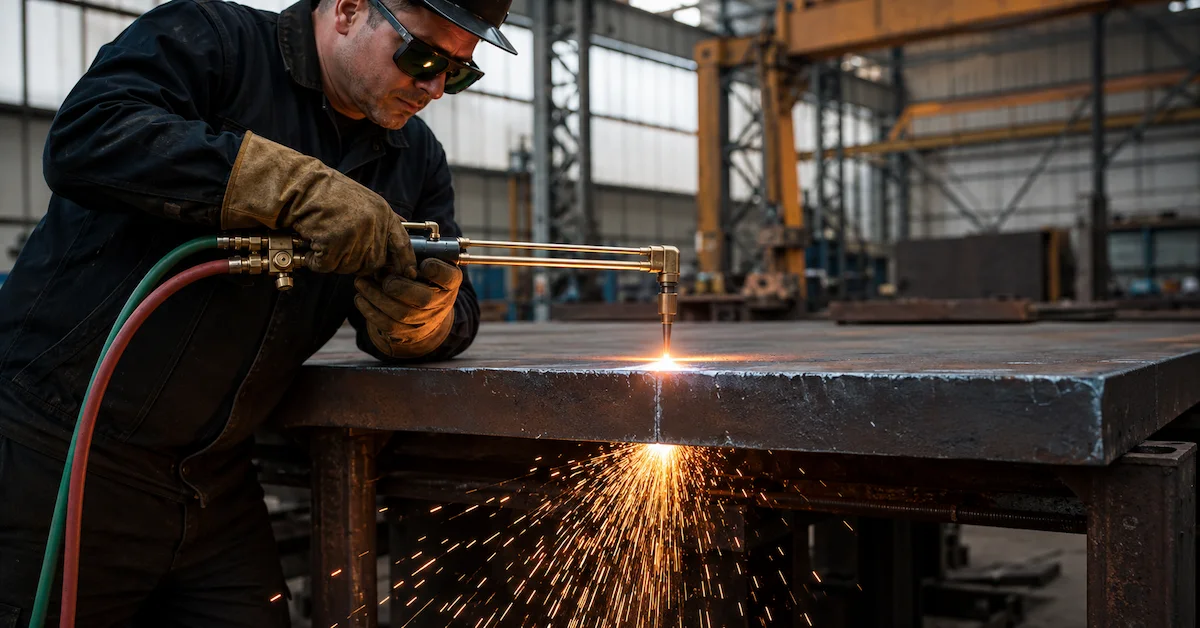


TL;DR: Choosing a reliable cutting nozzle supplier requires matching the nozzle to the fuel gas, cutting torch, steel thickness, and intended working conditions before comparing prices. Acetylene and propane cutting nozzles have different fuel-specific requirements, even when their published size ranges appear similar. UWELD offers acetylene models such as 1C001-0044 and 1C001-0049, propane model 1C001-0051, and propane/natural gas model 1C001-0030. For wholesale buyers, the most effective strategy is to verify compatibility, approve samples, establish batch inspection criteria, and calculate the complete cost of supply.
Industrial equipment distributors frequently face a difficult purchasing decision: should they stock acetylene cutting nozzles, propane cutting nozzles, or both?
The answer depends on their customers' fuel systems, compatible torch models, cutting applications, and inventory requirements.
A low-cost cutting tip can become an expensive sourcing mistake when its seating geometry does not match the customer's torch or its fuel-gas configuration is unsuitable.
This technical guide compares common oxy-fuel cutting nozzle configurations, examines published UWELD size specifications, explains supplier qualification requirements, and introduces a practical purchasing decision framework.
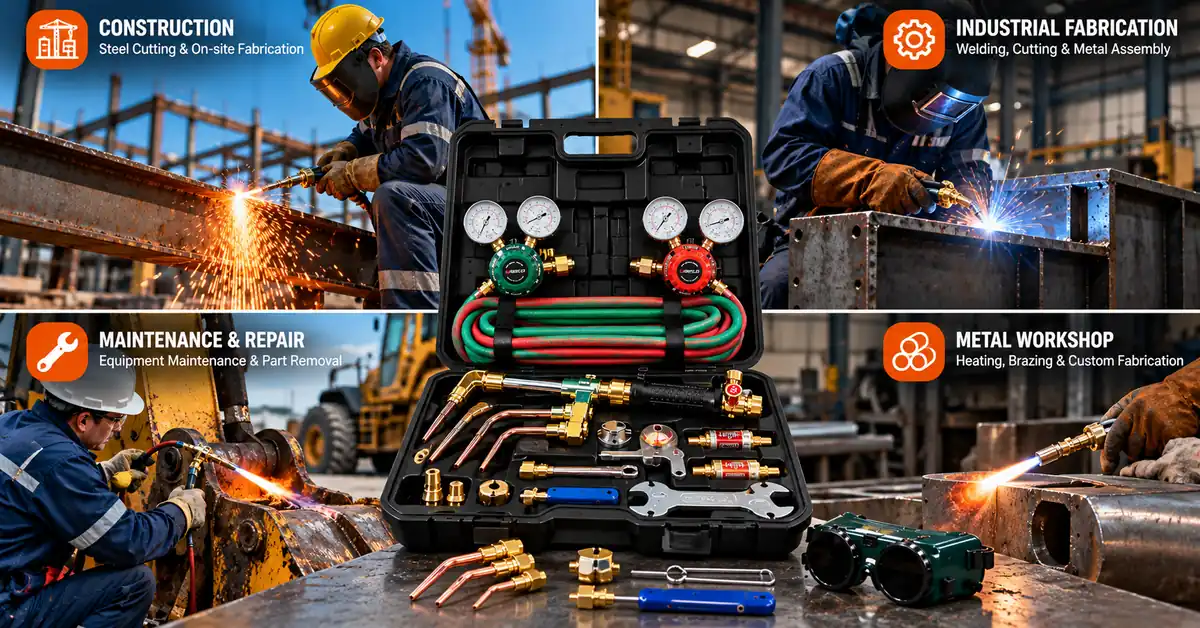
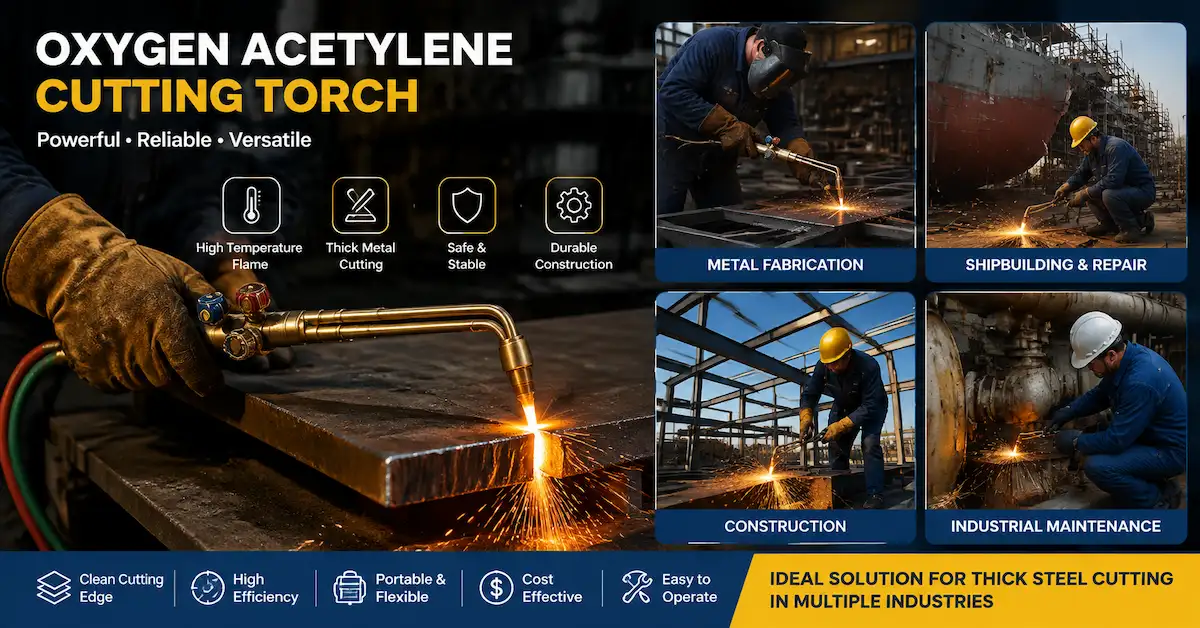
Explore UWELD Gas Cutting Equipment for cutting torches, nozzles, regulators, and related industrial accessories.
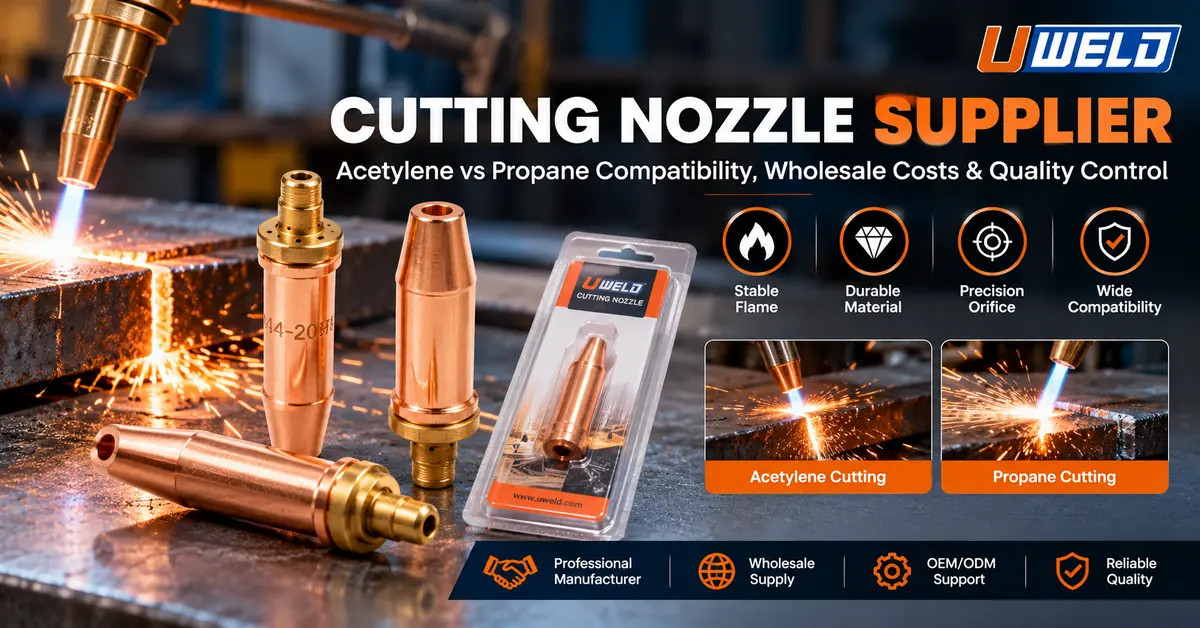
Key Takeaways: Acetylene vs Propane Cutting Nozzles
-
Choose acetylene-specific nozzles when the approved cutting system operates with oxygen and acetylene. Confirm the nozzle series, torch seating, and cutting-thickness range.
-
Choose propane-specific nozzles when the cutting equipment is approved for oxygen-propane operation. Do not substitute acetylene tips based on similar external dimensions.
-
Verify the nozzle family before selecting size. A nozzle marked with the same size number in two different series is not necessarily interchangeable.
-
Compare total supply costs rather than unit prices. Include inspection, freight, returns, replacement management, and inventory costs.
-
Prioritize controlled specifications for bulk orders. Material, orifice geometry, seating dimensions, and product identification should remain consistent across approved batches.
For distributors selling to mixed industrial markets, maintaining separate acetylene and propane product families may be more practical than trying to use one nozzle configuration for every customer.
How Do Acetylene and Propane Cutting Nozzles Compare?
The first purchasing decision is fuel compatibility.
Both acetylene and propane can be used in suitable oxy-fuel steel cutting applications, but their combustion characteristics and associated equipment requirements differ.
Technical Comparison Matrix
| Comparison Dimension | Acetylene Cutting Nozzle | Propane Cutting Nozzle | Recommended Selection Rule |
|---|---|---|---|
| Fuel gas | Oxygen-acetylene | Oxygen-propane | Match the approved fuel system |
| UWELD example | 1C001-0049 | 1C001-0051 | Confirm exact nozzle model |
| Preheating characteristics | Designed for acetylene combustion | Designed for propane combustion | Use fuel-specific nozzle geometry |
| Torch compatibility | Requires approved acetylene torch/nozzle arrangement | Requires approved propane torch/nozzle arrangement | Verify seating and connections |
| Cutting thickness | Depends on nozzle size and series | Depends on nozzle size and series | Follow model-specific cutting chart |
| Orifice geometry | Specific to the approved design | Specific to the approved design | Do not assume interchangeability |
| Operating economy | Depends on gas costs, consumption, and work conditions | Depends on gas costs, consumption, and work conditions | Compare actual operating costs |
| Inventory strategy | Stock for acetylene-system customers | Stock for propane-system customers | Segment by installed equipment |
Engineering conclusion: Neither nozzle type is universally superior. A technically compatible nozzle is the correct starting point; commercial comparisons should only be made after compatibility has been established.
How Does Fuel Gas Affect Cutting Performance?
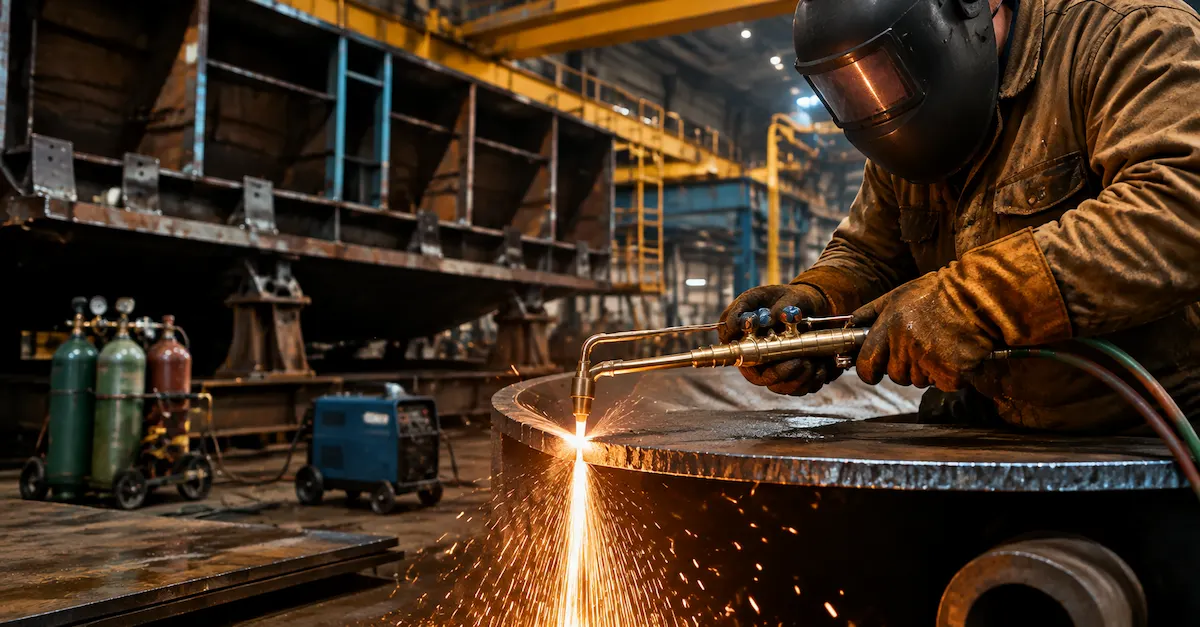
Oxy-fuel cutting requires two related processes: preheating and cutting.
First, a fuel-gas flame heats the steel to the required ignition condition. Next, a concentrated oxygen stream reacts with the hot iron and removes the resulting oxides from the cut.
The nozzle influences the preheating flame distribution and cutting oxygen delivery.
Acetylene Cutting Characteristics
Acetylene offers concentrated flame characteristics that are useful for suitable welding, cutting, and heating applications.
However, the cutting nozzle must be approved for the intended acetylene torch system.
UWELD's 1C001-0044 is a one-piece acetylene cutting tip designed for compatible oxy-acetylene cutting applications.
The 1C001-0049 series provides another acetylene-specific nozzle family.
Propane Cutting Characteristics
Propane has different preheating behavior, and an approved propane cutting system requires suitable nozzle and gas-control components.
UWELD's 1C001-0051 series is a propane cutting nozzle with a tapered-seat configuration.
For heavy-duty propane and natural gas applications, the 1C001-0030 SC50 series offers a different two-piece design.
These models serve different equipment arrangements and should not be treated as direct replacements without technical confirmation.
Why the Complete Gas System Matters
Nozzle performance depends on more than the tip itself.
The complete system includes the cutting torch, gas regulators, hoses, protective devices, oxygen supply, and approved fuel-gas source.
A correctly manufactured nozzle cannot compensate for an incompatible torch or unsuitable gas supply.
For purchasing managers, the first rule is to approve the complete equipment arrangement rather than evaluate the nozzle in isolation.
How Does Cutting Thickness Affect Nozzle Selection?
Steel thickness is a major factor in nozzle sizing.
Larger orifices and different nozzle geometries are associated with different cutting-capacity ranges, but the relationship must be interpreted using the manufacturer's specifications.
UWELD Published Size and Orifice Comparison
UWELD's 2023 product catalog includes the 1C001-0049 acetylene series and 1C001-0051 propane series with the following example specifications.
| Model Size | Published Cutting Thickness | Orifice Diameter | Acetylene Series | Propane Series |
|---|---|---|---|---|
| 6 | 1–6 mm | 0.6 mm | 1C001-0049 | 1C001-0051 |
| 12 | 12–20 mm | 1.2 mm | 1C001-0049 | 1C001-0051 |
| 15 | 25–75 mm | 1.5 mm | 1C001-0049 | 1C001-0051 |
| 24 | 150–200 mm | 2.4 mm | 1C001-0049 | 1C001-0051 |
Source: UWELD 2023 product catalog, Welding & Cutting Tip section, printed pages 73–74. These are historical catalog specifications, not independently measured performance results or current operating instructions. Buyers should verify the latest revision, torch compatibility, and approved operating conditions before ordering or using equipment.
The comparison highlights an important distinction: two fuel-specific nozzle families can have matching published size and orifice values without being interchangeable.
The nozzle's preheating passages, seating geometry, and approved torch configuration must also be considered.
Why Orifice Diameter Alone Is Not Enough
The cutting oxygen orifice helps determine the characteristics of the oxygen jet.
However, cutting performance also depends on oxygen delivery, the condition of the nozzle, workpiece material, and operating procedure.
Industrial buyers should never select a nozzle solely because its central opening has the desired diameter.
Instead, request a model-specific chart identifying the approved fuel gas, cutting range, nozzle family, and torch compatibility.
What Does This Mean for Wholesale Inventory?
For distributors serving general steel fabrication workshops, the correct inventory strategy is to stock nozzle sizes according to customer demand.
A distributor should not automatically purchase every size in a catalog.
Demand forecasting should consider common customer equipment, normal steel thicknesses, and historical replacement orders.
This approach helps reduce slow-moving inventory while maintaining availability for frequently used nozzle types.
When Should Torch Compatibility Determine the Purchasing Decision?
Fuel compatibility is essential, but torch seating can be equally decisive.
A nozzle may use the correct fuel gas yet still be unsuitable for a particular torch.
Nozzle Construction Comparison
| Feature | One-Piece Nozzle | Two-Piece Nozzle | Purchasing Consideration |
|---|---|---|---|
| Construction | Integrated nozzle body | Matched inner and outer components | Confirm complete configuration |
| UWELD example | 1C001-0044 | 1C001-0030 | Different nozzle families |
| Fuel service | Model-specific | Model-specific | Follow manufacturer approval |
| Replacement | Replace according to approved design | Identify correct matched components | Prevent component mismatch |
| Torch seating | Specific mating geometry | Specific mating geometry | Verify torch head |
| Inventory control | Single identified part | May require component-level tracking | Maintain accurate BOM |
What Should Buyers Verify?
Before approving a product, distributors should confirm the exact torch model, nozzle family, seat geometry, connection dimensions, fuel gas, and size.
A shared external diameter or similar appearance does not establish a correct fit.
UWELD's Cutting Torch Nozzle Selection Guide provides additional background on the importance of selecting nozzles for the intended gas cutting system.
How Do Manufacturing Accuracy and Material Quality Affect Cutting Results?
A cutting nozzle is a small but technically important component.
Its internal passages and seating surfaces must conform to the approved design.
Critical Manufacturing Features
| Feature | Technical Importance | Inspection Consideration |
|---|---|---|
| Cutting oxygen orifice | Influences oxygen jet characteristics | Diameter and geometry |
| Preheating passages | Influence flame distribution | Location, dimensions, condition |
| Seating surface | Establishes the intended torch interface | Geometry and finish |
| Material | Influences thermal and mechanical behavior | Approved alloy specification |
| Nozzle assembly | Important for multi-component designs | Correct matching |
| Surface condition | Can affect fit and serviceability | Damage, burrs, deformation |
Copper and copper-based materials are commonly used in cutting nozzle manufacturing because they provide useful thermal properties.
However, material quality alone does not guarantee superior performance.
Machining consistency, correct assembly, appropriate use, and maintenance also matter.
Why Batch Consistency Is Important
A sample nozzle may fit correctly, while a subsequent shipment could contain dimensional variations or substituted components.
For wholesale buyers, this creates a repeat-order risk.
The best approach is to approve a product drawing or specification, establish inspection criteria, and require documented approval before changes are introduced.
When Does a Lower-Cost Nozzle Become More Expensive?
The economic comparison between cutting nozzle suppliers should include more than the quoted unit price.
A low-cost nozzle may provide acceptable value when its specifications, compatibility, and manufacturing consistency satisfy the customer's needs.
However, incorrect products and quality problems can create additional expenses through returns, replacements, inspections, and production interruptions.
Total Cost of Supply
A useful purchasing calculation is:
Total Sourcing Cost = Purchase Cost + Freight + Inspection + Returns + Replacement Support + Inventory Carrying Cost
For industrial end users, downtime and rework costs may also matter.
Wholesale Cost Comparison
| Cost Factor | Lowest-Price Purchasing Approach | Specification-Controlled Purchasing Approach |
|---|---|---|
| Initial quotation | Focus on unit price | Compare equivalent approved products |
| Compatibility | May rely on catalog descriptions | Verify torch and fuel system |
| Sample approval | May be limited | Uses defined technical criteria |
| Inspection | May be reactive | Agreed before shipment |
| SKU management | Risk of similar product confusion | Controlled part numbers |
| Replacement support | Depends on supplier | Evaluated during sourcing |
| Long-term cost | Uncertain without data | Easier to measure and compare |
Neither purchasing strategy has a guaranteed cost advantage without actual order and service data.
How to Calculate a Break-Even Quantity
A useful method is to compare the initial cost of additional qualification with the expected savings per accepted nozzle.
[
Q=\frac{\text{Additional qualification cost}}{\text{Expected net savings per nozzle}}
]
Here, (Q) is the number of units needed to recover the additional qualification expenditure, provided the expected savings are positive and the cost assumptions are valid.
The model can include measurable differences in rejects, returns, inspection, and service.
There is no universal break-even quantity for cutting nozzles.
For example, a supplier with a slightly higher unit price may be more economical if verified data shows fewer compatibility returns or lower downstream handling costs.
Without that evidence, a percentage saving should not be claimed.
How Should Order Volume Change the Procurement Strategy?
The larger the intended purchasing program, the more important specification control becomes.
Procurement Volume and Risk Matrix
| Purchasing Stage | Recommended Focus | Main Objective |
|---|---|---|
| Technical sampling | Verify gas, torch, seat, size, and material | Establish product suitability |
| Pilot order | Test approved SKU and packing list | Confirm production consistency |
| Regular wholesale supply | Monitor quality and component revisions | Maintain repeatable deliveries |
| Large OEM program | Control labeling, drawings, packaging, and replacement references | Support long-term product consistency |
During Sample Qualification
Buyers should compare the proposed nozzle with the actual approved torch and fuel system.
Inspect dimensions and identification, and arrange qualified functional testing when required.
During Pilot Orders
The pilot order should confirm whether production units match the approved samples.
The supplier and buyer should agree on acceptable dimensional and visual criteria before shipment.
During Repeat Orders
Distributors should monitor compatibility complaints, return reasons, component changes, and SKU-level demand.
These records can support better future ordering and product range decisions.
How Can Buyers Choose a Cutting Nozzle Supplier in Three Steps?
A reliable supplier selection process should begin with technical suitability and end with commercial evaluation.
Step 1: Confirm Fuel and Torch Compatibility
Identify the intended gas system and exact torch model.
Record the approved nozzle family, size range, and mating geometry.
Decision: Exclude nozzles without verified compatibility.
Step 2: Compare Technical Specifications and Quality Evidence
Review current product drawings, material specifications, size charts, and sample inspection results.
For two-piece products, confirm the correct component combination.
Decision: Approve models that satisfy the required application and inspection criteria.
Step 3: Compare Total Cost and Supply Reliability
Evaluate prices, MOQ, packaging, delivery terms, replacement availability, and expected service costs.
Decision: Choose the configuration with the best verified balance of technical fit, consistent quality, and commercial value.
For available product families and related equipment, visit UWELD Gas Cutting Products.
Practical Procurement Scenario: Standardizing Nozzle Inventory for Industrial Distributors
Consider an industrial welding equipment distributor serving steel fabrication workshops, construction contractors, and maintenance businesses.
Some customers operate oxy-acetylene systems, while others use oxygen-propane equipment.
The distributor originally groups similar-looking cutting tips together and receives repeated questions about model compatibility.
This is an illustrative procurement scenario, not a documented UWELD customer project or a measured case study.
The Purchasing Challenge
The distributor needs to balance three requirements:
-
Carry suitable nozzles for different fuels.
-
Reduce unnecessary product overlap.
-
Maintain correct replacement-part identification.
Buying a large quantity of visually similar nozzles without exact compatibility records could create avoidable inventory and customer-service problems.
Engineering and Procurement Solution
1. Separate the product families.
The distributor creates different inventory groups for acetylene, propane, and approved propane/natural gas models.
2. Build a compatibility matrix.
Each SKU records the exact torch model, nozzle series, fuel gas, seating arrangement, and approved size.
3. Approve representative samples.
Sample verification includes dimensions, identification, fit, and relevant functional testing.
4. Establish reorder controls.
The distributor requires the supplier to maintain the approved product reference and notify it of proposed technical changes.
Expected Commercial Value
The approach can make product identification clearer, simplify repeat ordering, and reduce avoidable compatibility confusion.
Actual improvements in returns, inventory cost, or customer satisfaction would need to be measured from purchasing and service records.
The core lesson is that product-system compatibility should be standardized before optimizing purchasing volume.
What Quality Control Should a Cutting Nozzle Supplier Provide?
A professional supplier should be able to explain how product quality is controlled.
Relevant inspection stages may include incoming material verification, dimensional measurement, visual inspection, component identification, and suitable functional testing.
Recommended Quality Checklist
| Quality Check | Buyer Requirement |
|---|---|
| Incoming materials | Approved material specification |
| Nozzle identity | Exact model and size |
| Orifice dimensions | Conformance to approved drawing |
| Preheat passages | Correct geometry and condition |
| Seating surfaces | Verified fit requirements |
| Two-piece assembly | Correct matching components |
| Appearance | No unacceptable burrs or damage |
| Functional evaluation | Qualified test procedure where applicable |
| Packaging | Correct quantity and model identification |
| Traceability | Lot or order identification |
Relevant oxy-fuel welding and cutting standards and workplace requirements should be reviewed according to the product and market.
For example, ISO 5172 addresses applicable blowpipe equipment, while OSHA 29 CFR 1910.253 addresses oxygen-fuel welding and cutting workplace requirements in the United States.
These references should not be presented as proof that every cutting nozzle has an independent certification.
UWELD describes its broader engineering and manufacturing capabilities on its Solutions page.
OEM and Wholesale Cutting Nozzle Supply
Importers and private-label equipment brands may require customized product identification, packaging, and approved configurations.
UWELD supports wholesale and OEM/ODM inquiries for welding and cutting products.
A suitable OEM project should establish the nozzle specification before artwork, packing quantities, or commercial arrangements are finalized.
What Should Be Included in the RFQ?
| RFQ Field | Required Information |
|---|---|
| Product | Oxy-fuel cutting nozzle |
| Fuel type | Acetylene, propane, or natural gas |
| Preferred model | UWELD model reference |
| Torch | Exact compatible torch model |
| Seating | Approved nozzle seat and connection |
| Size | Required sizes and quantity by size |
| Material | Approved material specification |
| Cutting application | Material and thickness range |
| Quality | Drawings, inspections, sample requirements |
| Packaging | Bulk, distributor, or private-label |
| Volume | Trial order and expected regular demand |
| Destination | Country or region |
| Documentation | Technical specifications and applicable records |
MOQ, customization feasibility, and lead time must be confirmed for the selected products.
Buyers can review UWELD's FAQ information or submit a quotation request through the UWELD contact page.
Frequently Asked Questions About Cutting Nozzle Suppliers
1. What is the difference between acetylene and propane cutting nozzles?
They are designed for different fuel-gas systems and may use different preheating passages and torch arrangements. Buyers must verify the approved nozzle design for the intended fuel.
2. Can acetylene and propane nozzles have the same orifice diameter?
Yes. Some published UWELD nozzle families show corresponding size and orifice values. However, matching orifice diameters do not establish complete fuel-gas or torch compatibility.
3. Does a larger cutting nozzle always improve cutting speed?
No. A nozzle must match the specified material thickness, gas supply, and torch system. An unsuitable nozzle size may contribute to inefficient cutting conditions.
4. Which UWELD nozzle models are available for acetylene?
UWELD lists acetylene nozzle families including 1C001-0044 and 1C001-0049. Buyers should confirm the current configurations and compatible torch models.
5. Which UWELD nozzles are designed for propane?
Relevant models include 1C001-0051 and certain propane/natural gas families such as 1C001-0030. Compatibility depends on the specific torch and nozzle design.
6. How can a distributor verify nozzle quality?
Review approved specifications, inspect sample dimensions and seating geometry, confirm material and model identification, and request relevant inspection or test records.
7. How should wholesale buyers compare cutting nozzle costs?
Compare equivalent approved products and include freight, quality inspection, replacement support, inventory costs, and measurable return expenses—not just the unit price.
8. What causes repeated cutting nozzle compatibility complaints?
Common causes include incorrect fuel selection, wrong nozzle series, unsuitable seating geometry, inaccurate SKU information, and undocumented product substitutions.
9. Does UWELD offer OEM cutting nozzle supply?
UWELD supports OEM/ODM and wholesale inquiries. Available marking, packaging, product configurations, MOQ, and delivery requirements should be confirmed for the project.
10. What information is required for a cutting nozzle quotation?
Provide the fuel gas, torch model, nozzle family, size range, cutting application, technical requirements, expected quantity, destination market, and packaging requirements.
Conclusion
Selecting a reliable cutting nozzle supplier requires comparing technical compatibility, manufacturing quality, and total procurement cost rather than unit price alone.
Acetylene and propane cutting nozzles serve different approved gas systems. Even when published sizes and orifice diameters are similar, buyers must confirm the correct torch seating, nozzle family, and operating specifications.
For industrial distributors and OEM brands, a controlled product range can help improve replacement-part identification, support consistent repeat orders, and reduce avoidable sourcing risks.
UWELD supplies oxy-fuel cutting nozzle configurations alongside industrial cutting torches, regulators, protective accessories, and welding and cutting kits.
To evaluate suitable products for your customers, explore UWELD's Gas Cutting Equipment, review the UWELD Catalog, or contact UWELD for a wholesale quotation with your nozzle specifications and purchasing requirements.