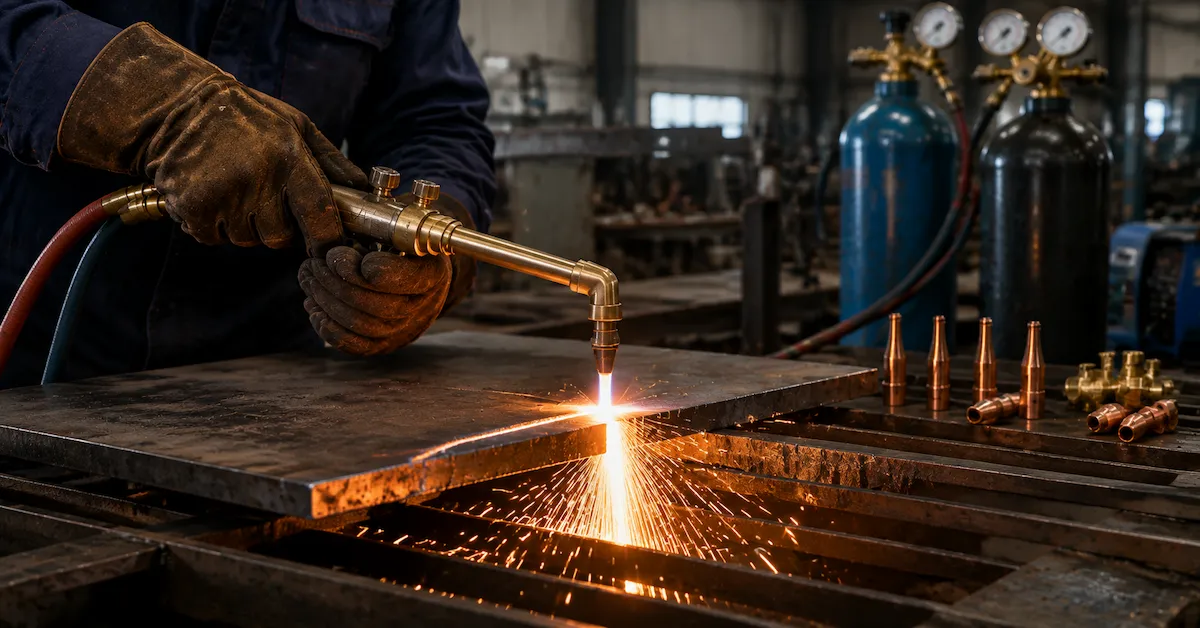


Quick Answer: A qualified OEM gas cutting torch manufacturer should help buyers convert application requirements into a repeatable, technically approved product. The process involves selecting a suitable cutting torch design, confirming oxygen and fuel-gas compatibility, checking nozzle and connection specifications, approving customized components, and establishing quality-control requirements before bulk production. UWELD supports OEM/ODM cooperation for industrial cutting equipment, including product branding, configuration reviews, engineering collaboration, and international wholesale supply.
For welding equipment brands, industrial importers, and professional tool distributors, developing a private-label cutting torch is more complex than printing a logo on an existing handle.
A cutting torch operates within a complete oxy-fuel system. Its performance and suitability depend on the torch head, mixing design, gas passages, valves, cutting nozzle, regulators, and connection interfaces.
Even small changes to these components may affect compatibility or require additional testing.
Without properly approved specifications, OEM buyers may experience inconsistent product batches, wrong-nozzle orders, unsuitable connections, and costly after-sales problems.
This guide explains how to evaluate OEM cutting torch projects, compare UWELD product platforms, control engineering changes, approve samples, and prepare a reliable bulk manufacturing program.
Explore UWELD's Gas Cutting product range for relevant cutting torches and accessories.
What Makes OEM Gas Cutting Torch Manufacturing Different?
Standard wholesale purchasing generally involves selecting an existing product configuration.
OEM manufacturing introduces additional requirements relating to branding, component selection, technical approval, and production consistency.
A successful project should establish which product features may be customized and which technical characteristics must remain controlled.
Standard Wholesale vs OEM Manufacturing
| Evaluation | Standard Wholesale | OEM / Private Label Manufacturing |
|---|---|---|
| Product design | Existing configuration | Approved standard or customized configuration |
| Branding | Manufacturer's brand | Buyer's brand or approved co-branding |
| Technical specifications | Published product specification | Project-specific approved specification |
| Packaging | Standard packaging | Custom labels, boxes, manuals, or kits |
| Sample approval | Product suitability verification | Technical and branding approval |
| Quality control | Standard inspection requirements | Agreed project-specific acceptance criteria |
| Repeat orders | Standard product SKU | Controlled OEM part number and revision |
| Main purchasing risk | Incorrect product selection | Unapproved component or design changes |
For industrial buyers, the main advantage of an OEM project is the ability to build a product range that matches a defined customer market.
However, customization should not be pursued without clear technical and commercial objectives.
Three Levels of OEM Cutting Torch Customization
Not every OEM project requires a completely redesigned torch.
The appropriate development level depends on the target market, requested changes, and technical feasibility.
Level 1: Private-Label Branding
This is generally the least complex customization route.
Potential changes include:
-
Logo marking.
-
Product labels and model identification.
-
Color packaging and printed materials.
-
Barcode and carton labeling.
-
Approved accessory packaging.
The cutting torch's functional configuration remains unchanged unless otherwise agreed.
This approach may be suitable for distributors introducing their own equipment brands.
Level 2: Application-Specific Configuration
Some buyers require an existing cutting torch to be supplied with different approved configurations.
Examples may include alternative torch lengths, head arrangements, nozzle combinations, hose connections, or kit accessories.
These changes require compatibility review and may involve different production or approval requirements.
For example, a construction equipment distributor may prioritize torch reach and handling, while a fabrication workshop supplier may emphasize compatible replacement nozzles and commonly used configurations.
Level 3: Engineering Development
A more advanced project may involve changes to functional components, such as the torch head, gas passages, valve structure, mixing arrangement, or connection design.
Such modifications require qualified engineering evaluation and appropriate testing.
The manufacturer and buyer should agree on drawings, technical responsibilities, verification criteria, and documentation before proceeding.
Customization Decision Matrix
| Customization Level | Typical Changes | Approval Requirements | Best-Fit Buyer |
|---|---|---|---|
| Private Label | Logo, labels, packaging | Artwork and product identification | Brand distributors |
| Configuration OEM | Approved connections, lengths, tips, kits | Compatibility review and sample approval | Industrial importers |
| Engineering ODM | Functional design or component changes | Engineering validation and applicable testing | Specialized equipment brands |
Purchasing recommendation: Start with an established product configuration whenever it already satisfies the intended application. Introduce additional engineering changes only when they deliver a clear benefit to the target customer.
Which UWELD Cutting Torch Models Can Serve as OEM Reference Platforms?
UWELD offers several industrial gas cutting torch configurations.
The following models provide useful reference points when discussing standard products, branding, or possible customization projects.
They should not be interpreted as confirmation that every dimension or component can be modified.
UWELD Cutting Torch Model Comparison
| UWELD Model | Published Product Features | Potential OEM Purchasing Direction |
|---|---|---|
| 1C005-0003 Heavy Duty Cutting Torch | Heavy-duty design, check-valve features, available handle variant | Industrial cutting torch branding and configuration evaluation |
| 1C005-0012 Straight Cutting Torch | Straight design, triangular stainless steel tubes, dual needle valves | Straight-style industrial cutting torch programs |
| 1C005-0001 Heavy Duty Straight Cutting Torch | 915 mm straight configuration for industrial oxy-fuel cutting | Longer-reach cutting applications |
The specific features and available variants must be confirmed against current UWELD product information.
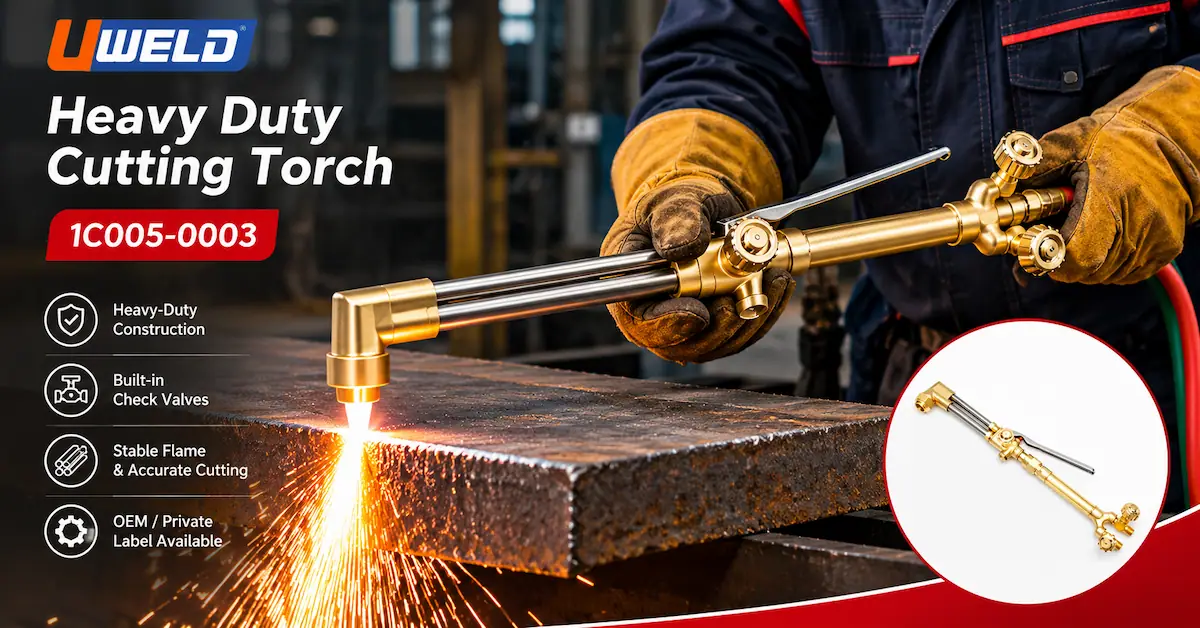
UWELD 1C005-0003 Heavy Duty Cutting Torch
The UWELD 1C005-0003 Heavy Duty Cutting Torch is particularly relevant to OEM sourcing discussions.
Its official listing identifies heavy-duty construction, check valves, and available customization options.
The product also has a separately listed handle variant.
For an OEM project, buyers should verify the complete torch assembly, intended fuel-gas configuration, compatible nozzles, connections, and included protective features.
Built-in check valves must not automatically be regarded as substitutes for all required flashback protection.
UWELD 1C005-0012 Straight Cutting Torch
The UWELD 1C005-0012 Straight Cutting Torch features triangular stainless steel gas tubes and dual needle valves.
Its straight configuration is relevant to professional oxy-fuel cutting applications.
OEM buyers should clarify the required torch length, head arrangement, nozzle series, and hose connections before discussing product variations.
UWELD 1C005-0001 Heavy Duty Straight Cutting Torch
The UWELD 1C005-0001 Straight Cutting Torch is described as a 915 mm heavy-duty cutting torch.
The current product listing states a cutting capability covering 1/8–5 inches of steel. That published range should be confirmed against the approved fuel, nozzle, and operating configuration before becoming an OEM product claim.
For distributors, this model may be worth evaluating when customer applications require a longer straight cutting torch.
Which Technical Specifications Must Be Approved Before Custom Manufacturing?
A reliable OEM development program should begin with a complete technical specification.
Describing a product only as a "heavy-duty cutting torch" is not sufficient.
The buyer and manufacturer need an agreed definition of the equipment configuration.
OEM Technical Specification Checklist
| Technical Parameter | Required Information | Why It Matters |
|---|---|---|
| Intended application | Fabrication, maintenance, construction, repair | Establishes product suitability |
| Workpiece material | Carbon steel and approved materials | Determines cutting-process suitability |
| Cutting requirement | Typical and maximum steel thickness | Guides equipment selection |
| Fuel gas | Acetylene, propane, or other approved gas | Determines gas-system requirements |
| Mixing arrangement | Approved torch mixing configuration | Influences technical compatibility |
| Torch head | Head type, geometry, required angle | Affects application and handling |
| Torch length | Approved overall dimensions | Affects reach and ergonomics |
| Cutting nozzle | Nozzle family, seat, gas compatibility | Prevents wrong-tip combinations |
| Connections | Thread, size, sealing design | Determines hose compatibility |
| Materials | Approved component specifications | Supports consistent construction |
| Valves and protective features | Required components and functions | Supports technical verification |
| Product identification | SKU, revision, brand markings | Enables traceability |
Why Gas Compatibility Must Be Confirmed First
Oxy-fuel cutting systems use oxygen with an approved fuel gas.
However, acetylene and propane systems may require different nozzle arrangements and gas-control components.
A cutting nozzle designed for one fuel should not automatically be substituted into another system.
For OEM product development, the approved nozzle and torch connection information should be included in the technical specification.
UWELD's Cutting Torch Nozzle Selection Guide provides related background for choosing compatible cutting accessories.
Connection Standards for International Markets
Different markets may use different hose fittings, regulator connections, and equipment configurations.
An OEM product should be specified for the intended destination market.
The purchasing team should verify the applicable technical standards and exact interface requirements before sample approval.
A mechanically similar connection does not necessarily establish safe gas-system compatibility.
How Does UWELD Support OEM Development From RFQ to Bulk Production?
UWELD describes engineering collaboration, customized manufacturing, and quality management as part of its OEM/ODM services.
For a professional purchasing project, these capabilities can be organized into a controlled development workflow.
The following six-stage process is a recommended OEM project model, rather than a guarantee that every project follows identical steps or timelines.
Stage 1: Requirement Review and RFQ
The buyer defines the target application, fuel gas, product requirements, destination market, estimated quantities, and branding needs.
The manufacturer reviews whether an existing product configuration can meet those requirements.
Key deliverable: Technical requirement sheet and preliminary configuration proposal.
Stage 2: Product Configuration and Engineering Review
The manufacturer and buyer identify the selected torch model and any requested changes.
Technical review should cover gas compatibility, nozzles, connections, materials, operating limits, and the intended use.
Any proposed modification to functional components should be evaluated before approval.
Key deliverable: Approved drawings, specifications, and preliminary bill of materials.
Stage 3: Prototype and Sample Approval
Representative samples are evaluated against the agreed technical and commercial requirements.
Buyers should verify component identity, assembly quality, compatibility, product labeling, and relevant functional requirements.
Testing involving pressurized gases should be performed by qualified personnel using approved procedures.
Key deliverable: Signed sample approval and identified reference configuration.
Stage 4: Packaging and Branding Approval
OEM branding is finalized after the technical product requirements have been established.
This may include logo placement, carton artwork, instruction materials, model labels, and packaging specifications.
Product markings must remain consistent with applicable identification and safety requirements.
Key deliverable: Approved branding files and packaging specification.
Stage 5: Pilot Production and Quality Verification
An initial production batch can help confirm that manufacturing output matches the approved sample.
The inspection plan should identify critical dimensions, component specifications, relevant functional checks, and packaging requirements.
Key deliverable: Pilot-order inspection records and approved production specification.
Stage 6: Bulk Production and Repeat-Order Control
Once the configuration is approved, the buyer and manufacturer establish production, inspection, shipment, and reorder requirements.
Any proposed component substitution or technical revision should be reviewed through an agreed change-control procedure.
Key deliverable: Controlled OEM SKU, approved revision, and repeat-order documentation.
For customized manufacturing discussions, explore UWELD's OEM and industrial solutions.
How Should Manufacturers Control Cutting Torch Quality?
Quality control should cover the components and processes that affect the torch's intended operation.
A visually attractive product is not necessarily a technically acceptable one.
For OEM buyers, the strongest evidence is a defined inspection plan supported by records for the actual product.
Manufacturing and Batch Inspection Matrix
| Inspection Stage | Critical Items | Recommended Evidence |
|---|---|---|
| Incoming components | Materials, valves, seals, fittings | Approved component specifications |
| Machining | Threads, mating surfaces, gas passages | Dimensional inspection records |
| Assembly | Correct components and configuration | Assembly inspection checklist |
| Gas integrity | Applicable leakage and sealing requirements | Qualified test results |
| Valve operation | Mechanical condition and required function | Functional inspection records |
| Nozzle compatibility | Approved tip and seating arrangement | Compatibility verification |
| Product marking | Correct OEM model and identification | Approved labels and artwork |
| Final inspection | Complete assembly and accessories | Final inspection report |
| Packaging | Carton, instructions, quantities | Approved packing list |
Why Valve and Gas-Passage Quality Matters
A cutting torch contains gas passages and control mechanisms designed for a specified application.
Manufacturing consistency is important for maintaining the intended component fit and function.
Relevant quality considerations include valve-seat condition, mating surfaces, thread dimensions, assembly integrity, and gas-path construction.
The exact acceptance criteria should be defined in product-specific drawings and test procedures.
Check Valves vs Flashback Arrestors
A check valve is intended to restrict reverse flow under its specified conditions.
A flashback arrestor is designed to prevent flame propagation under its rated conditions.
These are different protective functions, even when incorporated within a broader safety assembly.
For OEM products, buyers should confirm which devices are actually included and what additional protection is required for the intended gas system.
What About ISO and International Standards?
ISO 5172:2006, with applicable amendments, addresses specifications and testing for gas welding, heating, and cutting blowpipes. A revision is under development.
For U.S. workplaces, OSHA 29 CFR 1910.253 establishes requirements for oxygen-fuel gas welding and cutting equipment and its use.
UWELD states that it holds ISO 9001:2015 quality management system certification and references product-related international standards.
However, a quality management certificate does not automatically establish conformity for every individual torch configuration.
OEM buyers should request current model-specific documentation and verify the applicable destination-market requirements.
How Can OEM Buyers Prevent Repeat-Order Quality Problems?
A successful prototype does not guarantee that every future shipment will contain identical components.
Repeat-order inconsistencies may arise from undocumented changes to materials, valves, connections, nozzle interfaces, or packaging.
Common OEM Production Risks
| Risk | Possible Consequence | Recommended Control |
|---|---|---|
| Unapproved valve substitution | Different component characteristics | Controlled BOM and approval procedure |
| Changed nozzle connection | Replacement-tip incompatibility | Approved interface drawing |
| Different hose fitting | Regional installation problems | Connection specification verification |
| Material change | Unexpected product differences | Approved material requirements |
| Incorrect branding | Customer identification problems | Artwork and label approval |
| Incomplete accessories | Customer complaints and returns | Packing-list verification |
| Uncontrolled model revisions | Repeat-order inconsistency | Revision history and change notification |
Why Revision Control Matters
For a private-label distributor, the OEM product becomes part of its own brand portfolio.
Customers expect replacement components and repeat purchases to match the original approved configuration.
A useful system assigns each configuration a unique SKU and revision reference.
Changes should be documented before becoming part of regular production.
This improves traceability and helps buyers manage technical support more effectively.
How Do Customization and Order Volume Affect OEM Costs?
The cost of OEM manufacturing depends on the selected product platform and the scope of customization.
Branding an established product may involve fewer technical approval activities than redesigning functional components.
However, exact commercial terms depend on the project.
OEM Cost Comparison
| Cost Factor | Private Label | Configuration OEM | Engineering Development |
|---|---|---|---|
| Existing product platform | Usually retained | May be adapted | May require redesign |
| Artwork and packaging | Relevant | Relevant | Relevant |
| Component changes | Limited | Possible | More extensive |
| Engineering review | Depends on changes | Required where applicable | Significant |
| Prototype approval | Required for agreed scope | Required | Required |
| Testing requirements | Based on configuration | May increase | Potentially broader |
| Tooling investment | Project-dependent | Project-dependent | May be necessary |
| Development lead time | Project-dependent | Project-dependent | Generally more complex |
No universal MOQ, setup cost, or development period should be assumed.
Total OEM Sourcing Cost
A practical purchasing calculation is:
Total OEM Program Cost = Product Cost + Development and Tooling + Testing + Packaging + Inspection + Freight + Expected After-Sales Costs
For comparing alternative quotations, the buyer should use the same approved specification and order quantity.
A lower quoted unit price may not be economical if it excludes required accessories, inspection, tooling, or documentation.
MOQ and Lead Time
According to UWELD's FAQ page, minimum order quantities vary by product and customization requirements.
Stock items normally have a stated lead time of one to two weeks, while custom orders require separate confirmation.
For OEM projects, buyers should obtain written confirmation of sample approval timing, production schedules, packaging preparation, and delivery conditions.
Which Buyers Benefit Most From OEM Cutting Torch Manufacturing?
OEM cooperation is particularly relevant when the buyer needs a controlled product range for a defined market.
| Buyer Segment | Typical OEM Requirement | Primary Commercial Goal |
|---|---|---|
| Welding equipment brand | Private-label cutting torches | Brand differentiation |
| Industrial tool importer | Market-specific gas connections | Product compatibility |
| Welding equipment distributor | Approved torch and nozzle combinations | Repeat sales and after-sales support |
| Construction equipment supplier | Suitable torch configurations | Match contractor applications |
| Heavy fabrication equipment brand | Application-specific product requirements | Technical product positioning |
| Industrial maintenance supplier | Defined product kits and accessories | Simplified customer purchasing |
OEM manufacturing may be unnecessary when an existing standard product already meets the customer's needs and no meaningful branding or configuration requirement exists.
In that case, standard wholesale purchasing can be a simpler commercial route.
Practical OEM Scenario: Developing Cutting Torches for Two Export Markets
Consider an industrial equipment brand planning to sell gas cutting torches in two different markets.
One market primarily uses oxygen-acetylene systems. The second has customers operating approved oxygen-propane equipment.
The brand wants consistent packaging and product appearance across both markets.
This is an illustrative sourcing scenario, not a documented UWELD customer project.
The Engineering Challenge
The buyer initially considers using the same complete torch and nozzle configuration for both markets.
However, the technical review identifies fuel-specific nozzle requirements and different downstream equipment arrangements.
Using identical external packaging without clearly distinguishing the approved configurations could create customer confusion.
Recommended Development Approach
Step 1: Define separate technical configurations. Each market receives a product specification based on its actual fuel system and connection requirements.
Step 2: Approve compatible accessories. Cutting nozzles, hoses, regulators, and protective devices are identified for each configuration.
Step 3: Establish independent product references. Each OEM version receives its own SKU, approved BOM, and technical documentation.
Step 4: Standardize appropriate branding. Packaging can share a common visual identity while preserving the required product identification.
Step 5: Verify repeat production. Future orders are checked against the approved configuration and revision.
Expected Commercial Value
This process can reduce compatibility confusion, simplify product identification, and support more reliable replacement-part ordering.
Any improvement in warranty costs, returns, or sales performance would need to be measured using actual business records.
The central lesson is that technical compatibility should determine OEM configuration before branding decisions are finalized.
What Should Buyers Include in an OEM Gas Cutting Torch RFQ?
A complete request for quotation helps the manufacturer understand both technical and commercial requirements.
Recommended OEM RFQ Checklist
| RFQ Field | Information to Provide |
|---|---|
| Product category | OEM gas cutting torch |
| Target application | Fabrication, construction, repair, maintenance |
| Preferred model | UWELD model or required configuration |
| Fuel gas | Acetylene, propane, or other approved gas |
| Cutting requirement | Material and required thickness range |
| Torch design | Handle, head, length, required configuration |
| Nozzle compatibility | Approved nozzle family and sizes |
| Connections | Required thread and hose arrangements |
| Materials | Relevant component specifications |
| Protective features | Required devices and documentation |
| OEM branding | Logo, colors, labels, packaging |
| Quality requirements | Sample approval, inspection criteria |
| Market requirements | Destination countries and applicable standards |
| Order quantity | Samples, initial order, expected annual demand |
| Commercial terms | Delivery schedule, shipping and support expectations |
A detailed RFQ reduces quotation revisions and helps identify whether the project requires simple private labeling or engineering development.
Developing a custom cutting torch product line? Contact UWELD with your application, product drawings or reference models, fuel-gas requirements, target market, and projected order volume to request a technical evaluation and OEM quotation.
Frequently Asked Questions About OEM Gas Cutting Torch Manufacturers
1. What does an OEM gas cutting torch manufacturer do?
An OEM gas cutting torch manufacturer produces or develops cutting torch products for another company's brand or approved product program. Services may include product configuration, private-label branding, sample development, quality inspection, and bulk manufacturing.
2. Can UWELD customize gas cutting torches?
UWELD supports OEM/ODM inquiries involving branding, appearance, packaging, and feasible specification adjustments. The available options depend on the selected product and engineering review.
3. What is the difference between OEM and ODM cutting torch manufacturing?
OEM generally focuses on producing an approved product to the buyer's defined requirements. ODM may involve broader product design and engineering development. The actual scope should be agreed in the project specification.
4. Can one cutting torch configuration support acetylene and propane?
Some torch families offer approved configurations for different fuel gases. However, nozzles, gas-control equipment, connections, and other components must be verified for the intended fuel. Interchangeability should never be assumed.
5. Which UWELD models are suitable for OEM evaluation?
Relevant reference products include 1C005-0003, 1C005-0012, and 1C005-0001. Buyers should confirm current specifications and customization feasibility for each model.
6. What should be checked during cutting torch sample approval?
Important checks include product dimensions, materials, valve construction, nozzle fit, gas compatibility, connection accuracy, required functional tests, product identification, and packaging.
7. What standards apply to gas cutting torches?
ISO 5172 addresses relevant gas welding, heating, and cutting blowpipes. Other product and workplace requirements vary by country. Buyers should verify the applicable standard edition, test documents, and model-specific conformity.
8. Does OEM cutting torch customization require new tooling?
Not always. Private-label changes may not require functional tooling, while changes to the torch head, valves, gas passages, or other components may involve engineering development and additional tooling. Feasibility must be confirmed.
9. What is the minimum order quantity for OEM cutting torches?
UWELD states that MOQ varies by product and customization requirements. Buyers should request a quotation for their exact configuration and estimated volume.
10. How can I request an OEM cutting torch quotation from UWELD?
Provide the intended application, preferred torch model, fuel gas, connection requirements, target market, customization scope, expected order quantity, and documentation needs through the UWELD contact page.
Conclusion
Choosing a reliable OEM gas cutting torch manufacturer requires more than reviewing product appearance, factory claims, or unit prices.
For industrial distributors, equipment brands, and importers, a successful OEM project begins with a technically suitable cutting torch platform and continues through controlled customization, sample approval, quality verification, and repeat-order management.
The most important considerations are fuel-gas compatibility, cutting nozzle matching, connection specifications, component consistency, applicable safety requirements, and clear engineering change procedures.
UWELD supplies industrial gas cutting torches and related oxy-fuel equipment while supporting international OEM/ODM and private-label cooperation.
Buyers can evaluate the UWELD 1C005-0003 Heavy Duty Cutting Torch, explore UWELD's OEM manufacturing solutions, or contact UWELD to discuss custom configurations, samples, technical specifications, and wholesale purchasing requirements.