

Short answer: Arc welding machines are sold through four channels — industrial welding distributors, online B2B marketplaces, direct from the manufacturer, and used-equipment auctions. When you search for an arc welding machine supplier near me, what you are really choosing is how much local support, configuration choice and lead time you will trade against unit price. Proximity pays off when unplanned downtime is expensive; direct supply pays off when you need a specific electrical version, repeat volume or private-label packaging.
This guide compares those channels on the things that actually change a purchasing decision: lead time, technical support, documentation, spare parts and total landed cost. It also gives you the specification checklist and red flags to use before you send a deposit — whether the arc welding machine for sale you are looking at sits in a local showroom or on a manufacturer's quotation.
What Does "Near Me" Actually Change in an Arc Welding Machine Search?
A local search returns several different kinds of business under one heading: a stocking industrial distributor with a counter and a service bench, a regional dealer who resells but does not stock, a national catalog house with a warehouse address, and manufacturers who appear in local results because they ship nationally. They are not interchangeable, and the difference shows up after the machine arrives.
What proximity genuinely buys you is time and physical access: same-day or next-day collection, a demonstration unit you can strike an arc on, a service technician who can reach the site, and fast replenishment of consumables such as contact tips, nozzles, tungsten electrodes and liners. What proximity costs you is range. A local dealer carries the configurations that sell in that region, not the configuration your procedure requires, and the unit price usually carries the distributor margin.
The practical rule: buy locally when the cost of a stopped line or a stranded crew exceeds the price premium, and buy direct when the machine has to match a written specification, when you are ordering more than one unit, or when the machine will be branded and packaged for your own customers.
Where Are Arc Welding Machines Actually Sold?
Four channels cover almost every legitimate purchase. Before you decide where to buy an arc welding machine, accept that the table below is a sourcing framework, not a ranking — the right channel depends on your application and your tolerance for risk.
| Channel | Typical buyer | Lead-time pattern | Technical support | Price transparency | Best suited to |
|---|---|---|---|---|---|
| Industrial welding distributor | Workshops, maintenance teams, contractors | Stock item: days. Special order: weeks | Strong locally, limited to stocked brands | Published list price, negotiable at volume | Urgent replacement, on-site demo, local service |
| Online B2B marketplace | Small businesses, first-time buyers | Varies widely by seller | Usually messaging only | Low, but frequently incomplete | Price discovery and low-value accessories |
| Direct from manufacturer / OEM | Importers, distributors, private-label brands | Sample, approval and production stages | Engineering-level, by arrangement | Quotation-based, configuration-specific | Repeat volume, specific electrical version, branding |
| Used equipment and auction | Budget-constrained buyers, rebuilders | Immediate, as-inspected | None beyond the seller | Low, condition-dependent | Non-critical work where a failed unit is tolerable |
Industrial welding distributors
This is the default answer to "where can I find one near me," and for a single machine needed this week it is usually correct. A welding machine distributor earns the name by stocking the model, not by listing it. Ask three questions before you commit: is the exact model in stock or on backorder, does the quoted price include the leads, holder or torch and return clamp, and who performs warranty labour in your area. A distributor who cannot answer the third question is a reseller, not a support channel.
Online B2B marketplaces
Marketplaces are efficient for comparing headline specifications and for buying consumables. They are weak on the details that decide whether a machine is usable: the electrical version, the duty-cycle basis, the contents of the carton and the identity of the actual seller. Treat a marketplace listing as a lead, not as a specification. If the listing shows only a maximum amperage and a photograph, you do not yet have enough information to compare it with anything.
Direct from the manufacturer
Buying direct makes sense when the machine must match a written requirement, when you are ordering enough units that configuration control matters, or when the product will carry your own brand. An arc welding machine manufacturer can usually quote a configuration a reseller cannot, but the trade is time: you are now running a sample approval and a documentation review, not collecting a box. Expect to define the process, the input supply, the rated output, the accessory package and the destination market before a quotation means anything.
Used equipment and auction channels
Used arc welding machines can be excellent value in non-critical work and poor value anywhere else. Before bidding, ask for the nameplate photograph, the rated duty cycle at a stated current, whether the unit has been tested under load, and whether consumables and leads are included. A machine with no test record and no spare-parts availability is a project, not a purchase.
How Should You Compare Suppliers Beyond Unit Price?
Two quotations are only comparable once the technical scope and the delivery scope match. An arc welding equipment supplier quoting a bare machine and one quoting the same machine with a torch, return clamp and work lead are not offering comparable prices, even when the numbers look close. Build the comparison on total landed cost rather than the number at the top of the page:
machine price + required accessories + freight and import charges + inspection cost + budgeted spares and service
A cheaper machine that arrives without a return clamp, a torch or a work lead is not cheaper. Neither is one whose consumables you cannot restock locally. Use the same structure for every arc welding machine supplier on your shortlist and the decision becomes explainable to whoever signs the purchase order.
Which Specifications Make Two Quotes Comparable?
Send every arc welding machine supplier the same request. The table below is an RFQ checklist; it is not a specification claim for any particular model.
| Specification | What to request | Why it changes the decision |
|---|---|---|
| Welding process | Exact process or processes supported (for example stick/SMAW, MIG/MAG, TIG) | Prevents buying a single-process machine for multi-process work |
| Input power | Voltage, phase, frequency and rated input current | Confirms the machine can run on the supply you actually have |
| Rated output | Rated welding current and corresponding load voltage | Shows usable output, not just a peak figure |
| Duty cycle | Percentage, the current it applies to, and the test conditions | Separates a machine that welds continuously from one that does not |
| Electrode or wire range | Supported consumable sizes | Confirms your existing stock is usable |
| Connections | Output terminals, torch interface, remote-control socket | Prevents accessory mismatch on delivery |
| Cooling and protection | Cooling arrangement and documented protective functions | Defines the working conditions and limits |
| Supplied package | Leads, holder or torch, return clamp, plugs, case | Makes the two prices describe the same thing |
| Documentation | Manual, nameplate data, model-specific test documents | Gives you something to check the shipment against |
| Weight and dimensions | Current production version | Decides whether it is genuinely portable for your crew |
Read rated output together with duty cycle
Welding machine duty cycle is the share of a ten-minute reference period a machine can weld at a stated current before it needs to cool. A unit rated 200 A at 20% duty cycle welds for two minutes in every ten at that current; a unit rated 200 A at 60% welds for six. Those are very different machines with the same headline number, which is why a percentage quoted without its current and conditions tells you nothing.
Ask a second question that most buyers forget: what is the rating at the current your work actually uses? A machine that holds a high duty cycle at 120 A may be limited at 200 A. If your procedure sits at the top of the range all day, the lower-amperage rating is the one that will stop production.
Confirm the electrical version before you compare anything else
Voltage, phase and frequency can make an otherwise suitable machine unsellable in your market. This matters most for importers and multi-site buyers: two units that look identical can carry different input configurations, different plugs and different manuals. Give each electrical version its own model or inventory reference so that a repeat order cannot silently substitute one for the other.
Also resist the assumption that a compact machine will run from any generator or temporary supply. "Portable" describes how the unit is carried, not what it can be connected to. If generator operation is part of the plan, ask for the manufacturer's documented input requirements for that use.
What Documents Should a Reputable Supplier Provide?
For industrial and professional arc welding power sources, IEC 60974-1:2021, Arc welding equipment — Part 1: Welding power sources is the reference most buyers use when discussing safety and performance requirements. Citing it is not the same as proving a specific machine has been evaluated against it. Ask which standards and editions apply to the exact model and destination market, then ask for the documents that show it.
In the United States, OSHA 29 CFR 1910 Subpart Q sets workplace requirements for arc welding and cutting, including 1910.254. Those obligations sit with the employer, not the machine supplier, but a supplier who understands them can tell you what installation and operating information the manual must contain.
Keep three categories of paper separate, because buyers routinely confuse them:
- Company quality-system certificates — evidence about the factory's management system, not about the machine.
- Model-level product evidence — test reports or certificates naming the exact model and electrical version.
- Shipment records — inspection reports, packing lists and nameplate data for the units you received.
Check that the model designation, electrical version and any private-label name are consistent across all three. A certificate for a torch or a gas regulator does not establish anything about an electrical welding power source.
What Are the Red Flags in a "Supplier Near Me" Listing?
Most bad purchases are visible before the deposit. A competent arc welding machine supplier can answer these points without prompting; a listing that cannot is telling you something. Watch for these:
- No model number, and no nameplate or terminal-panel photograph.
- A duty-cycle figure with no current and no test conditions attached.
- Marketing built entirely on maximum amperage.
- No physical address, no service point and no named contact — only a web form.
- No spare-parts list, or a parts list with no ordering references.
- A price far below the market with no package list explaining what is excluded.
- Refusal to provide a sample, an inspection report or a test record.
- Inability to say which standards apply to the model and market being quoted.
- Vague answers about who performs warranty labour and who pays the freight.
One red flag may be a gap in a small supplier's paperwork. Three together describe a supply chain you will be managing yourself, without the authority to fix it.
Which Accessories Should Ship With the Machine?
An arc welding machine supplier is not selling a power source in isolation, and accessory compatibility deserves its own line on the purchase order rather than a vague "complete kit." In our own range, the items that most often appear alongside a machine purchase are these:
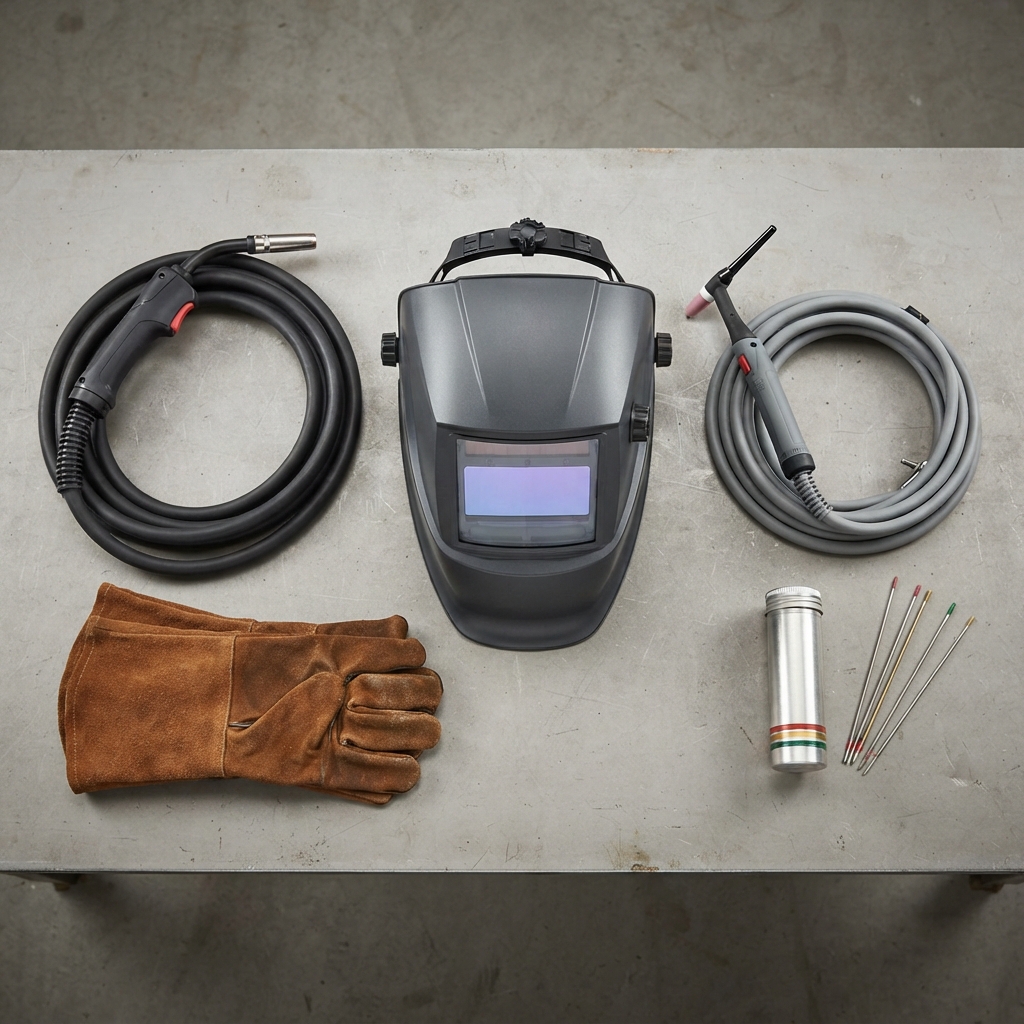
- 15AK MIG welding torch — 150 A rated output, air-cooled, described as optimised for MIG200 machines and suitable for steel and aluminium.
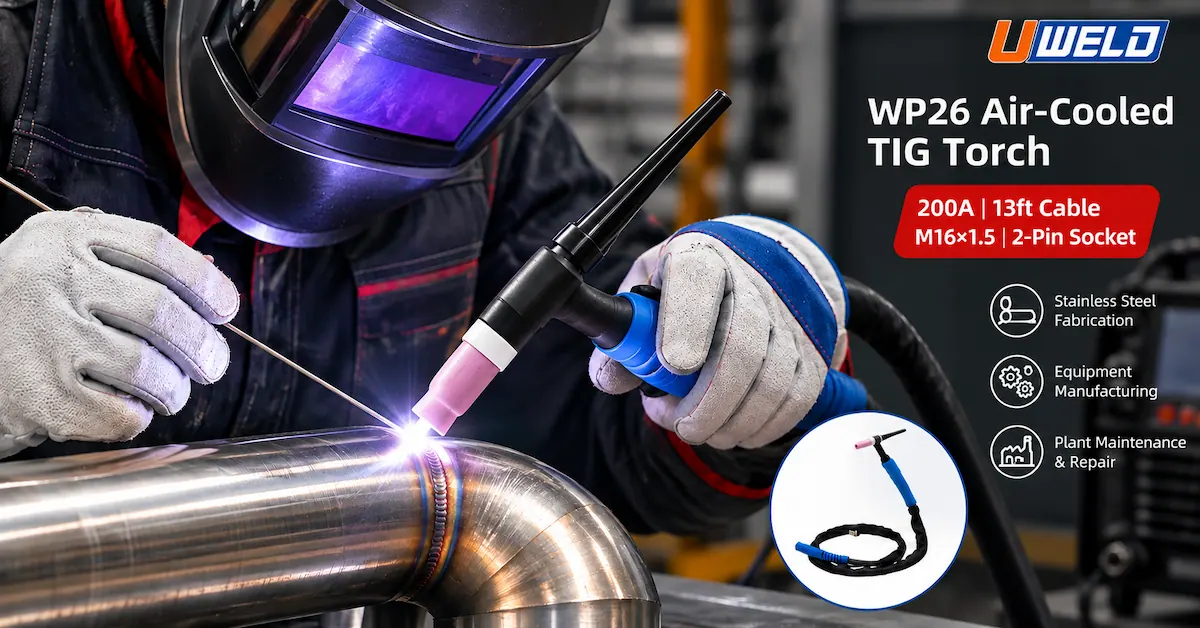
- WP26 air-cooled TIG torch — 200 A rated, 13 ft cable, M16×1.5 connector and 2-pin socket.
- WP18 water-cooled TIG torch — 350 A rated, 13.1 ft cable with a denim protective cover and ergonomic handle, intended for high-duty welding.
- True Color auto darkening welding helmet — 3/10000 s switching speed, 2 arc sensors, DIN 4/9-13 shade range and solar charging.
- Tungsten electrode sharpener — 4 sizes and 3 angles (15°, 22.5° and 32°) across a 1.0–4.0 mm tungsten range, with a CNC aluminium body and dust cover.
- Tungsten electrode storage container — 3-pack in green, red and blue with a 3-bay divider and magnetic base.
Two cautions. First, appearing in the same catalogue is not a compatibility statement: confirm the machine interface, cable length and current rating against the machine you are buying. Second, list every included item as a separate line with its part number, so that a later repeat order can be checked against the approved package instead of a memory of it.
How Do You Write an RFQ That Gets a Useful Answer?
A short, specific request gets a specific quotation. Include the welding process, material type and thickness range, joint and position requirements, available input supply, expected working pattern, required accessories, destination market, quantity and any branding or documentation needs. Add the model you are considering, if you have one, and ask the supplier to confirm the current electrical and performance specification rather than restating the catalogue.
If you are comparing a distributor, a marketplace seller and a manufacturer at the same time, send all three the same document. The arc welding machine supplier who answers the difficult fields — duty-cycle basis, package contents, warranty labour, spare-parts references — is telling you something about how the relationship will run after the invoice is paid.
What Mistakes Do Buyers Make Most Often?
- Comparing maximum amperage. It is the easiest number to advertise and the least useful one on its own.
- Assuming portable means generator-ready. Handling weight and input compatibility are unrelated questions.
- Approving a sample without recording it. A sample has no supply-chain value if you cannot later identify the version you approved.
- Ordering the machine and not the consumables. A machine that stops for a missing contact tip has the same downtime as a broken one.
- Ignoring freight, duty and inspection. These can move the ranking of two quotations.
- Choosing an arc welding machine supplier on price alone. The cheapest quote is often the one with the least support behind it.
If you want a deeper technical treatment of specification verification and repeat-order control, our welding machine supplier approval guide and our inverter welding machine supplier guide cover those steps in detail.
Frequently Asked Questions
1. Where can I find arc welding machine suppliers near me?
Start with a local industrial welding distributor if you need the machine this week and want on-site service. Look for distributors who publish a physical address, a service bench and a stocked consumables range, then confirm the exact model and what the carton contains. If the configuration you need is not stocked, a manufacturer quotation will usually be more precise than a special order through a reseller.
2. How much is an arc welding machine?
Price is driven by process capability, rated output and duty cycle, the electrical version, the accessory package and the documentation supplied — which is why a single figure is not meaningful without a specification. Compare total landed cost instead: machine, required accessories, freight, import charges, inspection and budgeted spares.
3. Is it better to buy from a local distributor or directly from a manufacturer?
Buy locally for speed, demonstration and service access. Buy direct when the machine must match a written specification, when you are ordering multiple units, or when the product will carry your own brand and packaging. Many buyers use both: a local distributor for urgent replacement, a manufacturer for planned and repeat volume.
4. What is welding machine duty cycle and why does it matter?
Duty cycle is the share of a ten-minute reference period a machine can weld at a stated current. A 200 A machine at 20% duty cycle welds two minutes in ten at that current; at 60% it welds six. Always ask for the percentage together with the current and the conditions it applies to.
5. What documents should I request from an arc welding machine supplier?
Ask for the manual, nameplate data, the model-specific test or inspection documents, and a statement of which standards and editions apply to the electrical version and destination market. Keep company quality-system certificates separate from model-level product evidence.
6. Can I buy a single unit directly from a manufacturer?
It depends on the manufacturer and the model. Single-unit supply is often possible for standard configurations, while custom electrical versions, branding and packaging normally involve a sample approval and a minimum quantity. Ask specifically about the model and configuration you need rather than assuming either way.
7. What accessories do I need with the machine?
At minimum, the welding leads or torch, the electrode holder or return clamp, and the correct plugs for your supply. Then add the consumables your process wears: contact tips and nozzles for MIG, tungsten electrodes and a sharpener for TIG, and appropriate eye and face protection. Confirm each item's compatibility with the machine interface rather than assuming it from the catalogue.
8. How do I check a used arc welding machine before buying?
Ask for a nameplate photograph, the rated duty cycle at a stated current, a load test record, and confirmation that leads and consumables are included. Check that spare parts are still available for the model. If there is no test record and no parts support, price the machine as a rebuild project.
9. Does a CE mark or an ISO certificate prove the machine complies?
No. An ISO 9001 certificate describes a quality-management system, not a product. A CE mark is a manufacturer's declaration against applicable directives, and the supporting technical file is what you would review. Check that any document you are shown names the exact model and electrical version you are buying.
10. How long does delivery take?
Stocked distributor items are typically measured in days, while special orders and direct manufacturing run through sample preparation, technical approval, production and inspection stages. Ask what starts the lead-time clock and whether approval delays move the shipment date, and get the answer for your exact configuration rather than a general figure.
Conclusion
Finding an arc welding machine supplier near you is the easy part; the work is deciding which channel fits the risk you are carrying. Use a local distributor when downtime is the constraint, use a marketplace only for price discovery, and use a manufacturer when the machine has to match a written specification or a repeat order. In every case, compare rated output with duty cycle, confirm the electrical version, list the accessory package line by line, and keep model-level documents separate from company certificates.
If you are building an arc welding package and need the torch, helmet, tungsten preparation and storage items specified alongside the machine, you can send your process, input supply and accessory requirements through our contact page. Our team works with distributors, importers and private-label buyers, and the welding product range is the place to start the accessory list.