

What Should a Welding Machine Supplier Prove Before You Order?
A welding machine supplier should be able to connect your application to an exact equipment configuration: the welding process, available power supply, rated output, duty cycle, accessories and service requirements. Start with those details before comparing prices. For an importer or distributor, the approval should also cover what arrives in the carton and how the same specification will be maintained on future orders. Approve a defined machine package, not a product photograph or a maximum-amperage claim. A useful purchasing decision leaves a clear record of the selected model, its operating limits, the supplied accessories and the evidence used to approve it.
Start With the Work, Not the Machine Name
Define the Welding Application
Give the supplier the material, thickness range, joint type, welding position and expected workload. Then identify the required process, such as stick welding, MIG/MAG or TIG, rather than assuming that “inverter” describes everything the machine can do. Ask which functions are standard, which require additional equipment and which are unavailable. A maintenance team making occasional repairs and a fabrication workshop producing repeated joints should not receive identical recommendations without an explanation. This article focuses on evaluating conventional arc-welding equipment for procurement; robotic cells, laser systems and specialized production installations need a separate technical specification.
Describe the Workplace and Electrical Supply
State the available input voltage, phase and frequency, together with whether the machine will remain in a workshop or move between sites. Ask for the rated input requirements and the manufacturer’s installation instructions. For generator use, request explicit compatibility information rather than assuming that a portable machine is suitable for any generator. Include the expected ambient conditions, exposure to dust and available working space in the inquiry. These details give the supplier something concrete to assess and let the buyer’s qualified electrical personnel review the proposed installation before the order is finalized.
What UWELD Lists: Separate Welding Machines From Welding Torches
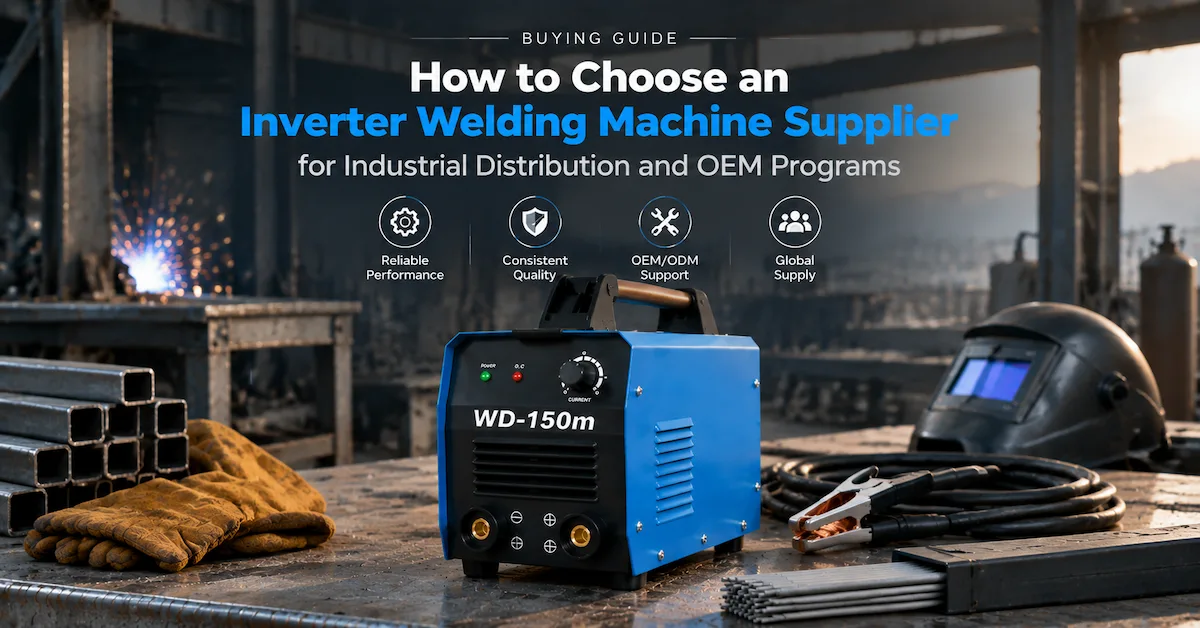
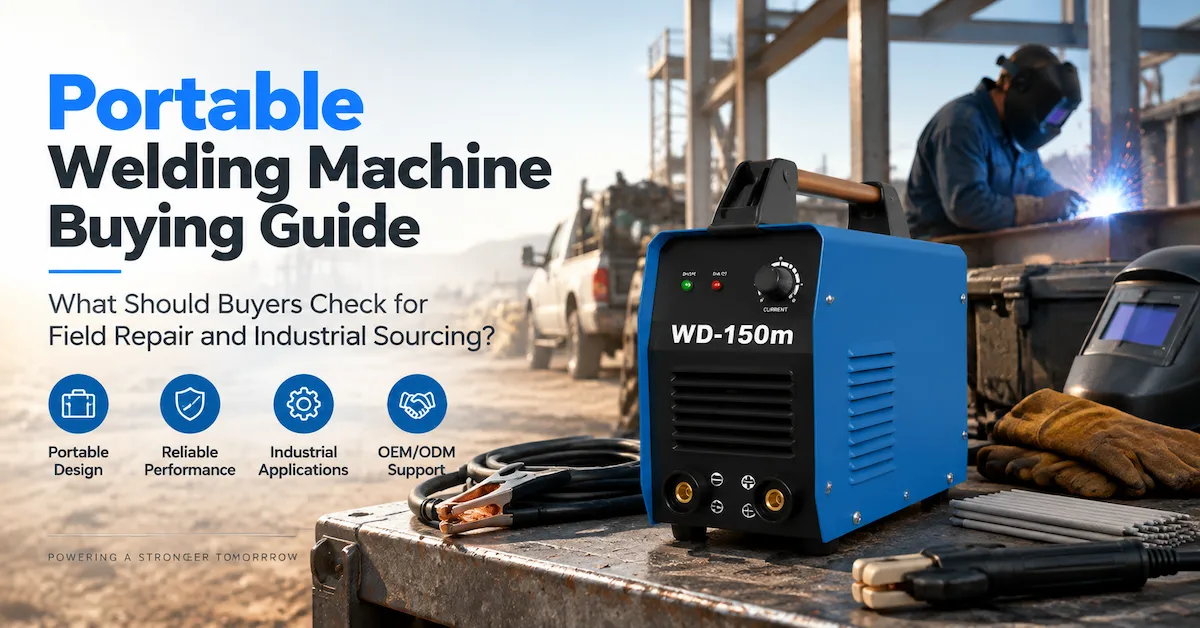
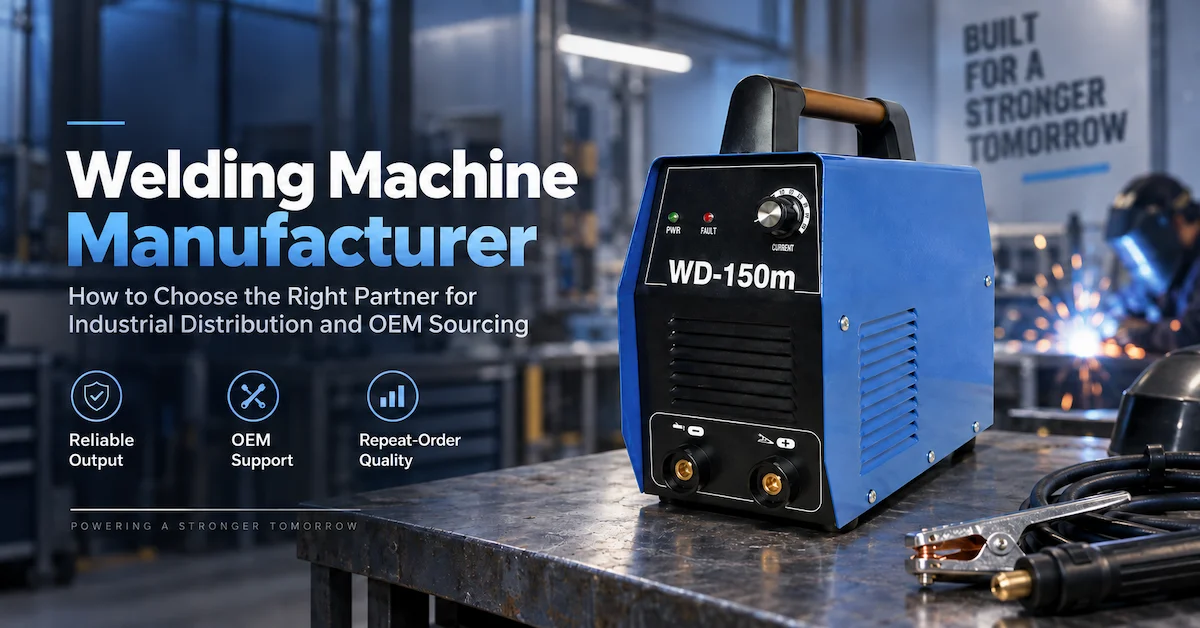
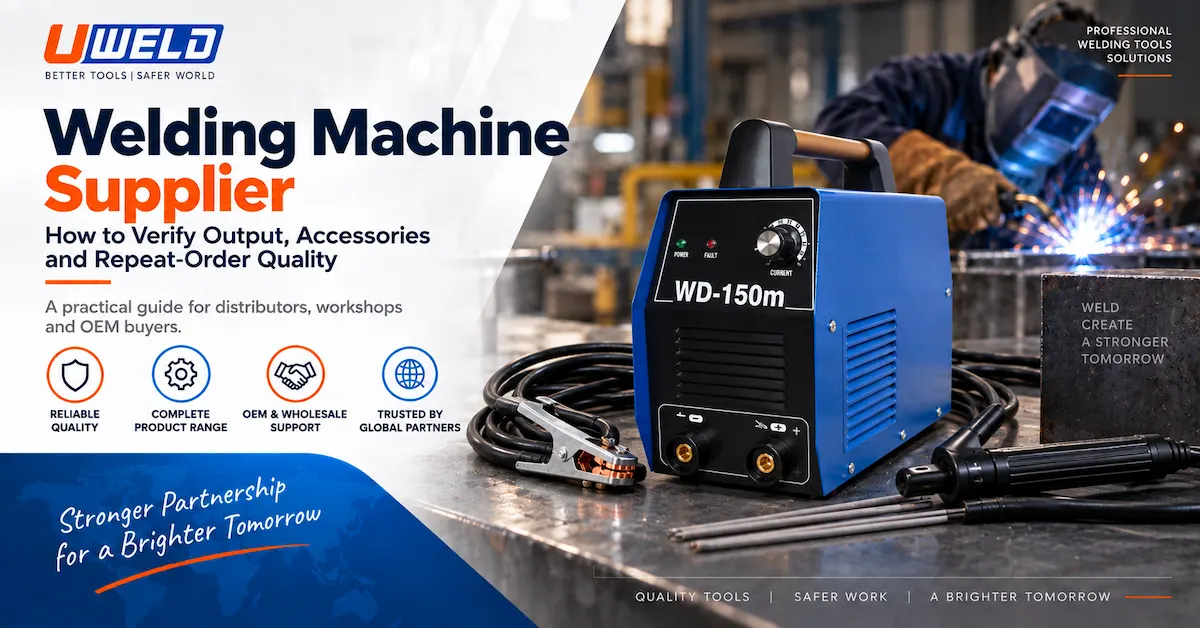
UWELD lists the WD-150m Welding Machine, product code 2W001-0001, alongside a broader welding range that includes MIG and TIG torches. Its public product description presents the WD-150m as a compact, portable inverter machine. Buyers can use the WD-150m product page as a starting point, then request the current specification and supplied-equipment list. The public listing should not be used to infer unlisted welding modes, input-voltage options or duty-cycle ratings.
The distinction between a power source and a torch is important when reviewing the catalog. UWELD’s 15AK and WP18 entries are welding torches, not alternative welding-machine models. The following comparison identifies their different roles; it does not establish that either torch is compatible with the WD-150m.
| Product Reference | Equipment Role | What the Published Information Establishes | What to Confirm Before Ordering |
|---|---|---|---|
| WD-150m / 2W001-0001 | Welding machine | Listed as a compact, portable inverter machine | Supported process, input requirements, rated output, duty cycle and included accessories |
| 15AK MIG welding torch | MIG welding torch | Published information identifies gas cooling and a Euro-style connection | Machine interface, wire range, cable length and applicable torch rating |
| WP18 water-cooled TIG torch | TIG welding torch | Listed as a water-cooled torch | Power connection, control interface, cooling requirements and current specification |
Technical Specifications to Request From a Welding Machine Supplier
Use one specification sheet for every supplier being considered. This makes missing information visible and prevents unlike configurations from being treated as equivalent quotations. The table below is an RFQ checklist, not a specification claim for the WD-150m or any other UWELD model.
| Specification | Information to Request | Buyer’s Decision |
|---|---|---|
| Welding process | Supported processes and the equipment required for each | Does the machine support the intended work? |
| Input power | Voltage, phase, frequency and rated input requirements | Can the planned installation support it? |
| Output range | Rated current and voltage information for the relevant process | Does the documented operating range match the application? |
| Duty cycle | Current, load voltage, percentage, reference period and test conditions | Can the equipment support the expected working pattern? |
| Consumable range | Supported electrode or wire specifications | Can the customer use the planned consumables? |
| Connections | Output connectors, torch interface and any remote-control connections | Will the selected equipment connect correctly? |
| Cooling and protection | Cooling arrangement, operating limits and documented protective functions | What conditions and restrictions apply? |
| Supplied package | Leads, holder or torch, return clamp, plugs and other included items | What must be purchased separately? |
| Physical requirements | Weight, dimensions and handling provisions | Is the package practical for the workplace? |
| Documentation | Manual, nameplate information and model-specific supporting documents | Is there enough evidence to approve the ordered version? |
Read Rated Output Together With Duty Cycle
A large current figure can be attractive on a carton, but it needs context. Miller Electric’s Buying Your First Welder: A Practical, Informative Guide explains welding-power-source duty cycle using a ten-minute reference period. When comparing equipment, obtain the rated current, corresponding load voltage and stated test conditions together. A percentage without those conditions is an incomplete comparison.
Consider a hypothetical example, not UWELD product data: two machines are advertised at 200 A, but one is rated at 20% duty cycle and the other at 60%, both under the same relevant conditions and ten-minute reference period. Those ratings represent two minutes and six minutes of welding respectively within that period, followed by the required cooling intervals. They are not equivalent output claims. Ask the supplier for performance at the current your application needs, not merely the highest setting. A brief sample demonstration cannot replace the documented duty rating.
Match Accessories Before Approving the Machine Package
Accessory compatibility deserves its own check. For a MIG package, request confirmation of the torch connection, wire size, liner, contact tip, cable length and rating under the intended conditions. For TIG, confirm the power connection, control interface, gas arrangement and any cooling requirements. UWELD’s published 15AK product graphic, for example, lists a 0.6–1.0 mm wire range and cable-length options of 3 m, 4 m and 5 m. That is useful ordering information, but the selected version still needs to match the machine and application.
Build a separate line item for each included accessory rather than approving a vague “complete kit.” The UWELD welding product range provides a starting point for discussing machines and related tools, but their presence in one catalog is not a compatibility statement. Record what is supplied, what is optional and which replacement part numbers belong to the approved package.
Inspect Materials and Assembly Beyond the Outer Case
For a sample review, ask for the specified lead lengths, conductor cross-sections and materials, connector details, cable insulation and strain-relief arrangements. Examine accessible handles, controls, terminals and enclosure fit without opening energized equipment. For an inverter welding machine supplier, a useful manufacturing discussion also asks how purchased components, assembly revisions and finished-unit checks are controlled. Request evidence of the actual procedure rather than supplying the answer yourself. A polished enclosure does not tell the buyer which internal components are fitted, and this guide does not assume that UWELD uses a particular circuit design, component brand or electrical test sequence.
Check Documents Against the Exact Machine and Market
For industrial and professional welding power sources, IEC 60974-1:2021, Arc welding equipment—Part 1: Welding power sources, provides a technical reference for safety and performance requirements. Referencing that standard is not the same as establishing that a particular machine has been evaluated against it. Ask which standards, editions and destination-market requirements apply to the ordered configuration, then request the relevant documents. Keep the manufacturer’s identity, model designation, electrical version and any private-label designation consistent across the purchase file.
UWELD’s guide to checking welding-equipment certification makes a useful distinction between company quality-system documents, product evidence and inspection records. Apply that distinction to machine purchasing: a certificate for a gas regulator or torch does not establish compliance of an electrical welding power source. Review the model list, scope, issuing organization and applicable limitations rather than counting certificate logos.
Use Sample Approval to Answer Specific Questions
Check the Delivered Configuration
Compare the sample against the quotation before arranging a welding trial. Record the model and version, nameplate, supplied leads, connectors, accessories, instructions and packaging. Note every difference, including apparently minor substitutions. The purpose is to establish what has actually been delivered. Ask the welding machine supplier to resolve discrepancies in writing before the sample becomes the reference for bulk production.
Run an Application-Based Evaluation
Have qualified personnel assess the sample using the manufacturer’s instructions and a documented test plan suited to the intended work. Specify the material, joint, consumable, settings and acceptance criteria in advance. Record the relevant input conditions and observations so a second sample can be evaluated on the same basis. Do not turn an informal trial into an unsupported claim about maximum output, service life or certification.
Approve the Records With the Sample
Keep photographs, the final specification, package list and evaluation results together. Identify the approved production version and agree how changes will be reviewed. A sample is useful only if the later shipment can be checked against it. For repeat orders, require notification of proposed changes to electrical configuration, important components, accessories or product identification rather than relying on the original appearance alone.
Make After-Sales Support Part of Supplier Selection
Ask a welding machine supplier what happens after the equipment reaches your customer. Obtain the written warranty terms, exclusions, reporting procedure, diagnostic requirements and available remedies. Clarify who pays for transport, whether local repair is supported and which work requires authorized service personnel. Separately, request a replacement-parts list with ordering references and availability information. These are matters to confirm in the commercial agreement, not benefits to assume from the presence of a support telephone number. A distributor should know how to identify the correct replacement lead or control component without having to reconstruct the original order.
Compare the Cost of a Complete, Approved Package
Compare quotations after the technical specification and delivery scope are aligned. One price may include a holder, return lead, torch or carrying case that another excludes. Freight, inspection, documentation, packaging and agreed support arrangements should also be visible. For internal evaluation, use a simple structure: equipment price + required accessories + freight and import costs + inspection costs + budgeted support costs. The figures will vary by order and market; no universal saving percentage is appropriate. This approach helps a buyer explain why one quotation is preferable without treating the lowest component price as the whole purchasing decision.
Wholesale and OEM Orders: Confirm Scope Before Artwork
UWELD’s partnership program presents two cooperation routes: UWELD brand distribution and custom/OEM manufacturing. Its stated audiences include importers, distributors, wholesalers, brands and specialized dealers. Those routes provide a basis for a commercial discussion, but the feasible customization scope must still be confirmed for the particular welding-machine model. General OEM capability should not be interpreted as proof that any requested electrical redesign, process addition or regional variant is available.
For a private-label project, approve the technical configuration first. Then confirm the permitted branding, product designation, manual language, packaging, supplied accessories and documentation responsibilities. Treat an electrical or control-system change differently from a carton-artwork change: ask the responsible technical team what further evaluation and document updates are needed. Before printing, make sure the claims on the box describe the approved machine rather than a desired future specification.
Ask for Model-Specific Capacity, MOQ and Lead Time
A welding machine supplier’s overall production statement is not a delivery commitment for your order. Request available capacity and scheduling information for the exact model, electrical version and package. Separate sample preparation, technical approval, artwork approval, production, inspection and shipment readiness in the schedule. Ask what starts the lead-time clock and what happens if approval is delayed. UWELD’s public partnership information describes tailored cooperation terms; it does not establish a universal welding-machine MOQ or production lead time. Those details belong in the project quotation and order confirmation.
Send a Technical RFQ Instead of an Amperage Request
A useful request for quotation identifies the intended users, process, material and thickness range, available power supply, expected working pattern, required accessories, destination market and order quantity. Include the candidate model and any mandatory documentation. For example, a distributor could request a review of the WD-150m for a defined repair application while asking UWELD to confirm the electrical specification, supported process and complete package. That is more actionable than “Please quote your best welding machine.” Submit the requirements through the UWELD contact page, keeping unresolved technical questions visible until they are answered.
Frequently Asked Questions
1. How Do I Choose a Reliable Welding Machine Supplier?
Compare the proposed equipment against your application, electrical supply and working pattern. Then review the supporting documents, sample results, accessory list, warranty terms and repeat-order controls. Clear answers for the exact model are more useful than broad claims about quality or factory size.
2. Does a Higher Maximum Current Mean a Better Welding Machine?
It does not establish that conclusion. Compare rated current together with load voltage, duty cycle and test conditions. Select for the required work rather than the largest advertised number, and ask for the applicable ratings at the output your customer expects to use.
3. What Should an Inverter Welding Machine Supplier Confirm?
Ask for the supported welding processes, input requirements, output ratings, operating limits and protection functions. Also request the manual and package list. “Inverter” is not a sufficient purchasing specification and should not be used to infer unlisted process capabilities.
4. Does UWELD List a Welding Machine?
Yes. UWELD lists the WD-150m, product code 2W001-0001. Buyers should request its current technical specification, configuration and commercial availability before final selection rather than interpreting the model name as a complete performance statement.
5. Are the 15AK and WP18 Welding Machines?
No. The 15AK is a MIG welding torch, while the WP18 is a water-cooled TIG torch. They are separate equipment categories and should not be presented as alternative power sources or assumed to fit the WD-150m.
6. What Should Be Checked During Sample Evaluation?
Check the delivered configuration against the quotation, then arrange an application-based evaluation by qualified personnel. Keep the settings, material, consumables, acceptance criteria and results on record. Resolve differences before approving the sample as the bulk-order reference.
7. Which Documents Should an Importer Request?
Request the current specification, instructions, product identification and the supporting documents required for the model and destination market. Check that the electrical version and any private-label designation match the ordered product. Keep these records separate from company-level quality-system certificates.
8. Can Welding Machines Be Ordered With Private-Label Packaging?
Discuss the proposed machine and branding requirements with UWELD before assuming availability. Its partnership program includes custom/OEM cooperation, but packaging changes, model identification and documentation need approval for the actual product being supplied.
9. What Are the MOQ and Delivery Time for Wholesale Welding Machines?
Obtain a written quotation for the exact model, quantity, electrical version and packaging. Ask whether sample or artwork approval affects the schedule. No fixed MOQ or delivery time is established here, and figures from another product category should not be reused.
10. Should Spare Parts Be Included in the First Order?
Discuss a starter spare-parts package based on the approved configuration and the distributor’s service plan. Ask for part numbers, prices, ordering quantities and availability. Distinguish customer-replaceable accessories from components that require qualified or authorized servicing.
Conclusion
Choose a welding machine supplier by the equipment and support you can verify. Define the application, compare rated output under stated conditions, confirm the electrical requirements and approve the complete accessory package. Then use sample records, model-specific documentation and written commercial terms to control the first shipment and future orders. UWELD’s WD-150m listing offers a starting point for a machine inquiry, while its welding-tool range supports separate accessory discussions. Contact UWELD with your intended process, power supply, workload, destination market and quantity to request a configuration-specific review and quotation.