

Quick Answer:
A reliable welding machine manufacturer should demonstrate more than the ability to supply a finished machine. Buyers should evaluate the supported welding process, electrical and output specifications, manufacturing control, sample consistency, quality inspection, customization scope, technical documentation and after-sales planning. For distributors and OEM brands, the strongest evidence is a clearly defined product specification that can be reproduced across samples, bulk production and repeat orders—not simply factory size, catalog breadth or a low quotation.
Introduction: Why Manufacturer Selection Matters for B2B Welding Buyers
For distributors, industrial wholesalers and private-label brands, choosing a welding machine manufacturer affects far more than the first purchase price. The decision can influence product compatibility, warranty pressure, replacement-parts availability, repeat-order consistency and the amount of technical support your own sales team must provide.
Common sourcing problems usually appear when the product was never fully defined. One quotation may refer only to maximum current, another may include accessories that the first excludes, and a third may use the same enclosure with a different electrical configuration. If buyers compare those offers only by unit price, the commercial comparison begins before the technical comparison is complete.
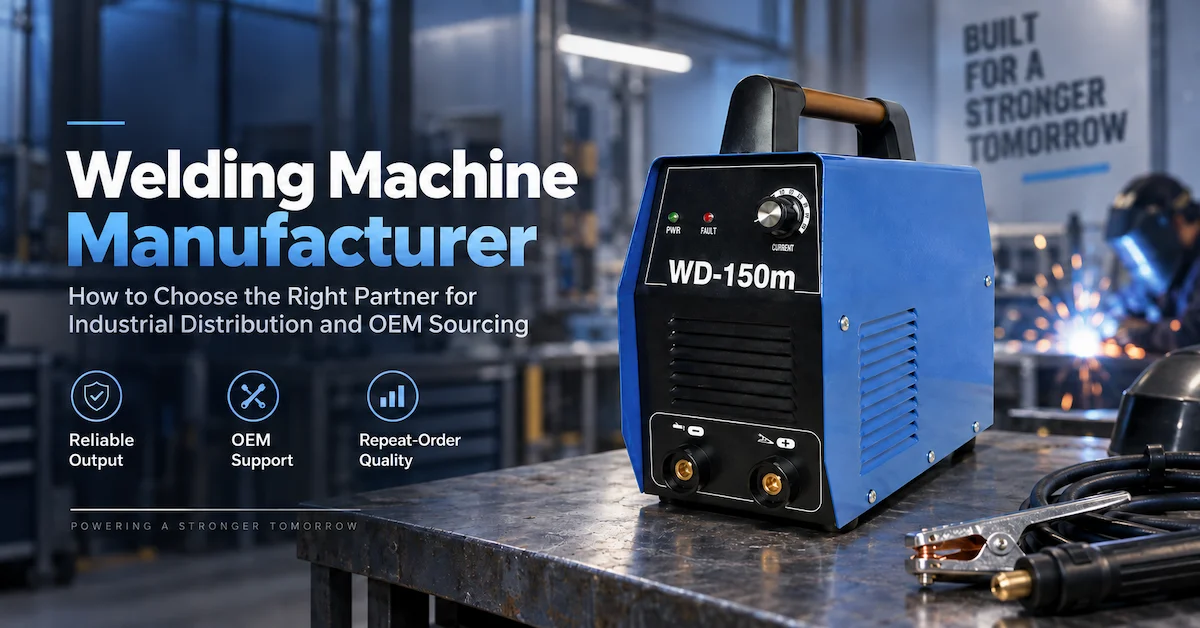
UWELD currently lists one product under its Welding Machine category—the WD-150m Welding Machine 2W001-0001—within a broader Welding category that also contains MIG torches, TIG torches, plasma cutting torches, electrode holders and related welding tools. Buyers can review the wider UWELD Welding product range before defining the scope of a sourcing project.
What Is a Welding Machine Manufacturer?
A welding machine manufacturer is a company that has direct responsibility for converting an approved product specification into repeatable welding equipment through engineering, component control, assembly, inspection and production management. Depending on the business model, the manufacturer may also provide OEM development, private-label support, packaging, documentation and after-sales coordination.
The most important distinction is control. A manufacturer should be able to explain how a product version is defined, how components and assembly are controlled, how finished units are checked and how a repeat order is kept consistent with the approved sample. A trading company or reseller may still be a useful sourcing partner, but it may not control all of these steps directly.
UWELD’s Solutions page describes co-development and engineering, vertical manufacturing, quality-control procedures and OEM/custom manufacturing as part of its operating model. Its site also states that buyers can work either with UWELD-branded products or customized projects.
For procurement purposes, however, buyers should still verify these capabilities at the specific welding-machine model level. A general manufacturing capability page does not automatically establish the production process, test items or certification status of every individual welding machine.
Manufacturer vs. General Supplier: What Should Buyers Actually Compare?
The words “manufacturer,” “supplier,” “factory” and “OEM partner” are often used interchangeably in B2B marketing. Buyers gain more value by testing what the company can actually control.
| Evaluation Area | Manufacturer-Level Evidence to Request | Why It Matters |
|---|---|---|
| Product definition | Approved specification, model/version identification | Prevents specification drift |
| Engineering | Technical team or documented change process | Helps resolve application or configuration issues |
| Component control | Approved components or controlled substitution process | Protects repeat-order consistency |
| Assembly | Defined work instructions and production controls | Reduces batch variation |
| Final inspection | Model-specific inspection items and records | Gives buyers measurable acceptance points |
| OEM capability | Defined scope for branding, packaging or engineering changes | Separates cosmetic customization from technical redesign |
| Change management | Notification and approval process | Prevents silent changes after sample approval |
| After-sales | Warranty process, spares and technical response path | Reduces distributor support risk |
The objective is not to prove that every reseller is unsuitable. It is to determine whether the partner has enough control for your particular sourcing risk.
Start With the Welding Process and Application
Before discussing factory capability, tell the welding machine manufacturer what customers will actually do with the machine. Define the process, material, typical thickness, joint type, working environment and expected workload.
A machine used for light repair work has a different purchasing profile from one expected to operate repeatedly in a fabrication shop. Similarly, the word “inverter” describes a power-conversion technology; it does not by itself tell buyers whether the machine supports stick, TIG, MIG/MAG or another process.
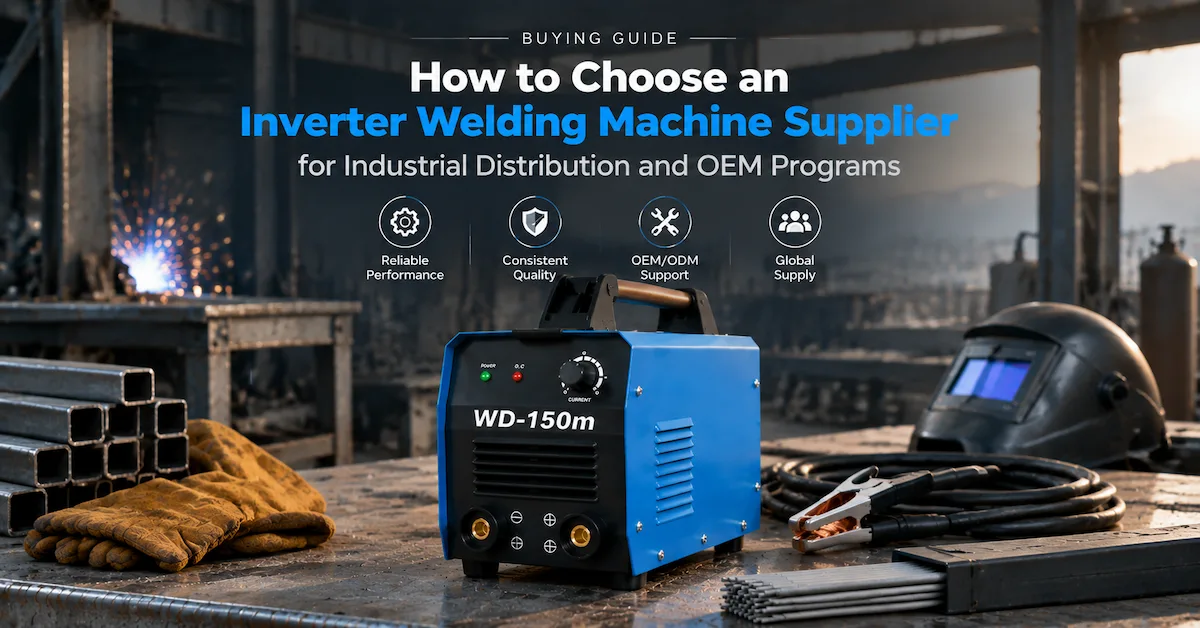
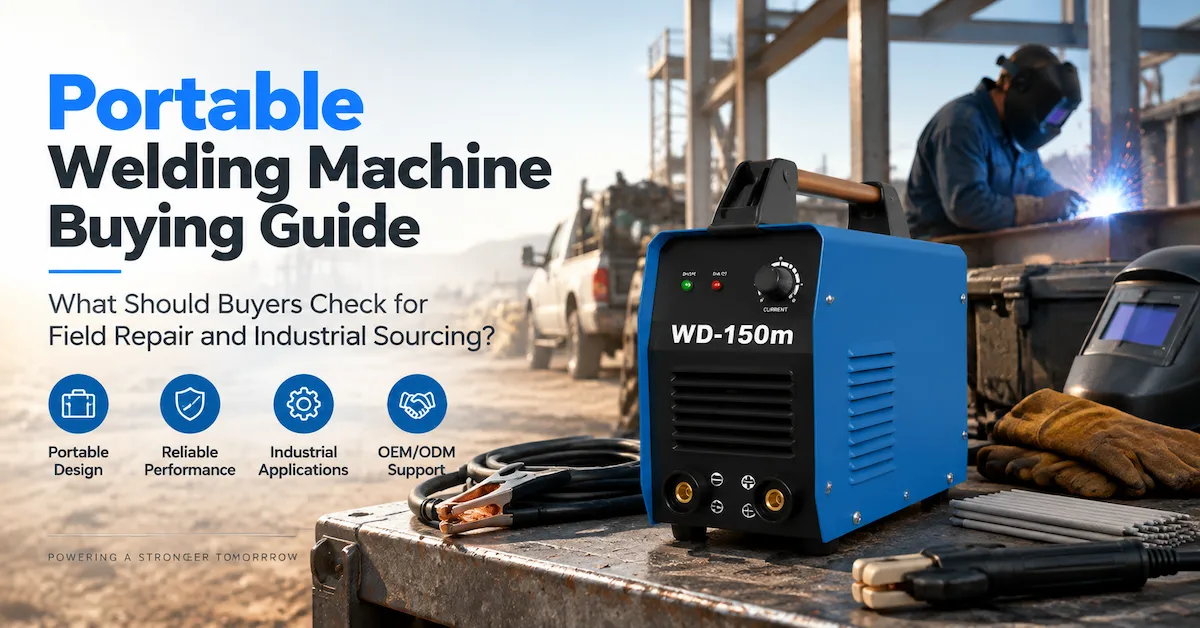
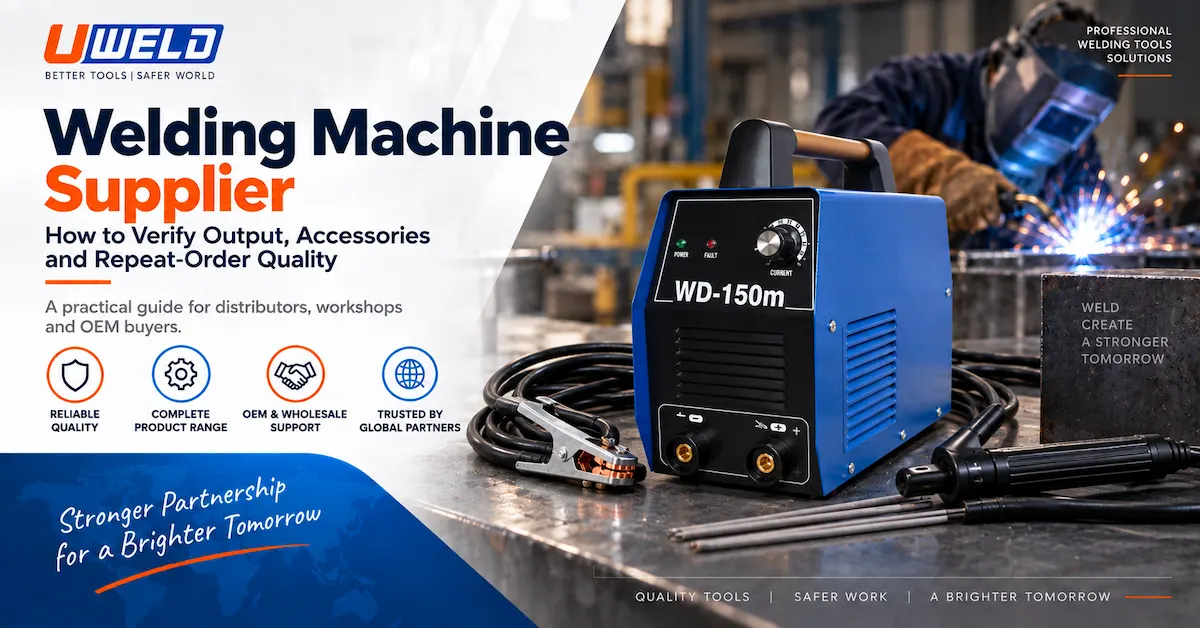
UWELD describes the WD-150m as a compact and portable inverter welding machine intended for tradespeople, panel beating, refrigeration work and general welding tasks. Buyers can use the WD-150m Welding Machine page as the product reference, but should request the current approved specification before assigning it to a particular application or market.
Which Technical Specifications Should Buyers Confirm?
A professional RFQ should make suppliers quote against the same technical requirement. Avoid sending only a target amperage and asking for “your best machine.”
| Specification | What to Confirm | Procurement Value |
|---|---|---|
| Welding process | Exact supported processes and required accessories | Confirms functional fit |
| Input supply | Voltage, phase, frequency and input requirements | Prevents market/application mismatch |
| Output range | Rated current and voltage information | Defines usable operating range |
| Duty cycle | Rating and associated test conditions | Helps assess workload suitability |
| Electrode/wire range | Supported consumables for the selected process | Connects machine to actual welding work |
| Connections | Output terminals, torch/control interfaces | Prevents accessory incompatibility |
| Protection functions | Documented thermal/overload or other protection | Avoids assumptions from marketing terms |
| Cooling arrangement | Fan or other specified cooling system | Helps assess installation requirements |
| Dimensions/weight | Actual approved configuration | Important for transport and field use |
| Included accessories | Lead set, holder, return clamp, torch or other items | Makes quotations comparable |
| Documentation | Instructions, nameplate data and required market documents | Supports importer approval |
The important principle is simple: compare rated information under stated conditions, not isolated headline numbers.
Duty Cycle Should Be Part of the Buying Decision
Maximum output alone does not describe how a machine performs over repeated work. Buyers should ask for the duty-cycle rating associated with the required current and relevant operating conditions.
For example, if two machines both display the same maximum amperage but their documented duty-cycle performance differs significantly, their suitability for repeated shop work may also differ. The buyer should therefore specify the expected workload and ask the manufacturer for the relevant rated information rather than selecting the largest number printed on the front panel.
This also prevents a common sourcing problem: approving a sample because it completes a short weld successfully, then discovering that the commercial application involves much longer or more frequent welding intervals.
How to Evaluate a Welding Machine Manufacturer’s Production Capability
A strong factory evaluation should connect manufacturing capability to the product being sourced.
UWELD publicly describes its manufacturing model as covering engineering, manufacturing, testing, assembly and global supply, while its New Products page presents a manufacturing flow covering R&D and engineering design, precision manufacturing, testing, assembly/integration and support.
When evaluating a welding machine project, buyers can turn that broad capability into more specific questions:
Engineering control: Who owns the product specification? How are technical changes approved?
Component control: Which electrical or mechanical components are controlled by specification? What happens when an existing component becomes unavailable?
Assembly control: Are there defined assembly instructions and process checkpoints for the approved version?
Inspection: Which measurements or functional checks are performed on finished machines?
Traceability: How is the production version identified if a complaint appears months later?
Repeat orders: How does the factory prevent an approved first order from quietly changing in later batches?
These questions produce more useful evidence than simply asking, “Are you a factory?”
Quality Control Should Follow the Product Through the Order
Buyers often ask whether a welding machine manufacturer performs quality inspection. The more useful question is what is checked, at which stage, and against which acceptance criteria?
A practical control plan can be divided into four stages.
Incoming Components
The factory should have a method for checking critical purchased components against approved requirements. For buyers, the key issue is not whether every component receives the same inspection; it is whether critical items are identified and substitutions are controlled.
Assembly Process
Production should follow the approved product version. If different electrical versions or accessories are offered for different markets, they should be distinguishable within the manufacturing process.
Finished-Unit Inspection
The buyer should ask which electrical, functional, appearance, connection and packaging checks apply to the model. Do not add unverified test items to the specification simply because they sound technically impressive; ask the manufacturer to document its actual procedure.
Pre-Shipment Verification
Before shipment, confirm quantity, model/version, included accessories, product marking, manuals, packaging and any buyer-approved customization. For private-label programs, artwork verification should be treated as a controlled part of the order rather than an informal final step.
UWELD also publishes an ISO welding equipment supplier quality guide, which emphasizes that management-system certification alone does not replace product specification, sample testing, inspection and batch-consistency review.
Use the Sample as a Controlled Reference, Not Just a Demonstration
Sample approval is one of the most valuable steps in B2B welding-machine sourcing, provided buyers document what they approve.
Start by recording the machine model, electrical version, nameplate information, leads, connectors, accessories, manual and packaging. Then have qualified personnel perform a defined application test using representative materials and consumables.
The test does not need to become a laboratory research project. It does need enough consistency that a second machine can be evaluated against the same criteria.
After approval, keep the specification, photographs and observations with the purchasing record. If future production requires an important technical change, the buyer should know how that change will be communicated and approved.
What Does the WD-150m Tell Buyers About UWELD’s Welding-Machine Range?
UWELD’s current Welding category shows one Welding Machine entry, while most of the category consists of torches and related welding equipment.
That fact should shape how the company is described in a purchasing article. UWELD has a broad welding and cutting product portfolio and currently lists the WD-150m welding machine, but the public catalog should not be interpreted as evidence of a large multi-model welding-machine range unless additional current models are confirmed.
For buyers specifically interested in the WD-150m, the correct sourcing path is therefore:
confirm the WD-150m specification → confirm required accessories → evaluate sample/application fit → confirm OEM or branding requirements → confirm quantity and production schedule.
That is more reliable than assuming that specifications from another welding-machine series apply automatically.
Welding Machines and Welding Torches Should Not Be Mixed in One Comparison
A welding machine is a power source. A MIG or TIG torch is a connected welding tool. This distinction sounds basic, but it matters in supplier evaluation because websites may display all three within one Welding category.
UWELD’s Welding product category currently includes MIG torches, TIG torches, plasma cutting torches and one welding-machine listing.
A buyer evaluating a complete product program may want all of those categories, but compatibility has to be confirmed rather than inferred from the shared brand.
For example, the 15AK is a MIG torch and the WP18 is a TIG torch. Their presence in the UWELD range does not by itself establish compatibility with the WD-150m. This kind of distinction strengthens a sourcing article because it prevents the product catalog from being interpreted more broadly than its data supports.
When Does OEM/ODM Capability Matter?
An OEM welding machine manufacturer becomes particularly valuable when the buyer wants to build a private-label line rather than purchase a standard product unchanged.
Common project requests can include brand identity, carton artwork, manuals, labels, accessory combinations and market-specific product presentation. Larger technical changes may involve electrical configuration or component changes and require a different engineering and validation process.
UWELD’s OEM welding equipment guide describes support for product selection, private-label requirements, packaging, technical documentation and repeat supply, while its Solutions page presents both UWELD-brand cooperation and custom manufacturing routes.
For buyers, the safest sequence is:
technical configuration first → sample approval → branding and packaging → final document approval → bulk order.
Changing the order and designing the packaging first can create unnecessary rework if the technical configuration changes later.
Do Not Assume Every OEM Request Is Available
OEM capability does not mean every modification is technically or commercially feasible. Replacing a logo is different from changing the electrical design. Changing an accessory set is different from altering output characteristics.
A good welding machine manufacturer should separate these requests and explain what additional engineering, testing, documentation or MOQ implications apply.
That transparency is valuable because it prevents customization from becoming a vague marketing promise.
Which Application Markets Should a Manufacturer Understand?
The manufacturer does not need to run your customer’s business, but it should understand enough about the application to identify unsuitable configurations.
Typical B2B use cases can include:
| Buyer/Application | Main Concern |
|---|---|
| Metal fabrication workshop | Stable welding performance and workload suitability |
| Repair and maintenance | Portability, simple setup and accessory availability |
| Automotive/body repair | Application fit for repair work and workshop handling |
| Refrigeration maintenance | Portable field requirements where appropriate |
| Industrial distributor | Repeatable specifications and product documentation |
| Private-label brand | Product differentiation and version consistency |
| Tool wholesaler | Packaging, inventory and replacement accessory planning |
UWELD’s Solutions page also positions its welding and cutting products across metal fabrication/manufacturing, HVAC/R-related work and automotive repair environments.
How Should Buyers Evaluate Certification and Documentation?
Never turn a company certificate into an automatic product claim.
Buyers should separate:
quality-management documents, which relate to the company or management system;
product-specific evidence, which applies to a particular product or range;
inspection records, which relate to a particular production or shipment;
and market documentation, which may be required for the destination country.
UWELD’s website presents ISO, CE, CSA and other compliance-related statements across its broader welding and cutting business. Those claims should still be checked against the exact machine being purchased before being used in product marketing or importer documentation.
This distinction protects both parties. A distributor avoids publishing unsupported compliance claims, while the manufacturer receives a clearer request for the documentation actually needed.
How to Compare Welding Machine Manufacturer Quotations
Unit price becomes useful only after the configurations match.
Normalize each quotation around:
| Commercial Item | Comparison Question |
|---|---|
| Machine configuration | Are the supported process and electrical versions equivalent? |
| Accessories | Are the same items included? |
| Packaging | Standard or private-label? |
| Documentation | What is supplied with the order? |
| Sample approval | Is it included or charged separately? |
| MOQ | Does it apply by model, version or artwork? |
| Lead time | When does the production clock begin? |
| Spare parts | What replacement items are available? |
| Warranty | What is covered and for how long? |
| Repeat order | How is specification consistency controlled? |
A low quotation that excludes essential accessories or requires a different technical configuration is not directly comparable with a higher quotation for a complete approved package.
Production Capacity and Lead Time Should Be Model-Specific
General factory capacity can tell buyers whether the company has manufacturing infrastructure, but it does not guarantee availability for a particular SKU.
Ask the manufacturer for the production plan for your exact welding-machine version. Separate:
sample preparation → technical approval → artwork approval → component preparation → production → inspection → shipment readiness.
This is especially important for OEM programs because delays may come from approval or customized packaging rather than machine assembly itself.
UWELD presents manufacturing and OEM capability through its Solutions and Partners pages, but the public website does not establish one universal MOQ or lead time for every welding-machine project. Those commercial conditions should therefore be confirmed in the quotation.
What Should Be in a Welding Machine Manufacturer RFQ?
A good RFQ should give the factory enough information to recommend or quote a defined configuration.
Include the intended welding process, material/application, target output requirements, electrical supply, expected workload, destination market, required accessories, order quantity, branding requirements and requested documentation.
If you are considering the WD-150m, identify it by model and ask UWELD to confirm its current specification rather than reconstructing specifications from photographs or model naming.
Buyers can first review the UWELD Welding range, then submit their technical and commercial requirements through the UWELD contact page.
Frequently Asked Questions
1. How Do I Choose a Welding Machine Manufacturer?
Start with the welding application and technical specification, then evaluate manufacturing control, sample consistency, quality inspection, documentation, OEM capability and repeat-order support. Factory size alone does not answer these questions.
2. What Is the Difference Between a Welding Machine Manufacturer and a Supplier?
A manufacturer directly controls at least part of engineering, production, assembly or quality operations, while a supplier may manufacture, source or distribute equipment. Buyers should evaluate actual control rather than rely only on the company label.
3. Does UWELD Manufacture Welding Equipment?
UWELD publicly describes direct manufacturing, engineering, production and OEM/customization capability for its welding and cutting business. Its current product center also lists the WD-150m welding machine. Buyers should still confirm the manufacturing and technical scope for the exact machine project being sourced.
4. What Welding Machine Does UWELD Currently List?
The current UWELD product center lists the WD-150m Welding Machine 2W001-0001. Buyers can request its current specification and supplied configuration before selection.
5. What Specifications Should Be Checked Before Bulk Ordering?
Confirm the welding process, input requirements, rated output, duty cycle, consumable compatibility, connections, protection functions, supplied accessories and required documentation.
6. Why Is Sample Testing Important?
A sample allows buyers to verify the delivered configuration and assess the machine in a representative application before bulk production. The approved sample also becomes more useful when supported by photographs and a controlled specification.
7. Can a Welding Machine Manufacturer Provide OEM Branding?
Many manufacturers can support private-label projects, but the exact scope differs. UWELD presents OEM/custom manufacturing capability, including product and packaging cooperation. Technical changes should be evaluated separately from branding changes.
8. Should Buyers Choose the Machine With the Highest Amperage?
Not automatically. Rated output should be reviewed with duty cycle, electrical requirements and the intended workload. The machine should fit the application rather than simply display the largest headline number.
9. How Can Buyers Reduce Repeat-Order Quality Risk?
Use a controlled specification, approved sample, clear accessory list and change-approval process. Ask the manufacturer how substitutions or technical revisions are communicated before they enter production.
10. What Should I Send UWELD for a Welding Machine Inquiry?
Send your required process, application, electrical supply, workload, destination market, quantity, required accessories, documentation and OEM requirements. Use the UWELD contact page so the inquiry can be reviewed against a defined sourcing requirement.
Conclusion
Choosing a welding machine manufacturer should be a technical and supply-chain decision rather than a search for the lowest quotation. Buyers should define the application first, verify the machine’s rated specifications, evaluate manufacturing and quality-control capability, approve a documented sample, and establish how accessories, customization and production changes will be managed across repeat orders. UWELD currently lists the WD-150m welding machine and publicly presents engineering, manufacturing and OEM capabilities across its welding and cutting business. Explore the UWELD Welding equipment range, review its custom manufacturing solutions, and contact UWELD with your application, electrical requirements, target market and order plan for project-specific confirmation.