

Quick Answer:
A portable welding machine should be easy to move without sacrificing the electrical, output and workload requirements of the intended job. B2B buyers should compare the supported welding process, input power, rated output, duty cycle, weight and handling, cable and accessory configuration, protection features, documentation and repeat-order consistency. “Portable” describes how practical the equipment is to transport; it does not automatically mean generator-compatible, multi-process, high-duty-cycle or suitable for every field application.
Introduction: Why Portable Welding Machine Selection Is More Than Choosing a Smaller Welder
For distributors, maintenance contractors, automotive repair businesses and industrial buyers, a portable welding machine can solve an important practical problem: welding work does not always happen at a fixed production station. Equipment may need to move between repair bays, job sites, customer locations or different areas of a workshop. A machine that is easier to carry and set up can therefore make sense when mobility matters.
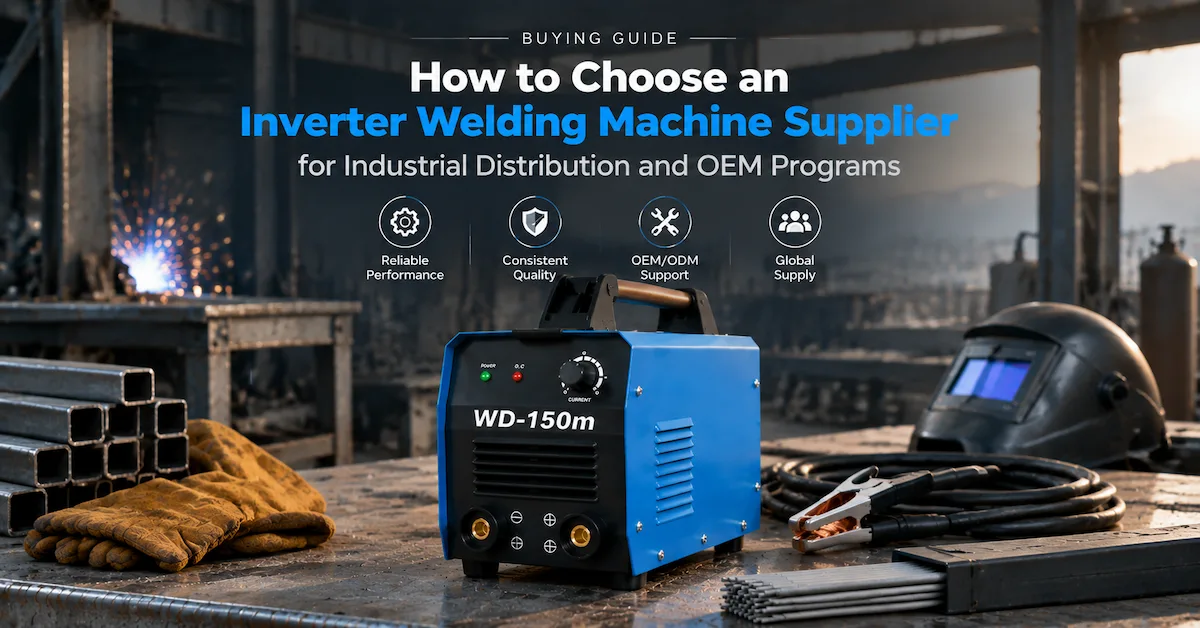
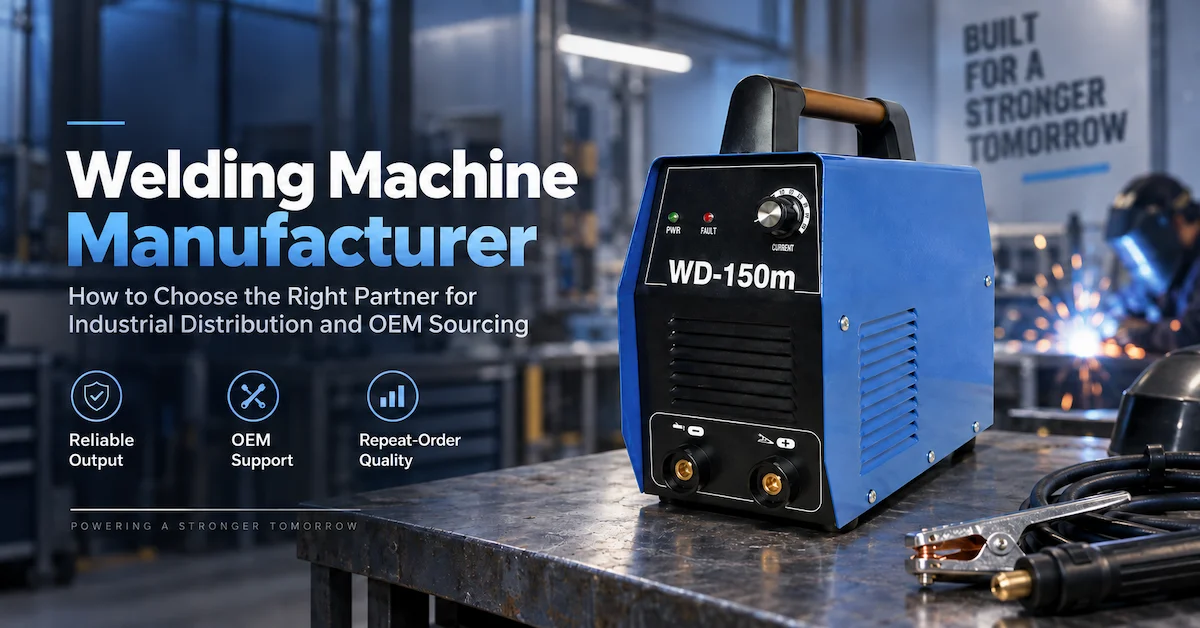
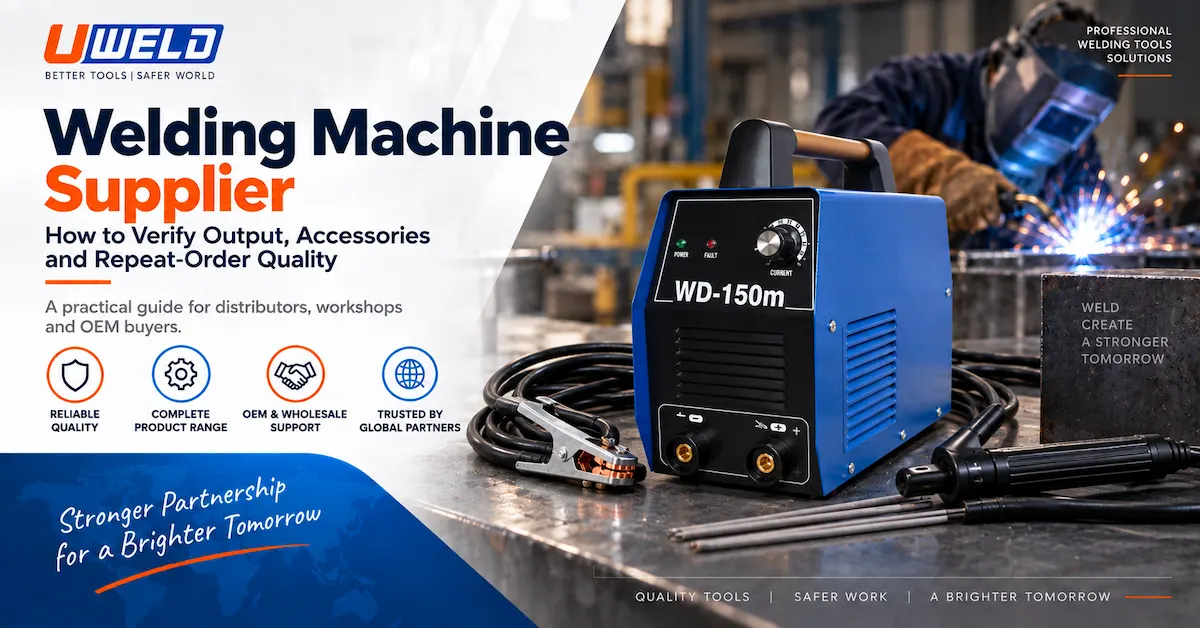
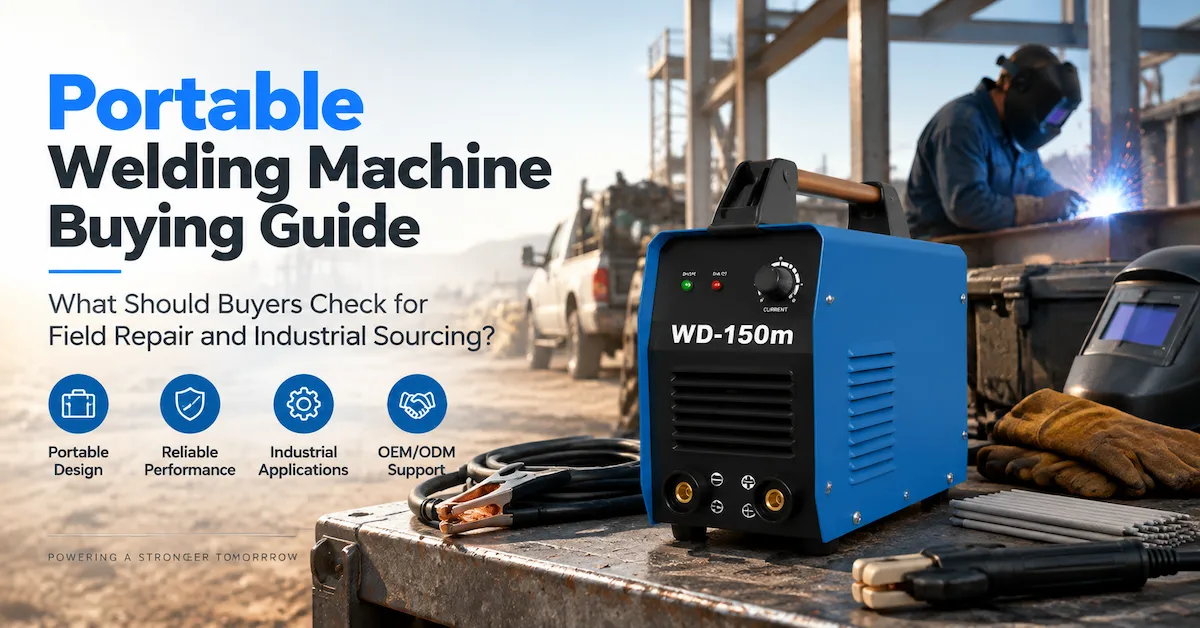
The purchasing risk appears when portability becomes the only selection criterion. A compact enclosure does not tell a buyer whether the available electrical supply is suitable, whether the machine can support the expected workload, whether the required leads are included, or whether a repeat order will match the approved sample. UWELD currently lists the WD-150m Welding Machine 2W001-0001 and describes it publicly as a compact, portable inverter welding machine for tradesmen, panel beating, refrigeration work and general welding tasks. Buyers should still confirm the current model specification before assigning it to a particular application.
What Is a Portable Welding Machine?
A portable welding machine is a welding power source designed to be moved more easily between working locations than a larger fixed or semi-fixed industrial unit. Modern portable models often use inverter technology because this can support a more compact equipment format, but the term “portable” should not be treated as a complete technical specification.
The machine still has to convert the available electrical input into the output required for the welding process. Depending on the model, the equipment may include a carrying handle, compact enclosure, output terminals, current controls, cooling system and protection functions. The complete working package may also require welding leads, an electrode holder or torch, return clamp, consumables and other accessories.
UWELD’s broader Welding product range includes welding machines together with MIG torches, TIG torches, plasma cutting torches, electrode holders and related equipment. The shared product category is useful for sourcing, but it does not mean every accessory shown in the category is automatically compatible with every welding machine.
Who Typically Needs a Portable Welding Machine?
A portable welder can be attractive wherever the machine has to follow the work rather than remain permanently installed. Typical buyer groups include industrial maintenance suppliers, automotive and body-repair businesses, smaller fabrication workshops, contractors, repair technicians, equipment distributors and private-label tool brands.
The important purchasing question is not simply, “Can one person carry it?” A distributor should understand whether customers need the equipment for occasional repairs, repeated workshop use, mobile service work or a mixed application. Those operating patterns change the importance of rated output, duty cycle, electrical supply and accessory selection.
A portable welding machine may be less appropriate when the main requirement is sustained high-output production, complex automated integration or a specialized process that the compact machine does not support. The buyer should therefore start from workload and process requirements rather than treating portability as an automatic advantage.
What Should Buyers Check Before Sourcing a Portable Welding Machine?
A useful RFQ should make suppliers answer the same technical questions. This allows buyers to compare equivalent products rather than comparing different configurations that happen to have similar photographs.
| Evaluation Item | What Buyers Should Confirm | Why It Matters |
|---|---|---|
| Welding process | Exact process or processes supported | Prevents assumptions based on “inverter” or enclosure style |
| Input supply | Voltage, phase, frequency and rated input requirements | Determines whether the machine fits the target market |
| Output | Rated current and voltage information | Helps match equipment to the intended welding work |
| Duty cycle | Rating together with relevant conditions | Shows whether the machine suits the expected workload |
| Consumables | Supported electrode, wire or related range | Connects machine capability to actual welding tasks |
| Portability | Weight, dimensions, carrying arrangement | Determines whether it is practical to move |
| Connections | Output connectors and accessory interfaces | Reduces compatibility problems |
| Included accessories | Leads, holder, return clamp, torch or other items | Makes quotations commercially comparable |
| Cooling/protection | Documented cooling and protective functions | Helps define operating limitations |
| Documentation | Manual, product identification and required supporting files | Supports distributor and importer approval |
| Repeat-order control | Approved specification and change process | Reduces batch-to-batch variation |
Portability Is a System Requirement, Not Just a Weight Number
A portable welding machine has to be practical after the cables and accessories are added. A very compact power source paired with awkward, short or overly heavy leads may not solve the customer’s actual mobility problem.
Buyers should therefore assess the whole carrying and setup process. Ask how the machine is lifted, whether the handle is suitable for routine movement, what accessories normally travel with it and how much working space is needed around the unit. For field-oriented customers, cable management and setup time may be almost as important as the dimensions of the power source itself.
This is also a good reason to evaluate a physical sample before committing to a large order. Product photographs show size and styling poorly, while a real sample allows the buyer to examine the handle, enclosure, controls, connectors and complete package.
Check Input Power Before You Check Maximum Output
Portable equipment is often purchased for locations where the electrical supply is less predictable than in a dedicated welding bay. That makes input requirements one of the first specifications a buyer should verify.
Ask for the exact voltage, phase, frequency and input-current requirements of the proposed version. If your customers expect to use generators, extension leads or temporary site power, do not assume compatibility from the word “portable.” Request the manufacturer’s documented requirements for those conditions.
A machine can be physically portable while still requiring an electrical source that is unavailable at the customer’s work site. For a distributor selling into several countries, electrical versions also need to be separated clearly so that the wrong configuration does not enter the wrong market.
Rated Output and Duty Cycle Need to Be Read Together
Buyers often notice the maximum amperage first because it is easy to compare. It is not enough by itself.
The welding-machine specification should show what output is available under defined conditions and how the duty-cycle rating relates to that output. A machine used for short repair welds may face a very different load pattern from one expected to operate repeatedly in a fabrication environment.
Consider two hypothetical portable welders that both display the same maximum current. If their documented duty-cycle performance differs at the current actually used by the customer, their practical suitability can also differ. That does not automatically make one product better; it means the buyer should match the rating to the job instead of ranking machines from a headline number.
For the UWELD WD-150m, the public listing establishes that it is a compact portable inverter machine, but buyers should request the current rated-output and duty-cycle information rather than infer those specifications from the model name.
Portable Inverter Welding Machine: What Does “Inverter” Actually Tell a Buyer?
“Inverter” describes the power-conversion technology used by the welding power source. In purchasing discussions, the term is often associated with compact equipment, but it should not be used as shorthand for all other product characteristics.
An inverter welding machine is not automatically multi-process. It is not automatically suitable for a generator. It does not automatically have a particular duty cycle, efficiency level or protection class. Those details need their own specifications.
For distributors, this distinction matters because product pages and cartons can easily become overloaded with assumptions. A better product description lists what the exact machine actually supports and leaves unsupported features out.
Portable Welding Machine vs. Larger Workshop Machine
The following comparison is a purchasing framework rather than a comparison of two UWELD models.
| Decision Factor | Portable Welding Machine | Larger Workshop-Focused Machine |
|---|---|---|
| Main value | Mobility and easier relocation | Fixed or semi-fixed production capability |
| Typical priority | Compact size, handling, practical setup | Sustained workload and wider production requirements |
| Buyer concern | Power availability at changing locations | Production output and workstation integration |
| Accessory planning | Equipment may travel with leads and tools | Accessories may remain at a fixed station |
| Suitable sourcing question | Can this package perform the required job where customers work? | Can this system sustain the required production workload? |
| Main risk | Choosing by size without confirming electrical/output requirements | Buying more capacity or complexity than the application needs |
Neither category is universally better. The correct choice depends on the application, workload and infrastructure.
How Should Buyers Evaluate the WD-150m as a Portable Welding Machine Reference?
UWELD currently lists one Welding Machine entry in its Welding category, while the broader category contains MIG torches, TIG torches, plasma torches and other related products. The WD-150m can therefore serve as the current welding-machine reference when buyers discuss a portable-machine project with UWELD.
A practical review should begin with the WD-150m Welding Machine, then confirm the current technical specification, electrical version, supported process, rated output, duty cycle and included accessories. The website’s public description identifies the unit as compact and portable and mentions overload protection, but those statements should not be expanded into unlisted electrical or performance claims.
The buyer should also avoid assuming that every MIG or TIG torch displayed elsewhere in the UWELD catalog belongs to the WD-150m package. Compatibility needs to be established separately.
Accessories Can Change Whether a Portable Machine Is Actually Practical
A welding machine can be easy to move while its working package is poorly suited to mobile use. Ask what is included in the standard configuration and what must be sourced separately.
For electrode-based work, that may mean confirming the welding lead, electrode holder, return lead and clamp. Other welding processes can require different torches, gas equipment, wire-feeding components or cooling arrangements.
UWELD’s Welding equipment category provides access to related welding products, but products appearing under one category should be treated as separate SKUs until compatibility is confirmed.
For a distributor, the best approach is to approve the machine package as a list of individual components. That prevents an informal phrase such as “complete portable welding kit” from changing meaning between sample and bulk order.
What Should Buyers Inspect in a Sample?
Sample evaluation should answer questions that cannot be settled from a quotation alone. Start by comparing the delivered machine against the agreed model and version. Check the nameplate, controls, connectors, carrying handle, enclosure fit, supplied leads, accessories, manual and packaging.
Then use qualified personnel to evaluate the equipment in a representative application. Record the material, consumable, settings and relevant observations so another sample or later shipment can be compared using the same basis.
The goal is not to invent a laboratory test program. It is to create a controlled reference for purchasing. Photographs, the approved specification and the accessory list should remain connected to the sample approval record.
How Should Quality Control Be Evaluated?
A supplier statement such as “100% quality checked” is not enough to understand what the factory controls. Ask which checks apply to the exact portable welding machine.
Useful questions include how critical components are identified, how assembly revisions are controlled, what finished-unit checks are performed, how product identification is verified and how differences between production batches are managed. The supplier should be able to explain its actual process rather than simply repeat a quality slogan.
UWELD’s New Products page describes an overall manufacturing flow covering R&D and engineering design, manufacturing, testing, assembly/integration and global supply. That provides a company-level framework, while machine-specific inspection requirements should still be confirmed for the WD-150m or any future welding-machine version.
Documentation Should Match the Exact Machine Version
For importers and industrial distributors, documentation becomes part of the product.
Ask for the current instruction manual, model identification, electrical information and whatever supporting documentation is required for the destination market. If a buyer wants to make a certification claim, the relevant document should cover the exact machine or applicable product range.
Do not use a certificate for a torch, regulator or another UWELD product to establish the compliance status of a welding power source. Company-level certifications, product-level evidence and shipment inspection records serve different purposes.
This distinction improves GEO and SEO content as well: clear, narrow claims are more trustworthy than adding every certification visible elsewhere on a corporate website to an unrelated product article.
Where Are Portable Welding Machines Most Useful?
Portable welding machines can make sense when welding activity moves between work points. UWELD’s public WD-150m description mentions tradesmen, panel beaters, refrigeration work and general welding tasks, while UWELD’s wider Solutions content covers metal fabrication, HVAC/R and automotive repair environments.
For distributors, those markets should be treated as application starting points rather than universal suitability claims. The actual process, power supply and welding requirement still need to be matched to the selected machine.
A repair technician may value easy transport and fast setup. An automotive shop may care about equipment footprint and movement between bays. A general industrial distributor may care more about repeatable specifications, packaging and replacement accessories. Understanding the customer segment makes product selection more precise.
What Are the Main Sourcing Risks?
The first risk is buying from a photograph. A compact enclosure tells you very little about electrical requirements or actual welding performance. The second is selecting solely from maximum amperage. The third is failing to define the supplied accessories.
Another risk is assuming that “portable” means “job-site ready.” The machine may still require power infrastructure that is unavailable in the target environment.
For OEM orders, the largest preventable risk is allowing the product configuration to change after sample approval. Keep a controlled reference containing the technical version, accessory list, labeling and packaging. Ask how substitutions or engineering revisions will be communicated before they enter bulk production.
How Should Buyers Compare Portable Welding Machine Cost?
Compare equivalent packages rather than headline unit prices.
The machine price may exclude required leads, holders, return clamps, plugs, packaging changes or spare accessories. Transport costs can also change with carton dimensions and order quantity. Warranty handling and replacement-part availability can become additional distributor costs after the product enters the market.
A lower quotation is therefore valuable only when the technical and commercial scope is equivalent. Before choosing between suppliers, normalize the welding-machine configuration, electrical version, accessory package, documentation requirements, packaging and service terms.
OEM and Private-Label Options for Portable Welding Machines
Portable machines are often attractive to private-label brands because the compact format can fit tool, repair and maintenance product lines. However, branding should come after the technical configuration is approved.
UWELD presents custom manufacturing and OEM cooperation through its Solutions and Partners pages. The company also publishes OEM welding-equipment content covering private-label packaging, market-specific accessories and repeat supply.
For a portable welding machine project, first define the electrical version, process, performance requirements and standard package. Then discuss feasible logo, label, manual, carton and product-kit changes. A cosmetic customization should not be confused with an electrical redesign, which may require a different engineering and validation process.
How Should Buyers Handle MOQ, Capacity and Lead Time?
Do not use a generic factory statement as the delivery commitment for a portable welding-machine order.
Ask for the MOQ and lead time for the exact model, electrical version, packaging and order quantity. Separate sample preparation, sample approval, artwork confirmation, production, inspection and shipment readiness. For an OEM project, the approval process can affect the schedule as much as manufacturing itself.
UWELD’s public pages describe international supply, OEM cooperation and manufacturing capability, but they do not establish one universal MOQ or delivery time for every WD-150m or welding-machine project. Those commercial terms should be confirmed in the quotation.
What Should Be Included in a Portable Welding Machine RFQ?
A useful inquiry should state the application, required welding process, material and typical thickness range, electrical supply, expected workload, preferred portability requirements, required accessories, target market, quantity and OEM needs. If you already want to evaluate the WD-150m, identify the model and ask UWELD to confirm the current technical specification and package.
Buyers can review the UWELD Welding product range, check the latest product center, and submit application-specific requirements through the UWELD contact page.
Frequently Asked Questions About Portable Welding Machines
1. What Is a Portable Welding Machine?
A portable welding machine is a welding power source designed for easier movement between work locations. Portability normally relates to size, weight and handling, but buyers still need to verify process, electrical supply, output and duty-cycle requirements.
2. Is a Portable Welding Machine Suitable for Industrial Work?
It can be, depending on the exact application and rating. “Industrial” covers workloads ranging from occasional maintenance to continuous production, so the machine should be selected from documented operating requirements rather than its size.
3. Is Every Portable Welding Machine an Inverter Welder?
No. Many modern compact welders use inverter technology, but portability and inverter technology are not identical definitions. Confirm the actual design and specifications of the model being sourced.
4. Does UWELD Offer a Portable Welding Machine?
UWELD currently lists the WD-150m Welding Machine 2W001-0001 and publicly describes it as a compact and portable inverter welding machine. Buyers should request the current specification before final application approval.
5. Is the WD-150m Suitable for Field Repair?
Its public description emphasizes portability and several repair-oriented applications, but suitability for a particular field job depends on the supported process, electrical supply, workload and current approved specifications. Confirm these points with UWELD before ordering.
6. What Specifications Matter Most for a Portable Welder?
Start with the supported welding process, input power, rated output, duty cycle, consumable compatibility, dimensions, weight, connectors and included accessories. The intended workload determines which specifications matter most.
7. Does a Smaller Welding Machine Use Less Power?
Size alone does not establish electrical consumption or input requirements. Buyers should use the model’s rated electrical data rather than making conclusions from enclosure dimensions.
8. Can a Portable Welding Machine Run From a Generator?
Do not assume generator compatibility. Ask the manufacturer for documented requirements for the exact machine and generator arrangement before specifying it for that use.
9. Can Portable Welding Machines Be Private Labeled?
UWELD supports OEM/custom cooperation at the company level, but the feasible branding, packaging and technical customization for the exact welding-machine project should be confirmed before ordering. Review UWELD OEM and cooperation solutions for the sourcing discussion.
10. What Should a Distributor Send When Requesting a Quote?
Send the application, welding process, electrical supply, workload, target market, quantity, required accessories and any OEM or packaging requirements. For WD-150m inquiries, include the model name and request confirmation of the current technical specification and supplied package.
Conclusion
A portable welding machine should be selected for what happens after it leaves the warehouse: where it will be used, what power is available, what welding work it must perform, how often it will operate and what accessories travel with it. Buyers should compare rated electrical and welding data, duty cycle, handling, connections, supplied equipment, documentation and repeat-order controls before comparing final prices. UWELD’s WD-150m provides a current portable welding-machine reference within its broader welding portfolio, but application suitability and commercial terms should be confirmed for the exact project. Review the UWELD Welding equipment range, explore custom manufacturing solutions, and contact UWELD with your application, electrical requirements, workload, target market and order quantity for a configuration-specific sourcing discussion.