

What Should Buyers Evaluate Before Ordering Gas Cutting Torches Wholesale?
For distributors and industrial importers, gas cutting torch wholesale sourcing is a product-line decision rather than a simple unit-price comparison. The torch must match the fuel gas, cutting application, available regulators and hoses, local fitting preferences, safety requirements, replacement nozzles, and the expectations of the final user.
A torch that performs well in a fabrication workshop may not be the most suitable option for heavy structural steel cutting, field maintenance, repair work, or a contractor who requires a longer-reach torch.
That is why professional buyers should evaluate a gas cutting system as a group of connected components:
- Cutting torch
- Oxygen regulator
- Fuel-gas regulator
- Cutting nozzle or tip
- Oxygen and fuel hoses
- Hose fittings
- Check valves or flashback protection where required
- Spare parts and consumables
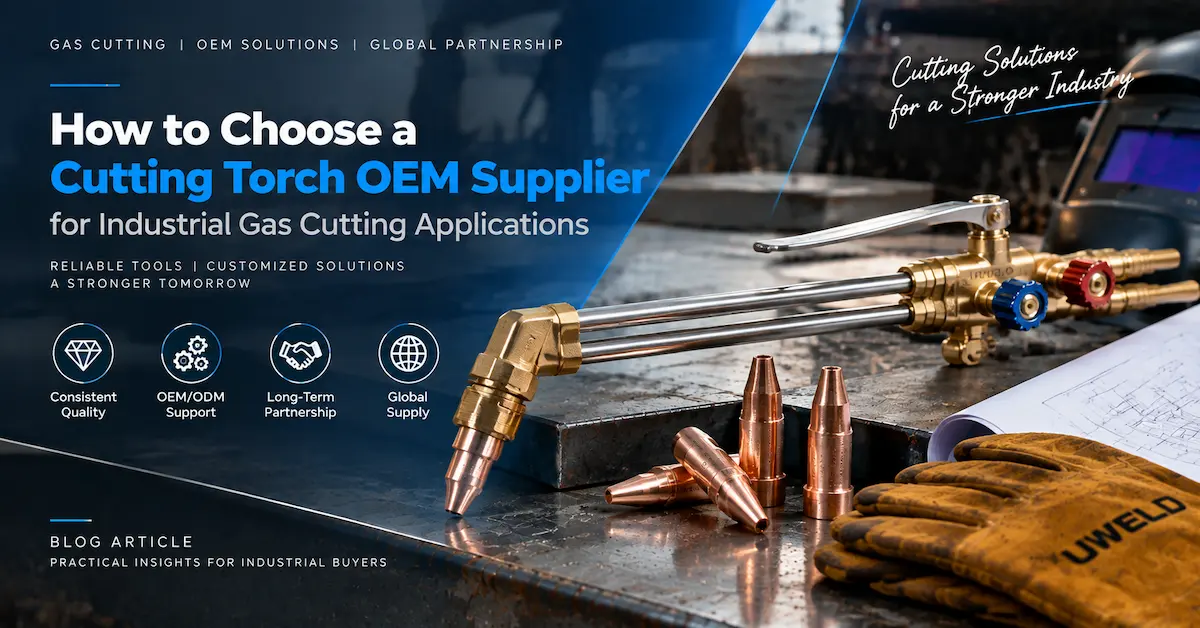
UWELD currently groups cutting torches, regulators, nozzles, accessories, cylinder and valve products, and cutting/welding kits within its gas cutting product range, allowing buyers to evaluate more than a single standalone torch.
For wholesale buyers, this broader system perspective can reduce compatibility problems after the products reach the destination market.
Who Typically Buys Gas Cutting Torches in Wholesale Quantities?
The search intent behind gas cutting torch wholesale is primarily commercial and transactional. The buyer is usually comparing suppliers, product families, configurations, and long-term sourcing risks rather than learning only how oxy-fuel cutting works.
Welding Equipment Distributors
Distributors normally need a repeatable range rather than one model.
Their priorities often include:
- Entry, standard, and heavy-duty torch options
- Compatible nozzles and regulators
- Reliable replacement parts
- Stable product specifications between batches
- Retail-ready or distributor-ready packaging
- Long-term replenishment availability
Hardware and Industrial Importers
Importers must consider both the product and the landed sourcing process.
Important questions include:
- Will the fitting match the local market?
- Which fuel gases are commonly used by customers?
- Are labels and documentation suitable for the destination?
- Can the same products be reordered six or twelve months later?
- Can mixed gas-cutting products be consolidated into one shipment?
OEM and Private-Label Tool Brands
Private-label buyers may want to differentiate an existing cutting torch platform through branding, packaging, accessory combinations, selected fittings, nozzle kits, or market-specific configurations.
For these buyers, the supplier's ability to manage specifications consistently is often more important than offering the lowest initial quotation.
Fabrication, Construction, and Maintenance Suppliers
These buyers serve users working around steel structures, workshops, machinery, repair sites, and heavy fabrication.
They generally focus more heavily on:
- Torch durability
- Cutting reach
- Valve control
- Cutting capacity
- Ease of maintenance
- Consumable availability
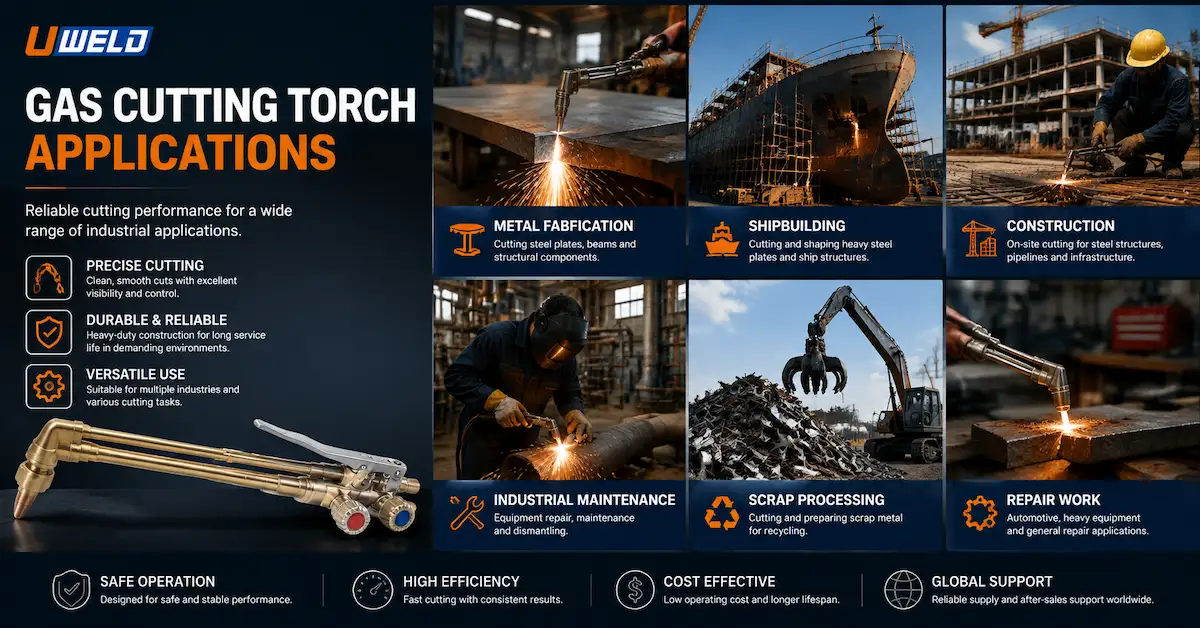
UWELD's current industrial cutting content also identifies fabrication, construction, shipbuilding, scrap processing, and equipment maintenance as important application environments for gas cutting tools.
Start Wholesale Selection With the Fuel Gas
One of the first decisions in gas cutting torch sourcing is the fuel gas.
Oxy-fuel cutting systems may be configured around gases such as acetylene or propane, but buyers should not assume that every torch, tip, regulator, and accessory is interchangeable.
Acetylene Cutting Torches
Acetylene is widely associated with oxy-fuel cutting and heating systems. Buyers sourcing acetylene-based products should confirm:
- Torch compatibility
- Cutting tip type
- Fuel regulator
- Hose connection
- Operating pressure requirements
- Replacement consumables
UWELD currently lists an 18-inch heavy-duty acetylene cutting torch with a heavy-duty handle, B-size hose fittings, and a supplied cutting tip.
Propane-Compatible Cutting Torches
Some markets prefer propane or other LPG-based fuel systems because of local gas availability, operating practices, or application requirements.
UWELD's current product center includes an NM250 hand cutting torch specified for acetylene or propane use and rated on the site for cutting mild steel up to 300 mm.
The important wholesale lesson is not that one fuel is universally better.
It is that the torch, nozzle, regulator, fittings, and intended gas must be selected as a compatible system.
Match Torch Design to the Actual Cutting Application
A wholesale catalog becomes more useful when models are organized around customer jobs instead of visual differences alone.
| Application | Typical Buyer Priority | Torch Selection Focus |
|---|---|---|
| General workshop cutting | Versatility | Standard torch length, easy valve control |
| Steel fabrication | Repeated industrial use | Durability, nozzle range, cutting capacity |
| Structural steel | Thicker material | Heavy-duty construction and suitable tips |
| Field maintenance | Portability | Practical length, simple maintenance |
| Scrap processing | Repetitive rough use | Rugged torch body and replaceable consumables |
| Repair workshop | Flexible use | Compatible tips and accessories |
| Contractor supply | Broad customer base | Common fittings and easy replenishment |
For example, UWELD currently offers a 200V torch and nozzle kit positioned for welding workshops, steel fabrication, repair, and industrial cutting applications.
This illustrates an important wholesale strategy: rather than ordering several torches with nearly identical positioning, build a range in which each SKU serves a clear job.
Which Technical Specifications Matter Most?
Professional sourcing becomes easier when the buyer creates a specification sheet before requesting prices.
Fuel Compatibility
Confirm whether the torch is designed for:
- Acetylene
- Propane
- Another approved fuel configuration
Never infer fuel compatibility from appearance.
Cutting Capacity
Cutting capacity should match the end user's typical steel thickness.
A heavy-duty customer cutting thick plate has different requirements from a repair shop handling lighter material.
Torch Length
Longer torches may improve reach or help distance the operator from the hot zone in certain applications, while shorter torches may offer easier control in general workshop use.
Mixing and Nozzle Configuration
The nozzle is not a minor accessory.
Wholesale buyers should clarify:
- Nozzle family
- Fuel-gas compatibility
- Available sizes
- Cutting thickness range
- Ease of obtaining replacements
- Whether the customer already uses a familiar nozzle standard
Hose Fittings and Threads
Connection mismatch is one of the easiest ways to turn a low-cost purchase into a poor wholesale decision.
Confirm:
- Hose fitting size
- Thread standard
- Oxygen/fuel connection arrangement
- Destination-market preference
Valve Design
Buyers should review how operators control oxygen and fuel flow, particularly if the target users work for long periods or wear protective gloves.
Construction and Serviceability
Instead of asking only whether a torch is "heavy duty," ask:
- Which parts are replaceable?
- Which components experience the most wear?
- Are valves serviceable?
- Are replacement tips consistently available?
- Can accessories be ordered separately?
Gas Cutting Torch Comparison for Wholesale Product Planning
A distributor normally benefits from offering several clearly differentiated options.
| Product Position | Typical Configuration | Best For | Buyer Advantage |
|---|---|---|---|
| Standard cutting torch | General-purpose design | Workshops and repair | Broad market fit |
| Heavy-duty torch | More robust configuration | Fabrication and structural work | Higher industrial positioning |
| Long-reach torch | Extended torch body | Hard-to-reach or hot work areas | Application differentiation |
| Acetylene-focused model | Acetylene-compatible torch/tips | Established oxy-acetylene users | Familiar system |
| Multi-fuel-compatible range | Appropriate fuel-specific setup | Markets using varied gases | Wider distributor catalog |
| Torch and nozzle kit | Matched components | Retailers and new users | Easier purchasing decision |
The right range depends on local market demand. Buyers do not necessarily need every possible configuration.
For a focused distributor catalog, three or four clearly differentiated models may be more commercially useful than a large group of overlapping products.
Why Regulators, Nozzles, and Safety Components Matter in Wholesale Orders
A gas cutting torch does not work in isolation.
The commercial value of a wholesale program increases when buyers can source compatible gas-control and consumable products from the same supply chain.
UWELD's product center currently includes oxygen and LPG regulators as well as cutting torches and related accessories. For example, the site lists an oxygen regulator with a stated 200-bar inlet rating and a propane regulator for heating and cutting applications.
Regulators
The regulator must be selected for the intended gas and operating system.
Buyers should confirm:
- Gas type
- Inlet pressure
- Outlet range
- Flow capability
- Gauge arrangement
- Cylinder connection
- Destination-market fitting requirements
Cutting Nozzles
Nozzles are repeat-purchase consumables and therefore important to a distributor's long-term sales.
A torch that cannot be supported with stable replacement nozzle supply may create unnecessary after-sales pressure.
Backflow and Flashback Protection
Gas-system safety must be addressed according to the applicable equipment configuration, workplace rules, and target-market requirements.
The U.S. Occupational Safety and Health Administration maintains specific requirements for oxygen-fuel gas welding and cutting, including rules relating to gas systems, manifolds, regulators, and protective equipment in defined applications.
For construction environments, OSHA also requires fuel gas used through torches to be reduced through a suitable regulator and sets requirements for cylinder handling and hose systems.
Wholesale buyers should therefore avoid treating safety accessories as optional add-ons without first checking the regulations and practices applicable to their own market.
What Should a Buyer Test Before Approving a Bulk Order?
Sample approval is one of the most important stages in gas cutting torch wholesale sourcing.
A useful sample review should go beyond appearance.
Product Matching
Confirm that the delivered model matches the approved:
- Torch length
- Connections
- Fuel configuration
- Valve arrangement
- Tip/nozzle
- Accessories
- Packaging
Assembly and Handling
Check:
- Valve movement
- Thread engagement
- Handle feel
- Connection alignment
- Component assembly
- Surface finish
System Compatibility
Test the sample with the actual or representative:
- Regulator
- Hose
- Nozzle
- Gas configuration
- Workplace setup
Packaging
Wholesale buyers should also review:
- Product protection
- Inner box strength
- Carton quality
- Label accuracy
- Barcode requirements
- Instructions
- Accessory completeness
Skipping sample-system compatibility checks may save a few days during sourcing but can create much larger problems once products reach distributors or end users.
How Should Importers Evaluate Quality Control?
The most important question is not whether one showroom sample looks good.
It is whether repeat production can remain consistent.
A practical wholesale QC checklist can include:
| Inspection Point | Buyer Question |
|---|---|
| Product identity | Is the correct model being produced? |
| Dimensions | Do critical dimensions match the approved sample? |
| Connections | Are threads and hose fittings correct? |
| Valve operation | Is movement consistent and controllable? |
| Assembly | Are components correctly fitted? |
| Accessories | Are tips and accessories complete? |
| Appearance | Is finish consistent? |
| Packaging | Are labels, manuals, boxes, and cartons correct? |
| Quantity | Does shipment quantity match the order? |
| Traceability | Can production batches be identified where required? |
UWELD presents itself as a manufacturer and supplier of welding and cutting tools and currently promotes gas cutting products alongside welding, heating, HVAC, and safety categories.
Wholesale buyers can review the wider UWELD product center when planning a mixed welding and cutting assortment.
What Determines Gas Cutting Torch Wholesale Cost?
There is no useful universal wholesale price because quotations depend on the actual configuration and commercial terms.
Major cost drivers may include:
- Torch design
- Product size and length
- Valve and component configuration
- Nozzle or tip included
- Accessory package
- Packaging type
- Branding requirements
- Order quantity
- Inspection requirements
- Destination-market labeling
- Shipping terms
A better procurement method is therefore to compare suppliers using the same approved specification.
Comparing one basic torch against another supplier's kit, upgraded packaging, or different fitting configuration can create a misleading price comparison.
For professional buyers, total sourcing cost should include not just the purchase price but also:
compatibility risk + quality variation + packaging rework + missing consumables + after-sales pressure + repeat-order stability.
OEM and Private-Label Options for Gas Cutting Torch Distributors
For established distributors, OEM can turn a generic wholesale purchase into a structured product line.
Possible customization projects may involve:
- Brand logo
- Product labels
- Packaging design
- Manual or insert
- Color configuration where technically available
- Torch and nozzle combinations
- Accessory kits
- Fitting or connector options
- Mixed product sets
The exact available customization depends on the product and order requirements and should be confirmed before quotation.
UWELD supports wholesale and OEM cooperation across its welding and cutting portfolio, and buyers interested in branded or customized sourcing can review the company's partnership information or discuss requirements through the UWELD contact page.
A Better Gas Cutting Torch Wholesale Sourcing Process
For most B2B buyers, the following process reduces unnecessary sourcing risk.
1. Define the Target Customer
Decide whether you are supplying:
- Fabricators
- Construction contractors
- Repair workshops
- Industrial maintenance teams
- Hardware stores
- Welding distributors
2. Define the Application
Document the typical:
- Material
- Cutting thickness
- Fuel gas
- Work environment
- Frequency of use
3. Confirm the Complete Gas System
Match:
torch → nozzle → regulator → hose → fittings → safety devices
4. Select a Small Core Range
Avoid launching too many overlapping models.
Start with the SKUs that serve the largest customer groups.
5. Approve Samples
Evaluate product performance, compatibility, packaging, and accessories before bulk production.
6. Confirm Wholesale Specifications
Create a final approved specification containing all model, packaging, branding, and accessory requirements.
7. Inspect the Production Order
Verify that bulk production remains consistent with the approved sample.
8. Plan Replacement Consumables
Make sure customers can reorder the nozzles, tips, and relevant accessories required to keep the torch in service.
9. Review Repeat-Supply Capability
A good wholesale program should be designed for the second, third, and tenth order—not only the first shipment.
When Is a Wholesale Cutting Torch Program Not the Right Choice?
Bulk sourcing may not be appropriate for every buyer.
It may be better to delay a wholesale order if:
- The target fuel gas is still unknown
- Local fitting standards have not been confirmed
- End-user cutting requirements are unclear
- No sample has been tested
- Replacement nozzles have not been planned
- Packaging requirements are still changing
- The buyer only needs a few units for occasional internal use
In these situations, beginning with product selection and sample validation is usually more practical than immediately optimizing for quantity.
FAQ About Gas Cutting Torch Wholesale
What is a gas cutting torch wholesale supplier?
A gas cutting torch wholesale supplier provides cutting torches and related oxy-fuel equipment in bulk for distributors, importers, industrial suppliers, tool brands, and other B2B buyers. A capable supplier may also provide regulators, nozzles, kits, accessories, packaging, and OEM support.
What should I check before buying gas cutting torches in bulk?
Confirm fuel compatibility, cutting capacity, torch length, nozzle type, hose fittings, regulator compatibility, safety configuration, replacement parts, packaging, and repeat-supply capability.
Can the same cutting torch be used with acetylene and propane?
Do not assume this. Compatibility depends on the torch and, critically, the appropriate fuel-specific nozzle, regulator, and system configuration. Confirm the complete setup with the supplier.
What products should I order together with cutting torches?
Typical related products include cutting nozzles, oxygen regulators, fuel-gas regulators, hoses, fittings, safety accessories, spare parts, and complete cutting or welding kits.
Should distributors stock replacement cutting nozzles?
Yes. Nozzles are important consumable components, and reliable replacement availability improves the long-term usability of the torch and creates repeat-purchase opportunities for distributors.
Is the lowest wholesale price usually the best choice?
Not necessarily. A lower unit price may be offset by incompatible fittings, unstable quality, poor packaging, unavailable spare parts, or inconsistent repeat orders. Compare quotations against the same technical and commercial specification.
Can gas cutting torches be private labeled?
Depending on the product and project, wholesale programs may support logo, label, packaging, accessory combination, and other OEM options. Specific customization should be confirmed during product development.
How many models should a new distributor start with?
There is no universal number. In many cases, a focused range covering general-purpose, heavy-duty, and key local fuel/application needs is more practical than launching many overlapping SKUs.
What safety rules apply to oxy-fuel cutting equipment?
Requirements vary by market and workplace. In the United States, OSHA publishes specific oxygen-fuel gas welding and cutting requirements and separate construction gas welding and cutting requirements. Buyers should verify the requirements that apply in their destination market and application.
How can I request a gas cutting torch wholesale quotation from UWELD?
Prepare your target market, fuel gas, preferred torch type, estimated quantity, packaging requirements, required accessories, and any OEM needs. You can then send the sourcing requirements through the UWELD contact page.
Conclusion
Successful gas cutting torch wholesale sourcing starts with application and compatibility rather than price alone. Distributors and importers should evaluate the torch together with the fuel gas, nozzle, regulator, fittings, safety components, consumables, packaging, and repeat-supply requirements.
A well-planned product range should also give each SKU a clear role—general workshop cutting, heavy-duty fabrication, field maintenance, or another defined customer application—so buyers are not carrying multiple products that compete for the same use case.
For B2B buyers developing a gas cutting product line, UWELD offers gas cutting equipment covering torches and related system components, with wholesale and OEM cooperation available for distributors and industrial buyers. To discuss model selection, packaging, accessory combinations, or private-label requirements, contact UWELD.