

Quick Answer: The UWELD WP18 water-cooled TIG torch is an industrial GTAW welding torch marketed with a 350A current designation, a 13.1ft cable assembly, protective denim covering, and an ergonomic handle. Its liquid-cooled design is intended for compatible welding systems handling demanding thermal workloads. Before purchasing, buyers should verify the documented amperage and duty-cycle conditions, coolant circulation requirements, machine connections, tungsten electrode compatibility, and included accessories.
Industrial TIG welding requires precise control of welding current, shielding gas, electrode configuration, and torch temperature.
For fabrication workshops, equipment manufacturers, industrial maintenance companies, and professional welding distributors, choosing the right TIG torch can affect operator handling, equipment compatibility, maintenance requirements, and purchasing costs.
A torch that performs adequately during short welds may not be appropriate for prolonged or repeated welding at elevated current.
This is one reason water-cooled TIG torch systems are commonly considered for applications with demanding thermal requirements.
However, water cooling does not automatically guarantee uninterrupted welding or make every torch compatible with a high-current welding machine.
The UWELD WP18 water-cooled TIG torch provides a product reference for buyers evaluating liquid-cooled GTAW equipment.
This guide examines its published features, cooling-system requirements, cable assembly, compatible consumables, industrial applications, quality inspection, and OEM/wholesale sourcing considerations.
Explore the UWELD WP18 Water-Cooled TIG Torch for product information and purchasing inquiries.
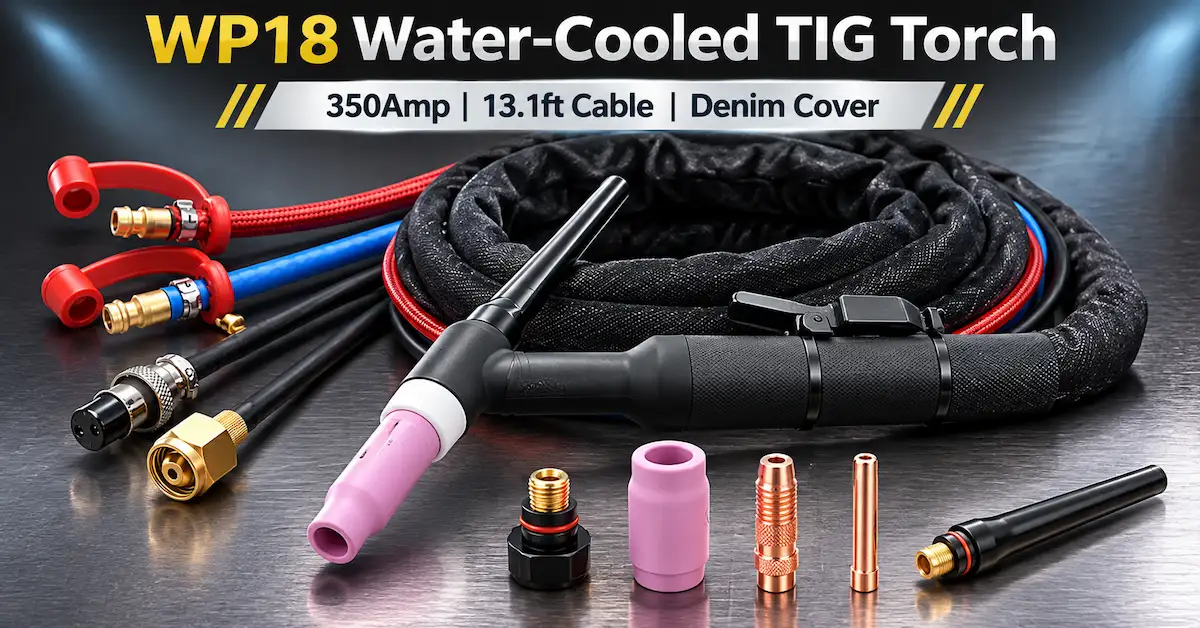
Key Takeaways: What Should Buyers Know About the UWELD WP18?
-
Water-cooled construction: The WP18 is designed for use with a compatible liquid-cooling system.
-
350A product designation: UWELD's current product title specifies 350A, while the associated catalog describes capacity above 320A. Exact rating conditions must be considered.
-
13.1ft cable assembly: The product listing identifies a 13.1ft cable with a protective denim cover.
-
Ergonomic handle: UWELD highlights a handle designed for professional TIG welding applications.
-
Tungsten electrode compatibility: The product illustration lists an electrode-size range of 0.5–4 mm, subject to the appropriate consumable configuration.
-
Ceramic nozzle components: The illustrated product range includes ceramic shielding-gas cups and related TIG consumables.
-
Cooling and machine connections: The torch requires compatible coolant, gas, electrical power, and control interfaces.
-
Wholesale sourcing: Buyers should establish the exact assembly, quality requirements, spare-parts list, and repeat-order specifications.
Purchasing recommendation: Select the WP18 according to the welding machine, actual operating current, cooling equipment, cable arrangement, and intended work cycle—not the 350A product designation alone.
What Is the UWELD WP18 Water-Cooled TIG Torch?
The WP18 is a water-cooled gas tungsten arc welding (GTAW) torch intended for compatible industrial TIG welding applications.
GTAW uses a nonconsumable tungsten electrode to establish the welding arc. Shielding gas protects the electrode and weld area from atmospheric contamination.
The torch provides the physical assembly for electrode holding, shielding-gas delivery, electrical current transfer, and operator control.
In a water-cooled configuration, a compatible coolant circuit helps transfer heat away from appropriate torch components.
UWELD WP18 Product Specification Overview
| Specification | Published UWELD Information |
|---|---|
| Brand | UWELD |
| Product model | WP18 |
| Product type | Industrial TIG welding torch |
| Cooling method | Water-cooled |
| Current in product title | 350A |
| Current reference in catalog illustration | Above 320A |
| Listed cable length | 13.1ft |
| Catalog length options | 4m / 8m |
| Cable protection | Denim protective cover |
| Handle | Ergonomic grip design |
| Electrode range in catalog | 0.5–4 mm |
| Consumable components | Ceramic cups, collets, related TIG accessories |
| Application | Compatible industrial GTAW welding |
| Commercial services | Wholesale and OEM/ODM inquiries |
Source: UWELD WP18 product page and accompanying TIG welding torch catalog illustration. The electrical rating and cable configurations are published descriptions, not a complete engineering rating certificate.
Why Are Different Current References Used?
The current product title identifies a 350A torch.
The catalog illustration separately describes operation above 320A.
These descriptions do not establish conflicting physical performance by themselves, but neither provides the complete test conditions required for engineering qualification.
For an accurate technical comparison, buyers should consider:
-
Rated welding current.
-
AC or DC operating conditions.
-
Duty cycle.
-
Compatible coolant circulation.
-
Applicable test conditions.
-
Complete supplied torch configuration.
A 350A listing does not automatically mean the torch supports continuous 350A operation at 100% duty cycle.
What About Cable Length?
UWELD's product title identifies a 13.1ft cable assembly.
The catalog lists 4m and 8m lengths.
For a wholesale purchase, the final cable length should be included in the ordered SKU and approved specification.
Different cable lengths may have different handling, connection, and replacement requirements.
How Does Water Cooling Improve TIG Torch Heat Management?
Water-cooled TIG torches use a circulating coolant system to help manage heat generated during welding.
Electrical current passing through the torch assembly produces heat, and the welding arc also exposes the torch head to substantial thermal loading.
Without adequate cooling, the equipment may exceed its permitted thermal limits.
How the WP18 Cooling System Works
A compatible cooling system generally includes a coolant supply, circulation equipment, torch cooling passages, return line, and suitable connections.
The coolant absorbs heat from the relevant torch components and transfers it through the cooling system.
The complete arrangement must be appropriate for the torch and welding equipment.
WP18 Cooling-System Evaluation
| Component | Main Function | Buyer Verification |
|---|---|---|
| Torch head | Supports welding electrode and current delivery | Approved water-cooled configuration |
| Coolant inlet | Supplies coolant | Correct connection and system requirements |
| Coolant return | Returns heated coolant | Correct connection and flow path |
| Cooling hoses | Transfer circulating coolant | Hose rating and physical condition |
| Power connection | Supplies welding current | Machine compatibility |
| Shielding gas line | Delivers protective gas | Gas fitting and seal compatibility |
| Cooling unit | Circulates and cools the fluid | Suitable capacity and operating requirements |
| Coolant | Transfers heat | Manufacturer-approved coolant specification |
Why Is Coolant Flow Important?
A water-cooled torch depends on appropriate coolant circulation.
Restricted flow, incorrect hose connections, unsuitable coolant, or cooling-system failure may affect heat removal.
Consequently, the complete cooling arrangement should be reviewed during equipment qualification.
The public WP18 product information does not provide a verified minimum coolant-flow rate or required coolant pressure.
These values should not be assumed from another manufacturer's WP18 product.
Can the WP18 Operate Without a Water Cooler?
The WP18 is identified as a water-cooled torch.
It should not be used as an ordinary air-cooled torch or operated outside its approved cooling requirements.
For industrial buyers, the availability of a compatible cooler is therefore a fundamental selection factor.
Does Water Cooling Guarantee Continuous Welding?
No.
Water cooling can help manage thermal loading, but actual operating limits depend on the torch, cooler, electrical connections, duty cycle, coolant conditions, and manufacturer's specifications.
The relevant rated data must be considered for the complete system.
What Does the 350A Rating Mean for Industrial TIG Welding?
A current rating is an important selection characteristic, but it must be interpreted with the conditions under which it applies.
The current required by a welding application depends on factors such as material thickness, welding position, joint design, electrode characteristics, and the welding procedure.
Three Current-Related Questions Buyers Should Ask
1. What current is normally used?
A workstation's maximum power-source output may be higher than its normal operating current.
The torch should be selected according to the actual application.
2. How long is the torch used at that current?
Short welding intervals and prolonged welding operations create different thermal conditions.
Duty-cycle requirements are therefore important.
3. What operating conditions apply to the rating?
AC/DC operation, cooling-system requirements, and relevant test conditions may influence the allowable torch current.
Current Rating vs Duty Cycle
| Parameter | Meaning | Purchasing Importance |
|---|---|---|
| Advertised amperage | Current designation published for the product | Initial product screening |
| Rated current | Current established under specified conditions | Engineering acceptance |
| Duty cycle | Permitted operating proportion under defined test conditions | Thermal workload evaluation |
| AC/DC mode | Welding current characteristics | Application compatibility |
| Cooling requirements | Conditions needed for adequate heat removal | Equipment integration |
| Cable configuration | Supplied power and service assembly | Connection and handling suitability |
The correct industrial purchasing decision is based on the complete approved rating.
A higher advertised amperage should not be used as the sole basis for replacing an existing torch.
What Are the Benefits of the 13.1ft Denim-Covered Cable?
UWELD's product listing identifies a 13.1ft cable assembly with a protective denim cover.
The cable package is an important part of a complete TIG torch because it connects the operator's torch to the associated welding equipment.
Why Cable Protection Matters
Industrial welding environments may expose cable assemblies to repeated bending, workshop surfaces, movement, and mechanical handling.
A protective outer covering can help organize and protect the cable package.
However, the presence of denim does not establish a specific abrasion-resistance rating, flame-resistance classification, or service-life improvement.
These characteristics would require appropriate product-specific evidence.
Cable Assembly Quality Checklist
| Evaluation Item | Why It Matters |
|---|---|
| Overall cable length | Working reach and workstation layout |
| Protective cover | Physical handling and cable protection |
| Cable flexibility | Operator movement |
| Strain relief | Connection durability |
| Coolant hoses | Water circulation |
| Shielding gas hose | Gas delivery |
| Power conductor | Welding current transfer |
| Machine-side fittings | Installation compatibility |
| Control connections | Switch and remote-control functions |
Is a Longer Cable Always Better?
Not necessarily.
A longer cable may provide more working reach, but it can also increase assembly bulk and change handling requirements.
The choice between cable configurations should depend on the workstation layout, welding position, equipment location, and approved assembly requirements.
For distributors, cable length should be treated as a distinct product configuration rather than an interchangeable description.
What Makes the WP18 Handle Suitable for Professional Welding?
UWELD highlights an ergonomic handle design for the WP18.
The handle allows the operator to position the tungsten electrode and shielding-gas nozzle during welding.
Operator Handling
A suitable handle should allow controlled torch movement within the intended working environment.
Relevant factors include grip dimensions, torch-head angle, overall weight, cable flexibility, and user preference.
A comfortable handle during a short demonstration does not automatically guarantee suitability for prolonged welding.
Torch Switches and Remote Control
UWELD's catalog illustration describes a switching arrangement and potentiometer-style remote control.
However, the product listing does not establish that every WP18 assembly includes all possible control variants.
For purchasing purposes, buyers should distinguish between:
-
Basic torch-switch arrangements.
-
Remote-current adjustment options.
-
Power-source-specific control connections.
-
Other approved control configurations.
The exact supplied control system should be identified in the product specification.
Why Machine Compatibility Matters
A torch may physically connect to a power source but still have an incompatible control interface.
Different welding machines may require different switch circuits, connectors, or remote-control arrangements.
Buyers should not assume that matching connector appearance guarantees electrical compatibility.
Which Tungsten Electrodes and TIG Consumables Fit the WP18?
Consumable selection is an important part of TIG torch procurement.
UWELD's WP18 illustration lists electrode sizes from 0.5 to 4 mm and shows several related consumable components.
However, the actual supported electrode diameter depends on the installed collet and associated torch configuration.
Common TIG Consumable Components
| Component | Function | Buying Consideration |
|---|---|---|
| Tungsten electrode | Produces the nonconsumable welding arc | Diameter and composition |
| Collet | Holds the electrode | Electrode-size compatibility |
| Collet body | Supports the electrode-holding arrangement | Correct WP18 configuration |
| Ceramic cup | Directs shielding gas around the weld area | Size and torch compatibility |
| Back cap | Secures the electrode assembly | Correct torch-head fit |
| Gas lens | Provides an alternative shielding-gas arrangement | Approved component compatibility |
| Insulators and seals | Support component fit and separation | Correct replacement references |
Why Is Electrode Diameter Important?
Different TIG welding procedures may require different tungsten electrode diameters.
Electrode selection depends on the welding current, polarity, material, and specified welding procedure.
A larger electrode is not automatically better for every application.
The correct collet size must match the selected electrode.
What About Ceramic Nozzles?
The WP18 catalog describes ceramic nozzle components and depicts a conventional TIG ceramic cup arrangement.
Suitable ceramic cups provide the shielding-gas outlet around the electrode.
However, cup size, material designation, and compatibility must be evaluated for the actual torch.
The presence of ceramic components does not independently establish superior weld quality.
Should Distributors Stock Extra Consumables?
Yes, when the parts are matched to the actual supplied torch.
Useful inventory categories may include replacement collets, ceramic cups, collet bodies, back caps, and compatible gas-lens accessories.
The correct assortment should be based on customer applications and approved replacement references.
For broader sourcing information, see UWELD's TIG Torch Supplier Guide.
WP18 Water-Cooled vs WP26 Air-Cooled TIG Torch
UWELD lists both water-cooled WP18 and air-cooled WP26 products.
Their published configurations provide useful reference points, but they are designed around different cooling arrangements.
UWELD WP18 vs WP26 Comparison
| Specification | WP18 | WP26 |
|---|---|---|
| Cooling system | Water-cooled | Air-cooled |
| Current in product title | 350A | 200A |
| Published cable length | 13.1ft | 13ft |
| Cable protection | Denim cover | Not specified in the compared listing |
| Machine-side interface | Configuration requires verification | M16×1.5 and 2-pin socket listed |
| Additional cooling unit | Compatible liquid cooler required | No separate torch coolant circuit |
| Main buying consideration | Cooling-system compatibility and thermal workload | Simpler cooling arrangement and machine fit |
The comparison records published product information rather than proving that one model always provides better welding performance.
When Is the WP18 a Suitable Candidate?
The WP18 may be relevant to workshops and manufacturers using compatible liquid-cooled TIG systems with demanding thermal workloads.
This includes industrial applications where cooling-system integration is already available.
When Might the WP26 Be More Practical?
The WP26 may be worth evaluating for compatible applications where an air-cooled arrangement is appropriate and a separate torch cooler is not desired.
Actual suitability depends on current, duty-cycle requirements, welding duration, and machine compatibility.
Can the WP18 Replace a WP26?
Not automatically.
The WP18 and WP26 may have different power, cooling, gas, and control arrangements.
A higher published current designation does not make them plug-and-play substitutes.
Buyers can compare the UWELD WP26 Air-Cooled TIG Torch with the WP18 according to their actual equipment requirements.
Which Industrial Applications Are Suitable for the WP18?
The WP18 is marketed for high-duty industrial TIG welding.
Potential applications include suitable stainless-steel fabrication, aluminum welding, industrial pipework, equipment manufacturing, and production welding.
The actual suitability of each application depends on the welding procedure, power source, cooling system, and work requirements.
Industrial Application Matrix
| Application | Main Welding Requirement | Buyer Priority |
|---|---|---|
| Stainless-steel fabrication | Controlled weld quality and shielding | Torch access and consumable selection |
| Aluminum components | Suitable AC TIG configuration | AC rating and cooling requirements |
| Industrial pipe welding | Controlled torch positioning | Cable reach and handle ergonomics |
| Equipment manufacturing | Repeated welding operations | Thermal management and uptime |
| Fabrication workshops | Multiple welding tasks | System compatibility and accessories |
| Industrial maintenance | Suitable repair welding | Equipment portability and serviceability |
Stainless-Steel Fabrication
Stainless-steel components may require controlled TIG welding to meet the intended joint and quality requirements.
A water-cooled torch may be useful when the operating workload creates substantial thermal demands.
However, weld quality also depends on shielding gas, electrode selection, joint preparation, and the approved welding procedure.
Aluminum Welding
Aluminum TIG welding commonly involves AC operation.
For these applications, the torch's relevant electrical rating and cooling requirements must match the intended AC welding conditions.
The 350A product title should not be interpreted as establishing the same allowable current for every AC and DC condition.
Pipe Welding
Industrial pipe welding may require controlled torch positioning around the joint.
The handle, cable package, torch-head configuration, and available working space influence equipment selection.
A 13.1ft cable may be useful in certain workstation layouts, but it does not establish universal suitability for every pipe welding application.
Equipment Manufacturing
Manufacturers performing repeated TIG operations may prioritize equipment consistency, suitable cooling, consumable availability, and maintenance planning.
For these buyers, the complete torch assembly can be more important than an isolated advertised rating.
Who Should Consider Another Torch?
A water-cooled WP18 may not be the most practical option when the workplace lacks a compatible cooling system, requires highly portable equipment, or has welding requirements that can be met with a suitable air-cooled torch.
The right product depends on actual application needs.
How Should Buyers Verify WP18 Machine Compatibility?
Machine compatibility is a major purchasing consideration for industrial TIG torches.
A product may have a suitable torch head and cable length but still be incompatible with the intended welding power source.
Three Critical Interfaces
1. Power Connection
The electrical connection must match the welding machine's approved power interface.
2. Shielding-Gas Connection
The gas connection must fit the intended shielding-gas supply arrangement.
3. Control Interface
The torch switch or remote-control system must match the machine's control requirements.
For the WP18, buyers must also verify the coolant supply and return connections.
WP18 Compatibility Checklist
| Parameter | Required Buyer Information |
|---|---|
| Welding machine | Manufacturer and exact model |
| Welding current | Normal and maximum intended current |
| Welding mode | AC or DC |
| Duty cycle | Actual working pattern |
| Torch power connection | Approved connector specification |
| Gas connection | Correct shielding-gas fitting |
| Control connector | Switch or remote-control requirements |
| Cooler | Compatible cooling unit |
| Coolant connections | Correct supply and return arrangement |
| Cable length | Required assembly length |
| Consumables | Approved tungsten and cup configurations |
Why Are Connectors Important for OEM Buyers?
A distributor may supply one torch family to several welding-machine brands.
Those machines may use different connectors or control arrangements.
For this reason, a WP18 product program should use distinct approved specifications for different machine configurations.
An adapter should not be considered a universal solution without technical verification.
What Quality Checks Matter for WP18 Water-Cooled TIG Torches?
A professional inspection plan should cover the complete torch assembly.
A product photograph cannot verify electrical performance, coolant integrity, or compatibility with the intended machine.
Recommended Quality-Control Checklist
| Inspection Area | Main Requirement |
|---|---|
| Product identification | Correct WP18 model and configuration |
| Torch head | Approved assembly and dimensions |
| Handle | Correct construction and condition |
| Cable length | Matches ordered specification |
| Denim cover | Correct installation and physical condition |
| Power connection | Approved mating configuration |
| Control connection | Correct switch and remote functions |
| Shielding-gas circuit | Appropriate connection and integrity |
| Coolant hoses | Correct routing and condition |
| Cooling circuit | Suitable flow and leakage verification |
| Consumables | Correct size and component compatibility |
| Packaging | Complete and correctly identified |
| Traceability | Batch or order identification |
Why Is Coolant Leakage Inspection Important?
A water-cooled torch contains coolant pathways and connections.
Leaks, damaged hoses, or incorrect fittings can affect system reliability.
Buyers should establish suitable inspection and acceptance requirements for the supplied configuration.
Why Does Cable Strain Relief Matter?
Cable assemblies experience movement during normal operation.
Strain-relief components help manage mechanical loading near the handle and connection points.
The adequacy of these components should be evaluated as part of representative sample approval.
How Should Functional Testing Be Conducted?
Testing should follow the applicable product and equipment requirements.
Qualified personnel should verify the relevant electrical, gas, cooling, and control functions using appropriate methods.
The buyer should obtain the documents required for its intended market and application.
No specific test result, certification, or failure-rate improvement should be assumed without supporting product evidence.
How Can Industrial Buyers Prevent WP18 Purchasing Problems?
For distributors, the main purchasing challenge is often configuration consistency.
The same torch family may be offered with different cable lengths, connectors, switches, or accessory combinations.
Common Purchasing Risks
| Risk | Possible Consequence | Recommended Control |
|---|---|---|
| Incorrect power connector | Machine incompatibility | Approve connector specification |
| Wrong coolant fitting | Cooling-system installation problem | Verify coolant connections |
| Wrong cable length | Unsuitable workstation reach | Specify exact assembly |
| Unapproved control plug | Switch or remote function mismatch | Verify machine interface |
| Incorrect collet size | Tungsten incompatibility | Match electrode and collet |
| Missing accessories | Delayed installation | Approved packing list |
| Uncontrolled component changes | Repeat-order differences | Revision management |
Why Should Buyers Approve the Complete Assembly?
A WP18 torch consists of more than the handle and head.
The cable package, coolant hoses, electrical connectors, gas connections, control arrangement, and consumables are all part of the delivered product.
A complete approved specification helps ensure that future orders match the initial purchasing requirements.
What Affects the Wholesale Cost of a WP18 TIG Torch?
The cost of sourcing a WP18 depends on the exact assembly and commercial requirements.
A complete water-cooled system may also require a suitable cooling unit, which should be considered separately from the torch quotation.
Total Sourcing Cost
Total Procurement Cost = Torch Cost + Cooling Equipment + Consumables + Inspection + Packaging + Freight + Maintenance and Replacement Costs
| Cost Factor | Procurement Consideration |
|---|---|
| Torch assembly | Head, handle and supplied components |
| Cable length | Required lead configuration |
| Protective cover | Specified cover construction |
| Cooling system | Compatible cooler and connections |
| Electrical interface | Power-source compatibility |
| Control system | Switch or remote-control requirements |
| Consumables | Electrode-holding and gas-shielding accessories |
| OEM branding | Labels, packaging and documentation |
| Quality inspection | Required sample and batch verification |
| Replacement supply | Long-term maintenance |
Is a Water-Cooled TIG Torch More Expensive Than an Air-Cooled Torch?
The complete cost may be higher when a separate liquid-cooling system is required.
However, total value depends on the actual welding workload and equipment arrangement.
For some industrial applications, water cooling may be technically appropriate despite additional system complexity.
For others, a suitable air-cooled torch may meet the requirements with fewer supporting components.
Why Is Spare-Parts Planning Important?
A torch that cannot be serviced with compatible consumables can create downtime and customer dissatisfaction.
Distributors should identify the replacement components appropriate to their approved WP18 configuration.
A useful spare-parts program may include consumables, serviceable head components, cable-related items, and approved coolant-system parts.
How to Select the Right WP18 TIG Torch in Three Steps
Step 1: Define the Welding Application
Identify the base metals, welding machine, AC/DC mode, normal current, duty cycle, and working environment.
Decision: Confirm that the intended application is suitable for a liquid-cooled TIG arrangement.
Step 2: Verify Cooling and Machine Compatibility
Check the cooling unit, coolant connections, power connector, gas fitting, control interface, cable length, and consumables.
Decision: Approve the complete equipment arrangement rather than relying only on the WP18 family name.
Step 3: Evaluate Quality and Wholesale Supply
Review the sample, product specification, inspection requirements, packaging, order quantity, and replacement-part availability.
Decision: Select the configuration that provides the best verified combination of technical suitability, quality consistency, and commercial value.
Explore the UWELD WP18 Product Page to evaluate the published configuration.
OEM/ODM WP18 TIG Torch Supply for Industrial Brands
UWELD supports wholesale and OEM/ODM inquiries for welding equipment.
International distributors and welding brands may require specific torch assemblies, cable lengths, control connections, packaging, and compatible accessory sets.
Potential customization should be reviewed according to technical feasibility.
Recommended OEM Purchasing Workflow
| Stage | Main Requirement |
|---|---|
| Application review | Define intended welding machine and workload |
| Product selection | Select WP18 configuration |
| Interface review | Confirm power, gas, control and cooling connections |
| Sample approval | Verify approved components and functions |
| Consumable selection | Establish replacement-part references |
| Branding and packaging | Approve model labels and packaging |
| Quality inspection | Define product acceptance requirements |
| Bulk ordering | Confirm quantity, pricing and delivery |
| Repeat orders | Maintain approved configuration and revision |
MOQ, Samples and Lead Times
UWELD's FAQ page explains that minimum order quantities depend on product and customization requirements.
Samples and production schedules should be discussed according to the actual product configuration.
For OEM projects, additional connector or packaging requirements may influence the quotation and approval process.
Explore UWELD's OEM and Manufacturing Solutions for cooperation information.
What Should Be Included in a WP18 Wholesale RFQ?
A complete RFQ helps the supplier identify the correct torch assembly and avoid unnecessary quotation revisions.
Recommended RFQ Checklist
| RFQ Field | Information to Provide |
|---|---|
| Product | WP18 water-cooled TIG torch |
| Brand | UWELD |
| Published current reference | 350A product listing |
| Welding mode | AC/DC requirements |
| Intended workload | Normal welding current and duty cycle |
| Welding machine | Exact make and model |
| Cooling system | Existing or required cooler |
| Coolant connections | Required fitting configuration |
| Cable length | 13.1ft or other approved option |
| Protective cover | Denim or agreed configuration |
| Power connection | Required machine interface |
| Control connection | Switch or remote-control requirements |
| Tungsten sizes | Required electrode diameters |
| Consumables | Collets, cups, back caps and other accessories |
| Quality documents | Specifications and inspection requirements |
| OEM branding | Logo, labels and packaging |
| Order quantity | Samples and expected bulk demand |
| Destination | Country or region |
| Delivery | Required commercial terms |
For an accurate quotation, provide the welding machine model and connector details rather than requesting only a "350A WP18 torch."
Looking for a WP18 water-cooled TIG torch for industrial distribution? Contact UWELD to request current specifications, cooling-system requirements, connector options, product samples, OEM customization details, and wholesale pricing.
Frequently Asked Questions About the WP18 Water-Cooled TIG Torch
1. What is the UWELD WP18 water-cooled TIG torch?
The UWELD WP18 is a liquid-cooled GTAW torch intended for compatible industrial TIG welding applications. The published product listing specifies a 350A designation, a 13.1ft cable assembly, and a protective denim cover.
2. Is the WP18 rated for 350A continuous welding?
The product title states 350A, but the public information does not establish a complete rating at 100% duty cycle. Buyers should evaluate the specified current, duty cycle, AC/DC conditions, and cooling requirements for the exact assembly.
3. Does the WP18 require a water cooler?
The WP18 is a water-cooled torch and requires an appropriate cooling arrangement. Buyers should verify the cooler, coolant, connections, and operating requirements before installation.
4. What cable length does the UWELD WP18 have?
The current product title lists 13.1ft. The associated product illustration also lists 4m and 8m length options. The required configuration should be stated in the purchasing specification.
5. What is the purpose of the denim cable cover?
The protective cover provides an outer layer around the cable assembly. However, the published information does not establish a specific abrasion-resistance, flame-resistance, or service-life rating.
6. What tungsten electrode sizes can the WP18 use?
The UWELD catalog illustration lists an electrode range of 0.5–4 mm. The actual supported diameter depends on the installed collet and other compatible consumables.
7. Can the WP18 be used for aluminum TIG welding?
A WP18 may be considered for compatible aluminum TIG applications when the welding machine, AC operating conditions, cooling system, and consumables meet the relevant requirements.
8. What is the difference between WP18 and WP26?
The WP18 is a water-cooled TIG torch, while UWELD's listed WP26 is air-cooled. Their published current designations and machine-connection details differ, so they should not be treated as direct replacements without verification.
9. What should buyers inspect before ordering WP18 torches in bulk?
Important checks include the torch head, handle, cable assembly, protective cover, power and control connectors, shielding-gas connection, coolant circuit, consumables, product identification, and relevant inspection records.
10. Does UWELD support OEM and wholesale WP18 orders?
UWELD supports OEM/ODM and wholesale inquiries for welding equipment. Available connector configurations, cable options, accessories, branding, quantities, and delivery requirements should be discussed for the intended project.
Conclusion
Selecting a reliable WP18 water-cooled TIG torch requires careful evaluation of the complete welding system rather than the torch's advertised amperage alone.
The UWELD WP18 is positioned for demanding industrial TIG welding applications and is marketed with a 350A current designation, a 13.1ft cable assembly, a protective denim cover, and an ergonomic handle.
Its water-cooled design makes cooling-system compatibility an essential purchasing consideration.
For industrial buyers, the most important requirements include the approved electrical rating, actual duty-cycle conditions, coolant circulation, machine interfaces, cable protection, and correct tungsten and ceramic consumables.
For welding equipment distributors and OEM brands, sample approval, consistent manufacturing specifications, spare-parts availability, and controlled repeat orders are also important for reliable long-term sourcing.
UWELD supplies TIG welding torches, MIG welding torches, related welding accessories, and industrial equipment for international professional markets.
To evaluate the WP18 configuration, visit the UWELD WP18 Water-Cooled TIG Torch, explore UWELD Welding Equipment, or contact UWELD to discuss cooling-system compatibility, samples, OEM customization, and wholesale purchasing requirements.