

Quick Answer: UWELD 1C003-0028 acetylene swaged welding tips are pure-copper accessories for compatible oxy-acetylene gas welding systems. The accompanying H welding tip chart lists sizes #1–#5, with drill openings from 0.028 to 0.042 inches and corresponding metal thickness references from 1/32 to 1/8 inch. Professional buyers should select tips according to torch compatibility, orifice dimensions, metal thickness, and approved gas-system requirements.
Selecting the correct oxy-acetylene welding tip is an important purchasing decision for fabrication workshops, industrial maintenance contractors, and welding equipment distributors.
Although a welding tip is a relatively small component, its orifice diameter, construction material, and mating interface influence how the torch delivers the flame to the workpiece.
Two copper welding tips may appear similar while having different gas openings, threaded connections, or intended welding applications.
Incorrect selection can lead to unsuitable flame characteristics, equipment compatibility problems, unnecessary product returns, and increased replacement costs.
UWELD, operated by Ningbo United Tools Co., Ltd., supplies welding tips, cutting nozzles, regulators, torches, and related accessories for international industrial markets.
The UWELD 1C003-0028 Acetylene Swaged Welding Tips are described as pure-copper components with a swaged profile and heat-dissipation characteristics.
This guide explains the published sizing information, the role of copper construction, welding-tip compatibility, industrial applications, wholesale quality control, and OEM sourcing requirements.
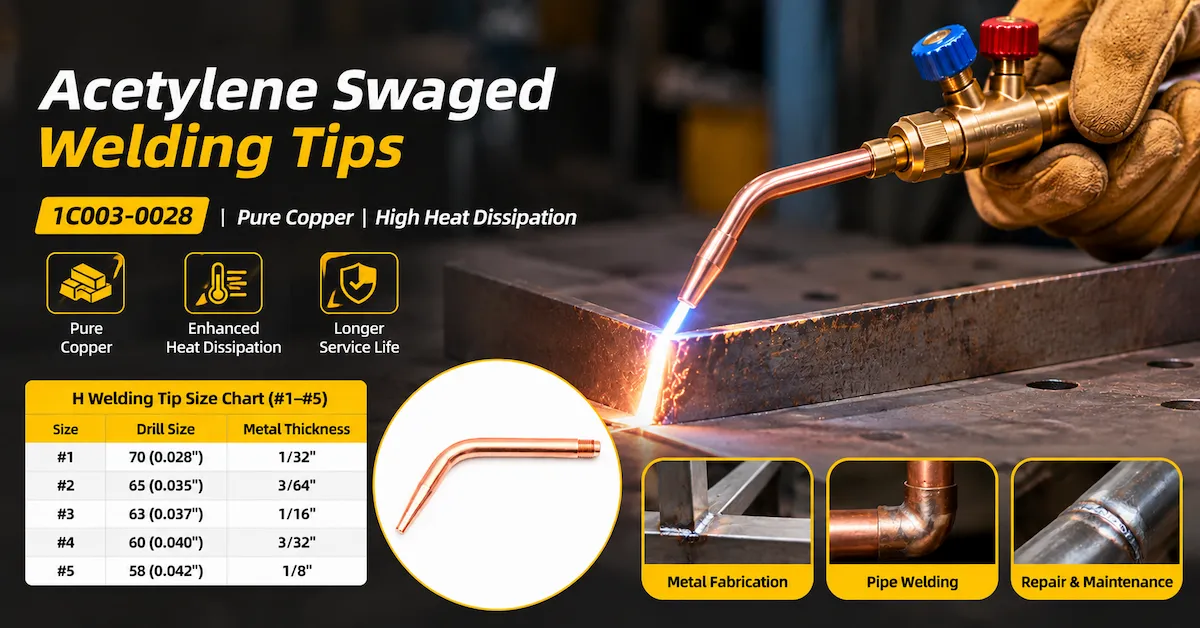
Key Takeaways: What Should Buyers Know About UWELD 1C003-0028?
-
Pure-copper construction: UWELD identifies pure copper as the material used for its 1C003-0028 welding tips.
-
Swaged profile: The product uses a formed, tapered working-end design associated with swaged welding tips.
-
Oxy-acetylene application: The product is intended for compatible oxygen-acetylene welding equipment.
-
Published H welding tip sizes: The supplied catalog chart lists sizes #1, #2, #3, #4, and #5.
-
Different gas orifices: The chart lists drill diameters ranging from 0.028 to 0.042 inches.
-
Metal thickness references: Each listed tip size corresponds to a particular nominal material thickness.
-
Torch compatibility: The exact mating interface must match the approved welding torch arrangement.
-
Wholesale considerations: Product identification, dimensional consistency, packaging, and repeat-order control are important for industrial distribution.
Purchasing recommendation: Choose the correct welding-tip size and compatible torch system before comparing material claims, service life, or unit prices.
What Are UWELD 1C003-0028 Acetylene Swaged Welding Tips?
The UWELD 1C003-0028 product family consists of copper welding tips designed for oxy-acetylene gas welding.
In oxy-acetylene welding, oxygen and acetylene are supplied through approved equipment and mixed to produce a controlled welding flame.
The flame provides heat to the workpiece so that an appropriate joint can be formed according to the welding procedure.
The welding tip is one component of this complete system.
It influences the delivery and shape of the flame but does not independently determine welding performance.
UWELD 1C003-0028 Product Overview
| Specification | Published Information |
|---|---|
| Brand | UWELD |
| Product model | 1C003-0028 |
| Product type | Acetylene swaged welding tip |
| Main material | Pure copper |
| Product construction | Swaged / formed tapered profile |
| Intended welding process | Oxy-acetylene gas welding |
| Associated catalog designation | H Welding Tip |
| Published size references | #1, #2, #3, #4, #5 |
| Drill-size range | No. 70–58 |
| Listed orifice range | 0.028–0.042 inches |
| Metal thickness references | 1/32–1/8 inch |
| Business services | Wholesale and OEM inquiries |
The size references come from the H welding tip chart supplied with the product materials. The complete available variants of the currently listed product should not be inferred from this chart alone.
What Does Swaged Mean?
Swaging is a metal-forming method used to produce or modify a component's shape through controlled deformation.
For welding tips, the term commonly describes a formed profile that tapers toward the gas outlet.
The shape of the tip helps establish its geometry and gas-delivery characteristics.
However, the exact production process for this UWELD model should not be inferred beyond the manufacturer's stated swaged construction.
How Is a Welding Tip Different From a Cutting Nozzle?
A welding tip is intended to deliver a suitable flame for welding.
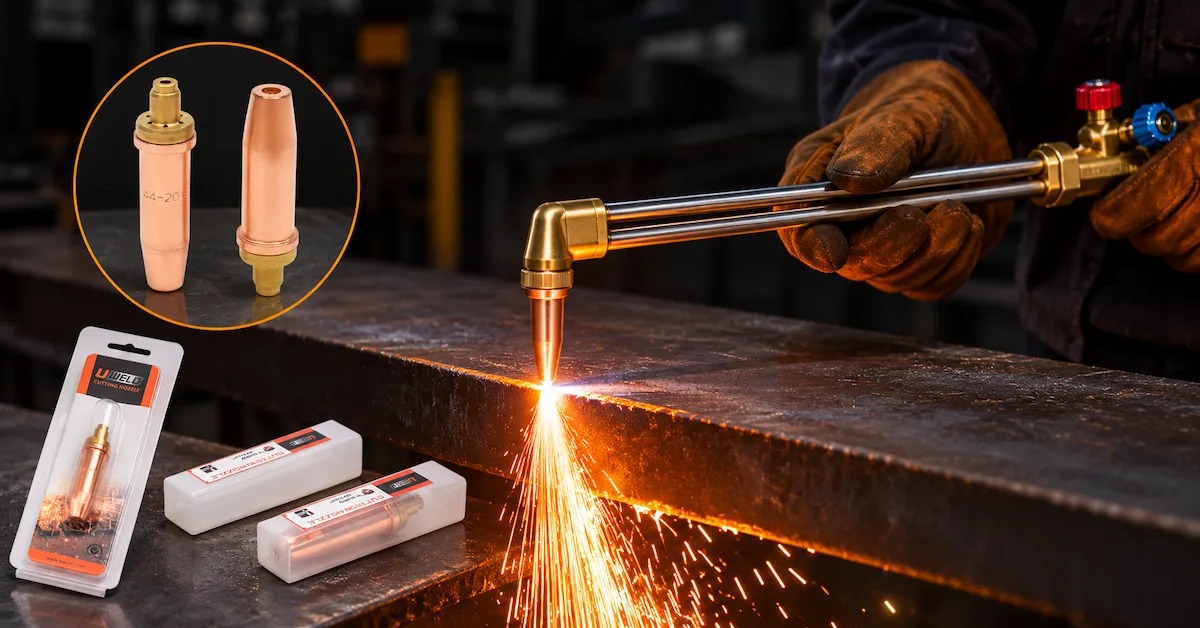
A conventional oxy-fuel cutting nozzle has a different purpose because it must also provide a concentrated cutting oxygen stream.
A gas welding tip should not be treated as a substitute for a cutting nozzle.
This distinction matters for distributors organizing their welding and cutting consumable catalogs.
Acetylene Welding Tip Size Chart: How to Choose #1–#5
The most useful technical information in the supplied UWELD catalog is the H welding tip size chart.
It identifies five welding-tip sizes, their drill-number references, the corresponding nominal opening diameters, and metal thicknesses.
UWELD H Welding Tip Size Chart
| Welding Tip Size | Drill Number | Listed Opening Diameter | Metal Thickness Reference |
|---|---|---|---|
| #1 | No. 70 | 0.028 in. | 1/32 in. |
| #2 | No. 65 | 0.035 in. | 3/64 in. |
| #3 | No. 63 | 0.037 in. | 1/16 in. |
| #4 | No. 60 | 0.040 in. | 3/32 in. |
| #5 | No. 58 | 0.042 in. | 1/8 in. |
Source: UWELD product illustration, H Welding Tip specification chart associated with 1C003-0028.
These values are manufacturer-published sizing references. They are not universal welding-capacity guarantees for every torch, gas supply, base metal, or joint configuration.
Why Is Drill Number Different From Welding Tip Size?
Drill numbers and welding-tip size numbers describe different things.
The welding-tip number identifies the size within the relevant product series.
The drill number is a reference for the nominal opening diameter.
For example, the chart identifies:
-
Welding tip #1 with drill No. 70 and a 0.028-inch opening.
-
Welding tip #5 with drill No. 58 and a 0.042-inch opening.
In the numbered drill-gauge system, a lower drill number generally indicates a larger drill diameter.
Therefore, buyers should not assume the drill number and welding-tip size follow the same numerical sequence.
Tip #1 and #2: Smaller Metal Thicknesses
The catalog associates #1 with a metal thickness reference of 1/32 inch and #2 with 3/64 inch.
These smaller tips may be relevant to compatible welding tasks involving relatively thin material.
However, the actual choice must account for base-metal characteristics, joint design, heat input requirements, and the approved torch system.
Tip #3: Intermediate Selection
Size #3 has a listed opening of 0.037 inches and a metal thickness reference of 1/16 inch.
It provides another nominal selection point within the product family.
Buyers should not assume it is suitable for every 1/16-inch joint without reviewing the intended welding procedure.
Tip #4 and #5: Larger Listed Openings
Sizes #4 and #5 have openings of 0.040 and 0.042 inches.
The chart associates them with 3/32-inch and 1/8-inch metal thickness references.
These specifications may help distributors distinguish products for different customer requirements.
Nevertheless, a larger tip does not automatically provide better weld quality.
Why Does the Orifice Matter?
The tip opening is one of the variables influencing gas delivery and flame characteristics.
A welding application requiring a different heat input may need a different tip size.
However, the orifice alone does not establish actual gas consumption or required operating pressure.
Those values depend on the complete approved torch configuration.
Buyer guidance: Use the size chart to shortlist suitable tips, then verify the exact application and torch compatibility before ordering.
Why Does UWELD Use Pure Copper for Its Swaged Welding Tips?
UWELD describes the 1C003-0028 series as manufactured from pure copper.
The product description emphasizes heat dissipation and longer service life.
These claims are relevant to material selection, but their actual performance should be evaluated against the intended application.
Copper Thermal Conductivity
Copper has high thermal conductivity compared with many common engineering metals.
This makes it useful for heat-intensive components, including certain welding and torch accessories.
A suitable copper design can help distribute heat through the component.
However, copper's thermal conductivity alone does not establish a particular operating-temperature limit or product lifetime.
Swaged Copper Tip Construction
The tapered shape is an important characteristic of the product.
Its geometry influences the physical working end and the relationship between the gas passage and the workpiece.
For purchasing managers, the most relevant characteristics include:
-
Correct material specification.
-
Approved orifice diameter.
-
Consistent tapered profile.
-
Suitable mating connection.
-
Acceptable surface condition.
-
Dimensional consistency between batches.
Does Pure Copper Guarantee Longer Tip Life?
Not by itself.
Service life can be influenced by the material, heat exposure, operating conditions, mechanical handling, contamination, and maintenance.
UWELD markets the product as having enhanced heat dissipation and longer service life, but the supplied information does not include a controlled comparative service-life test.
Industrial buyers should avoid assuming a specific percentage improvement without supporting evidence.
Copper Material Evaluation
| Material Consideration | Technical Relevance | Purchasing Requirement |
|---|---|---|
| Thermal conductivity | Supports heat transfer | Verify the approved material |
| Material purity | Part of the manufacturer's product claim | Request material specification when needed |
| Formed profile | Defines tip geometry | Check consistent dimensions |
| Orifice condition | Influences gas delivery | Inspect opening quality |
| Heat exposure | Affects working condition | Evaluate intended operating use |
| Wear and damage | Influences replacement needs | Establish inspection criteria |
For wholesale buyers, the goal is not simply to purchase a copper-colored tip.
It is to receive a product that consistently matches the approved copper welding-tip specification.
How Does the Swaged Profile Affect Welding Performance?
The working-end geometry is an important part of welding-tip design.
A swaged profile provides a tapered form toward the outlet.
Its effectiveness depends on the complete torch and gas-delivery arrangement.
Flame Characteristics
The welding tip influences the delivery of the gas mixture to the flame.
Different tip sizes can produce different flame characteristics when used within approved operating conditions.
However, the exact flame behavior depends on more than the outlet opening.
The torch's mixing arrangement, gas delivery, nozzle condition, and welding procedure also matter.
Heat Distribution
The copper body can transfer heat through the component.
This may be useful during welding operations involving elevated temperatures.
However, heat dissipation should not be confused with increased welding heat output.
The tip's ability to withstand service conditions must be evaluated according to its approved application.
Dimensional Consistency
For industrial users purchasing replacement tips, a consistent orifice and tapered profile can help maintain the approved equipment configuration.
A tip that differs dimensionally from the original may produce unexpected results or fail to fit correctly.
For distributors, this makes dimensional inspection and repeat-order consistency commercially important.
How to Check Oxy-Acetylene Welding Tip Compatibility
Selecting acetylene swaged welding tips involves more than choosing the appropriate opening diameter.
The welding tip must also match the intended torch and gas system.
Welding Tip Compatibility Checklist
| Evaluation Factor | What Buyers Should Check |
|---|---|
| Welding process | Approved oxy-acetylene welding application |
| Torch model | Exact compatible torch or mixer family |
| Tip model | UWELD 1C003-0028 |
| Tip size | Required #1–#5 catalog reference |
| Orifice | Correct drill number and diameter |
| Connection | Thread or mating geometry |
| Gas service | Oxygen and acetylene compatibility |
| Welding application | Material thickness and joint requirements |
| Technical documentation | Approved product specifications |
| Replacement plan | Accurate consumable identification |
Why Is Torch Compatibility Important?
A tip may appear similar to another product but use a different connection.
An incompatible tip should not be installed based only on its appearance or nominal size.
Buyers should identify the existing torch model and approved component reference before ordering replacements.
Can the Tips Be Used With Any Oxy-Acetylene Torch?
No universal compatibility is established by the supplied information.
The correct assembly requires a compatible tip interface, gas-mixing arrangement, and approved operating system.
The product's exact mating geometry should be checked against the intended torch.
Can the Tips Be Used With Propane?
The UWELD 1C003-0028 is marketed for oxy-acetylene welding.
It should not automatically be substituted into a propane or natural-gas system.
Different fuel gases may require different tip and mixer arrangements.
Is a Larger Tip Always Better?
No.
The correct tip size depends on the intended welding application.
Using a tip outside the approved range may create unsuitable flame or heating conditions.
The size should correspond to the workpiece and complete equipment specifications.
Where Are Acetylene Swaged Welding Tips Used?
The 1C003-0028 series is intended for compatible oxy-acetylene welding applications.
Potential customers include metal fabrication businesses, repair workshops, maintenance contractors, and welding equipment distributors.
Industrial Application Matrix
| Application | Main Requirement | Selection Consideration |
|---|---|---|
| Light metal fabrication | Welding selected thin metal components | Appropriate tip size and heat input |
| Repair workshops | Suitable metal joint repair | Torch and tip compatibility |
| Industrial maintenance | Welding during approved repair work | Equipment condition and access |
| General workshop welding | Different material thicknesses | Correct size selection |
| Equipment distribution | Replacement welding consumables | Product identification and inventory |
| OEM welding equipment supply | Consistent tip specifications | Batch quality and packaging |
Light Metal Fabrication
Some fabrication workshops use oxy-acetylene welding for suitable small metal components and repair work.
For these applications, tip selection must reflect the base metal, joint configuration, and approved welding procedure.
Repair and Maintenance
Repair workshops may require multiple welding-tip sizes to support different approved welding tasks.
A distributor supplying these customers benefits from maintaining accurate tip identification and replacement availability.
Industrial Equipment Distribution
For distributors, individual welding tips are small replacement components that may be purchased repeatedly.
Providing consistent product information can simplify customer selection and reduce incorrect orders.
What Applications Are Not Suitable?
A swaged oxy-acetylene welding tip should not automatically be used for metal cutting, high-output heating, MIG welding, or TIG welding.
Those processes use different equipment and consumables.
The product should be sold according to its intended gas welding application.
UWELD 1C003-0028 vs Other Welding Tip Families
UWELD offers several welding and heating-tip products.
These products may look related but differ in materials, configuration, or intended application.
UWELD Product Family Comparison
| Model | Published Product Characteristics | Main Purchasing Focus |
|---|---|---|
| 1C003-0028 | Pure-copper acetylene swaged welding tips | H-tip sizing and orifice selection |
| 1C003-0026 | General-purpose oxy-acetylene tips, sizes #0/#2/#4 | Light-duty welding and brazing |
| 1C003-0003 | Type 2/3 swaged welding nozzles using tellurium copper | Different material and nozzle family |
| 1C003-0029 | Type 551 oxygen-acetylene precision swaged welding tip | Alternative swaged tip configuration |
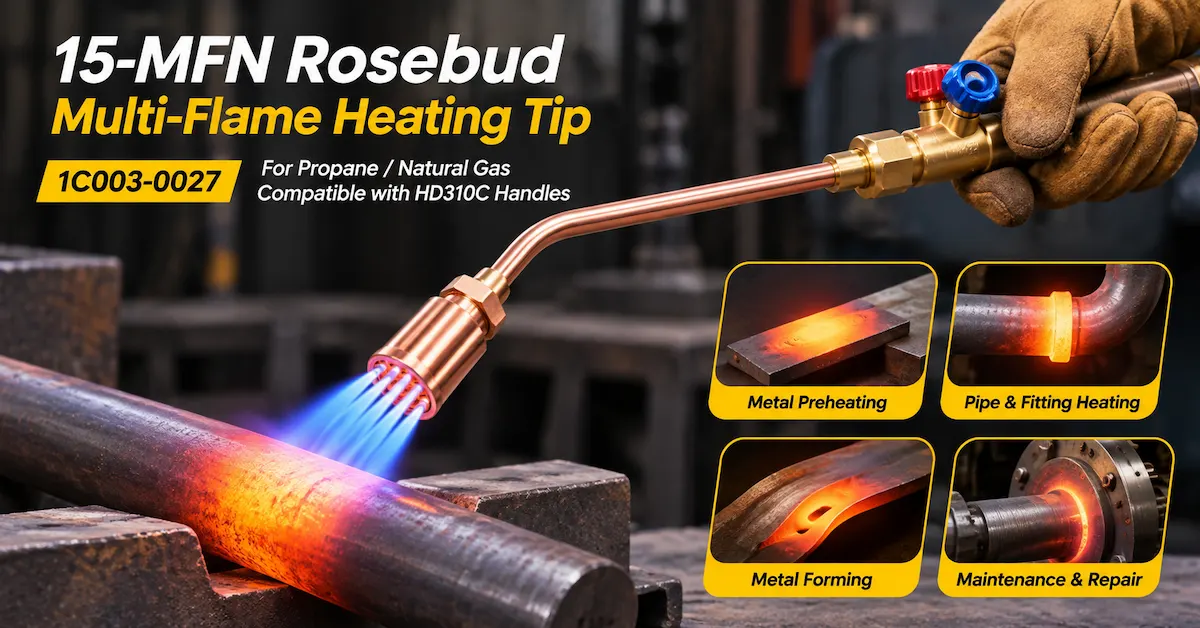
| 1C003-0027 | 15-MFN multi-flame heating head | Heating rather than conventional welding |
The models above should not be considered interchangeable without technical verification.
When Should Buyers Choose 1C003-0028?
This product is relevant when the customer requires the specified pure-copper swaged welding-tip family and compatible oxy-acetylene equipment.
The accompanying #1–#5 chart helps buyers evaluate different nominal metal thicknesses.
When Is 1C003-0026 More Relevant?
The 1C003-0026 series is marketed for general-purpose light-duty welding and brazing.
Its published #0, #2 and #4 sizes identify a different product family.
Customers should not assume that matching size numbers mean the two families share the same connection or working characteristics.
What About Tellurium Copper Tips?
UWELD also offers tellurium-copper welding tip products.
These use a different specified copper material.
The suitability of a particular material depends on the actual product design and application.
A purchasing decision should consider the complete component specification rather than select a material based on a general claim of superior durability.
For a broader product overview, explore UWELD Welding Tips.
What Quality-Control Checks Matter for Copper Welding Tips?
For industrial buyers, quality control involves confirming that each delivered product matches the approved specification.
A visually attractive copper welding tip is not sufficient evidence of suitable performance.
Recommended Quality Inspection Checklist
| Inspection Area | Main Requirement |
|---|---|
| Product identification | Correct 1C003-0028 model |
| Tip size | Approved #1–#5 size reference |
| Orifice diameter | Correct catalog-listed opening |
| Copper material | Approved material specification |
| Swaged profile | Conformance to specified geometry |
| Connection | Correct mating interface |
| Surface condition | No unacceptable damage or deformation |
| Internal passage | Suitable condition and dimensional consistency |
| Packaging | Correct size and product identification |
| Traceability | Order or production-lot information |
| Sample approval | Match the agreed reference sample |
| Functional verification | Appropriate model-specific testing |
Why Is Orifice Inspection Important?
The orifice is a critical dimensional characteristic.
An opening that differs from the approved specification may affect the intended gas-delivery arrangement.
For wholesale procurement, inspection should establish that the correct size has been supplied.
Why Should Buyers Inspect the Swaged Profile?
The tapered profile helps identify the product's intended geometry.
Deformation, damage or inconsistent dimensions may affect the suitability of the tip.
A purchasing specification should therefore define the relevant dimensional acceptance criteria.
How Can Suppliers Maintain Batch Consistency?
A recommended quality-control program includes incoming material verification, dimensional inspection, representative sample approval, product identification, and documented acceptance requirements.
These are recommended buyer checks, not a claim that every step has been independently verified for the UWELD production line.
Should Buyers Request Material Certificates?
For ordinary replacement purchases, a product specification and suitable sample may satisfy some commercial requirements.
For larger industrial or OEM programs, buyers may need additional material documentation.
The required documents depend on the application, market and purchasing agreement.
UWELD's FAQs describe its quality-documentation and sample-request services.
What Causes Oxy-Acetylene Welding Tips to Wear or Become Unsuitable?
Copper welding tips operate in a high-temperature environment.
Their condition may change through use, mechanical handling, or contamination.
Common Causes
| Potential Cause | Possible Effect | Purchasing or Maintenance Response |
|---|---|---|
| Excessive heat exposure | Component deterioration | Use approved operating conditions |
| Physical impact | Deformed working end | Inspect and replace damaged tips |
| Contamination | Unsuitable gas passage condition | Follow approved cleaning procedures |
| Incorrect torch connection | Mechanical or functional mismatch | Verify compatibility |
| Wrong tip size | Unsuitable welding characteristics | Use approved size chart |
| Improper modification | Changed nozzle geometry | Avoid unauthorized alterations |
Why Is Correct Maintenance Important?
A welding tip that becomes damaged may no longer match its original design.
Qualified users should inspect equipment according to the manufacturer's instructions and remove unsuitable components from service.
Improvised drilling, reshaping or enlargement of the gas opening should not be used as a substitute for the correct replacement tip.
Does Pure Copper Eliminate Wear?
No.
Copper can support useful thermal characteristics, but it remains subject to physical damage and changes caused by operating conditions.
For distributors, supplying correct replacements is more dependable than promising indefinite service life.
How Do Welding Tip Size and Product Quality Affect Wholesale Cost?
The wholesale cost of acetylene swaged welding tips depends on the approved product configuration and commercial purchasing requirements.
Material, dimensional control, tip sizes, inspection, packaging and logistics can all influence the quotation.
Total Purchasing Cost
Total Sourcing Cost = Product Cost + Inspection + Packaging + Freight + Inventory + Expected Replacement Costs
| Cost Factor | Purchasing Consideration |
|---|---|
| Copper material | Approved material specification |
| Tip size | Required size assortment |
| Orifice accuracy | Inspection requirements |
| Swaged geometry | Manufacturing and dimensional control |
| Packaging | Bulk or retail configuration |
| OEM branding | Labels and packaging artwork |
| MOQ | Quantity per size or order |
| Freight | Shipment and destination |
| Inventory | Popular and slow-moving sizes |
| After-sales | Replacement and compatibility support |
Why Does SKU Accuracy Matter?
A distributor may sell several similar-looking welding tips.
If different sizes are stored under incomplete product descriptions, warehouse selection errors can occur.
Accurate SKU identification can help separate #1, #2, #3, #4, and #5 variants.
How Should Buyers Plan Inventory?
Use actual customer demand to prioritize stock.
A distributor should not automatically purchase equal quantities of every size.
Frequently requested sizes can be stocked according to demand, while less common sizes can be purchased under an appropriate replenishment arrangement.
Is the Lowest Unit Price Always the Best Option?
Not necessarily.
A cheaper tip may provide suitable value when it meets the approved specification.
However, incorrect sizing, inconsistent dimensions, or poor replacement-part identification can create additional costs.
Comparing quotations using the same technical and packaging requirements provides a more meaningful basis for purchasing.
How Can Buyers Select the Right Acetylene Welding Tip in Three Steps?
Step 1: Define the Welding Application
Identify the base metal, nominal material thickness, joint design and intended welding procedure.
Use the published H welding tip chart as a starting point.
Decision: Select a relevant nominal tip-size range.
Step 2: Confirm Equipment Compatibility
Check the torch model, mating connection, fuel-gas service, orifice diameter and approved welding procedure.
Do not assume that visually similar tips are interchangeable.
Decision: Approve only a compatible welding-tip configuration.
Step 3: Review Product Quality and Supply Conditions
Evaluate samples, material requirements, dimensional inspection, packaging, MOQ and delivery terms.
Decision: Choose the configuration that meets both technical and purchasing requirements.
For model-specific information, review the UWELD 1C003-0028 Product Page.
How Should OEM Buyers Source Acetylene Swaged Welding Tips?
UWELD supports wholesale and OEM/ODM inquiries for welding and cutting equipment.
International distributors and equipment brands may require welding tips supplied in different quantities, assortments and packaging formats.
Recommended OEM Procurement Workflow
| Stage | Main Requirement |
|---|---|
| Application review | Define welding process and intended users |
| Product selection | Confirm model and sizes |
| Compatibility evaluation | Review torch and gas-service requirements |
| Sample approval | Evaluate dimensions, materials and condition |
| Packaging approval | Confirm labels, quantity and branding |
| Quality planning | Agree on inspection requirements |
| Bulk purchasing | Confirm pricing, MOQ and delivery |
| Repeat supply | Maintain approved product specifications |
OEM Customization Considerations
Potential requirements may include private-label packaging, model identification, carton markings and selected product assortments.
Changes affecting the tip's orifice, material or mating interface should receive appropriate technical evaluation.
MOQ, Samples and Lead Times
UWELD states that MOQ varies by product and customization requirements.
Samples may be arranged under agreed commercial conditions.
Lead times depend on product availability, order quantities and customization scope.
For an order containing several sizes, buyers should establish the required quantity and availability of each size separately.
What Should Be Included in a 1C003-0028 Wholesale RFQ?
A detailed request for quotation helps avoid incorrect product selection and unnecessary revisions.
Recommended RFQ Checklist
| RFQ Field | Information to Provide |
|---|---|
| Product | Acetylene swaged welding tip |
| Model | UWELD 1C003-0028 |
| Fuel gas | Acetylene |
| Welding process | Oxy-acetylene gas welding |
| Required tip sizes | Specify approved sizes |
| Drill size | Required nominal drill reference |
| Orifice | Required nominal opening diameter |
| Metal thickness | Intended application range |
| Torch model | Exact compatible equipment |
| Connection | Required mating geometry |
| Material | Pure copper per product specification |
| Quality requirements | Dimensions, samples and inspection |
| Packaging | Bulk or private-label |
| Order quantity | Quantity per tip size |
| Destination | Country or market |
| Delivery | Shipping and commercial requirements |
For accurate quotations, buyers should state the exact tip size rather than relying only on the base product model.
Looking for acetylene swaged welding tips for wholesale distribution? Contact UWELD to request the current 1C003-0028 size chart, torch compatibility details, samples, packaging options and bulk pricing.
Frequently Asked Questions About Acetylene Swaged Welding Tips
1. What are acetylene swaged welding tips?
Acetylene swaged welding tips are formed welding-tip components intended for compatible oxy-acetylene gas welding equipment. UWELD 1C003-0028 is described as a pure-copper swaged welding-tip product.
2. What material is used in the UWELD 1C003-0028?
UWELD identifies pure copper as the product material. Buyers with specific alloy or purity requirements should include those requirements in their purchasing specification.
3. What sizes are listed in the accompanying H welding tip chart?
The supplied chart lists #1, #2, #3, #4 and #5, with nominal openings from 0.028 to 0.042 inches.
4. What is the difference between tip size and drill number?
The tip size identifies the product variant within a tip family. The drill number refers to the nominal size of the opening. The two numbering systems should not be confused.
5. Which welding tip is listed for 1/16-inch metal?
The UWELD H welding tip chart associates size #3, drill No. 63 and a 0.037-inch opening with a 1/16-inch metal thickness reference. Final selection also depends on the approved torch and welding procedure.
6. Does pure copper guarantee longer service life?
No fixed improvement is established by the supplied information. Copper provides useful thermal properties, but actual service life depends on the product design, operating conditions, maintenance and handling.
7. Can these welding tips be used for metal cutting?
The 1C003-0028 is identified as a welding-tip product. Conventional oxy-fuel cutting requires a suitable cutting torch and cutting nozzle with a separate cutting oxygen stream.
8. Are these tips compatible with every oxy-acetylene torch?
No universal compatibility has been established. Buyers should verify the mating connection, torch model, tip size and approved equipment configuration.
9. What should distributors inspect before placing bulk orders?
Important checks include product identification, tip size, opening diameter, copper material, swaged geometry, mating connection, surface condition, packaging and production consistency.
10. Does UWELD support OEM and wholesale welding-tip orders?
UWELD supports wholesale and OEM/ODM inquiries for welding products. Buyers can discuss samples, packaging, quantities, technical requirements and available customization with its sales team.
Conclusion
Selecting the right acetylene swaged welding tips requires more than comparing copper material descriptions or product prices.
The UWELD 1C003-0028 product family is designed for compatible oxy-acetylene welding applications and features a swaged, tapered copper construction.
The associated H welding tip chart provides useful #1–#5 size references, including drill numbers, nominal opening diameters and corresponding metal thicknesses.
For industrial buyers, these specifications help establish the correct product selection, but actual suitability also depends on the intended torch, gas system and welding procedure.
Pure-copper construction offers relevant thermal properties, while product consistency depends on suitable materials, dimensional control and approved manufacturing requirements.
For distributors, importers and OEM brands, reliable purchasing also involves correct SKU identification, sample approval, quality inspection, packaging and replacement-part availability.
UWELD supplies welding tips, gas welding accessories, cutting equipment and related industrial products for professional international markets.
To explore the product, visit the UWELD 1C003-0028 Acetylene Swaged Welding Tips, review UWELD Welding Tips, or contact UWELD to request specifications, samples, OEM packaging options and wholesale quotations.