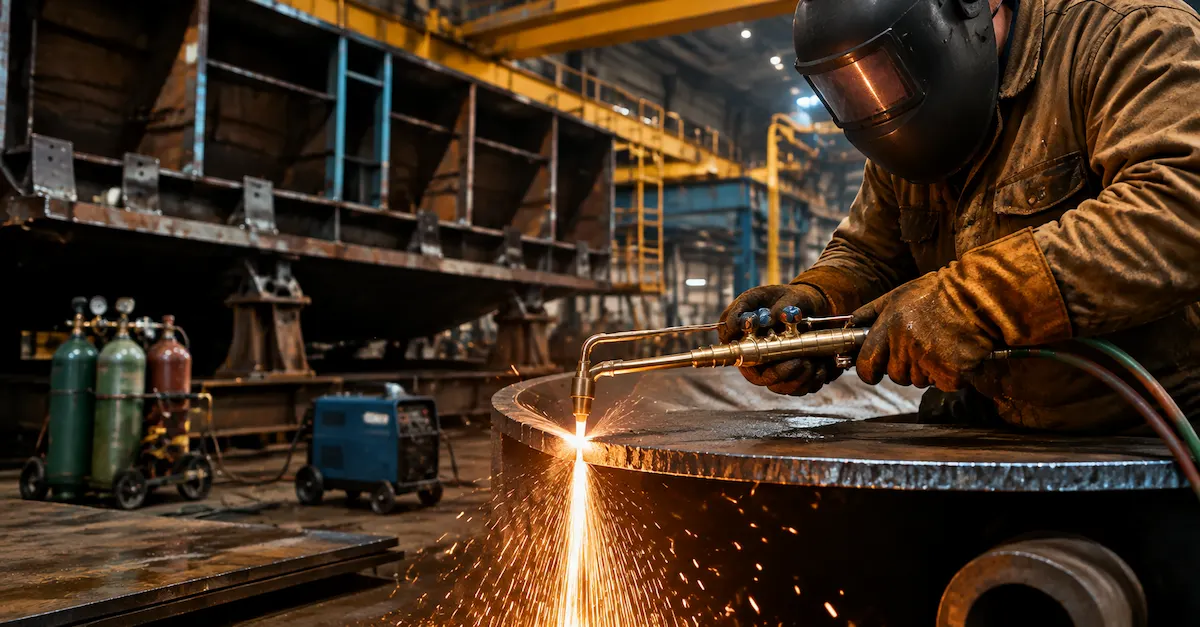


Quick Answer: The UWELD 1C008-0044 TA90 single stage oxygen regulator is a forged-brass pressure-reduction device designed for compatible oxy-fuel welding, cutting, heating, and brazing applications. It features dual pressure gauges, an integrated safety relief valve, a shut-off valve, and specified oxygen-service connections. Industrial buyers should verify the exact pressure ratings, cylinder compatibility, oxygen cleanliness, and product-specific inspection documents before approving wholesale or OEM orders.
Reliable oxygen pressure control is an essential part of professional oxy-fuel equipment.
For metal fabrication workshops, construction contractors, industrial maintenance companies, and welding equipment distributors, an incorrectly specified regulator can cause installation problems, unstable gas delivery, equipment downtime, and significant safety risks.
However, choosing an oxygen regulator involves more than comparing its body material or pressure gauges.
Buyers must evaluate the complete gas supply system, including cylinder connections, operating pressure requirements, flow capacity, hose fittings, protective devices, and destination-market standards.
UWELD, operated by Ningbo United Tools Co., Ltd., supplies industrial gas regulators, cutting torches, welding equipment, and related accessories for international industrial markets.
This guide examines the TA90 oxygen regulator's published features, explains the main technical selection criteria, and provides practical quality and purchasing checklists for distributors, importers, and OEM buyers.
Explore UWELD's Gas Cutting equipment range for related regulators and oxy-fuel accessories.
Key Takeaways: What Should Buyers Know About the TA90 Oxygen Regulator?
-
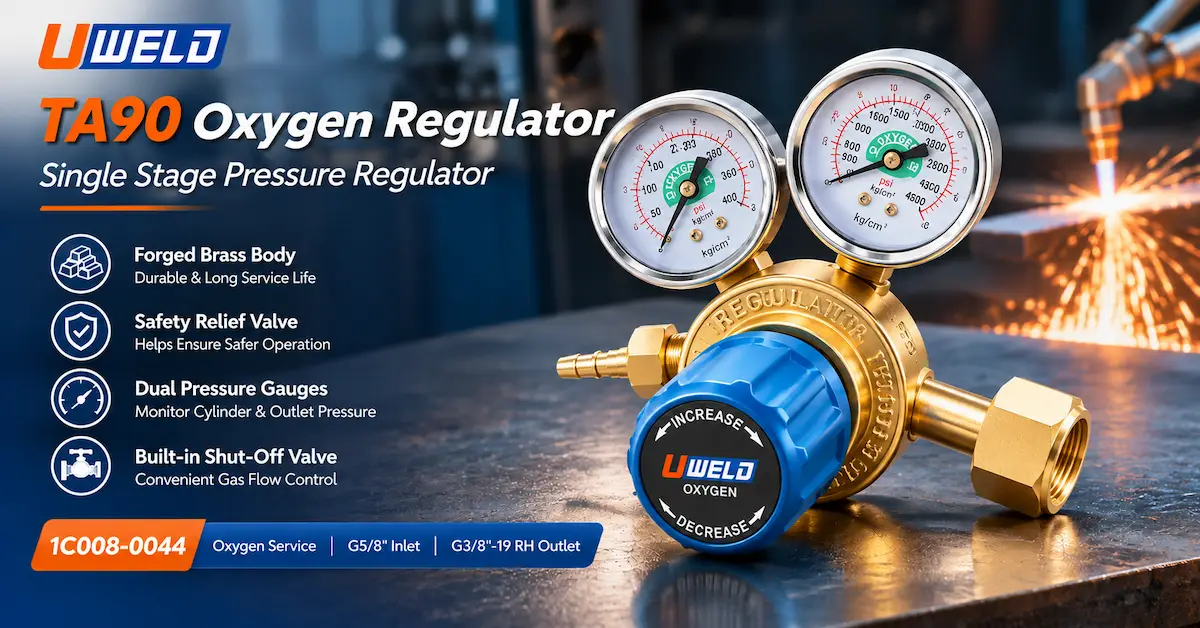
Single-stage construction: The TA90 reduces oxygen pressure through one regulating stage, suitable for applications within its approved technical limits.
-
Forged brass body: UWELD identifies forged brass construction as a key feature of the regulator.
-
Dual pressure gauges: The gauges provide indications of supply-side and outlet-side pressure.
-
Integrated protective features: The product description includes a safety relief valve and a built-in shut-off valve.
-
Connection verification: The product page lists a G5/8" inlet and G3/8"-19 RH outlet for the oxygen configuration.
-
Wholesale purchasing: OEM buyers should confirm current specifications, gas-service identification, testing requirements, and order conditions before production approval.
The most important purchasing principle is simple: select a regulator based on its approved oxygen-service specifications, not its appearance or maximum gauge markings alone.
What Is the UWELD TA90 Single Stage Oxygen Regulator?
The TA90 is a pressure regulator intended to reduce oxygen supply pressure to a controlled downstream pressure suitable for approved equipment.
In an oxy-fuel welding or cutting system, oxygen is delivered from a cylinder or other approved supply through a compatible regulator and downstream components.
The regulator provides pressure reduction, while the torch and other equipment determine the requirements for the particular working process.
How Does Single-Stage Pressure Regulation Work?
A single-stage regulator uses one pressure-reduction mechanism.
Its internal regulating assembly responds to pressure conditions and adjusts gas delivery according to its design and operating limits.
As cylinder pressure changes during use, the regulator must continue operating within its specified performance range.
The actual pressure stability depends on the regulator design, gas demand, and working conditions.
Single-Stage vs Two-Stage Oxygen Regulators
| Comparison | Single-Stage Regulator | Two-Stage Regulator |
|---|---|---|
| Pressure reduction | One regulating stage | Two regulating stages |
| Construction | Generally simpler | More complex regulating assembly |
| Pressure control | Depends on design and supply conditions | Can offer improved control against inlet pressure changes |
| Typical selection | Suitable conventional oxygen applications | Applications requiring more demanding pressure stability |
| Maintenance | Product-specific requirements | Product-specific requirements |
| Main buying criterion | Appropriate pressure, flow, and connection specifications | Verified pressure stability and application suitability |
A two-stage regulator is not automatically required for every industrial oxygen system.
For general welding and cutting applications, a properly specified single-stage regulator may be suitable.
Buyers should request actual performance specifications rather than assume that one design always delivers better results.
What Are the Main Features of the UWELD 1C008-0044 TA90?
UWELD identifies the 1C008-0044 OXY as the oxygen configuration within its TA90 regulator family.
The official product information highlights several features relevant to industrial procurement.
TA90 Product Specification Overview
| Specification | Published UWELD Information |
|---|---|
| Brand | UWELD |
| Product model | 1C008-0044 |
| Variant | 1C008-0044 OXY |
| Product series | TA90 |
| Product type | Single-stage oxygen pressure regulator |
| Gas service | Oxygen |
| Body construction | Forged brass |
| Pressure indication | Dual gauges |
| Safety relief feature | Integrated relief valve |
| Gas shut-off feature | Built-in shut-off valve |
| Inlet connection | G5/8" |
| Outlet connection | G3/8"-19 RH |
| Applications | Compatible welding, cutting, brazing, heating, and industrial gas systems |
| Customization | Subject to technical and commercial confirmation |
The exact current inlet-pressure rating, adjustable outlet range, flow capacity, relief-valve specification, and available connection variants should be verified using the latest model-specific datasheet.
See the UWELD 1C008-0044 TA90 Oxygen Regulator product page.
Forged Brass Body Construction
UWELD's product description identifies a forged brass body.
Brass is commonly used in industrial pressure-regulating equipment because suitable alloys offer useful mechanical and manufacturing characteristics.
However, material selection alone does not guarantee product performance.
The regulator's overall reliability also depends on its internal components, assembly quality, cleanliness, sealing integrity, and operating environment.
Dual-Gauge Pressure Monitoring
The TA90 features two gauges intended to monitor different pressure conditions.
One indicates supply-side pressure, while the other indicates regulated delivery pressure.
This arrangement helps operators monitor the gas system during approved operation.
However, a cylinder pressure gauge is not a precise measurement of remaining usable gas volume under all conditions.
Temperature and cylinder conditions also influence pressure readings.
For industrial purchasing, gauge scale, accuracy, legibility, and suitability for oxygen service should all be reviewed.
Integrated Safety Relief Valve
The product description identifies an integrated safety relief valve.
A relief valve is intended to provide a defined pressure-relief function under specified conditions.
It does not replace correct regulator selection, compatible pressure ratings, or the required system safety procedures.
Buyers should request information about the relief-valve specifications and applicable verification requirements.
Built-In Shut-Off Valve
The TA90 also includes a shut-off valve according to its published product features.
This provides an additional gas-control function within the equipment arrangement.
However, a built-in shut-off feature should not be treated as a substitute for proper cylinder isolation and the manufacturer's approved operating and shutdown procedures.
Why Are Oxygen Regulator Inlet and Outlet Connections Important?
Connection compatibility is one of the most important technical issues for overseas equipment buyers.
A regulator may have suitable internal construction but still be incompatible with the local cylinder or hose system.
TA90 Connection Requirements
The UWELD oxygen regulator product page lists:
| Connection | Published Specification | Buyer Verification |
|---|---|---|
| Inlet | G5/8" | Cylinder valve interface and approved sealing arrangement |
| Outlet | G3/8"-19 RH | Hose fitting, downstream assembly, connection requirements |
| Gas service | Oxygen | Oxygen-specific product identification |
| Alternative connections | Subject to supplier confirmation | Exact technical drawing and configuration approval |
Different markets may use different cylinder connection systems.
For example, certain North American oxygen cylinder arrangements use CGA 540 connections, while other regions use different approved interfaces.
A CGA connection and a metric or British-style threaded connection must not be assumed interchangeable.
Why Connection Labels Are Not Enough
A thread designation provides important information, but full compatibility also depends on the mating geometry, sealing arrangement, gas service, and pressure rating.
Buyers should never approve an installation solely because two fittings appear similar.
The correct purchasing procedure is to match the regulator's exact connection specification to the intended cylinder and downstream equipment.
Regional Purchasing Considerations
| Buyer Market | Main Requirement |
|---|---|
| European industrial distributors | Confirm applicable cylinder and threaded connection arrangements |
| North American importers | Verify required CGA connections and oxygen service |
| Middle Eastern equipment dealers | Confirm the standards used by local industrial gas suppliers |
| Asian industrial markets | Verify local cylinder valves, hose connections, and market requirements |
| OEM welding brands | Establish destination-specific approved product configurations |
For private-label programs, separate regional variants may be necessary.
Different connection configurations should receive distinct product identification to reduce ordering mistakes.
Where Is the TA90 Oxygen Regulator Used?
The TA90 oxygen regulator is intended for compatible industrial oxygen systems used in welding, cutting, brazing, and heating.
Its suitability depends on the complete equipment arrangement and approved operating specifications.
Application Comparison
| Application | Oxygen Regulator Function | Main Buyer Requirement |
|---|---|---|
| Oxy-fuel welding | Controls oxygen supply to compatible welding equipment | Pressure and flow suitability |
| Metal cutting | Supplies regulated oxygen to an approved cutting system | Adequate oxygen delivery and compatible connections |
| Metal fabrication | Supports suitable welding and cutting processes | Equipment compatibility and serviceability |
| Industrial workshops | Provides oxygen pressure regulation for approved equipment | Reliability, inspection, replacement support |
| Brazing and heating | Supports oxygen supply in compatible oxy-fuel systems | Torch and gas-system compatibility |
| Gas cylinder systems | Reduces oxygen cylinder pressure | Cylinder connection and rated inlet pressure |
Metal Fabrication Workshops
Metal fabrication facilities use oxy-fuel equipment for appropriate steel cutting, heating, and gas welding tasks.
A correctly specified regulator helps provide the required oxygen supply conditions for the connected equipment.
However, cutting performance also depends on nozzle selection, fuel gas, material thickness, and operator procedures.
Industrial Maintenance and Repair
Maintenance teams may use oxy-fuel equipment for removing damaged components, suitable repairs, and controlled heating operations.
For these users, equipment compatibility and replacement availability are important purchasing considerations.
Brazing and Heating Operations
Some brazing and heating applications use oxygen with an approved fuel gas to produce the required heating characteristics.
The regulator must be compatible with the oxygen supply and intended downstream equipment.
An oxygen regulator should not be used as a substitute for a fuel-gas regulator or an inert-gas purging regulator.
How Does TA90 Compare With Other UWELD Oxygen Regulators?
UWELD supplies multiple oxygen regulator configurations for different industrial applications.
The correct model depends on the required connection standard, pressure-control characteristics, body design, and target market.
UWELD Oxygen Regulator Comparison
| Model | Published Features | Main Purchasing Direction |
|---|---|---|
| 1C008-0044 TA90 OXY | Single-stage, forged brass, dual gauges, relief and shut-off valves | Buyers evaluating TA90-style oxygen pressure control |
| 1C008-0042 OXY | Gas regulator family with separate oxygen and fuel-gas variants | Buyers requiring another approved regulator configuration |
| 1C008-0048 | Medium-duty single-stage design, forged brass construction | General industrial oxygen regulator sourcing |
| 1C008-0080 OXY | Single-stage medium-duty regulator with color-coded gauges and protective features | Buyers evaluating an alternative gauge and adjustment arrangement |
| 1C008-0001 | Heavy-duty oxygen regulator with forged brass body and dual gauges | Industrial heavy-duty product sourcing |
These are different product configurations, not a verified ranking of pressure accuracy or durability.
For example, the TA90 and 1C008-0080 should not be compared solely by gauge appearance.
Their pressure ranges, flow capacities, connections, and required operating conditions must be confirmed through current product specifications.
Buyers can explore the UWELD Heavy Duty Oxygen Regulator 1C008-0001 or compare the 1C008-0048 Single-Stage Oxygen Regulator.
Oxygen vs Acetylene Versions
UWELD also offers acetylene regulator products within its broader gas-regulator range, including an acetylene version of the TA90 family.
An oxygen regulator and an acetylene regulator are not interchangeable.
They have different approved gas services, pressure requirements, and potentially different connections and internal components.
Buyers should verify the full model suffix and gas-service marking before placing an order.
What Quality Checks Matter for Oxygen Pressure Regulators?
Oxygen pressure regulators are safety-related gas-control components.
For industrial importers, quality verification should include more than visual inspection.
A professional procurement review should examine the approved configuration, material requirements, connections, pressure-control performance, cleanliness, and inspection records.
Recommended Inspection Checklist
| Inspection Area | Main Requirement | Suggested Evidence |
|---|---|---|
| Product identity | Correct OXY model and revision | Approved product label and specification |
| Body material | Approved forged brass specification | Material documentation |
| Inlet connection | Correct thread and sealing arrangement | Dimensional verification |
| Outlet connection | Correct downstream fitting | Approved drawing |
| Pressure gauges | Appropriate scales and readings | Gauge verification records |
| Regulating mechanism | Required functional performance | Model-specific functional test |
| Relief valve | Approved protective function | Applicable verification record |
| Shut-off valve | Correct component function | Assembly and functional inspection |
| Gas tightness | Conformance to approved leakage limits | Qualified leakage-test report |
| Oxygen cleanliness | Suitable control of contaminants | Cleaning and handling procedure |
| Packaging | Correct identification and protection | Approved packing specification |
| Traceability | Batch and product reference | Inspection and shipment records |
Why Oxygen Cleanliness Is Critical
Oxygen supports combustion and can intensify fire hazards when equipment is contaminated with incompatible substances.
Oil, grease, and other unsuitable contaminants must be controlled in oxygen-service equipment.
The U.S. Occupational Safety and Health Administration's 29 CFR 1910.253 requires oxygen equipment and related gas apparatus to be kept free from oily or greasy substances.
Therefore, an OEM supplier's cleaning, assembly, handling, and packaging procedures are important parts of the purchasing review.
What About ISO 2503?
ISO 2503:2009 addresses relevant pressure regulators for gas cylinders used in welding, cutting, and allied processes.
Its requirements can provide a useful technical reference when evaluating industrial gas-regulator products.
However, the existence of an applicable standard does not prove that every regulator is independently certified to it.
Buyers should verify the exact model, standard edition, conformity documentation, and market requirements.
UWELD states that it holds ISO 9001:2015 quality management system certification. This should be distinguished from individual product conformity.
How Can Distributors Reduce Oxygen Regulator Purchasing Risks?
Industrial regulators may be purchased repeatedly over several years.
For distributors, a successful initial sample does not guarantee that every subsequent shipment will contain an identical configuration.
Common Procurement Risks
| Risk | Possible Consequence | Recommended Control |
|---|---|---|
| Incorrect gas version | Unsuitable equipment supplied | Control OXY model identification |
| Wrong inlet connection | Cylinder incompatibility | Confirm exact interface |
| Wrong outlet thread | Hose or downstream fitting mismatch | Use approved connection drawings |
| Unverified pressure rating | Incorrect equipment selection | Require current technical data |
| Gauge substitution | Unexpected specification difference | Approve component references |
| Unapproved valve changes | Repeat-order inconsistency | Establish revision control |
| Incomplete test documents | Delayed product acceptance | Define documentation before production |
| Poor packaging identification | Warehouse and customer confusion | Apply controlled labels and SKUs |
Why a Controlled Product Specification Matters
For wholesale programs, the approved specification should identify the product model, gas service, required connections, technical limits, components, inspection criteria, and packaging.
Any proposed technical changes should receive appropriate review before production approval.
This helps maintain consistency across different batches and reduces the risk of confusing oxygen and fuel-gas variants.
What Affects the Wholesale Cost of an Oxygen Regulator?
The total purchasing cost depends on the regulator configuration and the requirements of the order.
Material selection, connection variants, gauge design, inspection procedures, packaging, order quantity, and logistics may all influence the quotation.
Total Cost of Supply
Total Sourcing Cost = Product Purchase Cost + Inspection + Packaging + Freight + Inventory + Expected After-Sales Costs
| Cost Factor | Purchasing Impact |
|---|---|
| Forged brass construction | Material and manufacturing cost |
| Gauge configuration | Component requirements |
| Connection customization | Technical and production arrangements |
| Quality inspection | Testing and documentation scope |
| OEM branding | Artwork and packaging requirements |
| Quantity | Commercial pricing and minimum order constraints |
| Shipping | Shipment and destination costs |
| Spare parts | Long-term maintenance and customer support |
A lower initial quotation is not necessarily the most economical option if it excludes required accessories or documentation.
For industrial procurement, quotations should be compared using the same approved technical specification.
No universal cost-saving percentage should be assumed without actual purchasing data.
How Can Buyers Select the Right Oxygen Regulator in Three Steps?
A structured selection process can help industrial buyers avoid unnecessary technical and commercial risks.
Step 1: Confirm the Application and Gas Service
Identify the intended equipment, oxygen supply, pressure and flow requirements, and operating environment.
Verify that the selected regulator is approved for oxygen service.
Decision: Exclude products that do not match the required gas service or application.
Step 2: Verify Technical Compatibility
Compare the regulator's inlet and outlet connections, pressure ratings, gauge arrangement, protective features, and applicable documents.
For the TA90, confirm whether the required G5/8" inlet and G3/8"-19 RH outlet match the intended installation.
Decision: Approve only technically suitable configurations.
Step 3: Review Quality and Commercial Terms
Evaluate sample inspection, current datasheets, testing documents, MOQ, packaging, lead times, and after-sales arrangements.
Decision: Select the configuration that provides the best verified combination of compatibility, quality, and purchasing value.
For product-specific assistance, review the UWELD TA90 Oxygen Regulator and contact the technical sales team.
OEM/ODM Single Stage Oxygen Regulator Supply
International equipment brands and industrial distributors may require private-label regulators or destination-market-specific configurations.
UWELD supports OEM/ODM inquiries involving branding, appearance, packaging, and feasible specification adjustments.
For gas regulators, technical changes require particular care because they may affect pressure control, oxygen compatibility, or the intended safety functions.
Recommended OEM Procurement Workflow
1. Application review: Define the intended oxygen equipment and destination market.
2. Technical specification: Confirm the regulator model, gas service, rated pressures, connections, and required documentation.
3. Engineering review: Assess any proposed changes to components or interfaces.
4. Sample approval: Verify the product against the agreed technical and quality requirements.
5. Branding and packaging: Approve the product identification, labels, cartons, and instructions.
6. Production inspection: Establish agreed verification and traceability requirements.
7. Repeat-order control: Maintain approved product specifications and documented revisions.
These are recommended project stages, not a guarantee of a particular development schedule.
MOQ, Samples, and Lead Time
According to UWELD's FAQ page, MOQ varies by product and customization requirements.
Product samples may be arranged, with sample and shipping expenses normally borne by the requesting customer.
Stock products generally have a stated preparation period of one to two weeks, while customized products require individual lead-time confirmation.
For a specific TA90 oxygen regulator order, buyers should confirm the current availability, minimum quantity, inspection requirements, and delivery schedule.
What Should Be Included in a TA90 Oxygen Regulator RFQ?
A complete request for quotation enables the supplier to identify the intended configuration and provide a more meaningful technical response.
| RFQ Field | Information to Provide |
|---|---|
| Product | TA90 single stage oxygen regulator |
| Model | 1C008-0044 OXY |
| Application | Welding, cutting, heating, industrial maintenance |
| Oxygen supply | Cylinder or other approved supply arrangement |
| Inlet pressure | Required rated specification |
| Outlet pressure | Required operating range |
| Flow capacity | Expected application demand |
| Inlet connection | G5/8" or requested approved alternative |
| Outlet connection | G3/8"-19 RH or requested approved alternative |
| Gauge requirements | Required scales and measurement characteristics |
| Safety requirements | Relief valve and applicable verification |
| Quality documents | Datasheet, inspection and conformity records |
| Branding | UWELD or private-label |
| Quantity | Sample quantity and expected bulk demand |
| Destination market | Country or region |
| Packaging | Standard or customized |
| Delivery | Required schedule and shipping terms |
Need current specifications or wholesale pricing? Contact UWELD to request the TA90 oxygen regulator datasheet, connection options, samples, OEM customization details, and a model-specific quotation.
Frequently Asked Questions About Single Stage Oxygen Regulators
1. What is a single stage oxygen regulator?
A single stage oxygen regulator reduces oxygen supply pressure through one regulating stage. It is used in compatible gas systems requiring controlled downstream oxygen pressure.
2. What is the UWELD TA90 oxygen regulator used for?
The UWELD TA90 is intended for compatible oxygen supply applications in oxy-fuel welding, steel cutting, brazing, heating, and industrial maintenance.
3. What are the main features of the UWELD 1C008-0044?
The product page identifies forged brass construction, single-stage pressure regulation, dual gauges, an integrated safety relief valve, a built-in shut-off valve, and specified oxygen-service connections.
4. What connections does the TA90 oxygen regulator use?
UWELD lists a G5/8" inlet and G3/8"-19 RH outlet for the oxygen configuration. Buyers should verify the current technical drawing and compatibility with their actual cylinder and downstream equipment.
5. What is the difference between single-stage and two-stage regulators?
A single-stage regulator uses one pressure-reduction mechanism. A two-stage regulator reduces pressure in two stages and can provide different pressure-control characteristics. Selection should be based on verified application requirements.
6. Can an oxygen regulator be used for acetylene or nitrogen?
Not unless the exact product configuration is explicitly approved for that gas. Oxygen, acetylene, and nitrogen systems may require different regulators, connections, materials, and operating specifications.
7. Does the TA90 safety relief valve replace a flashback arrestor?
No. A pressure relief valve and flashback arrestor serve different functions. The complete system must have the protective devices required by the manufacturer and applicable safety requirements.
8. What quality documents should an oxygen regulator supplier provide?
Buyers should request a current technical datasheet, applicable inspection and testing records, connection specifications, product identification, and any relevant conformity documentation.
9. Does UWELD support OEM oxygen regulator orders?
UWELD supports OEM/ODM inquiries involving branding, packaging, and feasible product customization. Technical requirements, MOQ, sample approval, and delivery terms must be confirmed for each project.
10. How can I get wholesale pricing for the TA90 oxygen regulator?
Provide the required model, gas service, connection specifications, operating requirements, destination country, purchase quantity, and any customization details through the UWELD contact page.
Conclusion
Choosing the right single stage oxygen regulator requires careful attention to the intended oxygen system, inlet and outlet connections, pressure-control requirements, manufacturing quality, and applicable safety documentation.
The UWELD 1C008-0044 TA90 offers a forged-brass construction, dual pressure monitoring, single-stage regulation, an integrated safety relief valve, and a built-in shut-off feature for compatible industrial oxygen applications.
For distributors, importers, and OEM brands, the purchasing decision should focus on verified technical specifications, oxygen-service suitability, sample approval, consistent product identification, and reliable repeat-order support.
UWELD supplies oxygen pressure regulators and related welding and cutting equipment for professional industrial applications, with options for international wholesale and OEM/ODM cooperation.
To evaluate the product, visit the UWELD TA90 Oxygen Regulator product page, explore UWELD's gas cutting equipment, or contact UWELD to request technical specifications, product samples, connection confirmation, and a customized wholesale quotation.