

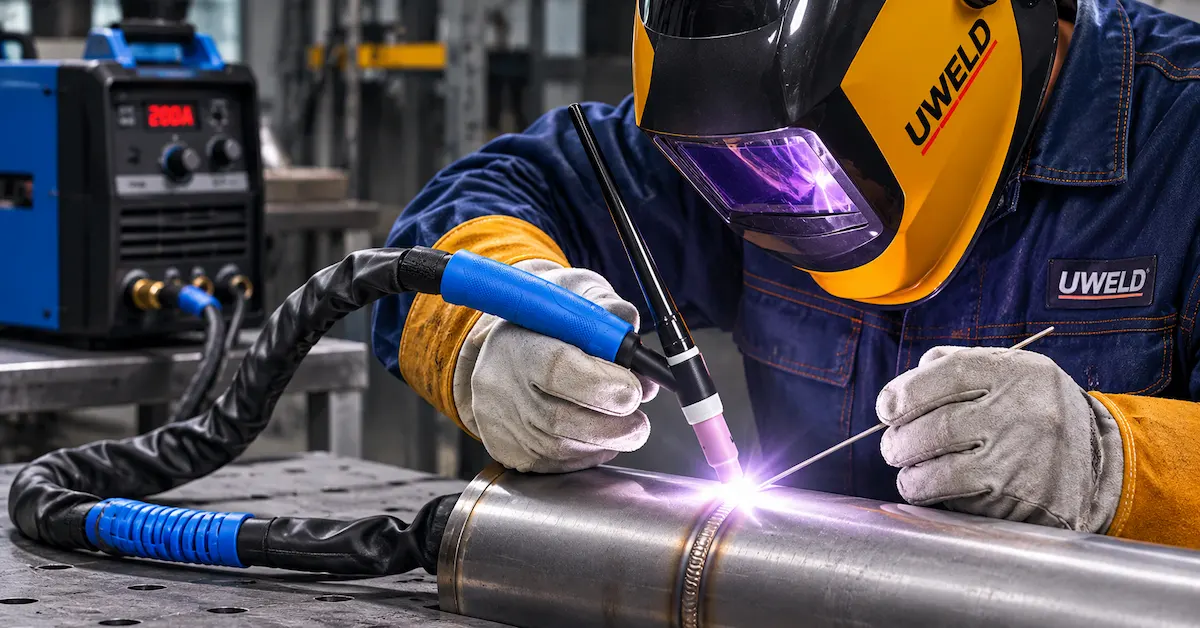
Quick Answer: The UWELD WP26 air-cooled TIG torch is designed for compatible gas tungsten arc welding (GTAW) systems. Its product listing identifies a 200A current designation, a 13ft cable, an M16×1.5 connection, and a 2-pin control socket. Air cooling eliminates the need for a separate torch water-cooling circuit, but actual current capability depends on duty cycle and operating conditions. Industrial buyers should verify machine connections, cable specifications, and consumable compatibility before purchasing.
Choosing an industrial TIG welding torch requires more than matching the amperage printed in a product title.
For fabrication workshops, welding equipment distributors, machinery manufacturers, and repair contractors, the correct torch must match the welding power source, electrical connection, shielding-gas arrangement, and intended operating workload.
A torch with the right-looking handle may still have an incompatible control connector. Likewise, a machine rated for 200A does not automatically mean every torch described as 200A can operate continuously at that current.
These details are particularly important for wholesale buyers purchasing multiple torches for different welding machines.
UWELD, operated by Ningbo United Tools Co., Ltd., supplies TIG and MIG welding torches, welding accessories, and related industrial equipment for international markets.
The UWELD WP26 is an air-cooled TIG torch with a published 13ft cable and specific machine-side connection references.
This guide examines its technical specifications, cooling design, duty-cycle information, electrical compatibility, replacement consumables, quality inspection, and OEM wholesale purchasing requirements.
Explore the UWELD WP26 Air-Cooled TIG Torch for product information and customization inquiries.
Key Takeaways: What Should Industrial Buyers Know About the WP26?
-
Air-cooled design: The WP26 operates without a separate liquid-cooling circuit for the torch.
-
200A product designation: UWELD lists 200A in the product title, while the supplied catalog provides separate AC/DC duty-cycle references.
-
13ft cable assembly: The current product listing identifies a cable approximately 4m long.
-
M16×1.5 connection: The published connector specification provides an important starting point for machine compatibility evaluation.
-
2-pin control socket: The exact electrical function and mating connector must match the intended welding machine.
-
Ergonomic handle: The catalog describes an operator-focused grip arrangement.
-
TIG consumables: Tungsten electrodes, collets, ceramic cups, and related components must match the selected WP26 configuration.
-
Wholesale purchasing: Connector verification, sample inspection, spare-parts availability, and repeat-order consistency are important.
Purchasing recommendation: Select the WP26 based on actual welding current, duty cycle, machine connections, cable requirements, and compatible consumables rather than its 200A product designation alone.
What Is the UWELD WP26 Air-Cooled TIG Torch?
The UWELD WP26 is an industrial TIG welding torch designed for compatible gas tungsten arc welding applications.
TIG welding uses a nonconsumable tungsten electrode to generate an electric arc between the electrode and the workpiece.
An appropriate shielding gas protects the weld area from atmospheric contamination.
The torch holds the electrode, directs shielding gas, transfers welding current, and provides the physical interface used by the operator.
Unlike a water-cooled TIG torch, an air-cooled model does not require a separate liquid-cooling circuit.
UWELD WP26 Technical Specifications
| Specification | Published UWELD Information |
|---|---|
| Brand | UWELD |
| Product model | WP26 |
| Product category | TIG welding torch |
| Cooling type | Air-cooled / gas-cooled |
| Current designation in product title | 200A |
| Cable length in product title | 13ft |
| Machine connection reference | M16×1.5 |
| Control connection | 2-pin socket |
| Catalog electrode-size reference | 0.5–4mm |
| Catalog cable-length options | 4m / 8m |
| Catalog DC duty-cycle reference | 180A at 35% |
| Catalog AC duty-cycle reference | 150A at 35% |
| Handle description | Ergonomic design |
| Main applications | Compatible industrial GTAW operations |
| Commercial services | Wholesale and OEM inquiries |
Source: UWELD WP26 product page and the manufacturer catalog illustration supplied with this article.
The product listing and catalog contain different current descriptions. These values should be preserved with their stated conditions rather than treated as interchangeable ratings.
Why Is the WP26 Classified as Air-Cooled?
The WP26 uses a non-liquid cooling arrangement.
Heat generated in the torch assembly is managed through its materials, construction, and surrounding operating environment.
This arrangement avoids the external coolant supply and return hoses required by a water-cooled torch.
However, it does not eliminate thermal limits.
The torch must remain within the approved current and duty-cycle conditions for its actual configuration.
Who Should Consider the WP26?
The WP26 may be relevant to professional TIG users who require an air-cooled torch and operate compatible welding machines.
Potential customers include industrial repair workshops, general fabrication facilities, maintenance teams, equipment manufacturers, and welding tool distributors.
It is not automatically the right product for every machine advertised as a 200A TIG welder.
WP26 200A vs 180A/150A: How Should Buyers Understand the Duty Cycle?
One of the most important technical questions concerning the UWELD WP26 is the relationship between its 200A product listing and the duty-cycle values shown in the catalog.
The current product title identifies a 200A configuration.
The supplied product illustration separately lists:
-
DC: 180A at 35% duty cycle.
-
AC: 150A at 35% duty cycle.
These figures should not be combined into an unsupported continuous-current rating.
Published Current Information
| Rating Reference | Published Value | What It Means for Buyers |
|---|---|---|
| Product title | 200A | Commercial current designation |
| Catalog DC rating | 180A at 35% | Catalog-stated DC operating condition |
| Catalog AC rating | 150A at 35% | Catalog-stated AC operating condition |
| Continuous current at 100% duty cycle | Not established | Cannot be inferred |
| Current configuration's full rating conditions | Not fully established | Refer to model-specific specifications |
What Is TIG Torch Duty Cycle?
Duty cycle describes the proportion of a defined test period during which equipment is permitted to operate at a specified output under stated conditions.
A 35% duty-cycle rating is different from a 100% duty-cycle rating.
The actual permitted operating time depends on the applicable test definition, current, thermal conditions, and equipment specifications.
For industrial procurement, the critical information is the complete rating rather than the maximum amperage number alone.
Why Can AC and DC Ratings Differ?
AC and DC welding produce different electrical and thermal conditions.
A torch's permitted current may vary according to current type and applicable testing conditions.
This is why an AC rating should not automatically be assumed equal to the DC rating.
For example, a fabrication workshop using AC TIG welding should evaluate the torch's approved AC operating characteristics rather than rely exclusively on a 200A product title.
Does 200A Mean Continuous Operation?
No continuous 200A capability is established by the supplied product information.
A buyer should not interpret the product title as a guarantee of welding at 200A for an unlimited period.
For demanding production work, the current rating, operating cycle, torch configuration, and applicable cooling conditions should all match the application.
B2B selection principle: A complete current specification with its duty cycle is more useful than a standalone amperage claim.
How Does the M16×1.5 Connection Affect WP26 Machine Compatibility?
The WP26 air-cooled TIG torch product listing identifies an M16×1.5 connection.
This is a significant purchasing detail because the torch must connect correctly to the intended welding machine.
However, a thread designation alone does not establish the complete connector arrangement.
What Does M16×1.5 Describe?
M16×1.5 is a metric thread designation.
It identifies a nominal diameter of 16mm and a thread pitch of 1.5mm.
For TIG equipment, the full connection also depends on the mating arrangement and its intended electrical or gas-service function.
WP26 Machine Connection Checklist
| Connection Item | Buyer Verification |
|---|---|
| Thread designation | M16×1.5 |
| Connector body | Correct mating component |
| Connection function | Approved power/gas arrangement |
| Electrical rating | Suitable for the intended equipment |
| Gas passage | Compatible shielding-gas path |
| Sealing arrangement | Correct component interface |
| Welding machine | Exact manufacturer and model |
| Product identification | Approved WP26 configuration |
Why Is Thread Matching Not Enough?
Two connectors may share a nominal thread size but use different internal structures or sealing methods.
A mechanically similar connection should not automatically be considered electrically or pneumatically compatible.
Professional buyers should compare the complete connection arrangement against the welding machine's requirements.
Can WP26 Connect to Every TIG Welder With an M16×1.5 Port?
Not automatically.
The torch and machine must have compatible power, gas, and control interfaces.
For distributors supplying multiple equipment brands, exact machine compatibility should be documented before ordering replacement torches.
This is particularly important when purchasing a large quantity under one product reference.
What Does the WP26 2-Pin Socket Control?
The WP26 product listing identifies a 2-pin socket.
This is generally relevant to the torch's electrical control interface, but the number of pins alone does not establish the complete control function.
The exact electrical arrangement depends on the selected welding machine and torch configuration.
Common TIG Torch Control Requirements
A TIG torch control may be used to communicate with a compatible welding machine.
Depending on the equipment design, the control arrangement may involve a torch switch or an approved remote-control system.
However, the current WP26 product title does not establish that every optional remote-control feature is included in the supplied assembly.
2-Pin Compatibility Checklist
| Evaluation Area | Why It Matters |
|---|---|
| Pin count | Identifies the basic connector arrangement |
| Connector shape | Determines physical fit |
| Male/female interface | Determines mating compatibility |
| Pin assignment | Determines electrical function |
| Switch circuit | Must match machine control requirements |
| Remote-control capability | Requires supported equipment configuration |
| Cable wiring | Must conform to the approved design |
Why Can a 2-Pin Connector Cause Purchasing Problems?
A distributor may receive two torches with similar-looking 2-pin connectors.
However, the connector's electrical function and mating design may differ.
If the wrong control connector is supplied, the torch may be unsuitable even when its physical construction appears correct.
What Should Buyers Check Before Bulk Orders?
For replacement purchasing, identify the intended welding-machine model and its torch-control requirements.
For OEM projects, the approved control connector and wiring arrangement should be included in the product specification.
This reduces the risk of ordering equipment based only on pin count.
What Are the Benefits of the 13ft WP26 Cable Assembly?
UWELD's current product title specifies a 13ft cable.
This is approximately 4m and corresponds closely to one of the length references shown in its catalog.
The catalog also lists an 8m option.
For purchasing purposes, these should be treated as configuration options rather than assuming both lengths are included in one product.
Cable Length Comparison
| Published Length | Approximate Equivalent | Main Purchasing Consideration |
|---|---|---|
| 13ft | 3.96m | Current product listing |
| 4m | 13.1ft | Catalog length reference |
| 8m | 26.2ft | Alternative catalog length |
Why Does Cable Length Matter?
Cable length influences the operator's working reach and the physical arrangement of a welding workstation.
A longer cable may provide greater distance between the welding machine and workpiece.
However, it can also increase routing requirements, cable bulk, and handling considerations.
The most appropriate length depends on the actual application.
Cable Construction and Handling
For industrial workshops, the cable assembly must withstand normal movement and handling within its approved operating limits.
Relevant evaluation factors include the cable covering, flexibility, strain relief, connection quality, and overall assembly integrity.
Why Is Strain Relief Important?
Cable assemblies experience repeated movement during welding operations.
Strain-relief components help manage mechanical loading near connection points and the torch handle.
An approved cable assembly should maintain suitable electrical and mechanical integrity under its intended conditions.
Should Distributors Stock Both Lengths?
That depends on customer demand.
Some users may prefer a shorter assembly for compact welding stations.
Others may need additional working reach.
A distributor should maintain separate product identification for different approved cable lengths and connection configurations.
Which Tungsten Electrodes and Consumables Fit the WP26?
TIG welding consumables are important to both welding performance and aftermarket supply.
The WP26 catalog illustration lists a tungsten electrode-size range of 0.5–4mm.
However, actual electrode compatibility depends on the collet, torch-head arrangement, and associated consumables installed.
Main WP26 Consumable Components
| Component | Main Function | Purchasing Consideration |
|---|---|---|
| Tungsten electrode | Produces the welding arc | Appropriate diameter and type |
| Collet | Holds the tungsten electrode | Correct electrode size |
| Collet body | Supports the electrode-holding assembly | WP26 component compatibility |
| Ceramic cup | Directs shielding gas | Suitable size and mating design |
| Back cap | Secures the electrode assembly | Correct torch-head version |
| Gas lens | Optional shielding-gas arrangement | Approved accessory compatibility |
| Insulators and seals | Support assembly integrity | Correct replacement parts |
Why Does Tungsten Diameter Matter?
Electrode diameter influences the suitability of the tungsten for a particular welding current and process.
A smaller tungsten electrode may be appropriate for certain lower-current applications, while other welding conditions require larger diameters.
The correct selection depends on the tungsten composition, current type, welding procedure, and approved torch components.
A larger electrode is not automatically superior.
Why Is Collet Compatibility Important?
The collet must match the selected electrode diameter.
An incorrect collet can create an unsuitable electrode-holding arrangement.
For wholesale buyers, consumables should therefore be specified by their complete approved references rather than appearance alone.
Ceramic Nozzle Selection
Ceramic cups are used to direct shielding gas around the welding electrode and weld area.
Different cup sizes and configurations support different shielding requirements.
However, the appropriate selection depends on the torch assembly and welding application.
Nozzle size alone does not guarantee improved weld quality.
Replacement-Parts Planning
For a distributor supplying the WP26 air-cooled TIG torch, a useful replacement-parts program may include appropriate ceramic cups, collets, collet bodies, back caps, and compatible gas-lens accessories.
The exact inventory should match the delivered WP26 assembly and customer demand.
Explore the UWELD TIG Torch Supplier Guide for broader TIG torch sourcing considerations.
What Industrial Applications Are Suitable for the WP26?
The WP26 is positioned for professional TIG welding applications using compatible welding equipment.
Potential users include fabrication workshops, industrial repair businesses, equipment manufacturers, and welding service providers.
The final suitability of each application depends on welding current, duty cycle, base materials, machine compatibility, and work conditions.
Industrial Application Matrix
| Application | Main Requirement | Buyer Priority |
|---|---|---|
| Stainless-steel fabrication | Controlled TIG welding | Current and shielding requirements |
| General metal fabrication | Suitable welding of metal components | Torch handling and consumables |
| Equipment maintenance | Welding repair operations | Portability and machine compatibility |
| Workshop manufacturing | Repeated welding tasks | Duty cycle and cable durability |
| Aluminum TIG welding | Compatible AC TIG process | AC rating and electrode selection |
| Welding equipment distribution | Replacement and OEM torch supply | Connector and SKU identification |
Stainless-Steel Fabrication
TIG welding is commonly used for suitable stainless-steel components where controlled welding and appropriate shielding are important.
The WP26 may be evaluated when the power-source and torch ratings match the intended procedure.
Weld quality also depends on the base material, shielding gas, electrode, joint preparation, and operator technique.
Industrial Maintenance
Maintenance workshops may require a portable air-cooled torch for suitable repair welding tasks.
An air-cooled arrangement avoids a separate torch water-cooling circuit, which can simplify the equipment setup.
However, the torch's actual current and duty-cycle limits must still be respected.
General Metal Fabrication
Fabrication workshops often work with different part geometries and welding positions.
The WP26's handle and cable configuration may be relevant to operator access and equipment layout.
The ideal configuration depends on the welding machine and working conditions.
Aluminum Welding
Aluminum TIG welding commonly uses AC current.
For these applications, the published AC duty-cycle information is particularly relevant.
The catalog's 150A at 35% AC reference should not be replaced by the 200A figure from the product title when evaluating a specific operating condition.
When Is WP26 Not the Best Choice?
An air-cooled torch may be unsuitable if the intended work requires current or duty-cycle conditions beyond its approved rating.
In applications involving sustained high thermal loading, a compatible water-cooled torch may be worth considering.
The best selection depends on the complete welding system rather than cooling type alone.
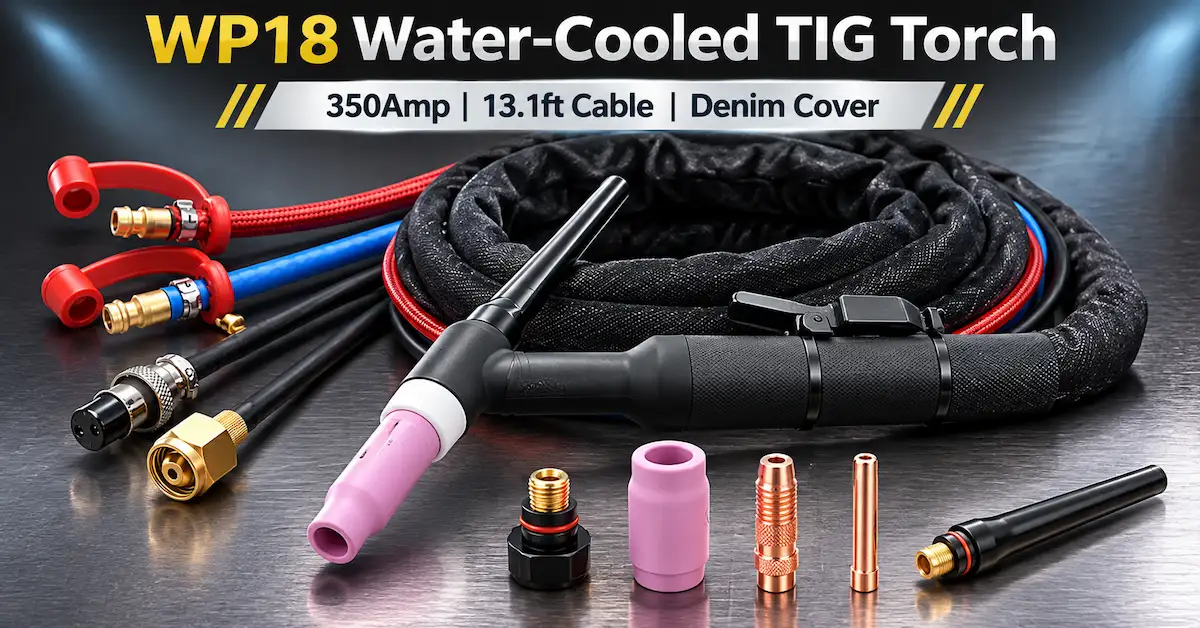
WP26 Air-Cooled vs WP18 Water-Cooled TIG Torch
UWELD supplies both WP26 air-cooled and WP18 water-cooled TIG torches.
Although both are designed for GTAW applications, their cooling arrangements and published configurations differ.
UWELD WP26 vs WP18 Comparison
| Specification | WP26 | WP18 |
|---|---|---|
| Cooling type | Air-cooled | Water-cooled |
| Current in product title | 200A | 350A |
| Published cable length | 13ft | 13.1ft |
| Cooling equipment | No separate liquid torch cooler | Compatible liquid-cooling system required |
| Published connector detail | M16×1.5, 2-pin socket | Configuration-specific |
| Cable covering | Product-dependent | Denim cover listed |
| Main evaluation | Machine connections and duty-cycle limits | Cooling compatibility and thermal workload |
| Target application | Compatible air-cooled TIG operations | Compatible liquid-cooled TIG operations |
These are published product descriptions, not independently verified performance rankings.
When Should Buyers Choose WP26?
WP26 is worth evaluating when the welding application is compatible with an air-cooled torch and the user does not require a separate torch water-cooling circuit.
It may be relevant to suitably rated fabrication, maintenance, and general workshop applications.
When Should Buyers Consider WP18?
WP18 may be more appropriate for compatible welding systems requiring liquid cooling to manage demanding thermal workloads.
However, its use requires a suitable cooling system and verified equipment connections.
Is WP26 Interchangeable With WP18?
No direct interchangeability should be assumed.
The cooling arrangements and machine-side interfaces may differ.
Replacing one torch with another requires a technical compatibility assessment.
For the water-cooled alternative, see UWELD's WP18 Water-Cooled TIG Torch Guide.
What Quality-Control Checks Matter for WP26 TIG Torches?
Industrial buyers should evaluate the complete torch assembly rather than inspect only the handle and ceramic nozzle.
Product consistency involves electrical connections, gas delivery, cable construction, control interfaces, and consumable compatibility.
Recommended WP26 Quality-Control Checklist
| Inspection Item | What Buyers Should Verify |
|---|---|
| Product identification | Correct WP26 model and variant |
| Cooling type | Approved air-cooled construction |
| Torch head | Correct assembly and physical condition |
| Handle | Approved grip and switch configuration |
| Cable length | Matches ordered specification |
| Cable covering | Suitable condition and assembly |
| M16×1.5 connector | Correct dimensions and mating arrangement |
| 2-pin socket | Approved connector and electrical functions |
| Power conductor | Appropriate construction and integrity |
| Shielding-gas path | Correct connection and gas integrity |
| Tungsten consumables | Approved collet and electrode sizes |
| Ceramic cups | Correct configuration and condition |
| Packaging | Complete accessories and model identification |
| Traceability | Approved product and order references |
Why Is Electrical Connection Inspection Important?
The TIG torch transfers welding current through the power connection and conductor assembly.
Incorrect connections or unsuitable components can create equipment problems.
For wholesale purchasing, electrical compatibility should be established as part of product approval.
Why Should Gas Connections Be Inspected?
Shielding-gas delivery is necessary for appropriate TIG welding.
Incorrect fittings or gas leakage can affect the intended shielding arrangement.
Buyers should establish suitable inspection requirements for the complete gas path.
What Should Sample Approval Include?
A representative sample should be evaluated against the intended welding machine and application.
The inspection may include physical dimensions, connection compatibility, assembly condition, control function, and appropriate product-specific performance checks.
Testing should be performed by qualified personnel using approved procedures.
These are recommended purchasing practices, not claims that every listed inspection has been independently verified for the UWELD production line.
How Can Distributors Reduce WP26 Purchasing Risks?
The main purchasing risks associated with TIG torches are often configuration related.
A torch may be correctly manufactured but unsuitable for the customer's machine.
Common Procurement Risks
| Risk | Possible Consequence | Recommended Control |
|---|---|---|
| Incorrect power connector | Machine incompatibility | Confirm complete connector design |
| Incorrect 2-pin arrangement | Control malfunction or incompatibility | Verify pin functions |
| Unverified current rating | Unsuitable operating expectations | Evaluate rating and duty cycle |
| Wrong cable length | Insufficient reach or handling problems | Specify exact assembly |
| Wrong tungsten collet | Electrode compatibility problem | Approve consumable references |
| Incomplete accessories | Installation delay | Verify packing list |
| Unapproved component changes | Repeat-order inconsistency | Maintain revision control |
Why Is SKU Management Important?
A wholesale distributor may supply WP26 torches with different cable lengths, control connectors, and accessory packages.
These configurations should have distinct product identification where their differences affect compatibility or purchasing.
This helps warehouse personnel select the intended item and reduces the risk of incorrect substitutions.
Why Should Buyers Maintain a Spare-Parts List?
Compatible replacement consumables can support long-term product use.
A distributor should maintain the approved references for frequently replaced components.
For industrial customers, clear parts identification can make maintenance and future purchasing more straightforward.
How Much Does a WP26 TIG Torch Cost for Wholesale Buyers?
The total sourcing cost depends on the approved torch configuration and commercial requirements.
A WP26 sold with one cable length or control connector may have a different cost from an alternative assembly.
The quotation should also identify which consumables and accessories are included.
Total Procurement Cost
Total Sourcing Cost = Torch Purchase Cost + Accessories + Inspection + Packaging + Freight + Inventory + Expected After-Sales Costs
| Cost Factor | Purchasing Consideration |
|---|---|
| Torch head and handle | Approved construction |
| Cable length | Required assembly |
| Power connector | Welding-machine compatibility |
| Control socket | Correct 2-pin configuration |
| Consumables | Included and replacement components |
| Quality inspection | Testing and documentation |
| OEM branding | Labels and packaging |
| Order quantity | MOQ and quotation |
| Shipping | Destination and logistics |
| After-sales | Spare parts and replacement support |
Is an Air-Cooled Torch More Economical?
An air-cooled torch does not require a separate liquid-cooling circuit for the torch.
This may simplify the equipment arrangement.
However, total value depends on the actual welding workload and requirements.
For some applications, a water-cooled system may be technically preferable despite additional equipment costs.
For others, an appropriately rated air-cooled torch may provide a suitable solution.
Why Should Buyers Compare Complete Quotations?
Two suppliers may quote different WP26 assemblies under similar product names.
Differences in cable length, connector design, control options, consumables, and packaging can affect the final cost.
A meaningful comparison requires equivalent approved specifications and commercial conditions.
How to Choose the Right WP26 Air-Cooled TIG Torch in Three Steps
Step 1: Define the Welding Application
Identify the welding machine, AC/DC operating mode, material, normal current, duty-cycle requirements, and working environment.
Decision: Determine whether an air-cooled WP26 configuration is suitable for the actual workload.
Step 2: Verify Machine and Consumable Compatibility
Check the M16×1.5 connection, 2-pin control socket, cable assembly, shielding-gas connection, and required tungsten consumables.
Decision: Approve only a configuration compatible with the intended welding machine.
Step 3: Evaluate Quality and Commercial Requirements
Review samples, inspection requirements, product documentation, packaging, MOQ, delivery terms, and replacement-part availability.
Decision: Choose the configuration that meets the technical requirements and provides consistent supply value.
For product-specific assistance, visit the UWELD WP26 Product Page.
OEM/ODM WP26 TIG Torch Supply for Industrial Brands
UWELD supports OEM/ODM and wholesale inquiries involving welding equipment and related accessories.
International welding brands and distributors may require specific torch configurations, packaging, product identification, and approved connection arrangements.
Recommended OEM Purchasing Workflow
| Stage | Main Requirement |
|---|---|
| Application review | Define target machines and welding requirements |
| Product selection | Select WP26 configuration |
| Connector review | Confirm power, gas and control interfaces |
| Cable selection | Establish approved length and construction |
| Sample approval | Verify the complete supplied assembly |
| Consumable planning | Identify approved replacement components |
| Branding | Confirm labels and packaging |
| Quality planning | Establish inspection and acceptance criteria |
| Bulk order | Agree on quantity and delivery requirements |
| Repeat purchasing | Maintain approved product revisions |
Technical modifications affecting electrical connections, gas passages, or other functional components require appropriate engineering evaluation.
MOQ, Samples and Lead Time
UWELD's FAQ page explains that minimum order quantities depend on product and customization requirements.
Sample arrangements and delivery schedules should be discussed according to the intended configuration.
For an OEM order, custom connectors, cable options, and packaging may affect commercial terms.
Explore UWELD Manufacturing and OEM Solutions for cooperation information.
What Should Buyers Include in a WP26 Wholesale RFQ?
A detailed request for quotation helps avoid incompatible product configurations and unnecessary purchasing revisions.
Recommended WP26 RFQ Checklist
| RFQ Field | Required Information |
|---|---|
| Product | WP26 air-cooled TIG torch |
| Brand | UWELD |
| Published current designation | 200A |
| Welding process | TIG/GTAW |
| Current type | Required AC/DC operating mode |
| Duty cycle | Actual application requirement |
| Welding machine | Manufacturer and model |
| Power connection | Required M16×1.5 or approved configuration |
| Control socket | Required 2-pin arrangement |
| Cable length | 13ft or specified option |
| Handle configuration | Required grip and switch arrangement |
| Tungsten sizes | Required electrode diameters |
| Consumables | Collets, ceramic cups, back caps and accessories |
| Quality documents | Technical specifications and inspection records |
| OEM branding | Logo, labels and packaging |
| Order quantity | Sample and bulk requirements |
| Destination | Country or region |
| Delivery | Commercial and shipping requirements |
A useful RFQ should include the intended welding-machine model and the complete required connector arrangement.
Looking for a WP26 air-cooled TIG torch for industrial distribution? Contact UWELD to discuss machine compatibility, 2-pin control options, cable assemblies, samples, OEM requirements, and wholesale pricing.
Frequently Asked Questions About the WP26 Air-Cooled TIG Torch
1. What is the UWELD WP26 air-cooled TIG torch?
The UWELD WP26 is an air-cooled GTAW torch intended for compatible industrial welding systems. Its product listing identifies a 200A current designation, 13ft cable, M16×1.5 connection, and 2-pin control socket.
2. Is the WP26 rated for 200A continuous welding?
The product title lists 200A, but that does not establish continuous operation at 100% duty cycle. The supplied catalog lists DC 180A and AC 150A at 35% duty cycle. Buyers should evaluate the actual approved operating conditions.
3. Does WP26 require a water cooler?
No separate liquid-cooling circuit is required for the air-cooled WP26 configuration. However, the torch must still operate within its approved thermal and electrical limits.
4. What does the M16×1.5 connector mean?
M16×1.5 identifies a metric thread with a nominal diameter of 16mm and a 1.5mm pitch. Complete compatibility also depends on the actual connector and intended electrical or gas-service arrangement.
5. What is the function of the 2-pin socket?
The 2-pin socket is part of the torch's published control connection arrangement. Its exact function and pin assignment must match the intended welding machine.
6. What cable length does the UWELD WP26 have?
The product title lists 13ft. The supplied catalog also lists 4m and 8m options. Buyers should specify the required length when ordering.
7. Can WP26 be used for aluminum welding?
A WP26 may be considered for compatible AC TIG welding applications when the torch, power source, electrode, and actual operating conditions are suitable. The catalog's AC duty-cycle reference should be considered.
8. What tungsten electrode sizes can WP26 support?
The supplied catalog lists 0.5–4mm. Actual compatibility depends on the appropriate collet and related torch consumables.
9. Is WP26 better than WP18?
Neither is universally better. WP26 is air-cooled, while WP18 is water-cooled. The correct choice depends on welding current, duty-cycle requirements, cooling arrangements, machine interfaces, and working conditions.
10. Does UWELD support wholesale and OEM WP26 orders?
UWELD supports wholesale and OEM/ODM inquiries for TIG welding torches. Buyers can discuss connector requirements, cable options, accessories, branding, sample evaluation, quantities, and delivery conditions.
Conclusion
Choosing a reliable WP26 air-cooled TIG torch requires careful evaluation of the actual welding application, machine connections, duty-cycle requirements, and complete torch assembly.
The UWELD WP26 is marketed with a 200A current designation, a 13ft cable, an M16×1.5 connection, and a 2-pin control socket.
Its air-cooled design avoids the need for a separate torch water-cooling circuit, making it relevant to compatible industrial welding applications where a liquid-cooled system is not required.
However, the published current designation should not be interpreted as a continuous 200A operating guarantee. The catalog's AC/DC duty-cycle references and the complete approved specifications remain important.
For industrial distributors, equipment importers, and OEM brands, purchasing quality also depends on connector compatibility, cable construction, consumable availability, sample approval, and consistent repeat-order specifications.
UWELD supplies TIG welding torches, MIG welding torches, welding accessories, and related industrial equipment for international professional markets.
To evaluate the WP26, visit the UWELD WP26 Air-Cooled TIG Torch, explore UWELD Welding Equipment, or contact UWELD to request current specifications, compatible connectors, product samples, OEM options, and wholesale quotations.