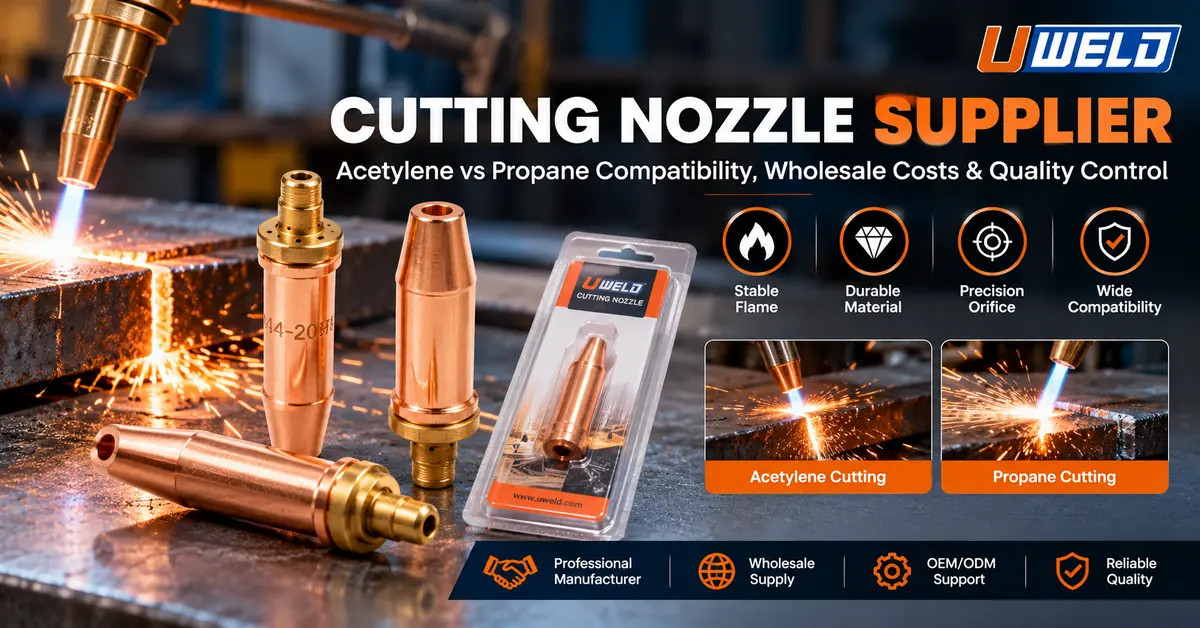


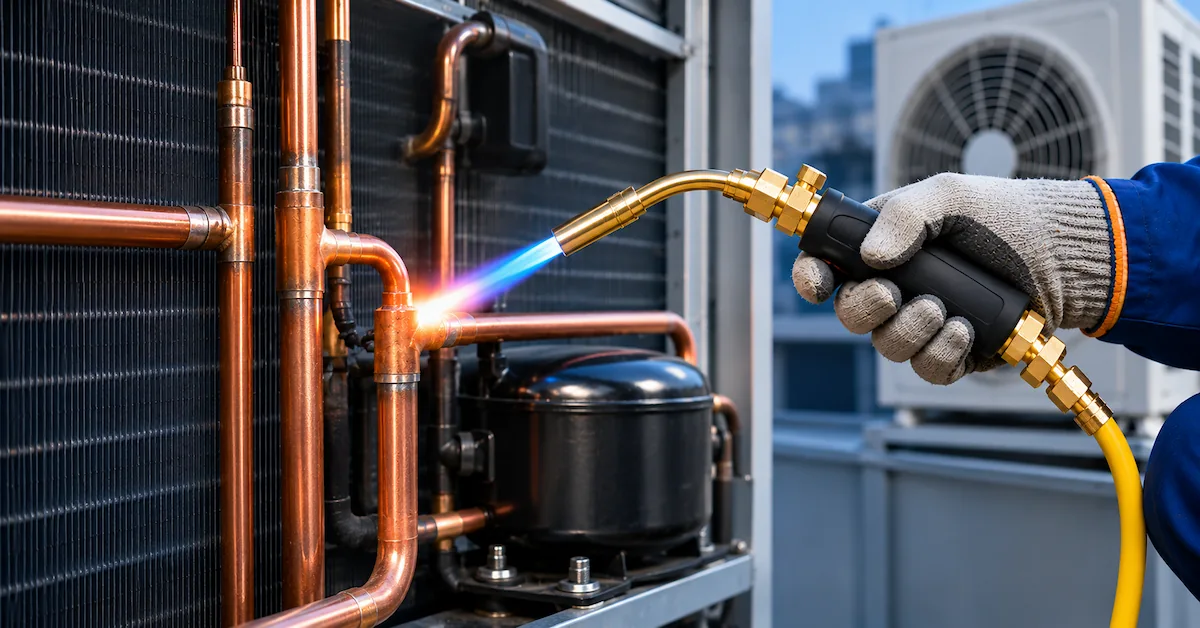
Quick Answer: A reliable HVAC brazing torch supplier should provide fuel-compatible torches with suitable flame characteristics, controlled gas delivery, convenient access to copper pipe joints, and consistent product quality. For refrigeration copper-line applications, buyers should evaluate torch output, swirl or concentrated flame design, hose length, ignition mechanism, cylinder connections, and replacement-part availability. UWELD offers MAPP/propane torch configurations for HVAC installation, refrigeration maintenance, brazing, and heating, with wholesale and OEM/ODM sourcing options.
For HVAC/R equipment distributors, choosing a brazing torch involves more than finding a product that produces a hot flame.
A torch used for residential air-conditioner installation may need to reach copper connections inside a compact outdoor unit. A commercial refrigeration contractor may require equipment suitable for larger copper tubing and repeated field service. An industrial service technician may prioritize flexible hose arrangements, ignition reliability, and accurate flame control.
These different requirements influence which torch configuration is appropriate.
Purchasing an unsuitable product can create problems involving restricted access, excessive heating of nearby components, incompatible fuel cylinders, or unnecessary operating costs.
UWELD, operated by Ningbo United Tools Co., Ltd., supplies professional welding, cutting, and industrial heating products, including MAPP/propane torches designed for HVAC and refrigeration applications.
This guide explains how to compare brazing torch configurations, evaluate product specifications, understand important installation requirements, and qualify a supplier for international wholesale or private-label purchasing.
Explore UWELD's Gas Heating Products for available torch configurations and related equipment.
Key Takeaways: What Should HVAC Buyers Prioritize?
-
Match the torch to the application. Copper tube dimensions, joint accessibility, surrounding components, and expected workload affect equipment selection.
-
Verify the approved fuel. MAPP-type fuel products, MAP-Pro fuel, and propane must not be assumed interchangeable without manufacturer approval.
-
Consider flame design. Swirl flames and concentrated burner designs offer different heating characteristics for different tasks.
-
Evaluate hose-equipped models. An extension hose may improve handling and access while allowing the fuel cylinder to remain in a suitable position.
-
Understand nitrogen protection. Nitrogen purging is a separate refrigeration-system procedure; the brazing torch does not replace the required nitrogen supply and control equipment.
-
Review complete purchasing costs. Technical compatibility, inspection requirements, spare parts, packaging, and repeat-order consistency can be more important than initial unit price.
-
Approve samples before bulk orders. Verify ignition, flame control, connections, assembly quality, and model identification under suitable controlled conditions.
What Makes an HVAC Brazing Torch Different From a General Heating Torch?
An HVAC brazing torch is used to supply controlled heat for joining suitable copper tubes, fittings, and other approved metal components.
In brazing, the base metals are heated sufficiently for a suitable filler alloy to melt and flow into the joint. The copper tubing itself should not be melted during the process.
The joint design, filler alloy, cleanliness, heating method, and thermal conditions all influence the final result.
Unlike general-purpose heating work, refrigeration brazing often takes place close to valves, insulation, electronic components, and other heat-sensitive parts.
For this reason, flame control and access are important purchasing considerations.
HVAC Brazing Torch vs General Heating Torch
| Evaluation | HVAC Brazing Torch | General Industrial Heating Torch |
|---|---|---|
| Primary application | Copper pipe joints and compatible HVAC/R components | General surface and material heating |
| Flame requirements | Controlled heating around the joint | May prioritize wider-area heating |
| Working access | Often used in confined equipment spaces | Depends on industrial application |
| Hose configuration | Frequently useful for mobile service work | Product-dependent |
| Fuel compatibility | Must match approved torch and cylinder | Must match approved heating equipment |
| Joint quality | Depends on brazing procedure and filler | Not necessarily intended for brazed joints |
| Buyer priority | Flame control, access, connections, portability | Heating coverage and application suitability |
A general-purpose heating torch should not automatically be marketed as suitable for refrigeration-system brazing.
Professional buyers should verify the intended application of each model.
How Do MAPP/Propane Brazing Torches Compare With Oxy-Acetylene Equipment?
HVAC technicians use different heating systems depending on the joint, material, work location, and equipment requirements.
Common options include approved single-fuel air-fuel torches and oxy-fuel equipment.
Torch System Comparison
| Selection Factor | MAPP/Propane Air-Fuel Torch | Oxy-Acetylene Torch |
|---|---|---|
| Gas supply | Approved fuel-gas source with atmospheric air | Separate oxygen and acetylene supplies |
| Equipment arrangement | Often compact, potentially cylinder-mounted or hose-equipped | Typically requires regulators, hoses, and two gas supplies |
| Flame characteristics | Depends on burner and fuel design | Concentrated, high-temperature flame characteristics |
| Portability | Often convenient for mobile service | Depends on cylinder and kit arrangement |
| Heating capability | Must be matched to joint size and material | Must be matched to approved tip and gas settings |
| Main compatibility concern | Fuel cylinder, burner, connection | Both gas supplies, regulators, torch, tip |
| Suitable applications | Selected copper tube brazing, soldering, heating | Selected brazing, welding, and cutting applications |
Neither system is universally better.
An air-fuel torch may be practical for accessible copper joints within its rated capability, while an oxy-fuel system may be appropriate for other joint sizes or heating requirements.
For distributors, the correct choice should reflect the target technicians' actual work rather than relying on a general claim that one fuel provides the highest temperature.
Why Fuel Names Require Care
Products may be advertised using terms such as MAPP, MAP-Pro, or propane.
These names should not be treated as proof that every fuel cylinder has the same composition or is suitable for every torch.
Buyers should confirm the exact approved fuel type, cylinder connection, operating limitations, and manufacturer instructions.
How Do Flame Design and Copper Pipe Size Affect Torch Selection?
A brazing torch must supply suitable heat to the required joint without unnecessary heating of adjacent equipment.
The correct burner depends on several factors, including tube dimensions, fitting mass, base metals, filler alloy, access, and ambient conditions.
Swirl Flame vs Concentrated Flame
A swirl flame is designed to distribute heat differently from a narrow, concentrated flame.
A suitable swirl burner may be helpful when a relatively broad joint requires even heating.
A concentrated burner may be useful for more localized work, depending on the application.
However, a flame pattern alone does not establish the copper tube sizes a torch can successfully braze.
Flame Selection Matrix
| Application Requirement | Potentially Useful Torch Feature | What Buyers Should Verify |
|---|---|---|
| Small copper tube joints | Controlled, concentrated flame | Suitable burner and joint heating |
| Larger copper fittings | Appropriate heat output and distribution | Approved joint-size capability |
| Restricted equipment spaces | Angled head, swivel design, or hose | Access and cylinder handling |
| Frequent field service | Reliable ignition and flame control | Product durability and serviceability |
| Vertical or awkward joint positions | Suitable burner orientation | Manufacturer-approved operating positions |
| Workshop brazing | Stable heating and replaceable parts | Burner configuration and consumables |
Why a Bigger Flame Is Not Always Better
An unnecessarily large flame can increase unwanted heating of surrounding components.
Conversely, a torch with insufficient heat input may struggle to heat the joint uniformly.
The goal is not simply to select the hottest advertised torch.
It is to match usable heat delivery, flame distribution, working access, and operator control to the brazing application.
Is There a Universal Copper Pipe Diameter Limit?
No.
The maximum practical brazing diameter depends on torch design, fuel supply, joint geometry, copper wall thickness, fitting mass, filler alloy, and working conditions.
A supplier should provide model-specific recommendations or validated application data rather than promise universal brazing capability.
Which UWELD Brazing Torch Models Should HVAC/R Buyers Compare?
UWELD offers several MAPP/propane torch configurations relevant to HVAC, refrigeration, plumbing, and professional heating applications.
The main differences include hose arrangement, ignition system, burner design, flame adjustment, and cylinder connection.
UWELD HVAC Brazing Torch Comparison
| UWELD Model | Published Product Features | Main Purchasing Consideration |
|---|---|---|
| 1C020-0071B | 1.5 m extension hose, CGA600 connection, automatic ignition, dual control valves | HVAC brazing requiring a hose-equipped arrangement |
| 1C020-0047A | Self-igniting MAPP torch with hose, spiral flame, multi-turn flame valve | Refrigeration service and adjustable flame control |
| 1C020-0033 | 5 ft hose, self-ignition, swirl flame, swivel-regulated configuration | Mobile service and flexible torch positioning |
| 1C020-0013A | Extension hose, turbo-flame design, automatic ignition | Alternative hose-equipped HVAC brazing configuration |
| 1C020-0083 | Pinpoint and cyclone burner tips, trigger-start features | Buyers evaluating different burner patterns |
The information above describes published product features, not independently verified comparisons of heating speed, joint strength, or energy efficiency.
Actual copper-joint suitability and operating limits require model-specific confirmation.
1. UWELD 1C020-0071B: HVAC Brazing Torch With Extension Hose
The UWELD 1C020-0071B MAPP Gas Torch is directly positioned for HVAC brazing.
Its published specifications include:
-
1.5 m extension hose.
-
CGA600 connection.
-
Automatic self-ignition.
-
Dual control valves.
-
MAPP gas torch configuration.
For professional HVAC equipment distributors, this model is relevant when customers require a hose-equipped torch arrangement for copper pipe installation and repair.
The extension hose may make it easier to position the torch without holding the fuel cylinder directly at the joint.
However, buyers should verify approved cylinder positioning, gas compatibility, hose specifications, and permitted operating conditions.
2. UWELD 1C020-0047A: Self-Igniting Torch With Adjustable Flame
The UWELD 1C020-0047A MAPP Gas Torch is marketed for HVAC and refrigeration applications.
UWELD describes a hose-equipped design with self-ignition, a 5.5-turn flame valve, and a spiral flame.
The product listing also advertises an 1800°C flame characteristic.
That temperature should be treated as a manufacturer-published flame claim, not a verified copper-joint operating temperature or guarantee of brazing performance.
For purchasers, the most useful features to evaluate are adjustment control, ignition operation, burner condition, and compatibility with the required fuel supply.
3. UWELD 1C020-0033: Swirl Flame Hose Torch
The UWELD 1C020-0033 is a MAPP/propane hose hand torch with a published 5 ft hose and swirl-flame configuration.
Its description emphasizes self-ignition, swivel or multi-position functionality, and professional heating applications.
This model may be useful for buyers comparing portable equipment arrangements.
Before approval, request confirmation of the current burner design, hose assembly, approved fuel types, and actual brazing applications.
Which Model Should Distributors Prioritize?
For a distributor specifically targeting refrigeration copper-line brazing, 1C020-0071B is a strong starting model for technical evaluation because its official product positioning explicitly identifies HVAC brazing.
The 1C020-0047A is another relevant option when flame adjustment and refrigeration service are important purchasing criteria.
Neither should be presented as universally superior without comparable application testing.
Why Is Nitrogen Purging Important During HVAC Copper Brazing?
Heating copper tubing can cause oxidation inside the pipe when oxygen is present.
During refrigeration-system operation, loose oxide scale may circulate with the refrigerant and contaminate sensitive components.
This is why many HVAC equipment manufacturers specify dry-nitrogen purging during brazing.
What Does Nitrogen Purging Do?
Nitrogen displaces oxygen inside the tubing during the approved brazing process.
This helps reduce the formation of internal copper oxide scale.
The exact purge method, flow conditions, and duration must follow the equipment manufacturer's installation instructions.
Excessive nitrogen flow or pressure is not appropriate because it may interfere with the joint or create additional hazards.
Is a Brazing Torch the Same as a Nitrogen Purge System?
No.
The brazing torch supplies heat to the joint.
Nitrogen purging requires a separate, correctly specified nitrogen source, control equipment, and approved tubing arrangement.
A conventional high-pressure nitrogen regulator should not automatically be considered suitable for precise low-flow purging without reviewing its intended service and performance.
UWELD also lists nitrogen pressure regulators within its broader gas-control portfolio. For example, the 1C008-0015 High Pressure Nitrogen Regulator is a product that buyers may investigate when sourcing nitrogen-control equipment.
Its suitability for HVAC purging must be confirmed independently; its high-pressure product positioning does not establish a specific low-flow purge capability.
HVAC Brazing System Checklist
| Component or Requirement | Function | Procurement Consideration |
|---|---|---|
| Brazing torch | Provides heat | Fuel, burner, ignition, connections |
| Fuel supply | Supplies approved combustible gas | Cylinder compatibility and safety |
| Nitrogen supply | Provides inert purge gas | Approved cylinder and regulator |
| Nitrogen flow control | Maintains suitable purge conditions | Application-specific low-flow capability |
| Brazing filler alloy | Joins the prepared metals | Base-metal and system compatibility |
| Heat protection | Protects nearby components | Approved shields and work practices |
| Pressure/leak testing equipment | Checks the completed system | Manufacturer-approved method |
| Technician documentation | Defines the required procedure | Equipment installation instructions |
For B2B buyers, these products may represent related purchasing needs, but they should not be described as one interchangeable system.
How Should Copper-to-Copper and Copper-to-Brass Brazing Be Evaluated?
The base metals influence filler-alloy selection and the brazing procedure.
Copper-to-copper joints may use suitable copper-phosphorus brazing alloys under approved conditions.
Dissimilar-metal joints, including some copper-to-brass connections, can require different filler alloys or flux arrangements.
The correct selection depends on the joint materials and applicable equipment instructions.
Brazing Application Comparison
| Joint Type | Main Technical Concern | Buyer Evaluation |
|---|---|---|
| Copper-to-copper | Joint preparation, heating, filler compatibility | Suitable torch and approved filler |
| Copper-to-brass | Different material and filler requirements | Verify alloy and flux instructions |
| Copper tube near service valves | Heat-sensitive seals and components | Controlled heating and protection |
| Larger copper fittings | Greater thermal mass | Adequate usable heat delivery |
| Confined equipment connections | Limited access | Torch head and hose configuration |
The brazing torch is only one part of joint quality.
Even a suitable burner cannot compensate for improper joint preparation, incorrect filler metal, unsuitable purge conditions, or an unapproved installation procedure.
What Safety Requirements Matter for HVAC/R Brazing?
Brazing is a hot-work operation involving combustible fuel, elevated temperatures, and potential exposure to hazardous fumes.
HVAC/R work introduces additional hazards because refrigeration equipment may contain refrigerants, compressor oil, and heat-sensitive components.
Only appropriately trained personnel should perform brazing according to the equipment manufacturer's instructions and applicable regulations.
Important Safety Evaluation Areas
Refrigerant management: Before hot work on a refrigeration circuit, the system must be properly isolated and refrigerant handled according to the applicable procedure and legal requirements.
Flammable refrigerants: Additional precautions may apply to A2L, A3, and other flammable-refrigerant systems. A gas torch must never be used on a system without completing the required safety procedures.
Fire protection: Work areas should be assessed for combustible materials and other heat-related risks.
Ventilation: Appropriate ventilation and fume control should be provided.
Fuel-gas equipment: Torch heads, hoses, fittings, ignition mechanisms, and fuel cylinders must be approved and in suitable condition.
Protective equipment: Operators need appropriate eye, hand, body, and other protection for the actual process.
OSHA 29 CFR 1910.252 addresses important welding, cutting, and brazing workplace requirements in the United States.
This article is a sourcing and selection guide, not a substitute for technician training or an approved brazing procedure.
How Should an HVAC Brazing Torch Supplier Control Product Quality?
For wholesale buyers, consistent manufacturing is essential.
A torch may appear suitable in a product photograph but fail to meet the buyer's expectations if its ignition mechanism, gas connections, hose construction, or burner assembly differs from the approved sample.
A supplier qualification program should therefore define the relevant product characteristics before accepting bulk deliveries.
Recommended Quality Inspection Checklist
| Inspection Area | Main Requirement | Acceptance Evidence |
|---|---|---|
| Product identification | Correct model and configuration | Approved SKU and label |
| Gas compatibility | Correct fuel service | Product specification |
| Torch head | Correct assembly and condition | Visual and dimensional inspection |
| Burner construction | Approved burner components | Technical drawing or specification |
| Ignition system | Required ignition function | Controlled functional test |
| Flame adjustment | Correct operation within approved limits | Functional inspection |
| Gas valve | Suitable control and sealing | Inspection records |
| Hose assembly | Correct length, fittings, rating | Approved hose specification |
| Cylinder connection | Correct approved interface | Connection verification |
| Gas tightness | Required leakage limits | Qualified test record |
| Packaging | Correct accessories and identification | Packing-list inspection |
| Traceability | Production and order identification | Batch or order records |
For OEM orders, changes to fuel-related components should require formal technical review.
Why Ignition Reliability Matters
Self-ignition can make a torch convenient for repeated field service.
However, a self-igniting torch still requires proper inspection and safe operating procedures.
Buyers should evaluate whether ignition performance remains consistent across samples and production batches, rather than assume that a trigger-start feature guarantees reliability.
Hose Quality and Flexibility
For extension-hose torches, buyers should verify hose materials, length, connection integrity, allowable operating conditions, and physical protection.
A longer hose may improve reach, but it can also introduce different handling and storage requirements.
The correct length should match real field-service needs.
What Affects the Wholesale Price of an HVAC Brazing Torch?
Wholesale pricing depends on the torch configuration and the commercial requirements of the order.
A self-igniting torch with a hose, multiple control features, or interchangeable burner tips may have a different cost structure from a simpler hand torch.
However, no configuration is automatically more economical for every customer.
Total Cost of Supply
Total Sourcing Cost = Torch Purchase Cost + Accessories + Inspection + Packaging + Freight + Inventory + Expected After-Sales Costs
| Cost Factor | What Buyers Should Evaluate |
|---|---|
| Torch construction | Materials, burner, handle, valves |
| Ignition system | Product design and inspection requirements |
| Extension hose | Length, fittings, material specifications |
| Burner tips | Included types and replacement availability |
| Fuel connection | Standard or approved regional configuration |
| OEM packaging | Branding, artwork, minimum quantities |
| Quality inspection | Test procedures and documentation |
| Shipping | Weight, cartons, destination costs |
| Spare parts | Availability and compatibility |
| Repeat supply | SKU stability and order consistency |
Is a Higher-Priced Torch Worth Buying?
A more expensive configuration may offer value if its features match the technician's actual working requirements.
For example, an extension hose can be useful when access around the equipment is restricted.
But additional features do not automatically improve joint quality or reduce operating costs.
The correct decision should consider the complete torch specification, sample performance, customer needs, and commercial quotation.
How Should Buyers Calculate Long-Term Cost?
A practical comparison can consider the average cost per usable service period or per completed job.
This requires real data on the purchase price, fuel consumption, replacement parts, maintenance, and operating conditions.
Without controlled testing or actual service records, claims about a specific percentage reduction in brazing time or gas consumption should be avoided.
How Can Buyers Select an HVAC Brazing Torch Supplier in Three Steps?
A structured selection process helps distributors avoid committing to unsuitable products.
Step 1: Define the HVAC/R Application
Identify whether the product is intended for residential air conditioning, commercial refrigeration, equipment maintenance, or general copper pipe installation.
Confirm the typical joint dimensions, working access, target fuel, and expected operating conditions.
Decision rule: Exclude torch configurations that cannot meet the required application or fuel compatibility.
Step 2: Verify Product Specifications and Samples
Review the proposed model's burner design, hose arrangement, cylinder connection, ignition mechanism, flame control, and maintenance requirements.
Evaluate representative samples under appropriate controlled conditions.
Decision rule: Approve only configurations supported by suitable technical and quality evidence.
Step 3: Review Commercial and Supply Requirements
Confirm MOQ, packaging, spare parts, samples, production schedules, inspection arrangements, and delivery terms.
Decision rule: Select a supplier capable of maintaining the approved product specification during repeat orders.
For HVAC-focused models, begin by comparing the UWELD 1C020-0071B and UWELD 1C020-0047A.
Practical Sourcing Scenario: Developing a Brazing Torch Range for HVAC Distributors
Consider an industrial equipment importer supplying tools to residential HVAC installers and commercial refrigeration service contractors.
The importer initially plans to purchase one brazing torch configuration for both customer groups.
However, its purchasing review identifies different requirements.
Residential installation technicians frequently work around compact outdoor units and wall-mounted equipment.
Commercial refrigeration service teams may encounter different copper fitting dimensions, equipment layouts, and service conditions.
This is an illustrative procurement scenario, not a documented UWELD customer project.
The Purchasing Challenge
The importer needs to balance product portability, flame control, fuel connections, maintenance, and inventory complexity.
Selecting one torch based only on its highest advertised flame temperature may not meet both groups' requirements.
Recommended Procurement Approach
1. Define separate applications. Record copper joint types, working clearances, and fuel requirements for each customer group.
2. Compare suitable torch models. Review hose-equipped configurations, burner types, and ignition arrangements.
3. Approve technical samples. Evaluate gas compatibility, component identification, flame-control characteristics, and required inspection results.
4. Establish controlled SKUs. Assign each approved configuration a unique product reference and packing list.
5. Plan replacement supply. Identify applicable spare parts, accessory kits, and service documentation.
Expected Commercial Value
This approach can reduce product-selection uncertainty and make distributor inventory easier to manage.
Any reduction in product returns, installation delays, or servicing costs would need to be measured through actual purchasing and customer-service data.
The main lesson is that application-based product selection is more valuable than treating all HVAC brazing torches as interchangeable.
OEM/ODM HVAC Brazing Torch Manufacturing and Wholesale Supply
International tool brands and distributors may require brazing torches with their own brand identity, packaging, and market-specific configurations.
UWELD supports OEM/ODM cooperation, including branding, appearance, packaging, and feasible product customization.
Possible Customization Requirements
| OEM Requirement | Purchasing Consideration |
|---|---|
| Private-label logo | Approved branding and placement |
| Product packaging | Retail boxes, cartons, instructions |
| Cylinder connection | Market-specific technical approval |
| Torch configuration | Approved burner or hose options |
| Accessory kit | Specified compatible components |
| Product identification | SKU, model, traceability |
| Documentation | Destination-market language and requirements |
| Quality plan | Agreed inspection and acceptance criteria |
Changes affecting gas control, burner construction, fuel compatibility, or safety-related components require appropriate engineering evaluation.
Recommended OEM Workflow
Requirements review: Define the intended applications and destination markets.
Product selection: Choose an existing approved torch platform where possible.
Technical evaluation: Review the proposed configuration and any requested modifications.
Sample approval: Verify representative products against agreed requirements.
Packaging approval: Confirm artwork, product identification, and instructions.
Production inspection: Establish suitable quality-control criteria.
Bulk delivery: Confirm quantities, packaging, shipment arrangements, and repeat-order references.
Explore UWELD's Manufacturing and OEM Solutions for customization and cooperation information.
MOQ, Lead Time and Samples
According to UWELD's FAQ page, minimum order quantities vary according to the product and customization requirements.
Samples can be arranged under agreed conditions, while production and delivery schedules depend on product availability and the scope of the order.
Buyers should request specific commercial terms rather than rely on universal MOQ or delivery promises.
What Should Buyers Include in an HVAC Brazing Torch RFQ?
A detailed request for quotation helps the supplier recommend a suitable product and provide an accurate commercial offer.
Recommended RFQ Checklist
| RFQ Field | Information to Provide |
|---|---|
| Product category | HVAC brazing torch |
| Intended application | Air conditioning, refrigeration, copper pipe installation |
| Preferred model | 1C020-0071B, 1C020-0047A, or other approved configuration |
| Fuel requirement | Approved MAPP-type fuel, MAP-Pro, or propane |
| Copper joint requirements | Typical tube sizes, fittings, materials |
| Working environment | Confined access, field service, workshop |
| Burner requirement | Swirl, concentrated flame, or other approved type |
| Ignition | Required ignition mechanism |
| Hose | Required length and construction |
| Cylinder connection | Required approved standard |
| Accessories | Burner tips, replacement parts, packaging |
| Quality documents | Technical specifications, test and inspection records |
| Branding | UWELD or private label |
| Order quantity | Samples, initial order, forecast demand |
| Destination | Country and target market |
| Commercial terms | Required schedule, shipping conditions |
Providing these details helps avoid unnecessary quotation revisions and compatibility errors.
Looking for an HVAC brazing torch supplier? Contact UWELD to request product specifications, model comparisons, samples, OEM/ODM options, and wholesale pricing.
Frequently Asked Questions About HVAC Brazing Torch Suppliers
1. What is an HVAC brazing torch used for?
An HVAC brazing torch supplies controlled heat for joining compatible copper tubes and fittings used in air conditioning, refrigeration, and related equipment. The correct torch depends on the joint materials, dimensions, filler alloy, and working environment.
2. Is MAPP or propane better for HVAC brazing?
Both may be suitable in approved torch configurations. The selection depends on the actual fuel composition, burner design, joint heating requirements, equipment instructions, and supply conditions. Neither fuel should be considered universally superior.
3. What is the advantage of a swirl flame brazing torch?
A swirl burner produces a particular flame distribution that may help heat suitable joints more evenly. Actual performance depends on the burner, fuel supply, copper fitting, and operating conditions.
4. Why do HVAC technicians use torches with extension hoses?
Extension hoses can improve torch handling and reach while allowing the fuel cylinder to remain in a suitable position. Buyers should verify the hose rating, fittings, allowed operating orientation, and required storage procedures.
5. Why is nitrogen purging important during copper pipe brazing?
Dry nitrogen helps displace oxygen from the inside of copper tubing during an approved brazing procedure. This reduces internal oxide formation that could otherwise contaminate sensitive refrigeration-system components.
6. Can an HVAC brazing torch be used on a charged refrigerant system?
Brazing must not be performed on a charged or improperly isolated refrigerant circuit. Trained technicians must follow the equipment manufacturer's refrigerant recovery, isolation, safety, and hot-work procedures before heating the system.
7. Which UWELD models are suitable for HVAC brazing evaluation?
Relevant models include 1C020-0071B, 1C020-0047A, 1C020-0033, and other approved MAPP/propane torch configurations. Exact fuel compatibility, connections, and joint-size suitability must be verified for each model.
8. What should distributors inspect before buying HVAC brazing torches in bulk?
Inspect the approved gas-service configuration, burner assembly, ignition system, flame-control mechanism, hose, cylinder connection, product identification, packaging, and relevant functional test records.
9. Does UWELD offer OEM HVAC brazing torches?
UWELD supports OEM/ODM inquiries involving branding, packaging, product identification, and technically feasible configuration adjustments. Available options, MOQ, sample requirements, and delivery terms should be confirmed for each project.
10. How can I request HVAC brazing torch wholesale pricing?
Provide the target application, preferred torch model, fuel type, required cylinder connection, hose and burner configuration, destination market, expected quantity, and customization needs through the UWELD contact page.
Conclusion
Choosing the right HVAC brazing torch supplier requires evaluating more than flame temperature, product appearance, or initial purchase price.
For professional refrigeration and air-conditioning applications, the purchasing decision should account for copper joint requirements, fuel compatibility, flame distribution, working access, ignition reliability, hose construction, and the quality of the complete equipment arrangement.
Nitrogen purging, appropriate filler-metal selection, refrigerant safety, and approved installation procedures are also essential parts of successful refrigeration copper-line brazing, even though they are separate from the torch itself.
For HVAC/R distributors, industrial equipment importers, and OEM brands, reliable sourcing depends on verified specifications, sample approval, consistent manufacturing quality, suitable replacement parts, and clear repeat-order arrangements.
UWELD offers MAPP/propane heating and brazing torches for professional applications, including the 1C020-0071B hose-equipped HVAC brazing torch and the 1C020-0047A self-igniting torch configuration.
To evaluate suitable products for your market, explore the UWELD Gas Heating Equipment range, review UWELD's OEM/ODM solutions, or contact UWELD to request technical specifications, samples, model compatibility information, and a wholesale quotation.