

Quick Answer: A reliable welding and cutting equipment supplier should help industrial distributors source compatible products, maintain accurate SKU records, plan replenishment, and coordinate repeat orders. The most effective purchasing strategy combines application-based product selection, approved technical specifications, replacement-parts planning, and realistic lead-time calculations. UWELD supplies gas cutting equipment, MIG/TIG welding tools, gas regulators, heating products, and related accessories, with wholesale and OEM/ODM cooperation for international buyers.
For industrial distributors, purchasing welding and cutting equipment involves more than choosing products from a catalog.
A distributor may sell MIG torches to fabrication workshops, oxy-fuel cutting tools to construction contractors, and gas regulators to industrial maintenance teams. Each product family has different technical requirements, replacement parts, and inventory patterns.
Without a coordinated procurement system, even an established distributor can experience wrong-SKU deliveries, unavailable consumables, surplus inventory, and delayed customer orders.
These problems affect both profitability and customer retention.
UWELD, operated by Ningbo United Tools Co., Ltd., provides welding, cutting, gas-control, and industrial heating equipment for international distributors, importers, and professional buyers.
This guide explains how to create a balanced product assortment, prevent compatibility mistakes, calculate reorder points, evaluate supplier support, and develop a reliable wholesale purchasing program.
Explore the UWELD Product Center to review available equipment categories.
What Should a Welding and Cutting Equipment Supplier Provide?
A supplier serving professional industrial buyers should support the complete purchasing process, from product selection to repeat-order fulfillment.
A broad catalog is useful, but distributors also need technical information, clear product identification, consistent configurations, and practical commercial support.
Supplier Evaluation Matrix
| Evaluation Dimension | Supplier Requirement | Buyer Benefit |
|---|---|---|
| Product portfolio | Welding, gas cutting, heating, and related accessories | Coordinated product sourcing |
| Technical compatibility | Correct connections, ratings, and consumables | Fewer product selection mistakes |
| Quality consistency | Approved samples and batch specifications | More predictable product quality |
| Inventory support | Clear SKUs and replenishment information | Better stock planning |
| Documentation | Datasheets, instructions, applicable test reports | Easier product approval and resale |
| OEM/ODM services | Branding, packaging, feasible customization | Market-specific product development |
| Delivery coordination | Confirmed production and shipment schedules | Better purchasing visibility |
| After-sales support | Product identification and issue-resolution process | More efficient customer support |
The best supplier is not necessarily the one offering the most products or the lowest initial quotation.
The stronger purchasing choice is a supplier whose equipment, documentation, commercial terms, and service capabilities match the buyer's actual business requirements.
Key Takeaways
-
Verify the technical compatibility of products and their replacement accessories before ordering.
-
Organize inventory by customer application and product family, not simply by catalog category.
-
Calculate reorder points using realistic demand, replenishment lead time, and safety stock.
-
Confirm MOQ and availability separately for different product configurations.
-
Compare complete landed costs instead of supplier unit prices alone.
-
Establish a repeat-order system with approved SKUs, specifications, and packaging requirements.
Which Welding and Cutting Equipment Categories Should Distributors Source Together?
A multi-category purchasing strategy works best when products are selected according to the needs of the same customer groups.
UWELD's main product families include Gas Cutting, Welding, Safety, Gas Heating, HVAC, and specialized gas-control equipment.
For general industrial distributors, the most relevant assortment usually combines equipment with suitable accessories and replacement consumables.
Product Portfolio Planning Matrix
| Product Family | Main Products | Target Customers | Related Purchasing Requirements |
|---|---|---|---|
| Gas Cutting | Cutting torches, cutting nozzles, regulators | Steel fabricators, maintenance contractors | Correct gas type, torch/nozzle compatibility |
| Welding | MIG and TIG torches, plasma torches, welding accessories | Fabrication workshops, machine shops | Machine interfaces, consumables, cooling |
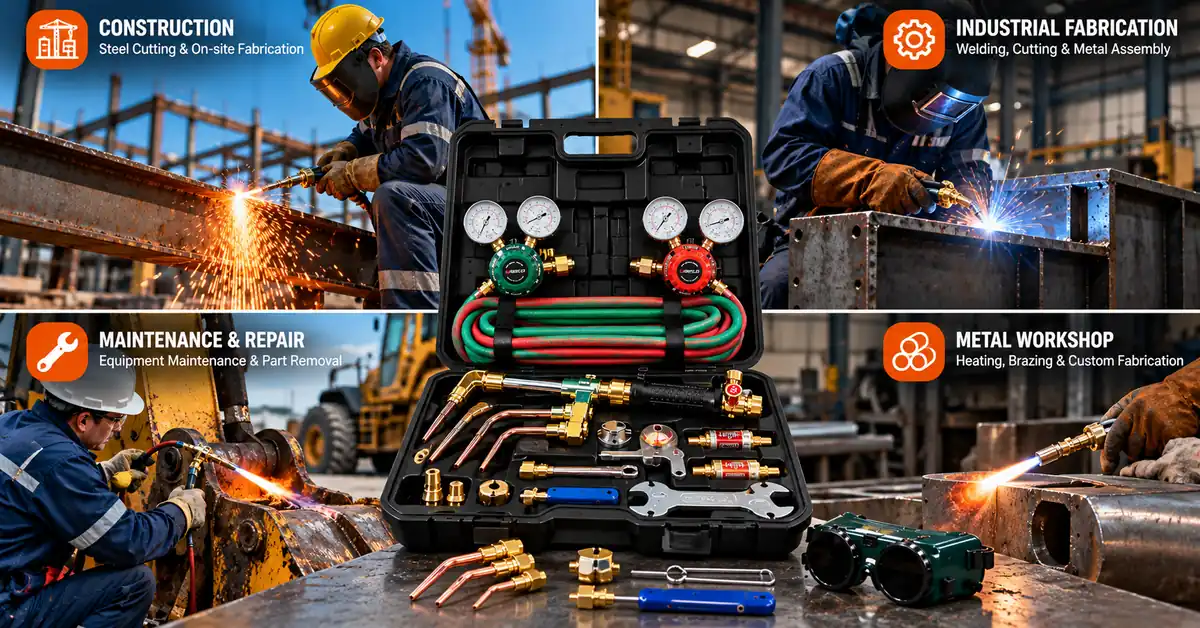
| Welding & Cutting Kits | Complete oxy-fuel equipment sets | Professional repair and maintenance businesses | Approved accessory list and gas connections |
| Gas Heating | MAPP/propane torches, heating heads | HVAC/R installers, maintenance contractors | Fuel compatibility and heating application |
| Safety | Welding helmets, face shields, protective products | Welding workshops and industrial dealers | Relevant product protection requirements |
| Replacement Parts | Tips, nozzles, electrodes, compatible accessories | Existing equipment users | Accurate SKU and equipment matching |
Distributors should avoid stocking unrelated products merely to increase catalog size.
Instead, build an assortment around customer demand and ensure that each main equipment product has an appropriate replacement-parts plan.
Core Equipment vs Repeat-Purchase Products
Main equipment and consumables often follow different purchasing patterns.
Cutting torches and welding machines may be purchased less frequently, while cutting tips, contact tips, nozzles, electrodes, and other consumables can generate recurring demand.
A distributor should therefore create separate inventory policies for equipment and replacement parts.
For example, a customer purchasing a MIG torch may later require compatible consumables, even when the torch itself does not need replacement.
Providing accurate replacement-part references can make the distributor more useful to its customers.
How Can Distributors Prevent Wrong-SKU Orders?
Wrong-SKU orders often result from incomplete product descriptions rather than an obvious purchasing mistake.
A welding torch can have a familiar model designation but use a different connector, cable length, or control arrangement.
Likewise, two oxy-fuel cutting nozzles may look similar while requiring different fuel gases or torch seating designs.
Technical Compatibility Matrix
| Equipment | UWELD Example | Specifications to Record | Common Ordering Risk |
|---|---|---|---|
| MIG Welding Torch | 24KD MIG/MAG Torch | Connector, cable length, consumables | Wrong machine connection |
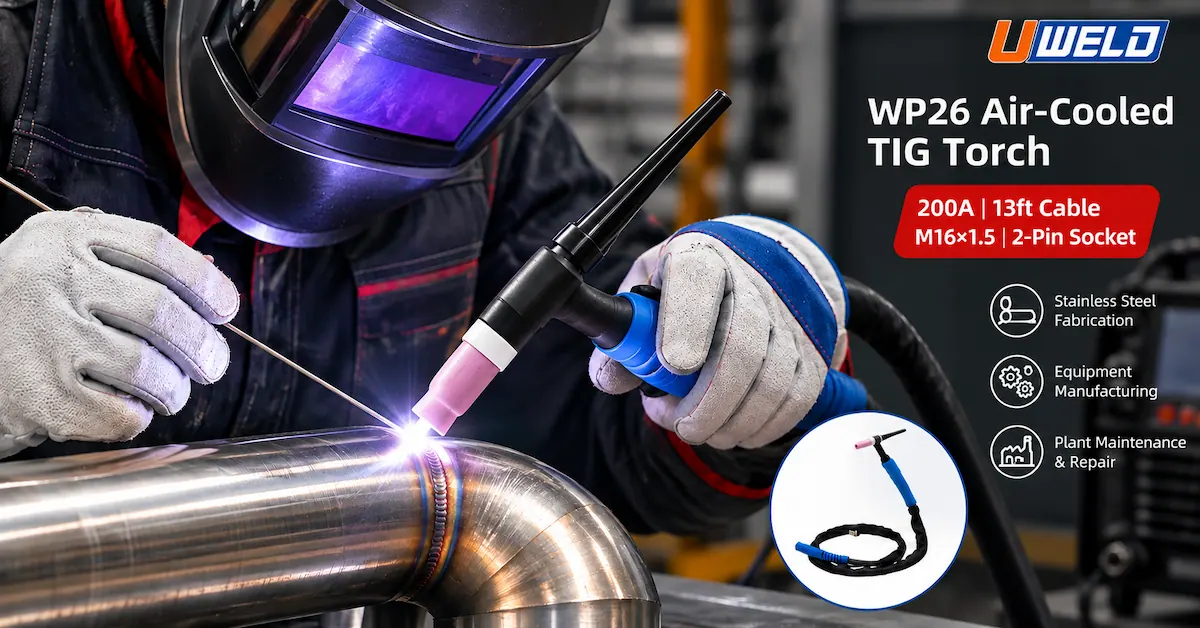
| TIG Welding Torch | WP26 Air-Cooled TIG Torch | Power connector, control plug, cooling, cable | Incompatible welding machine |
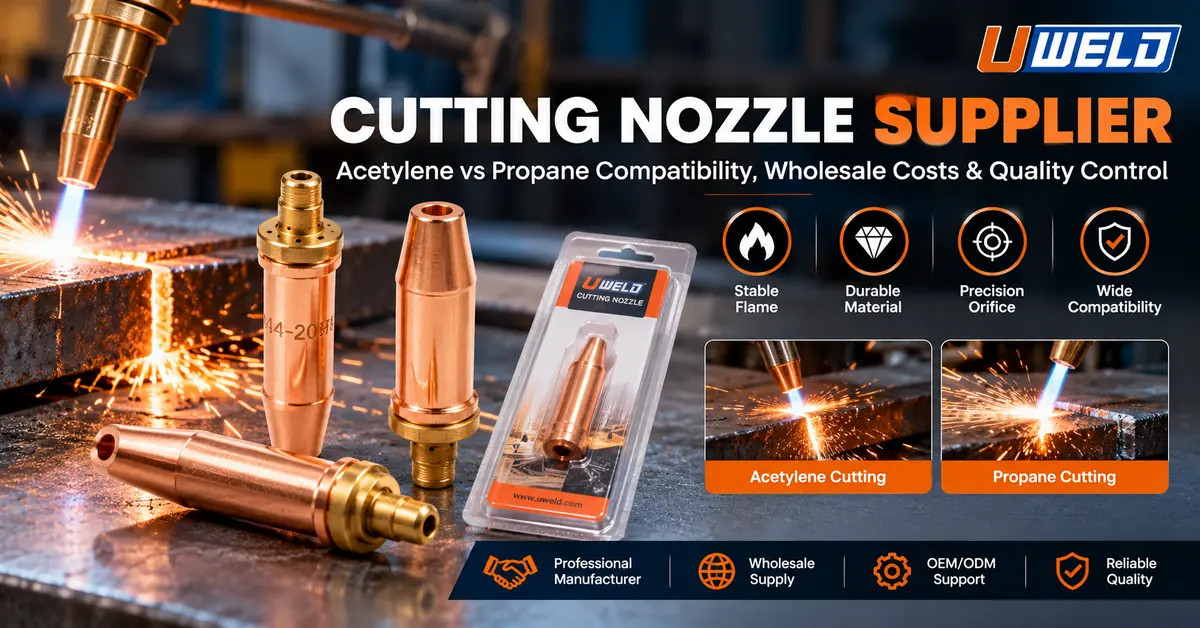
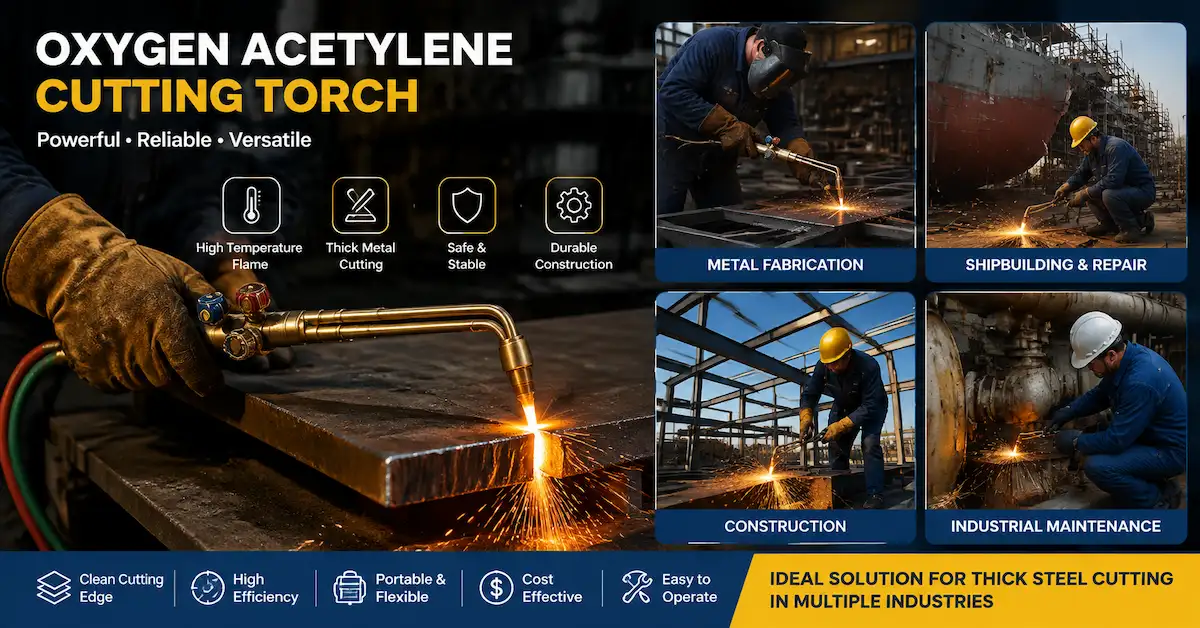
| Heavy Duty Cutting Torch | 1C005-0003 | Fuel gas, nozzle family, connections | Incorrect cutting tip |
| Acetylene Regulator | 1C008-0005 | Gas approval, inlet, outlet, pressure range | Wrong cylinder fitting |
| Flashback Arrestor | H188 Oxygen Series | Gas type, position, fitting, protective functions | Incorrect protective-device selection |
| Cutting & Welding Kit | 1C016-0045 | Complete BOM, regulators, torch, accessories | Missing or substituted components |
Example 1: MIG Torch Compatibility
The UWELD 24KD Air-Cooled MIG/MAG Torch is listed with a 10 ft cable and Euro connector.
For purchasing managers, identifying the model as "24KD" is not sufficient.
The order should also confirm the actual machine interface, cable arrangement, consumables, and approved configuration.
This is particularly important when serving customers with welding machines from different manufacturers.
Example 2: TIG Torch Compatibility
The UWELD WP26 Air-Cooled TIG Torch has a published 200 A rating, 13 ft cable, M16×1.5 connector, and 2-pin socket.
However, these details do not prove compatibility with every TIG welding machine.
Buyers must also consider the rated duty cycle, cooling requirements, control connection, and intended equipment arrangement.
Example 3: Gas Cutting Components
The UWELD Heavy Duty Cutting Torch 1C005-0003 is listed with check-valve features and configurable options.
For a complete gas cutting system, distributors should confirm fuel-gas compatibility, approved nozzle family, regulator specifications, and required protective devices.
A check valve should not be assumed to replace every flashback-protection requirement.
Recommended SKU Identification System
Each distributor SKU should contain or reference:
-
Original manufacturer model number.
-
Product category and exact configuration.
-
Applicable gas or electrical interface.
-
Dimensions, ratings, or consumable specifications.
-
Approved revision and product documentation.
-
Packaging quantity and replacement-part references.
An internal inventory code should link back to the manufacturer's approved technical specification.
This reduces the risk of ordering products that appear similar but cannot be substituted.
How Should Distributors Calculate Reorder Points?
A supplier may offer suitable products, but inventory planning still determines whether a distributor can meet customer demand.
A reorder point identifies when the business should initiate another purchase order.
A practical starting formula is:
Reorder Point = Average Demand During Replenishment Lead Time + Safety Stock
When demand is measured weekly:
Reorder Point = Average Weekly Demand × Replenishment Lead Time in Weeks + Safety Stock
The replenishment period should cover the full time from placing an order until the products are available for sale—not simply the supplier's production time.
Illustrative Replenishment Example
Assume a distributor sells an average of eight compatible welding torch units per week.
Its expected end-to-end replenishment time is six weeks, and it wants to hold twelve additional units as safety stock.
| Inventory Variable | Illustrative Value |
|---|---|
| Average weekly demand | 8 units |
| Total replenishment lead time | 6 weeks |
| Expected demand during lead time | 48 units |
| Safety stock | 12 units |
| Reorder point | 60 units |
The distributor would review replenishment when its inventory position approaches 60 units.
Inventory position should account for stock on hand, outstanding orders, and committed backorders—not just warehouse shelf quantity.
This example is hypothetical and does not represent UWELD sales, inventory, or delivery data.
Why Lead Time Must Be Calculated Carefully
International procurement may involve several stages:
Product availability → order confirmation → production or preparation → inspection → shipment → customs clearance → local delivery.
UWELD's FAQ page states that stock items normally take one to two weeks, while customized orders require separately confirmed schedules.
These general lead times do not necessarily include international transportation and customs processing.
For purchasing planning, buyers should request a complete order schedule for the actual products.
Different Products Need Different Safety Stock
Not every SKU requires the same reserve quantity.
High-demand consumables may justify more frequent replenishment, while expensive or slow-moving equipment may require smaller planned inventory.
Safety stock should reflect demand variability, replenishment uncertainty, customer service targets, and storage costs.
A practical inventory classification can distinguish fast-moving products, moderate-demand accessories, and specialized low-volume items.
How Can Buyers Control MOQ and Mixed-SKU Wholesale Orders?
A supplier's minimum order quantity can affect inventory cost, especially when several product families are purchased together.
The MOQ for a standard cutting torch may differ from the requirement for a customized welding kit or private-label safety product.
Buyers should confirm whether MOQ applies to each individual SKU, each variant, a product family, or the overall order.
Mixed-SKU Purchasing Checklist
| Purchasing Item | Questions to Ask |
|---|---|
| Standard products | Are the required models available from stock? |
| MOQ | Is the minimum calculated per SKU or per order? |
| Product variants | Can different approved versions be combined? |
| Custom packaging | Are there separate packaging minimums? |
| Sample orders | Can samples be approved before bulk purchasing? |
| Lead time | Which products have the longest preparation time? |
| Shipment planning | Can compatible orders be consolidated? |
| Spare parts | Can replacement consumables be included? |
| Product changes | How are revised configurations communicated? |
Should Buyers Combine Different Product Categories?
Combining products in one purchasing program can reduce administrative work and may support shipment consolidation.
However, mixed-SKU purchasing is beneficial only when the products meet their individual technical and commercial requirements.
A distributor should not purchase excess slow-moving stock solely to meet a general order target without evaluating inventory carrying costs.
For a new business relationship, starting with a controlled group of priority SKUs is often more manageable than immediately ordering every available product type.
What Quality Documents Should a Supplier Provide?
Industrial distributors need documents that support product identification, technical approval, and applicable market requirements.
A general company certificate is useful, but it does not replace the technical evidence required for each product.
Documentation by Equipment Category
| Product Family | Recommended Documentation |
|---|---|
| Gas Regulators | Gas service, pressure specifications, connections, applicable test records |
| Cutting Torches | Torch configuration, approved nozzles, operating instructions |
| Welding Torches | Current rating, duty cycle, connectors, consumable references |
| Cutting Nozzles | Fuel compatibility, size chart, seating design |
| Flashback Arrestors | Gas rating, mounting position, protective functions |
| Complete Kits | Bill of materials, packing list, model references |
| Welding Protection | Model-specific protection specifications and applicable conformity evidence |
UWELD states that it holds ISO 9001:2015 quality management system certification and references standards including EN ISO 2503 and EN ISO 5172 for relevant product categories.
However, these statements should not be interpreted as proof that every model has the same individual certification.
For regulated or safety-critical equipment, verify the actual document scope, product identification, and destination-market requirements.
Sample Approval Before Repeat Orders
A purchasing program should use a representative approved sample as a reference.
The buyer should document the product configuration, inspection criteria, packaging, and any approved modifications.
Future deliveries can then be compared against the agreed specification.
This reduces uncertainty when different production batches or product revisions are involved.
How Should Buyers Evaluate Supplier Delivery Reliability?
Delivery reliability is more than whether a shipment arrives on the originally requested date.
Distributors also need accurate order acknowledgments, visibility into preparation stages, consistent product identification, and appropriate handling of delays.
Supplier Service Scorecard
The following is a suggested buyer evaluation model, not an official industry certification or Google SEO score.
| Evaluation Dimension | Suggested Weight |
|---|---|
| Technical and product compatibility | 25 |
| Product quality and repeat-order consistency | 20 |
| Delivery and replenishment support | 20 |
| Documentation and compliance support | 15 |
| Total landed cost | 10 |
| After-sales and OEM/distributor support | 10 |
| Total | 100 |
A higher score should reflect documented supplier performance rather than general marketing claims.
For example, delivery performance can be measured using agreed shipment dates and actual order records.
Product quality can be evaluated through inspection findings, documented nonconformities, and customer returns.
Without verified data, assigning a supplier a perfect score would be misleading.
Important Delivery Questions
A distributor should clarify when the lead-time clock begins, whether all SKUs will be ready together, what happens if a component is unavailable, and how approved substitutions or schedule changes are communicated.
These details should be agreed during quotation or order confirmation.
What Is the True Cost of Welding and Cutting Equipment Supply?
A wholesale quotation is only one part of the complete purchasing cost.
For distributors, the actual expense also includes freight, import charges, inspections, storage, inventory financing, customer support, and replacement parts.
Total Sourcing Cost
Total Sourcing Cost = Product Cost + Freight & Import Charges + Inspection + Inventory Carrying Cost + Expected After-Sales Costs
| Cost Factor | Potential Commercial Impact | Buyer Control |
|---|---|---|
| Unit price | Initial product expenditure | Compare equivalent configurations |
| Freight | Landed cost per shipment | Review consolidation options |
| Product mismatch | Returns and replacements | Verify SKUs and compatibility |
| Slow-moving stock | Capital tied up in inventory | Forecast demand by product family |
| Stockouts | Missed customer orders | Set realistic reorder points |
| Batch variation | Extra inspections or claims | Control approved specifications |
| Missing spare parts | Longer customer repair cycles | Establish replacement-part plans |
| Custom packaging | Setup and inventory requirements | Confirm approved artwork and quantities |
Is a Lower Supplier Price Always Better?
No.
A lower quotation may provide good value when product quality, technical compatibility, and delivery conditions are equivalent.
However, a cheaper product can become more expensive if the buyer must purchase additional accessories or manage frequent returns.
The correct comparison should use equivalent product configurations and realistic commercial assumptions.
Any claimed percentage saving should be based on actual purchasing records rather than an unsupported estimate.
How Can Distributors Build a Reliable Supply Program in Three Stages?
An effective sourcing program should grow through verified demand instead of expanding the product range without a clear plan.
Stage 1: Establish a Core Assortment
Select products that match existing customers.
A fabrication-focused distributor may begin with MIG/TIG torches, cutting torches, gas regulators, selected protective devices, and relevant consumables.
Confirm the technical specifications and approve representative samples before placing larger orders.
Stage 2: Add Compatible Consumables and Accessories
Build a replacement-parts matrix connecting each main equipment SKU to approved accessories.
Monitor customer demand and actual replacement patterns.
This stage can improve product availability and help sales teams answer compatibility questions more accurately.
Stage 3: Develop Replenishment and Partnership Procedures
Establish purchasing cycles, reorder points, review dates, quality-reporting methods, and supplier communication responsibilities.
For consistent repeat orders, maintain approved BOMs and product revision records.
The distributor can then expand into heating, HVAC/R, safety, or customized equipment based on documented market demand.
Practical Scenario: Supporting Two Industrial Customer Groups
Consider an importer serving both metal fabrication workshops and HVAC/R maintenance dealers.
The fabrication customers purchase MIG welding torches, oxy-fuel cutting tools, gas regulators, and replacement consumables.
The HVAC/R dealers mainly need appropriate heating and brazing equipment.
This is an illustrative sourcing scenario, not a documented UWELD customer project.
The Purchasing Challenge
The importer initially manages all products with one general purchasing schedule.
This creates a mismatch between the different inventory patterns.
Frequently requested welding consumables sell more quickly than specialized heating tools.
The importer also receives questions about whether replacement parts fit the original equipment.
The Recommended Solution
First, separate the two customer groups into distinct product and demand categories.
Second, establish compatibility information for every torch, regulator, nozzle, and relevant accessory.
Third, calculate reorder points using actual sales demand and full replenishment lead times.
Fourth, purchase slow-moving specialized products according to documented customer demand rather than using the same safety-stock level for every SKU.
Finally, review supplier performance and customer feedback at regular intervals.
Expected Benefits
This approach can improve product identification, support more accurate stock planning, and reduce unnecessary compatibility confusion.
Actual improvements in inventory turnover, stockout frequency, and profitability should be measured from the distributor's own sales and purchasing records.
The core lesson is that supplier coordination and inventory planning should be developed together.
How Does UWELD Support Distributors and OEM Buyers?
UWELD presents two partnership approaches through its official Partners page.
UWELD Brand Distribution
This approach is designed for importers, wholesalers, distributors, and equipment suppliers interested in offering UWELD-branded products.
The company describes product training, marketing materials, export assistance, and logistics support as part of its distributor partnership program.
Specific commercial terms must be agreed for each partnership.
OEM/ODM and Private-Label Supply
UWELD also supports customization discussions for brands requiring their own product identity or selected equipment configurations.
Potential project requirements may include product labels, packaging, accessory selection, and feasible design adjustments.
Technical changes affecting gas compatibility, safety components, or electrical interfaces require appropriate engineering review.
The company's Solutions page describes its manufacturing and customization capabilities.
What Should Buyers Confirm Before Cooperation?
Important subjects include product selection, expected order volume, MOQ, samples, approved technical specifications, packaging, quality requirements, delivery conditions, and after-sales responsibilities.
For long-term distribution programs, buyers should also discuss replacement-parts availability and how future product changes will be communicated.
What Should Be Included in a Wholesale RFQ?
A detailed RFQ makes it easier for a supplier to recommend suitable configurations and prepare an accurate quotation.
| RFQ Field | Information to Provide |
|---|---|
| Buyer profile | Distributor, importer, OEM brand, industrial user |
| Target market | Destination countries and customer industries |
| Required categories | Welding, gas cutting, heating, safety |
| Product models | Exact UWELD SKU or desired configuration |
| Technical requirements | Current, pressure, connections, fuel compatibility |
| Accessories | Compatible consumables and replacement parts |
| Quantity | Sample quantity and expected repeat orders |
| Inventory requirements | Estimated demand and replenishment schedule |
| Quality documentation | Specifications, inspections, applicable certificates |
| Branding | UWELD-branded or private-label |
| Packaging | Standard or customized |
| Delivery | Destination and requested shipment arrangements |
| After-sales | Service, spare parts, and issue-reporting requirements |
An RFQ should also identify any critical component that cannot be substituted without buyer approval.
Buyers can review the UWELD Catalog and then request current datasheets for their selected products.
Looking for a welding and cutting equipment supplier for your distribution business? Contact UWELD to discuss product selection, compatible accessories, wholesale pricing, MOQ, samples, and a repeat-order supply plan.
Frequently Asked Questions About Welding and Cutting Equipment Suppliers
1. What products should a welding and cutting equipment supplier offer?
A suitable supplier may offer MIG/TIG torches, gas cutting torches, regulators, cutting nozzles, heating equipment, welding protection, and related consumables. The appropriate product range depends on the distributor's target customers.
2. How can distributors prevent incorrect welding equipment orders?
Use approved model numbers, technical specifications, compatibility matrices, and controlled product configurations. Confirm connections, consumables, ratings, and accessories before placing orders.
3. How should distributors calculate welding equipment reorder points?
Use expected demand during the complete replenishment lead time plus an appropriate safety-stock allowance. Review the calculation periodically using actual sales and delivery records.
4. Can different welding and cutting products be ordered together?
Mixed-category purchasing may be possible, subject to product availability, MOQ, packaging, and commercial arrangements. Confirm the requirements for each SKU rather than assuming one minimum applies to every product.
5. What is the difference between a welding equipment manufacturer and supplier?
A manufacturer performs defined production activities, while a supplier may manufacture, distribute, or coordinate product supply. B2B buyers should verify each partner's actual technical, manufacturing, logistics, and after-sales responsibilities.
6. Why are replacement parts important for welding equipment distributors?
Compatible consumables and spare parts support customer maintenance and repeat purchasing. Clear replacement-part references can reduce the risk of supplying incompatible accessories.
7. What certifications should buyers request?
Request the documents applicable to the exact equipment model and destination market. Company-level quality management certification does not automatically establish conformity for every individual product.
8. Does UWELD support international distributors?
UWELD describes brand distribution cooperation, marketing and training support, and logistics assistance through its Partners page. Specific partnership conditions are subject to agreement.
9. Can UWELD supply OEM or private-label welding equipment?
UWELD supports OEM/ODM inquiries involving branding, packaging, and feasible product customization. MOQ, sample requirements, specifications, and lead times depend on the project.
10. How can I request a wholesale quotation from UWELD?
Provide your target market, product categories, preferred models, connection requirements, estimated order quantities, packaging needs, and delivery destination through the UWELD contact page.
Conclusion
Selecting a reliable welding and cutting equipment supplier requires more than comparing product catalogs, prices, or manufacturing claims.
For industrial distributors, importers, and OEM brands, long-term purchasing success depends on technical compatibility, accurate SKU identification, realistic replenishment planning, consistent product specifications, and dependable supplier communication.
A well-structured sourcing program combines main equipment with compatible consumables, calculates inventory requirements using actual demand, and establishes clear approval procedures for repeat orders.
UWELD provides professional gas cutting products, MIG/TIG welding tools, gas regulators, heating equipment, and related accessories for international industrial markets.
Its wholesale and OEM/ODM cooperation options allow buyers to discuss market-specific product configurations, distribution support, and longer-term purchasing requirements.
To build a more reliable equipment supply program, explore the UWELD Product Center, review the company's distribution partnership options, or contact UWELD for a tailored wholesale quotation with your product list, technical specifications, and expected purchasing volumes.