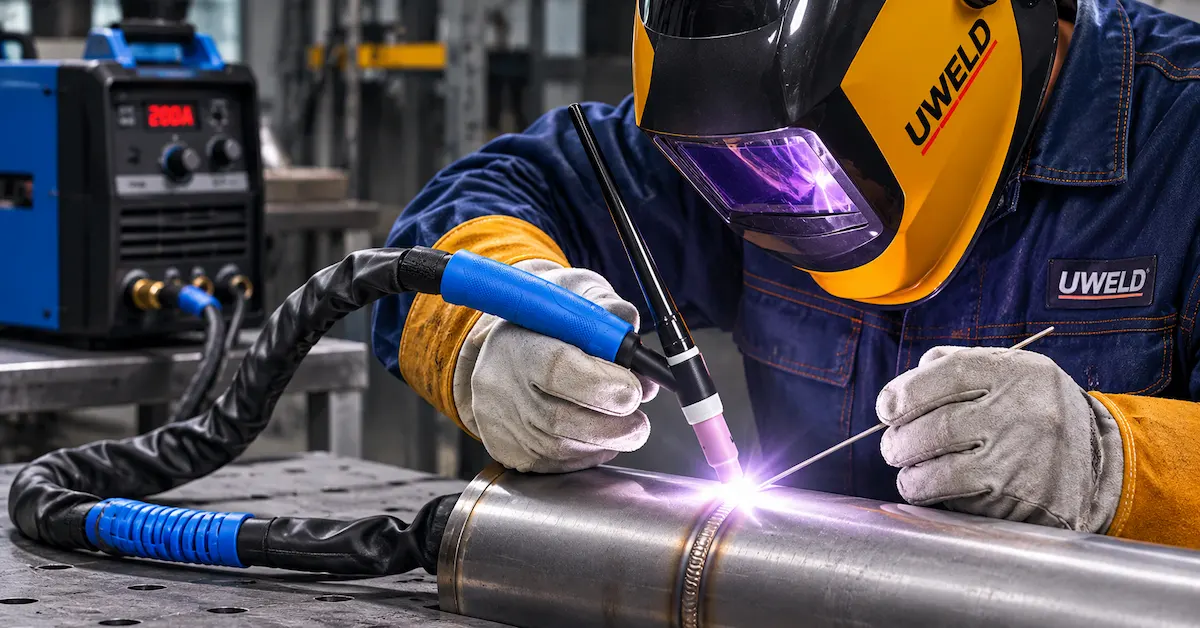


Quick Answer: The UWELD 81544 solar powered welding helmet, product number 3S003-0010, features an adjustable shade 9–13 auto-darkening filter, solar cells and lithium batteries, two arc sensors, and adjustable sensitivity and recovery delay. Its plain black shell and published 420 g weight make it a candidate for industrial welding equipment programs. Buyers should evaluate filter performance, power-system readiness, protective requirements, replacement parts, and batch consistency before approving bulk purchases.
For industrial fabrication workshops, purchasing welding helmets involves more than selecting a suitable shade range or comparing unit prices.
When dozens of welders share equipment across multiple workstations, differences in filter response, battery condition, headgear adjustment, and replacement-part availability can create unnecessary equipment management problems.
Welding equipment distributors face similar challenges when supplying helmets to customers with different welding processes and operating environments.
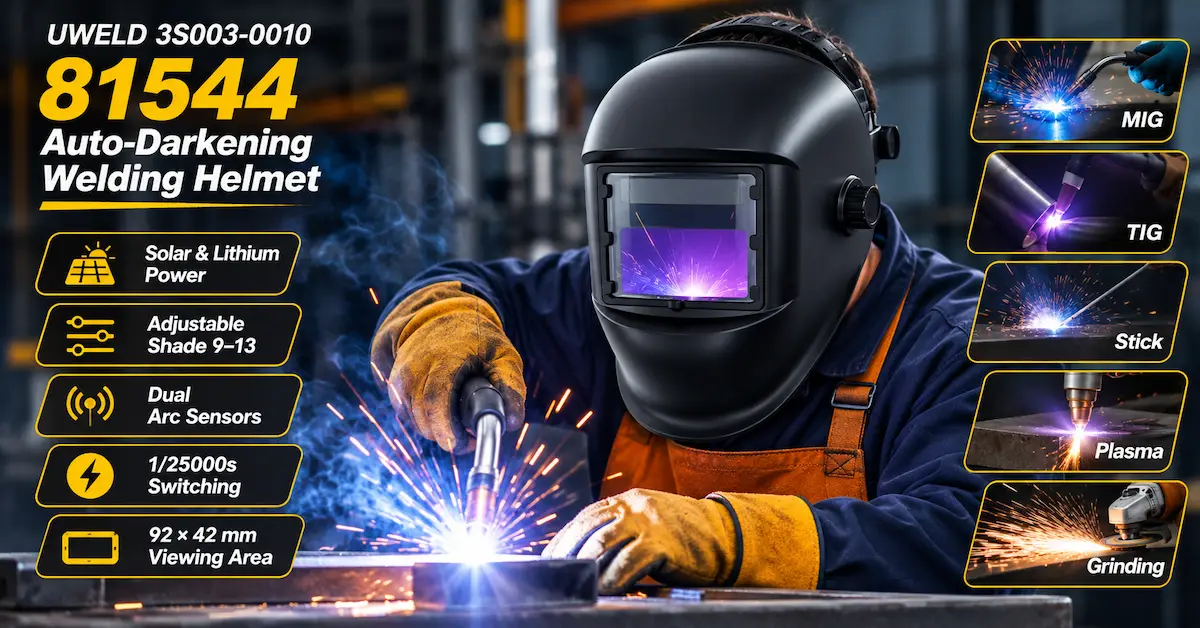
The UWELD 3S003-0010 Auto-Darkening Welding Helmet combines an automatic filter system, adjustable operating controls, solar and lithium battery power, and a conventional black helmet shell.
This guide examines the product's technical characteristics and explains how professional buyers can evaluate its suitability for workshop deployment, industrial distribution, and OEM wholesale purchasing.
Key Takeaways
-
Solar and lithium battery power: A combined power arrangement supports electronic filter operation.
-
Automatic filter switching: The published light-to-dark response time is 1/25000 second.
-
Adjustable shade 9–13: Provides a selectable dark-state range for compatible welding applications.
-
Two arc sensors: Support the filter's automatic response to detected welding arc conditions.
-
Adjustable sensitivity and delay: Allow different aspects of filter response to be controlled.
-
Plain black shell: Provides a consistent appearance for industrial equipment programs and potential private-label projects.
-
Wholesale procurement: Buyers should prioritize protective documentation, sample approval, filter consistency, and replacement-part planning.
What Is the 81544 Solar Powered Welding Helmet?
The UWELD 3S003-0010 is a welding helmet equipped with an electronic auto-darkening filter, commonly referred to as an ADF.
The filter changes its visible-light transmission in response to detected welding arc conditions. This allows operators to observe the work area in its light state and use an appropriately selected dark state during approved welding operations.
Unlike a fixed-shade helmet, this product incorporates arc sensors, electronic controls, an adjustable filter, and a combined power supply.
The UWELD product listing identifies the helmet using the 81544 model reference. Its product suitability must be evaluated according to the actual supplied configuration and applicable protective equipment requirements.
UWELD 3S003-0010 Technical Specifications
| Specification | Manufacturer-Published Information |
|---|---|
| Supplier brand | UWELD |
| Product number | 3S003-0010 |
| Model reference | 81544 |
| Product category | Auto-darkening welding helmet |
| Exterior design | Plain black |
| Filter dimensions | 110 × 90 × 9 mm |
| Viewing area | 92 × 42 mm |
| Light state | DIN 4 |
| Dark state | DIN 9–13 |
| Switching time | 1/25000 second |
| Recovery delay | 0.2–0.8 seconds, adjustable |
| Arc sensors | 2 |
| Sensitivity | Adjustable |
| Optical class | 1/1/1/2 |
| Published UV/IR protection | DIN 16 |
| Power supply | Solar cells and lithium batteries |
| Power on/off | Fully automatic |
| Shade adjustment | External knob |
| Grinding function | Listed in product literature |
| Helmet weight | 420 g |
| Working temperature | −5°C to 55°C |
| Commercial services | Wholesale and OEM inquiries |
Source: UWELD 3S003-0010 official product listing and associated manufacturer product illustration. The values above are published product specifications, not independent laboratory test results.
Who Should Consider This Helmet?
The product is relevant to several professional purchasing groups:
-
Welding equipment distributors.
-
Industrial protective equipment importers.
-
Metal fabrication workshops.
-
Welding training centers.
-
Industrial maintenance contractors.
-
Professional tool wholesalers.
-
OEM and private-label equipment brands.
Applications requiring protective characteristics outside the helmet's documented capabilities should be evaluated using alternative equipment.
How Does a Solar Powered Welding Helmet Work?
A solar powered auto-darkening welding helmet uses electronic components to control its welding filter.
The UWELD 3S003-0010 combines solar cells with lithium batteries to support automatic filter operation.
The solar component can contribute electrical energy under suitable lighting conditions, while the battery arrangement supports the electronic system according to its design.
Main Power-System Components
| Component | Main Function | Purchasing Consideration |
|---|---|---|
| Solar cells | Contribute electrical power | Physical condition and approved configuration |
| Lithium batteries | Support electronic operation | Battery specification and replacement design |
| Arc sensors | Detect relevant welding light conditions | Detection suitability |
| Electronic control circuit | Controls filter operation | Functional consistency |
| Auto-darkening filter | Changes visible-light transmission | Optical and protective performance |
| Automatic power management | Supports electronic operating functions | Manufacturer-approved behavior |
Does Solar Power Mean the Helmet Never Needs Battery Maintenance?
No.
The presence of solar cells does not establish unlimited operating life or eliminate battery-related maintenance.
Some welding helmets have replaceable batteries, while others use different battery arrangements.
The available product information does not establish the exact battery replacement method or expected battery life for the UWELD 3S003-0010.
A buyer evaluating the 81544 solar powered welding helmet should therefore request the relevant battery and maintenance instructions instead of assuming that solar assistance makes the helmet maintenance-free.
Can the Helmet Be Used in Poorly Lit Workshops?
Workplace illumination and power-system requirements should be evaluated according to the manufacturer's instructions.
The combined solar and lithium arrangement does not independently establish reliable operation under every lighting condition.
Before industrial deployment, the complete filter system must meet the intended application requirements.
What Is Auto-Darkening Filter Readiness?
Filter readiness refers to the condition in which the helmet's electronic filter, power supply, sensors, controls, and optical components are functioning according to the manufacturer's requirements.
It is especially important for helmets stored between shifts or distributed through industrial warehouses.
A new helmet should not be assumed ready for use solely because its exterior shell is undamaged.
Recommended Filter Readiness Checklist
| Inspection Area | Evaluation Requirement |
|---|---|
| Power supply | Appropriate operating condition |
| Arc sensors | Clean and unobstructed |
| Filter cartridge | Correct assembly and physical condition |
| Shade control | Functioning within the approved range |
| Sensitivity control | Appropriate functional response |
| Delay control | Correct recovery behavior |
| Cover plates | Free from unacceptable damage |
| Operating mode | Correct mode for the intended task |
| Helmet shell | No unacceptable cracks or deformation |
| Headgear | Suitable condition and fit |
All functional checks should follow the manufacturer's approved inspection and testing methods.
Operators must never intentionally expose their eyes to an active welding arc to determine whether a filter works.
A helmet that fails its approved pre-use checks should be removed from service.
What Does the 1/25000-Second Switching Speed Mean?
UWELD's product literature identifies a light-to-dark switching time of 1/25000 second, equivalent to 40 microseconds.
This specification describes the published filter transition time under its relevant rating conditions.
For industrial buyers, switching speed is useful when comparing electronic welding filters, but it should not be interpreted independently of sensor response and optical protection.
Switching Time and Recovery Delay Comparison
| Function | Published Specification | Purpose |
|---|---|---|
| Light-to-dark switching | 1/25000 second | Transition to the dark state |
| Dark-to-light delay | 0.2–0.8 seconds | Adjustable return to the light state |
| Arc detection | Two sensors | Detects relevant arc conditions |
| Sensitivity | Adjustable | Controls detection responsiveness |
Switching time and recovery delay are different functions.
A rapid light-to-dark transition does not mean that the helmet immediately returns to its light state after welding.
Does a Faster Switching Time Guarantee Better Protection?
No.
The complete protective performance of a welding helmet also depends on its UV/IR filtration, detection reliability, electronic condition, optical design, and applicable testing.
Buyers should evaluate these characteristics together rather than select a product based only on its advertised switching speed.
How Do Shade, Sensitivity and Delay Controls Differ?
The UWELD 3S003-0010 features several adjustable controls intended for compatible welding applications.
Understanding these functions helps distributors provide accurate product information and reduce customer confusion.
Welding Helmet Control Functions
| Control | Main Function | Buyer Evaluation |
|---|---|---|
| Shade adjustment | Selects the available dark-state shade | Suitable range for the intended process |
| Sensitivity | Adjusts arc-detection responsiveness | Detection behavior |
| Delay | Controls the return to the light state | Suitable recovery characteristics |
| Automatic power | Manages electronic operation | Approved power-system behavior |
| Grinding function | Supports an alternative mode where approved | Correct mode identification and mechanical protection |
Adjustable Shade 9–13
The published dark-state range of DIN 9–13 allows shade selection within the product's specified limits.
Higher shade numbers generally correspond to greater visible-light attenuation.
The appropriate setting depends on the welding process, current, applicable protection requirements, and manufacturer's instructions.
The DIN 4 light state is not intended for direct viewing of an active welding arc.
Adjustable Sensitivity
Sensitivity controls influence how the filter responds to detected light conditions.
This may be relevant in workshops with different welding processes, surrounding lighting, and multiple welding stations.
The correct setting should be established according to the approved operating instructions.
Adjustable Recovery Delay
The manufacturer lists an adjustable delay range of 0.2–0.8 seconds.
This controls the filter's return timing after detected arc conditions end.
Different welding applications may require different recovery behavior. However, the appropriate setting should follow the equipment manufacturer's guidance.
How Should Buyers Evaluate the Viewing Area and Optical Performance?
The UWELD 3S003-0010 has a published viewing area of 92 × 42 mm and filter dimensions of 110 × 90 × 9 mm.
The viewing area describes the usable observation window, while the filter dimensions describe the overall cartridge size.
These values should not be confused when sourcing replacement components.
Published Optical Information
| Optical Parameter | Published Value |
|---|---|
| Viewing area | 92 × 42 mm |
| Filter dimensions | 110 × 90 × 9 mm |
| Light state | DIN 4 |
| Dark state | DIN 9–13 |
| Optical class | 1/1/1/2 |
| UV/IR protection | DIN 16 |
In the commonly used four-part optical classification system, the numbers represent optical quality, light diffusion, transmission variation, and angular dependence.
However, a published optical class does not independently demonstrate full protective equipment compliance.
For professional procurement, the actual filter model and applicable test documents should correspond to the supplied helmet.
Are Filters With the Same Dimensions Interchangeable?
Not necessarily.
Two filter cartridges may share similar external dimensions but have different mounting features, protective characteristics, sensor arrangements, and electrical configurations.
Replacement filters and cover plates should be approved for the actual helmet.
Which Industrial Applications Are Suitable for the UWELD 81544?
UWELD's product literature identifies ARC, TIG, MIG and plasma-related applications.
The suitability of the helmet for each process depends on the applicable filter requirements, arc-detection capability, mechanical protection, and working conditions.
Industrial Application Matrix
| Application | Main Requirement | Purchasing Focus |
|---|---|---|
| MIG welding | Appropriate arc protection and visibility | Shade range and detection response |
| TIG welding | Suitable detection at the intended current | Minimum supported TIG current |
| Stick welding | Appropriate filter and face coverage | Process-specific protection |
| General metal fabrication | Repeated use across welding operations | Controls, fit and replacement parts |
| Industrial maintenance | Different workplace conditions | Equipment readiness and suitability |
| Welding training | Standardized equipment for multiple users | Instructions and inspection procedures |
| Plasma cutting | Process-specific optical protection | Appropriate shade and approved application |
Production Welding Workshops
Workshops with several welding stations may benefit from standardizing helmet configurations.
Consistent controls, model identification and replacement-part references can simplify equipment management.
TIG Welding
Low-current TIG welding may place particular demands on arc detection.
The supplied specifications do not establish the minimum supported TIG current for this model.
Buyers targeting precision TIG applications should obtain the relevant detection specifications before approving the product.
Welding Training Centers
Training facilities often require several helmets with similar controls and consistent operating instructions.
A standardized helmet configuration can support more straightforward equipment familiarization and routine inspection.
Grinding Applications
Although grinding is listed in the product literature, this does not establish an independently verified impact-protection rating.
Grinding requires suitable protection against flying particles and mechanical hazards.
Only equipment documented as appropriate for the task should be used, together with additional eye protection where required.
Grinding mode must not be used for active welding.
Why Consider a Plain Black Welding Helmet for Industrial Fleets?
Unlike graphic-patterned welding helmets, the UWELD 3S003-0010 features a conventional black exterior.
For industrial buyers, this may provide a practical option when appearance consistency is important across multiple workstations.
Commercial Advantages of a Standardized Exterior
| Purchasing Objective | Potential Benefit |
|---|---|
| Equipment identification | Consistent model appearance |
| Workshop deployment | Standardized protective equipment assortment |
| Inventory management | Simpler product identification |
| OEM packaging | Potential private-label presentation |
| Repeat purchasing | Easier reference to approved configurations |
| Distributor catalogs | Distinct standard model within a broader range |
These are potential inventory and commercial benefits, not claims of superior protective performance.
The helmet's optical and mechanical suitability remains more important than its exterior appearance.
UWELD 81544 vs GX-500S vs KD890 Welding Helmets
UWELD offers multiple auto-darkening helmet configurations.
Industrial buyers can compare these products according to their published features, intended application and commercial requirements.
UWELD Welding Helmet Model Comparison
| Product | Published Shade Range | Main Characteristics | Selection Focus |
|---|---|---|---|
| 3S003-0010 / 81544 | 9–13 | Solar/lithium power, adjustable sensitivity, black shell | Workshop standardization and power-system readiness |
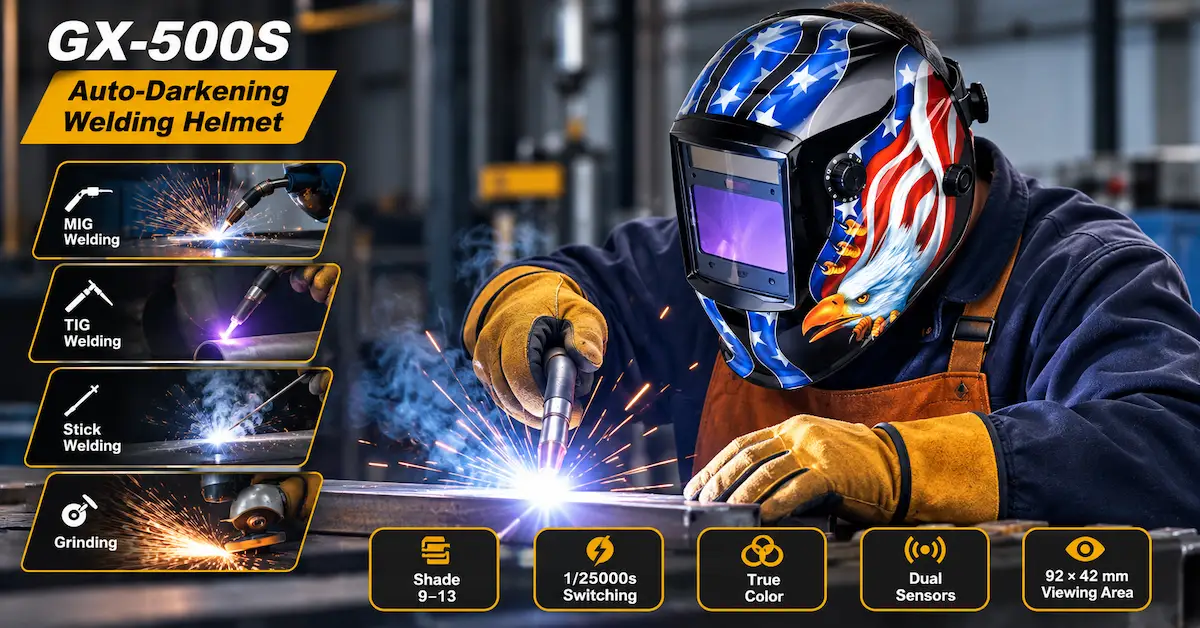
| 3S003-0005 / GX-500S | 9–13 | True Color, American Eagle graphics, 1/25000s switching | Optical features and distinctive graphics |
| 3S003-0017 / KD890 | 9–13 | Published switching time of 0.0001s | Filter response and documented configuration |
| UW-3S003-0001 | 9–13 | Four arc sensors, solar-assisted battery arrangement | Sensor configuration and headgear |
The table compares manufacturer-published product characteristics rather than establishing an independent safety ranking.
When Should Buyers Choose 3S003-0010?
The 81544 model is worth evaluating when purchasing requirements include a plain black shell, adjustable shade 9–13, solar and lithium power, and adjustable electronic filter controls.
When Should Buyers Consider GX-500S?
The UWELD GX-500S Auto-Darkening Welding Helmet may be relevant when buyers specifically require its published True Color feature and American Eagle exterior design.
When Is a Four-Sensor Helmet More Relevant?
The UWELD UW-3S003-0001 Auto Welding Mask lists four arc sensors.
This provides another configuration for technical evaluation where sensor arrangement is an important purchasing consideration.
Sensor count alone does not determine overall protective performance.
How to Standardize the 81544 Solar Powered Welding Helmet Across a Fleet
Industrial buyers supplying multiple welders should consider the complete equipment lifecycle rather than individual helmet purchases.
A standardized fleet purchasing program may help organize inspection, maintenance, replacement parts and future procurement.
Five-Stage Helmet Management Process
| Stage | Recommended Management Activity |
|---|---|
| 1. Application assessment | Identify welding processes and protection requirements |
| 2. Product approval | Evaluate samples and model-specific documentation |
| 3. Equipment deployment | Assign approved helmets and provide instructions |
| 4. Routine inspection | Monitor filters, controls, shells and headgear |
| 5. Replacement management | Maintain approved replacement references and batch records |
Practical Procurement Scenario
Consider a fabrication workshop equipping 30 welding stations with standardized auto-darkening helmets.
The purchasing manager wants to simplify spare-parts inventory while reducing the possibility of different operators receiving incompatible equipment.
A suitable procurement approach would be to establish one approved helmet configuration for the relevant applications, maintain a compatible replacement-parts list, and record the product batches supplied to each department.
The workshop could also define an inspection schedule based on manufacturer instructions and workplace requirements.
This is an illustrative procurement scenario, not a documented UWELD customer project.
Any actual reduction in equipment downtime, maintenance costs, or product returns should be measured through the customer's own records.
What Manufacturing and Quality Checks Matter for Wholesale Welding Helmets?
A professional inspection program should evaluate both the auto-darkening filter and the complete helmet assembly.
A visually acceptable shell cannot establish electronic reliability or verified optical protection.
For bulk purchases of the 81544 solar powered welding helmet, buyers should define measurable acceptance requirements before approving production orders.
Recommended Wholesale Quality-Control Checklist
| Inspection Item | Buyer Acceptance Requirement |
|---|---|
| Model identification | Correct 3S003-0010 reference |
| Helmet shell | Approved construction and black exterior |
| Filter assembly | Correct approved cartridge |
| Viewing dimensions | Matches the specified configuration |
| Optical performance | Relevant documented test evidence |
| Shade adjustment | Correct specified range |
| Arc sensors | Approved two-sensor configuration |
| Switching response | Qualified functional verification |
| Sensitivity control | Appropriate adjustment response |
| Delay control | Matches the approved specification |
| Solar components | Suitable condition and assembly |
| Lithium batteries | Correct approved configuration |
| Headgear | Suitable adjustment and mechanical condition |
| Cover plates | Correct fit and physical condition |
| Product markings | Matches applicable documentation |
| Packaging | Correct model and accessory identification |
| Traceability | Product batch and order identification |
These are recommended purchasing and inspection requirements. They do not represent independently verified production procedures for every UWELD helmet.
Why Is Sample Approval Important?
A representative sample allows the buyer to evaluate the actual helmet, filter, electronic functions, headgear and packaging.
The approved sample should be linked to a controlled product specification.
Changes to the filter, power supply, shell, or other safety-related components should receive appropriate technical review before future orders.
Why Is Batch Traceability Important?
If a product problem is identified, traceability helps distributors determine which units or batches may be affected.
Relevant records can include the product model, filter reference, batch number, inspection results, and shipment information.
This supports more organized after-sales management and corrective action.
What Safety and Compliance Documents Should Importers Request?
Welding helmets are personal protective equipment and must be appropriate for their intended applications.
Manufacturer-published shade and switching-speed information provides useful initial product screening, but additional documentation may be necessary for procurement approval and market access.
Recommended Documentation
| Document | Purchasing Purpose |
|---|---|
| Model-specific technical specification | Establishes the approved product configuration |
| Optical test reports | Supports evaluation of filter characteristics |
| UV/IR filtration documentation | Supports evaluation of protective performance |
| Mechanical protection reports | Establishes relevant physical protection characteristics |
| Applicable conformity documents | Supports destination-market requirements |
| User instructions | Provides approved operating and maintenance guidance |
| Product marking information | Supports identification and traceability |
The GX-500S, KD890 and 81544 models should be evaluated separately.
A certificate issued for another welding helmet must not automatically be applied to the UWELD 3S003-0010.
Similarly, a company-level quality management certificate does not replace model-specific protective equipment documentation.
Buyers can explore UWELD Industrial Safety Solutions for additional information about the company's protective equipment range.
What Affects the Wholesale Cost of Solar Powered Welding Helmets?
The wholesale cost of a welding helmet depends on its complete configuration, filter design, electronic components, protective construction, inspection requirements, and commercial terms.
For professional buyers, the initial purchase price represents only part of the total procurement cost.
Total Procurement Cost
Total Sourcing Cost = Product Cost + Inspection + Documentation + Packaging + Freight + Replacement Parts + Expected After-Sales Costs
| Cost Factor | Purchasing Consideration |
|---|---|
| Auto-darkening filter | Optical and electronic characteristics |
| Power supply | Solar and battery configuration |
| Helmet shell | Construction and approved appearance |
| Headgear | Adjustment and replacement requirements |
| Protective documentation | Destination-market requirements |
| Inspection | Sample and batch acceptance |
| OEM customization | Branding and packaging |
| Replacement parts | Long-term equipment management |
| Order quantity | MOQ and commercial quotation |
| Logistics | Shipment size and destination |
Why Should Buyers Compare Complete Configurations?
Two helmets advertised with the same shade range may contain different filters, sensors, headgear, batteries, or protective components.
Comparing only unit prices may therefore produce misleading results.
A more reliable comparison uses equivalent approved product specifications and documentation requirements.
OEM and Wholesale Welding Helmet Supply
UWELD supports wholesale and OEM inquiries for welding equipment and related protective accessories.
International distributors and private-label brands may require agreed product configurations, customized packaging, product identification, and suitable supporting documentation.
Potential OEM Purchasing Requirements
-
Private-label packaging.
-
Approved product branding.
-
Distributor barcode labels.
-
Carton artwork and product identification.
-
Market-specific user instructions.
-
Approved samples and inspection requirements.
-
Repeat-order configuration control.
Any customization affecting protective performance, filter construction, electronic components, or product markings requires appropriate technical and compliance review.
Explore UWELD OEM and Manufacturing Solutions to discuss manufacturing cooperation and customization opportunities.
MOQ, Samples and Lead Times
Minimum order quantities depend on the selected product configuration and customization scope.
Sample availability, production schedules and delivery arrangements should be established according to the intended order.
UWELD provides general purchasing information through its Frequently Asked Questions.
What Should Buyers Include in an 81544 Welding Helmet RFQ?
A detailed request for quotation helps establish the correct product configuration, documentation requirements, and commercial terms.
Recommended Wholesale RFQ Checklist
| RFQ Field | Information to Provide |
|---|---|
| Product | 81544 solar powered welding helmet |
| UWELD model | 3S003-0010 |
| Intended application | Required welding processes |
| Destination market | Country or region |
| Filter requirements | Shade range and optical specifications |
| Arc detection | Required detection characteristics |
| Power system | Required battery and solar configuration |
| Helmet appearance | Black shell or approved customization |
| Documentation | Applicable protective equipment requirements |
| Replacement parts | Cover plates, headgear or other approved components |
| Sample quantity | Required evaluation units |
| OEM branding | Logo and packaging requirements |
| Bulk quantity | Initial and expected repeat orders |
| Delivery | Required schedule and commercial terms |
Looking for an 81544 solar powered welding helmet for industrial distribution? Contact UWELD to request product specifications, samples, available protective equipment documentation, OEM packaging options, and wholesale pricing.
Frequently Asked Questions
1. What is the 81544 solar powered welding helmet?
The UWELD 3S003-0010 is an auto-darkening welding helmet featuring a plain black shell, adjustable shade 9–13, and a combined solar and lithium battery power arrangement.
2. Does a solar powered welding helmet need batteries?
Many solar-assisted helmets also use batteries to support electronic filter operation. The UWELD 3S003-0010 is described as using solar cells and lithium batteries.
3. What is the switching speed of the UWELD 81544?
The manufacturer publishes a switching time of 1/25000 second, equivalent to 40 microseconds. This is a published product specification rather than an independently verified test result.
4. What is the viewing area of the helmet?
The product illustration lists a viewing area of 92 × 42 mm and filter dimensions of 110 × 90 × 9 mm.
5. Does the helmet have adjustable sensitivity?
Yes. UWELD identifies adjustable sensitivity and an adjustable recovery delay of 0.2–0.8 seconds.
6. Can the 3S003-0010 be used for MIG and TIG welding?
UWELD lists MIG and TIG applications. Actual suitability depends on the intended welding process, current, detection requirements, and documented protective capabilities.
7. Is the helmet suitable for industrial fleet purchasing?
It may be evaluated for standardized workshop equipment programs. Buyers should first establish protective suitability, approved configurations, inspection procedures and replacement-part requirements.
8. Does DIN 16 UV/IR protection establish product certification?
No. DIN 16 is a manufacturer-published protection reference. Applicable independent test reports and conformity documents are needed to substantiate product-specific compliance claims.
9. Can distributors order customized helmet packaging?
UWELD supports OEM inquiries. Available branding and packaging options depend on the agreed configuration, technical feasibility, and relevant product-marking requirements.
10. How can I request wholesale pricing?
Provide the UWELD product number 3S003-0010, intended welding applications, destination market, order quantity, documentation requirements and customization needs through the UWELD contact page.
Conclusion
Selecting a reliable 81544 solar powered welding helmet requires careful consideration of the complete auto-darkening filter system, power supply, arc detection, operating controls, and protective equipment requirements.
The UWELD 3S003-0010 combines a published shade range of 9–13, solar and lithium battery power, two arc sensors, adjustable sensitivity, adjustable delay, and a conventional black exterior.
For fabrication workshops and industrial maintenance teams, standardized helmet configurations can support more organized equipment management and replacement-part planning.
For distributors, protective equipment importers, and OEM brands, purchasing decisions should also consider model-specific documentation, sample approval, batch traceability, packaging, and consistent repeat-order specifications.
UWELD supplies welding helmets, welding equipment, protective accessories, and related industrial products for international professional markets.
Explore the UWELD 3S003-0010 Auto-Darkening Welding Helmet, browse UWELD Industrial Safety Solutions, or contact UWELD to request technical specifications, product samples, OEM customization information, and wholesale quotations.