

For welding tool distributors, choosing the right products is not only about purchasing at a competitive price. A successful product line must balance customer demand, product reliability, inventory efficiency, repeat sales potential, and supplier support.
The welding market serves many professional users, including fabrication workshops, HVAC/R technicians, automotive repair companies, construction contractors, maintenance teams, and industrial manufacturers. Each customer group has different requirements for welding tools, accessories, replacement parts, and complete kits.
Distributors that choose the right welding tools can build stronger customer relationships, increase repeat orders, and reduce dependence on price competition.
UWELD provides professional welding and cutting solutions for global distributors, covering welding tools, gas cutting products, heating tools, HVAC/R solutions, safety equipment, regulators, torches, hoses, and accessories. Buyers can explore product categories through the UWELD product center or discuss distributor cooperation through UWELD solutions.

Why Product Selection Matters for Welding Tool Distributors
A distributor’s success depends heavily on choosing products that customers actually need.
Common problems distributors face include:
- Too many low-demand products in inventory
- Unstable supplier quality
- Products without replacement parts
- Poor packaging for retail channels
- Lack of technical information
- Difficulty competing against identical products
- Suppliers unable to support repeat orders
A better strategy is to build a product portfolio around customer applications rather than simply collecting many different products.
A strong welding tool product line should include:
- High-demand core products
- Frequently replaced accessories
- Safety products
- Application-specific kits
- Products with repeat purchasing potential
Who Buys Welding Tools from Distributors?
Understanding end users helps distributors choose the right inventory.
| End User | Common Needs | Recommended Product Focus |
|---|---|---|
| Metal fabrication shops | Daily welding and cutting work | Torches, cutting tools, accessories |
| HVAC/R technicians | Field installation and repair | Brazing tools, heating kits, regulators |
| Automotive repair shops | Repair and restoration | Welding torches, clamps, accessories |
| Construction contractors | Job-site operations | Durable cutting and welding tools |
| Industrial maintenance teams | Equipment repair | Multi-purpose tools and replacement parts |
| Hardware stores | Retail customers | Popular tools and packaged products |
A distributor that understands customer applications can stock products with higher sales potential.
Essential Welding Tools for Distributors
A successful distributor should usually focus on several key product categories.
1. Welding Torches
Welding torches are among the most important products for professional users. They are commonly purchased by fabrication workshops, repair shops, and industrial users.
Products may include:
- TIG torches
- MIG torch accessories
- Torch handles
- Cables
- Connectors
- Contact tips
- Nozzles
- Replacement parts
When selecting welding torches, distributors should consider:
- Machine compatibility
- Cable quality
- Handle comfort
- Heat resistance
- Spare part availability
- Product consistency
Reliable torch products can create repeat sales because users regularly replace consumable parts.
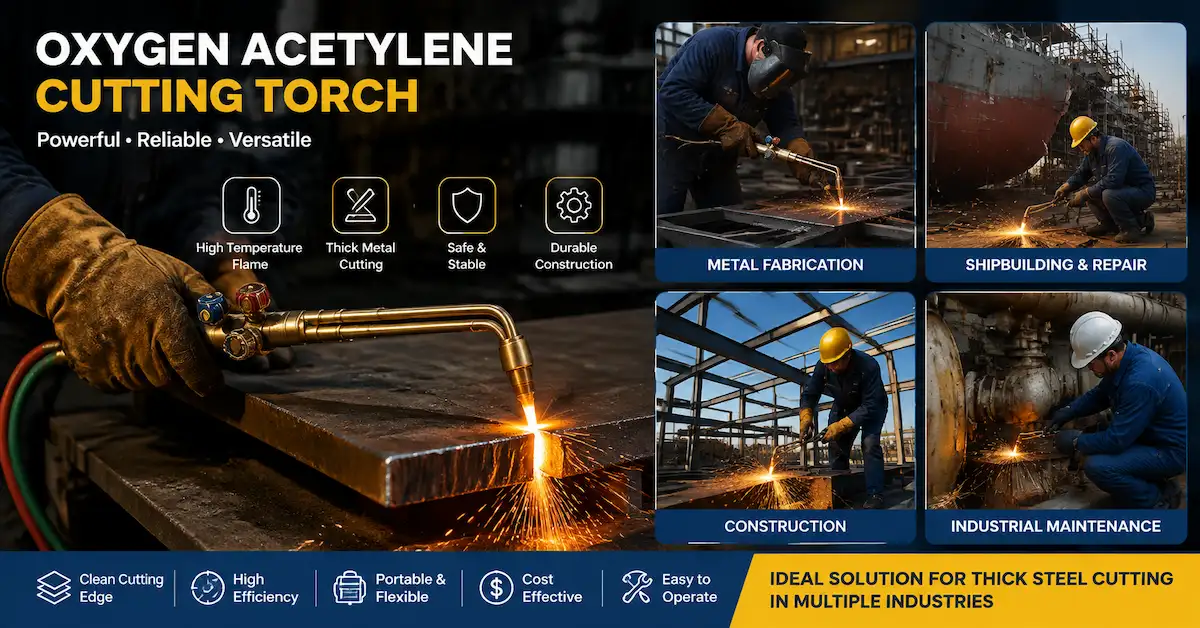
2. Gas Cutting Tools
Gas cutting products are widely used in fabrication, construction, steel processing, and maintenance.
A distributor product range may include:
- Cutting torches
- Cutting attachments
- Cutting tips
- Regulators
- Gas hoses
- Flashback arrestors
- Cutting kits
Important selection factors:
- Stable flame control
- Durable materials
- Correct connection standards
- Easy maintenance
- Available replacement parts
Complete cutting kits are often attractive for distributors because they provide a ready-to-use solution.
3. Heating and Brazing Tools
Heating and brazing tools are important products for HVAC/R and maintenance markets.
Common products include:
- Brazing torches
- Heating torches
- Portable kits
- Gas regulators
- Hose assemblies
For HVAC/R customers, distributors should focus on:
- Portability
- Easy operation
- Flame adjustment
- Product durability
- Complete accessory combinations
4. Welding Safety Products
Safety products help distributors expand their product range.
Examples include:
- Welding helmets
- Gloves
- Protective accessories
- Safety equipment
Advantages for distributors:
- Easy product bundling
- Higher order value
- Repeat replacement demand
- One-stop purchasing support
5. Consumables and Replacement Parts
Consumables are important for long-term distributor profitability.
Examples:
- Tips
- Nozzles
- Contact tips
- Clamps
- Rods
- Fittings
- Accessories
Unlike one-time equipment purchases, consumables create continuous sales opportunities.
How Distributors Should Build a Welding Tool Portfolio
A good product portfolio should include different product levels.
Entry-Level Products
Purpose:
- Attract new customers
- Support retail channels
- Create initial sales
Examples:
- Basic welding accessories
- Small torch kits
- Standard safety products
Professional Products
Purpose:
- Serve industrial users
- Increase customer loyalty
- Create higher-value sales
Examples:
- Professional welding torches
- Heavy-duty cutting tools
- Industrial regulators
- Complete kits
Premium or Customized Products
Purpose:
- Differentiate from competitors
- Improve brand value
- Support private-label strategies
Examples:
- Custom welding kits
- OEM products
- Branded packaging
- Special configurations
How to Choose a Welding Tools Supplier as a Distributor
A distributor’s supplier choice directly affects business growth.
Product Range
A supplier with multiple product categories helps distributors reduce sourcing complexity.
Look for suppliers offering:
- Welding tools
- Cutting tools
- Heating tools
- Regulators
- Safety products
- Accessories
UWELD’s product range can be reviewed through the products page.
Product Quality Consistency
Distributors need products that perform consistently across every shipment.
Important quality factors include:
- Material quality
- Assembly accuracy
- Product function
- Accessory matching
- Packaging quality
- Batch consistency
One poor-quality batch can affect distributor reputation.
Technical Support
Professional customers often ask technical questions.
A reliable supplier should help distributors understand:
- Product differences
- Application scenarios
- Compatible accessories
- Maintenance requirements
- Replacement parts
Technical support helps distributors sell products more effectively.
OEM and Private Label Support
Many distributors want to create their own product identity.
OEM options may include:
- Logo printing
- Custom packaging
- Product kits
- Labels
- Manuals
- Carton marks
- Brand-specific combinations
Private-label welding tools help distributors reduce direct price competition.
Delivery and Inventory Support
Distributors depend on stable supply.
A good supplier should support:
- Predictable lead time
- Repeat orders
- Spare parts supply
- Packaging consistency
- Production planning
Reliable supply helps distributors avoid stock shortages.
Distributor Product Selection Checklist
| Evaluation Point | What to Check |
| Product demand | Are customers actively buying these tools? |
| Application fit | Does the product match target users? |
| Quality | Is performance stable between batches? |
| Spare parts | Are replacement components available? |
| Packaging | Is it suitable for retail or wholesale? |
| Supplier support | Can the supplier provide technical help? |
| OEM options | Can products be customized? |
| Lead time | Can inventory be replenished quickly? |
| Documentation | Are specifications available? |
| Long-term supply | Can the supplier support growth? |
Common Mistakes Distributors Should Avoid
Buying Only Based on Price
The cheapest products may create:
- More returns
- Customer complaints
- Higher after-sales costs
- Poor reputation
Stocking Too Many Similar Products
Too many similar products increase inventory pressure.
Distributors should focus on:
- High-demand products
- Complementary products
- Repeat-purchase items
Ignoring Accessories
Accessories and consumables often create more frequent purchasing opportunities.
Choosing Suppliers Without Technical Support
Without technical support, distributors may struggle to answer customer questions.
Not Planning OEM Opportunities
Private-label products can help distributors create stronger market differentiation.
Application Markets for Distributor Welding Tools
Metal Fabrication
Customers need:
- Welding torches
- Cutting tools
- Regulators
- Accessories
- Safety equipment
HVAC/R
Customers need:
- Brazing tools
- Heating torches
- Regulators
- Portable kits
Automotive Repair
Customers need:
- Welding tools
- Heating tools
- Clamps
- Accessories
Construction
Customers need:
- Durable cutting tools
- Portable welding tools
- Safety products
Industrial Maintenance
Customers need:
- Repair tools
- Replacement parts
- Multi-purpose equipment
Why Choose UWELD as a Welding Tools Supplier for Distributors?
UWELD supports global distributors looking for reliable welding and cutting product solutions.
Distributor advantages include:
- Wide welding tool categories
- Gas cutting and heating solutions
- HVAC/R product support
- Safety product options
- OEM/private-label cooperation
- Product matching support
- Quality-focused supply
- Long-term cooperation planning
Buyers can explore products through the UWELD product center, learn more through the UWELD blog, or contact the team through UWELD solutions.
FAQ: Welding Tools for Distributors
1. What welding tools should distributors stock?
Distributors should consider welding torches, cutting tools, regulators, heating tools, safety products, consumables, and accessories.
2. Who buys welding tools from distributors?
Common customers include fabrication shops, HVAC/R technicians, automotive repair companies, contractors, and industrial maintenance teams.
3. Why are consumables important for distributors?
Consumables create repeat purchasing opportunities and help distributors maintain long-term customer relationships.
4. Can distributors sell private-label welding tools?
Yes. Many suppliers support logo customization, packaging, labels, manuals, and customized product kits.
5. How do distributors choose a welding tool supplier?
Evaluate product range, quality consistency, technical support, OEM capability, delivery reliability, and after-sales support.
6. Are welding kits better than individual tools?
For many customers, complete kits provide easier purchasing and better application solutions.
7. Why should distributors care about spare parts?
Spare parts improve customer satisfaction and create additional sales opportunities.
8. Can distributors order customized welding tools?
Yes. OEM suppliers can support customized products based on market requirements.
9. What makes a good welding tool supplier?
A good supplier provides reliable quality, technical support, stable delivery, and long-term cooperation.
10. How can distributors contact UWELD?
Distributors can contact UWELD through the solutions page to discuss product supply, OEM cooperation, and distribution opportunities.
Conclusion
Choosing the right welding tools for distributors requires more than finding low-cost products. Successful distributors need reliable tools, strong supplier support, suitable product categories, repeat supply capability, and opportunities for brand development.
By building a balanced product portfolio with welding torches, cutting tools, heating products, safety equipment, and accessories, distributors can better serve professional customers and create long-term business growth.
For distributors looking for welding tools, OEM solutions, and reliable supply support, UWELD provides professional welding and cutting product solutions.
Explore the UWELD product center or contact UWELD through UWELD solutions for cooperation.