

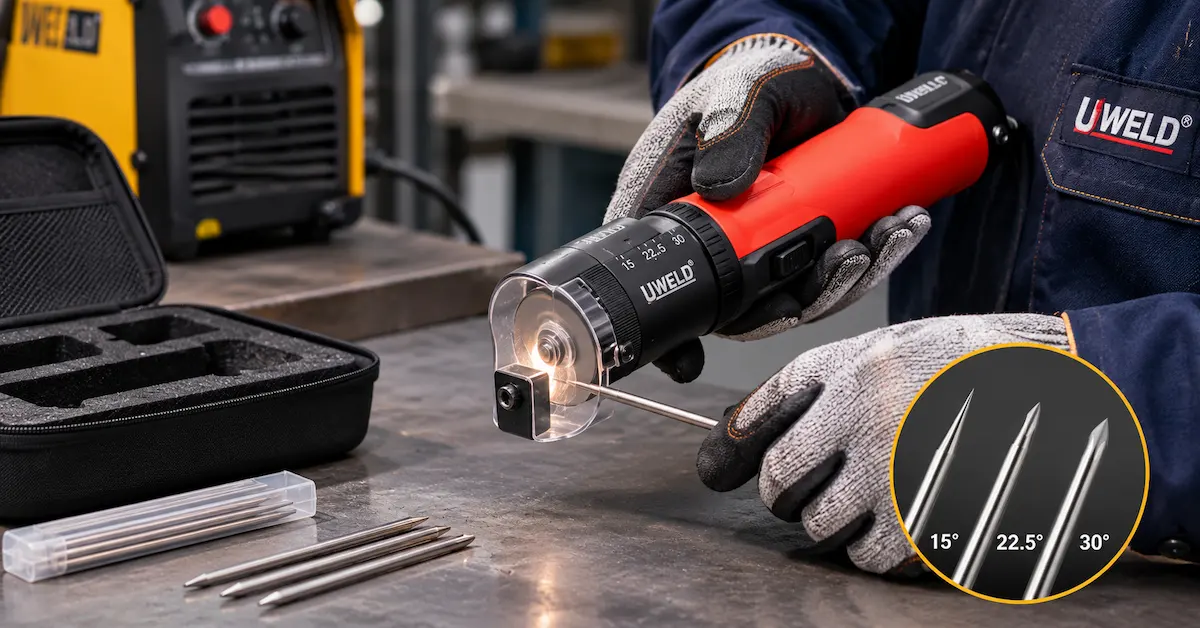
Quick Answer: A TIG tungsten electrode grinder is a dedicated tool used to prepare tungsten electrode tips for gas tungsten arc welding (GTAW). The UWELD 2W008-0004T features a handheld electric design, multiple grinding-angle options, a CNC-machined aluminum component, a dust cover, and flat-grinding and cut-off features. Its dedicated preparation design helps professional welders establish controlled electrode geometry while reducing the risk of cross-contamination from general-purpose grinding equipment.
Consistent TIG welding begins before the welding arc is established.
The condition, shape, and surface finish of the tungsten electrode can influence arc initiation, arc stability, heat distribution, and welding repeatability.
For stainless steel fabrication workshops, aluminum equipment manufacturers, industrial maintenance teams, and welding equipment distributors, electrode preparation is an important part of welding process control.
Using a general-purpose grinder without defined angle references may introduce unnecessary variation between electrodes. Shared grinding surfaces may also transfer foreign material onto the tungsten.
The UWELD 2W008-0004T Tungsten Electrode Sharpener Grinder provides a dedicated handheld solution for TIG electrode preparation.
This guide examines its product features, electrode grinding principles, technical selection criteria, industrial applications, quality requirements, and wholesale sourcing opportunities.
Key Takeaways
-
Controlled electrode geometry: Multiple grinding-angle options help support consistent tip preparation.
-
Longitudinal grinding: Lengthwise grinding marks are generally preferred for pointed tungsten electrodes in applicable TIG welding procedures.
-
Dedicated diamond wheel: A dedicated abrasive surface helps reduce cross-contamination from other metals.
-
Handheld electric design: Suitable for evaluating mobile and workshop-based electrode preparation requirements.
-
Multiple electrode diameters: Buyers can select the appropriate supported guide openings for their required tungsten sizes.
-
Dust management: The dust cover helps contain grinding debris but does not replace appropriate workplace extraction and personal protection.
-
Wholesale and OEM sourcing: Buyers should evaluate electrical configurations, replacement wheels, grinding-head consistency, packaging, and spare-parts support.
Table of Contents
-
Product overview and technical specifications
-
Electrode geometry and grinding angles
-
Longitudinal versus radial grinding
-
Diamond grinding wheel selection
-
Dedicated grinder versus bench grinder
-
Industrial applications
-
Quality inspection and safety
-
Wholesale pricing and OEM purchasing
-
RFQ checklist
-
Frequently asked questions
What Is the UWELD 2W008-0004T TIG Tungsten Electrode Grinder?
The UWELD 2W008-0004T is a handheld electric grinding tool intended for preparing tungsten electrodes used in TIG welding.
Unlike a general-purpose rotary tool, a dedicated tungsten sharpening tool incorporates features intended to support electrode positioning and controlled tip preparation.
The product is particularly relevant to professional buyers who need a repeatable electrode-preparation method across multiple welding stations or industrial customers.
UWELD 2W008-0004T Product Specifications
| Specification | Product Information |
|---|---|
| Brand | UWELD |
| Product model | 2W008-0004T |
| Product type | Handheld tungsten electrode grinder |
| Intended process | TIG / GTAW electrode preparation |
| Power type | Corded electric |
| Grinding design | Multi-angle and offset configuration |
| Electrode compatibility | Multiple supported diameters |
| Grinding head | CNC-machined aluminum construction as described in product information |
| Grinding wheel | Double-sided diamond wheel design shown in product materials |
| Dust management | Protective dust cover |
| Additional features | Flat grinding block and cut-off slot |
| Storage | Carrying case shown in product materials |
| Target users | Professional welders, workshops, industrial distributors |
| Commercial services | Wholesale and OEM inquiries |
Source: UWELD official product information and associated tungsten grinder product literature.
The exact motor specification, voltage version, supported electrode diameters, grinding-angle definitions, wheel dimensions, and included accessories should be identified in the ordered configuration.
Who Should Consider This Product?
The UWELD tungsten grinder is relevant to welding equipment distributors, industrial tool importers, TIG fabrication workshops, equipment maintenance suppliers, and private-label welding accessory brands.
It is particularly useful to evaluate where repeatable electrode preparation is an important part of the customer's welding workflow.
It should not be treated as a general-purpose metal cutting machine or an unrestricted grinding tool for unrelated materials.
Why Is Tungsten Electrode Preparation Important in TIG Welding?
TIG welding uses a nonconsumable tungsten electrode to establish an electrical arc between the electrode and the workpiece.
The electrode's geometry influences how the arc develops and how welding energy is distributed.
Although electrode preparation is only one part of the welding process, inconsistent preparation can introduce variation between welding operations.
Four Important Electrode Preparation Factors
| Preparation Factor | Potential Influence | Quality Objective |
|---|---|---|
| Grinding angle | Arc characteristics and heat distribution | Match the welding procedure |
| Tip geometry | Arc initiation and electrode behavior | Consistent end shape |
| Grinding direction | Arc stability | Appropriate longitudinal finish |
| Surface contamination | Electrode and weld-pool condition | Clean, dedicated abrasive surface |
| Tip flatness | Tip geometry and erosion behavior | Controlled end preparation |
A properly selected TIG tungsten electrode grinder helps operators prepare electrodes according to defined requirements rather than relying entirely on freehand grinding.
However, electrode preparation alone cannot guarantee defect-free welding.
The welding current, shielding gas, electrode composition, joint preparation, and operator technique also influence weld quality.
How Do Tungsten Grinding Angles Affect TIG Welding?
Grinding angle is one of the most important characteristics when preparing pointed tungsten electrodes.
Different tip geometries can influence arc concentration, penetration characteristics, and the distribution of heat within the welding area.
The correct geometry depends on the electrode diameter, electrode composition, current type, welding current, and approved welding procedure.
Sharper vs Blunter Tungsten Electrode Tips
| Tip Geometry | General Characteristics | Selection Consideration |
|---|---|---|
| Sharper tapered tip | May suit certain lower-current applications | Arc requirements and tip durability |
| Intermediate tapered tip | Provides another geometry for controlled preparation | General procedure requirements |
| Blunter tapered tip | May suit certain higher-current applications | Electrode loading and arc characteristics |
| Truncated tip | Includes a controlled flat at the end | Procedure-specific electrode geometry |
These are general selection considerations rather than universal current or angle recommendations.
Included Angle vs Grinding Guide Angle
Industrial buyers should distinguish between the complete included angle at the electrode tip and the angle measured relative to the electrode's centerline.
For example, an included angle and an individual taper angle may have different numerical values even when they describe the same electrode geometry.
This distinction is particularly important when comparing grinders from different manufacturers.
The UWELD 2W008-0004T is marketed with multiple grinding-angle options. Buyers requiring a particular electrode geometry should establish how the guide angles are defined.
Is One Grinding Angle Suitable for All TIG Applications?
No.
A universal grinding angle cannot satisfy every TIG welding procedure.
Different applications may require pointed, truncated, or other approved electrode preparations. Aluminum AC welding, stainless steel DC welding, and precision low-current work can have different electrode requirements.
The welding procedure and equipment instructions should determine the appropriate preparation.
Longitudinal vs Radial Grinding: Which Is Better for Tungsten Electrodes?
Grinding direction is an important consideration when preparing pointed TIG electrodes.
Longitudinal grinding produces surface marks that run along the electrode's length, while radial grinding produces marks around its circumference.
For TIG procedures requiring a pointed electrode, longitudinal preparation is generally preferred because inappropriate circumferential grinding marks may contribute to arc wandering.
Grinding Direction Comparison
| Evaluation Factor | Longitudinal Grinding | Radial Grinding |
|---|---|---|
| Grinding-mark direction | Along the electrode axis | Around the electrode circumference |
| Arc behavior | Generally preferred for pointed TIG electrodes | May contribute to less stable arc behavior |
| Surface preparation | Suitable for controlled tapered geometry | Less desirable for applicable pointed preparations |
| Operator consistency | Can be supported by dedicated guides | Depends heavily on preparation technique |
| Industrial purchasing focus | Repeatable electrode preparation | Limited suitability for this purpose |
A dedicated TIG tungsten electrode grinder should allow users to achieve the electrode geometry and surface orientation required by their welding procedures.
Why Does Repeatability Matter?
In industrial fabrication, different operators may prepare electrodes for the same production task.
If the tip geometry varies significantly between operators, the welding process may become less consistent.
A defined preparation method helps reduce this source of variation.
For distributors, demonstrating repeatable sample geometry can provide more useful technical evidence than making an unsupported claim about improved welding performance.
Why Use a Diamond Grinding Wheel for Tungsten?
Tungsten is a hard material that requires an appropriate abrasive for controlled grinding.
Diamond grinding wheels are commonly used in dedicated tungsten electrode preparation equipment because they are suitable for machining hard materials.
UWELD's associated product literature describes a double-sided diamond grinding wheel.
What Are the Benefits of a Double-Sided Diamond Wheel?
A double-sided wheel provides two abrasive working surfaces where the manufacturer's design permits their use.
This can offer additional usable abrasive surface compared with a wheel having only one working side.
However, actual wheel service life depends on electrode material, grinding frequency, operating conditions, and maintenance.
No specific service-life improvement should be assumed without comparative testing.
Diamond Wheel Selection Checklist
| Wheel Characteristic | Purchasing Consideration |
|---|---|
| Abrasive material | Suitable for tungsten preparation |
| Wheel diameter | Compatible with the grinding head |
| Mounting hole | Correct fit for the approved tool |
| Wheel thickness | Suitable for the equipment configuration |
| Working surfaces | Single-sided or double-sided design |
| Speed rating | Compatible with the grinder |
| Abrasive condition | Suitable surface integrity |
| Replacement availability | Correct spare-wheel reference |
Why Should the Wheel Be Dedicated to Tungsten?
A wheel previously used for steel, aluminum, or other materials may carry foreign particles.
These particles can contaminate a tungsten electrode during preparation.
Maintaining a dedicated electrode-grinding surface helps control this risk.
For industrial workshops, abrasive identification and contamination prevention should form part of the welding preparation procedure.
What Do the Multi-Angle and Offset Features Do?
The UWELD 2W008-0004T incorporates a multi-angle and offset grinding-head design.
These features provide different preparation references within the intended equipment arrangement.
Multi-Angle Grinding
Different guide positions allow the operator to select an approved electrode preparation geometry.
For industrial buyers, this can be useful when one workshop performs several TIG welding applications requiring different electrode profiles.
The exact available angles and their measurement definitions should match the purchasing specification.
Offset Grinding Positions
Offset positions may provide alternative working locations on the abrasive surface, depending on the grinding-head design.
Buyers should assess the actual guide geometry and available positions rather than assume that every offset setting offers identical functionality.
Flat Grinding Block
The flat grinding feature supports evaluation of electrode-end preparation where a controlled flat or truncated end is required.
The correct flat dimension depends on the welding procedure and electrode configuration.
Cut-Off Slot
The product also includes a cut-off feature in its published description.
This provides an additional electrode preparation function when used according to the manufacturer's instructions.
Together, these features make the UWELD grinder relevant to buyers seeking more than a basic single-angle sharpening tool.
How Should Buyers Match Tungsten Diameter to the Grinder?
A TIG tungsten electrode grinder must support the electrode diameters required by the intended welding applications.
Common tungsten electrode sizes used in professional TIG welding include 1.0 mm, 1.6 mm, 2.4 mm, 3.2 mm, and 4.0 mm.
These are general industry size examples, not a claim that every listed diameter is supported by every UWELD grinder configuration.
Electrode Diameter Selection Considerations
| Electrode Diameter | General Purchasing Consideration |
|---|---|
| 1.0 mm | Selected precision and lower-current applications |
| 1.6 mm | Various lighter TIG welding applications |
| 2.4 mm | Common industrial TIG applications |
| 3.2 mm | Applications requiring an appropriate larger electrode |
| 4.0 mm | Selected higher-current applications |
The electrode diameter must also match the torch's collet and associated consumables.
Buyers should establish the exact supported grinder openings, electrode sizes, and required tip geometries when ordering.
Why Is Guide Fit Important?
An electrode guide should position the tungsten according to the approved grinder design.
Incorrect fit may affect alignment and preparation consistency.
Industrial importers should therefore include supported electrode diameters in the technical purchasing specification.
Dedicated Tungsten Grinder vs General Bench Grinder
Some workshops prepare tungsten electrodes using general-purpose bench grinders.
Although a bench grinder may remove electrode material, it does not automatically provide the positioning, contamination control, or repeatability required by professional TIG applications.
Grinding Equipment Comparison
| Selection Factor | UWELD Dedicated Tungsten Grinder | General Bench Grinder |
|---|---|---|
| Main purpose | TIG electrode preparation | General material grinding |
| Product design | Handheld electric tool | Typically stationary |
| Angle references | Multi-angle guide features | Often requires separate guide or freehand preparation |
| Electrode positioning | Dedicated electrode openings | Depends on setup |
| Abrasive selection | Dedicated diamond wheel design | Depends on installed wheel |
| Contamination control | Supports dedicated tungsten preparation | Shared wheels may introduce contamination |
| Dust management | Product dust cover | Depends on installed guards and extraction |
| Portability | Handheld configuration | Generally workshop-based |
| Main purchasing focus | Electrode preparation consistency | General workshop versatility |
A dedicated grinder is particularly relevant when repeated TIG electrode preparation is required.
However, a stationary specialist tungsten grinder may be more appropriate for applications requiring centralized, automated, or higher-volume preparation.
The best equipment depends on production requirements.
How Does the UWELD Grinder Fit Into a Complete TIG Welding Workflow?
A TIG welding system includes more than a power source and welding torch.
Electrode preparation, consumable selection, shielding-gas management, and equipment maintenance also contribute to the complete process.
Related UWELD Product Selection
| UWELD Product | Main Function | Purchasing Consideration |
|---|---|---|
| 2W008-0004T tungsten grinder | Electrode preparation | Grinding angles, supported sizes and replacement wheels |
| WP26 air-cooled TIG torch | Welding with a compatible air-cooled arrangement | Machine connections and duty cycle |
| WP18 water-cooled TIG torch | Welding with a compatible liquid-cooled system | Cooling and electrical requirements |
For compatible air-cooled applications, buyers can evaluate the UWELD WP26 TIG Torch.
For applications requiring liquid cooling, the UWELD WP18 Water-Cooled TIG Torch provides another product reference.
The tungsten grinder does not connect directly to these welding torches. Compatibility concerns relate to the tungsten electrode diameters and preparation requirements used by the welding system.
This allows distributors to evaluate the grinder as a complementary product within a broader TIG equipment and consumables range.
Where Are TIG Tungsten Electrode Grinders Used?
A TIG tungsten electrode grinder is relevant to industries where controlled electrode preparation forms part of professional GTAW operations.
Industrial Application Matrix
| Industry | Typical Application | Grinder Selection Priority |
|---|---|---|
| Stainless steel fabrication | Preparation for controlled TIG joints | Consistent tip geometry |
| Aluminum fabrication | Electrode preparation for approved AC TIG procedures | Correct electrode and tip configuration |
| Industrial pipework | Preparation for pipe and fitting welding | Repeatability and consumable management |
| Equipment manufacturing | Repeated production welding | Controlled preparation procedures |
| Automotive repair | Workshop and maintenance TIG welding | Portability and flexibility |
| Welding training | Teaching consistent electrode preparation | Clear angle and size references |
| Industrial distribution | Supplying welding preparation tools | Product configuration and spare parts |
Stainless Steel Fabrication
Stainless steel TIG welding frequently requires careful heat control and shielding.
Consistent tungsten preparation can help reduce unnecessary variation in electrode geometry between welding operations.
A dedicated grinder can form part of a controlled preparation station.
Aluminum Equipment Manufacturing
Aluminum TIG welding commonly uses AC current.
Electrode preparation requirements vary according to the power source, electrode type, and welding procedure.
A dedicated grinding tool may be relevant where the specified preparation requires controlled tapering or end geometry.
Industrial Pipe Welding
Pipe fabrication often involves multiple welding positions and defined joint requirements.
Consistent electrode preparation can support standardized welding practices when used together with the appropriate torch, consumables, and qualified procedure.
Welding Equipment Distribution
For distributors, a tungsten grinder provides a complementary product category alongside TIG torches, tungsten electrodes, ceramic cups, collets, and other accessories.
A complete product range can address several customer requirements through one sourcing relationship.
What Quality-Control Checks Matter for Tungsten Electrode Grinders?
The performance of a tungsten sharpening tool depends on the complete assembly.
Motor operation, grinding-wheel condition, guide dimensions, alignment, electrical safety, and physical construction should all be considered.
Recommended Quality Inspection Checklist
| Inspection Item | Buyer Verification |
|---|---|
| Model identification | Correct UWELD 2W008-0004T reference |
| Electrical configuration | Correct destination-market voltage and plug |
| Motor operation | Approved functional condition |
| Grinding head | Correct construction and assembly |
| Electrode guide openings | Specified diameter compatibility |
| Angle guides | Correct geometry |
| Grinding wheel | Approved dimensions and abrasive specification |
| Flat grinding feature | Correct configuration |
| Cut-off slot | Correct design and condition |
| Dust cover | Suitable assembly and physical integrity |
| Power cord and switch | Appropriate electrical and mechanical condition |
| Accessories | Matches the agreed packing list |
| Packaging | Correct identification and protection |
| Documentation | Relevant specifications and instructions |
Why Is Grinding-Head Accuracy Important?
The grinding head provides the positioning references used during electrode preparation.
Dimensional variation can affect the resulting geometry.
Buyers requiring a specific angle tolerance or repeatability requirement should include measurable acceptance criteria in the purchase specification.
How Should Samples Be Evaluated?
A representative sample should be examined using the electrode types and sizes relevant to the intended application.
The evaluation should establish whether the product can provide suitable preparation geometry under its approved conditions.
For OEM orders, the approved sample, wheel configuration, guide dimensions, and electrical version should form part of the repeat-order reference.
How Should Buyers Evaluate Dust Control and Electrical Safety?
Grinding tungsten electrodes produces fine particles that require appropriate workplace controls.
A protective dust cover is useful for containing some grinding debris, but it should not be treated as a certified dust-extraction or respiratory-protection system.
Dust Management Requirements
Industrial buyers should consider:
-
Appropriate local exhaust ventilation.
-
Suitable eye and face protection.
-
Respiratory protection where required by the exposure assessment.
-
Safe collection and disposal of grinding debris.
-
Dedicated abrasive surfaces.
-
Manufacturer-approved inspection and maintenance procedures.
Special Considerations for Thoriated Tungsten
Grinding thoriated tungsten can release particles containing radioactive thorium.
These materials require additional consideration under the applicable workplace safety requirements.
Where technically suitable, professional users may consider approved non-thoriated alternatives, such as lanthanated or ceriated tungsten electrodes.
The electrode manufacturer's safety documentation and welding procedure should guide material selection.
A dust cover alone does not establish adequate protection for radioactive or other hazardous grinding dust.
Electrical Configuration and Destination Markets
Handheld electric grinders must be suitable for the intended electrical supply and market.
International buyers should confirm the required voltage version, plug arrangement, frequency, electrical documentation, and applicable conformity requirements.
Different voltage versions should not be assumed interchangeable.
Product-specific certification should only be claimed when supported by the appropriate documents for the ordered configuration.
How Much Does a Wholesale TIG Tungsten Electrode Grinder Cost?
The wholesale cost of a TIG tungsten electrode grinder depends on its electrical version, grinding head, abrasive wheel, accessories, packaging, order quantity, and commercial requirements.
A lower initial price does not necessarily provide the best long-term purchasing value.
Total Sourcing Cost
Total Sourcing Cost = Grinder Purchase Cost + Replacement Wheels + Accessories + Inspection + Packaging + Freight + Maintenance and After-Sales Costs
| Cost Factor | Purchasing Consideration |
|---|---|
| Motor and electrical version | Destination-market compatibility |
| Grinding head | Guide design and dimensional consistency |
| Diamond wheel | Abrasive specification and replacement cost |
| Accessories | Included and optional components |
| Carrying case | Packaging and storage requirements |
| OEM branding | Logo, labels and packaging |
| Inspection | Sample and production acceptance requirements |
| Replacement supply | Wheels and service components |
| Order quantity | MOQ and wholesale quotation |
| Shipping | Destination and transport requirements |
Why Is Replacement Wheel Availability Important?
A grinder may remain mechanically functional while its abrasive wheel requires replacement.
If suitable replacement wheels are difficult to obtain, customers may experience unnecessary equipment downtime.
For industrial distributors, maintaining accurate replacement-wheel references can support both customer service and repeat sales.
Compare Equivalent Configurations
When reviewing supplier quotations, ensure that each offer includes the same electrical version, grinding head, wheel specification, accessories, and packaging requirements.
This provides a more meaningful comparison than comparing product prices alone.
OEM/ODM and Wholesale Tungsten Grinder Supply
UWELD provides wholesale and OEM/ODM cooperation opportunities for welding equipment and related industrial accessories.
International distributors may require product identification, private-label packaging, destination-market electrical configurations, and agreed accessory arrangements.
Recommended OEM Purchasing Workflow
| Stage | Main Requirement |
|---|---|
| Application review | Identify target TIG welding customers |
| Product selection | Select the intended grinder configuration |
| Technical evaluation | Review angles, electrode sizes and wheel specifications |
| Electrical configuration | Establish approved voltage and plug requirements |
| Sample approval | Evaluate the complete product |
| Packaging approval | Confirm logo, labels and instructions |
| Quality planning | Define inspection requirements |
| Bulk purchasing | Agree on quantity, price and delivery |
| Repeat orders | Maintain approved specifications |
Technical modifications affecting the motor, electrical components, grinding head, wheel mounting, or protective features require appropriate engineering evaluation.
Buyers can explore UWELD OEM and Manufacturing Solutions for additional cooperation information.
MOQ, Samples and Delivery
UWELD offers sample arrangements and customization inquiries subject to the selected product and commercial requirements.
Minimum order quantities depend on the product configuration and customization scope.
For international purchases, delivery schedules should account for product availability, packaging, inspection, and shipping requirements.
Review the UWELD FAQs for general purchasing and sample information.
What Should Buyers Include in a Tungsten Grinder RFQ?
A complete request for quotation helps the supplier identify the correct configuration and prepare a more accurate commercial offer.
Recommended RFQ Checklist
| RFQ Field | Information to Provide |
|---|---|
| Product | TIG tungsten electrode grinder |
| Model | UWELD 2W008-0004T |
| Intended application | TIG electrode preparation |
| Electrode diameters | Required supported sizes |
| Grinding angles | Required angle definitions |
| Electrode materials | Intended tungsten types |
| Electrical requirements | Voltage, frequency and plug |
| Grinding wheel | Required specification and spare quantity |
| Accessories | Required grinding and storage components |
| Dust management | Intended workplace requirements |
| Quality documents | Technical and conformity requirements |
| OEM branding | Logo, labels and packaging |
| Sample quantity | Required evaluation units |
| Bulk quantity | Initial and projected repeat orders |
| Destination market | Country or region |
| Delivery | Requested commercial terms |
Providing these details helps avoid unnecessary quotation revisions and incorrect product configurations.
Looking for a handheld TIG tungsten electrode grinder for industrial distribution? Contact UWELD to request the current product specification, electrode-size compatibility, replacement diamond wheel information, samples, OEM options, and wholesale pricing.
Frequently Asked Questions About TIG Tungsten Electrode Grinders
1. What is a TIG tungsten electrode grinder?
It is a dedicated tool used to prepare tungsten electrode geometry for applicable TIG welding procedures. It helps establish controlled tip shape and surface preparation.
2. What is the UWELD 2W008-0004T used for?
The UWELD 2W008-0004T is designed for handheld tungsten electrode sharpening and related preparation functions before TIG welding.
3. Why is diamond abrasive used for tungsten grinding?
Diamond abrasive is suitable for grinding hard materials such as tungsten. A dedicated diamond wheel also helps reduce cross-contamination from unrelated grinding operations.
4. Should tungsten electrodes be ground longitudinally?
For applicable pointed tungsten preparations, longitudinal grinding is generally preferred. The exact tip geometry and finish should follow the approved welding procedure.
5. Can one grinding angle be used for every TIG welding application?
No. The appropriate angle depends on electrode composition, diameter, welding current, polarity, base material, and process requirements.
6. Does the UWELD tungsten grinder support multiple electrode sizes?
UWELD describes the product as supporting multiple electrode sizes. Buyers should obtain the exact supported diameter information for the intended configuration.
7. Is a dust cover sufficient for tungsten grinding safety?
No. A dust cover does not replace appropriate ventilation, dust extraction, protective equipment, and safe handling of grinding debris.
8. Can the grinder prepare electrodes for AC aluminum TIG welding?
It may be considered where the applicable AC welding procedure requires a supported electrode preparation. The correct geometry depends on the electrode and welding power source.
9. Can distributors order replacement diamond grinding wheels?
Buyers can discuss replacement-wheel requirements and available accessories with UWELD. The exact wheel dimensions and compatibility should match the supplied grinder.
10. Does UWELD support OEM tungsten grinder orders?
UWELD supports wholesale and OEM/ODM inquiries. Buyers can discuss branding, packaging, electrical configurations, approved accessories, sample requirements, order quantities, and delivery terms.
Conclusion
Selecting a reliable TIG tungsten electrode grinder requires careful consideration of grinding geometry, electrode diameter compatibility, abrasive quality, electrical configuration, and workplace dust management.
The UWELD 2W008-0004T offers a dedicated handheld electric design with multi-angle grinding features, a diamond wheel arrangement, protective dust cover, flat grinding block, and cut-off functionality.
For fabrication workshops and industrial maintenance teams, controlled electrode preparation can help reduce unnecessary variation within TIG welding workflows.
For welding equipment distributors, importers, and OEM brands, accurate product configurations, replacement-wheel availability, sample approval, quality consistency, and clear purchasing specifications are essential for reliable long-term sourcing.
UWELD supplies TIG welding torches, electrode preparation equipment, welding accessories, and related industrial products for professional international markets.
To evaluate the available grinder configuration, visit the UWELD 2W008-0004T Tungsten Electrode Grinder product page, or contact UWELD to request technical specifications, product samples, replacement-wheel information, OEM customization options, and wholesale quotations.