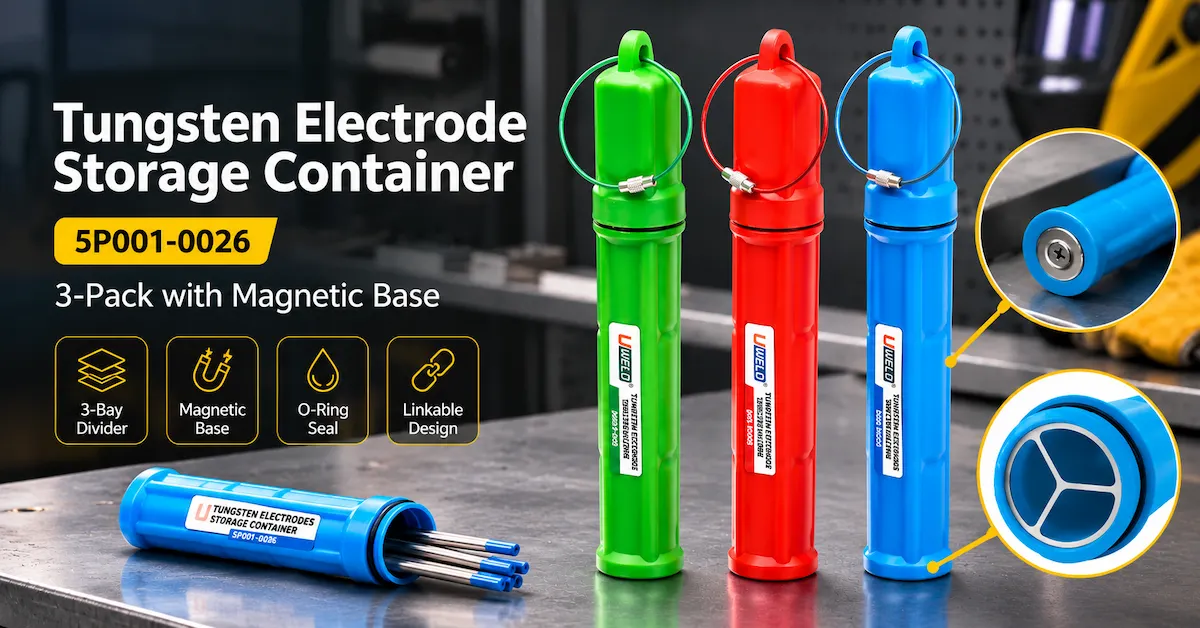


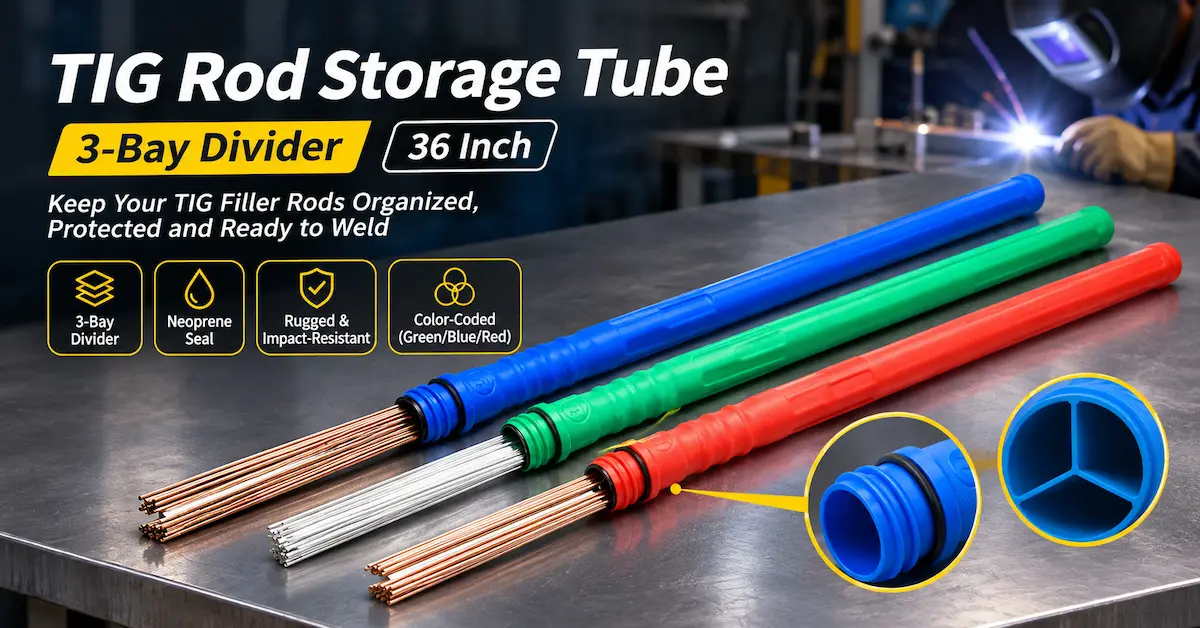
Quick Answer: The UWELD 5P001-0027 TIG filler rod storage tube is a nominal 36-inch welding accessory featuring three internal compartments, a threaded cap, and a neoprene sealing arrangement. Available in green, blue, and red, it helps fabrication workshops organize filler metals by alloy, diameter, and material identification. For industrial distributors, its compartmentalized design provides a practical addition to TIG welding consumable and accessory programs.
Selecting the correct filler metal is an important part of producing consistent TIG welds. However, even a correctly specified filler rod can become difficult to identify if different alloys, diameters, and production batches are mixed during storage.
For stainless steel fabrication workshops, aluminum equipment manufacturers, industrial maintenance teams, and welding equipment distributors, organized filler metal storage is therefore an important part of welding preparation and material management.
Conventional single-compartment containers may provide basic protection but offer limited separation when several rod sizes are required at the same workstation.
The UWELD 5P001-0027 TIG Rod Storage Tube addresses this challenge through a three-bay internal design, protective cap, and multiple color options.
This guide examines its published features, filler metal organization methods, storage requirements, industrial applications, quality inspection, and wholesale procurement considerations.
Key Takeaways
-
Three-bay divider: Supports the separate organization of different filler rod sizes or approved material groups.
-
Nominal 36-inch design: Intended for long TIG filler rods.
-
Neoprene sealing arrangement: Helps limit environmental exposure during normal storage.
-
Threaded protective cap: Provides a closed storage arrangement when correctly secured.
-
Three color options: Green, blue, and red support workshop-defined visual identification systems.
-
Rugged construction: Designed for professional workshop and field storage applications.
-
Wholesale purchasing: Buyers should evaluate usable internal dimensions, divider integrity, sealing components, packaging, and batch consistency.
What Is the UWELD 5P001-0027 TIG Filler Rod Storage Tube?
The UWELD 5P001-0027 is a long-format storage container designed for TIG welding filler rods.
Unlike tungsten electrodes, which establish the welding arc, filler rods provide additional metal to the weld pool when required by the welding procedure.
Different welding applications require different filler metal classifications, diameters, and material properties. Proper identification helps prevent unintended material substitution during welding.
A dedicated storage tube provides an organized location for suitable filler rods while helping protect them from workshop debris and handling damage.
UWELD 5P001-0027 Technical Specifications
| Specification | Published Product Information |
|---|---|
| Brand | UWELD |
| Product model | 5P001-0027 |
| Product category | TIG filler rod storage container |
| Nominal product designation | 36 inches |
| Internal structure | Three-bay divider |
| Available colors | Green, blue, red |
| Cap design | Threaded protective cap |
| Sealing arrangement | Neoprene seal |
| Additional sealing feature | O-ring-protected cap described in product literature |
| Body design | Rugged, impact-resistant construction |
| Primary function | Filler metal storage and organization |
| Intended applications | Fabrication, maintenance, field welding |
| Target buyers | Welding distributors, industrial suppliers, OEM brands |
| Supply options | Wholesale and OEM inquiries |
Source: UWELD 5P001-0027 product description and manufacturer product literature.
The nominal product designation should not be treated as a guaranteed usable internal storage length. Buyers should match the actual filler rod dimensions to the container's usable space.
Is This Product Designed for Tungsten Electrodes or Filler Rods?
The 5P001-0027 is intended primarily for long welding filler rods.
Although tungsten electrodes and filler rods are both used in TIG welding, they perform different functions and typically require different storage arrangements.
UWELD offers a separate, shorter tungsten electrode storage container for electrode preparation management.
Why Does TIG Filler Metal Storage Matter?
Industrial welding workshops often use several filler metal classifications and diameters.
For example, a fabrication facility may work with carbon steel, stainless steel, and aluminum components, each requiring suitable filler materials.
When rods are removed from their original packaging, identification can become more difficult.
Poor storage practices may contribute to material selection mistakes, unnecessary waste, and additional preparation work.
Common Welding Rod Storage Problems
| Storage Problem | Potential Consequence | Recommended Solution |
|---|---|---|
| Different alloys mixed together | Incorrect filler metal selection | Separate and label material groups |
| Different diameters mixed | Unsuitable rod selection | Dedicated compartments |
| Exposure to workshop dirt | Surface contamination | Closed protective storage |
| Unidentified rod remnants | Loss of material traceability | Separate, labeled storage or quarantine |
| Loose rods during transport | Bending or physical damage | Protective long-format container |
| Missing batch information | Difficulty verifying material origin | Retain original identification records |
| Disorganized inventory | Unnecessary searching and replacement purchases | Standardized storage procedures |
A TIG filler rod storage tube can help address these problems by providing a defined storage location and internal separation.
However, it does not replace approved filler metal selection, welding procedure requirements, or material traceability records.
How Does the Three-Bay Divider Improve Filler Rod Organization?
The three-bay divider is a defining feature of the UWELD 5P001-0027.
Rather than storing all welding rods together, the internal divider allows users to establish separate compartments according to their production requirements.
Example Three-Bay Storage Arrangement
| Compartment | Example Assignment | Purpose |
|---|---|---|
| Bay 1 | Identified 1.6 mm filler rods | Smaller-diameter storage |
| Bay 2 | Identified 2.4 mm filler rods of the same alloy | Larger-diameter storage |
| Bay 3 | Clean, traceable usable remnants of the same alloy | Controlled material reuse |
The diameters shown above are illustrative workshop examples, not verified product capacity specifications.
Should Different Filler Metal Alloys Be Stored Together?
Physical separation can support organization, but it does not automatically establish adequate material segregation for every industrial application.
For example, stainless steel filler rods and aluminum filler rods have different material characteristics and handling requirements.
Where contamination control or strict material traceability is required, separate dedicated containers for each filler metal classification may be preferable.
A practical approach is to assign one container to a defined alloy family and use its internal compartments to separate rod diameters.
Can Shortened Filler Rods Be Stored in the Third Compartment?
Clean, identifiable filler rod remnants may be stored separately when permitted by the workshop's material-control procedures.
However, remnants with unknown classifications, uncertain batch information, or contamination should not be returned to usable stock.
Unlike tungsten electrodes, TIG filler rods generally do not require tip regrinding as part of normal welding preparation.
How Can Workshops Organize Carbon Steel, Stainless Steel and Aluminum Filler Rods?
Material segregation is particularly important for fabrication facilities working with multiple metals.
The same-looking metallic rod may have a different chemical composition and intended application.
Common TIG Filler Metal Identification Examples
| Filler Metal Classification | General Material Category | Storage Consideration |
|---|---|---|
| ER70S-2 | Carbon steel | Maintain classification and diameter identification |
| ER308L | Stainless steel | Separate from other stainless classifications |
| ER316L | Stainless steel | Maintain distinct alloy identification |
| ER4043 | Aluminum alloy | Protect from dirt and unsuitable handling |
| ER5356 | Aluminum alloy | Keep separately identified from other aluminum fillers |
These classifications are examples of commonly encountered TIG filler metals. Their suitability for a specific weld must be determined by the applicable welding procedure.
They are not a statement that UWELD supplies these particular filler metal grades.
Why Should ER308L and ER316L Remain Identifiable?
Both are commonly associated with stainless steel welding, but they have different chemical compositions and intended application requirements.
Their similar appearance does not make them interchangeable.
A workshop using several stainless steel filler metal grades should retain clear labels and original material documentation.
The same principle applies to aluminum and carbon steel filler metal classifications.
How Should Green, Blue and Red Storage Tubes Be Used?
The UWELD 5P001-0027 is available in green, blue, and red.
These colors can support a visual material-management system established by the workshop.
Example Color-Coded Filler Metal Storage System
| Container Color | Example Assignment |
|---|---|
| Green | Stainless steel filler metal |
| Blue | Aluminum filler metal |
| Red | Carbon steel filler metal |
This is an illustrative workshop arrangement, not an official welding filler metal color standard.
Container colors alone must not be used to identify the actual chemical composition of stored rods.
Each container should also carry written identification.
Recommended Container Label Information
-
Filler metal classification.
-
Rod diameter.
-
Manufacturer or supplier reference.
-
Production batch or heat number, where applicable.
-
Material acceptance status.
-
Relevant workshop or project reference.
For industrial production, these labels can support material control when used alongside the original filler metal packaging and documentation.
Why Is Color Coding Useful for Distributors?
A distributor can offer different container colors to customers operating multi-material fabrication workshops.
The colors provide a practical product differentiation feature without requiring different mechanical storage designs for every application.
Actual color availability and packaging configurations should be identified in the wholesale quotation.
How Do Neoprene Seals and Threaded Caps Protect Welding Rods?
The UWELD product description identifies a neoprene sealing arrangement, while its product literature describes a threaded cap with O-ring protection.
These features are intended to help limit environmental exposure during storage.
Protective Component Evaluation
| Component | Primary Function | Purchasing Consideration |
|---|---|---|
| Container body | Holds and physically protects rods | Construction quality |
| Internal divider | Separates stored materials | Compartment integrity |
| Threaded cap | Provides a closed storage arrangement | Thread fit and condition |
| Neoprene sealing arrangement | Helps limit environmental ingress | Seal condition and assembly |
| O-ring-protected cap | Supports sealing at the closure | Correct fit and physical integrity |
| Exterior grip profile | Supports handling | Surface condition and usability |
Does the Container Guarantee Moisture-Free Storage?
No storage tube should be assumed to provide unlimited protection from moisture under every environmental condition.
A correctly fitted cap and intact seal can help reduce exposure to external dirt and moisture.
However, the supplied product information does not establish an independent waterproof rating, immersion resistance, or quantified airtightness performance.
The container should therefore be treated as a protective storage accessory rather than a certified waterproof enclosure.
Can Wet or Contaminated Rods Be Placed Inside?
A closed container does not remove existing moisture or contamination.
Filler rods should be handled and stored according to their manufacturer's requirements and the applicable welding procedure.
Placing unsuitable materials inside a sealed container may preserve the existing contamination rather than eliminate it.
Why Is Clean Filler Metal Storage Important for Aluminum TIG Welding?
Aluminum TIG welding requires appropriate preparation of the base metal and filler materials.
Oil, moisture, dirt, and other contaminants can contribute to weld-quality problems, including porosity under certain conditions.
A dedicated TIG filler rod storage tube helps establish an organized location for clean and identified aluminum filler materials.
Nevertheless, protective storage is only one part of contamination control.
Other important considerations include suitable material preparation, clean handling, approved shielding gas, and adherence to the welding procedure.
Filler Metal Protection Priorities by Material
| Material Group | Storage Priority |
|---|---|
| Carbon steel | Limit exposure to moisture, dirt and corrosion-promoting conditions |
| Stainless steel | Maintain alloy identification and avoid unsuitable cross-contamination |
| Aluminum | Protect clean surfaces from moisture, oils and workshop debris |
A separate container for each defined filler material group can simplify these storage requirements.
How to Choose the Right TIG Filler Rod Storage Tube
The appropriate storage container depends on the physical dimensions of the filler rods and the workshop's material-control requirements.
Selection Criteria for Industrial Buyers
| Selection Factor | What to Evaluate |
|---|---|
| Rod length | Match the usable internal container length |
| Rod diameter | Verify compartment suitability |
| Alloy classification | Establish separate material identification |
| Storage capacity | Evaluate required quantity against usable compartment space |
| Divider construction | Check whether compartments meet organization needs |
| Cap arrangement | Inspect opening, closure and thread condition |
| Seal condition | Evaluate protective storage requirements |
| Color options | Match workshop identification practices |
| Portability | Consider transport and storage arrangements |
| Packaging | Evaluate wholesale or retail presentation |
Is a Larger Storage Container Always Better?
Not necessarily.
A larger container may hold longer materials, but the most appropriate design depends on actual rod dimensions, storage location, transport needs, and inventory organization.
Industrial buyers should avoid purchasing containers based only on an advertised exterior size.
Usable internal length and compartment geometry are more relevant to filler rod compatibility.
How Many Welding Rods Can the Container Hold?
The supplied product information does not establish a verified maximum rod quantity.
Actual capacity depends on rod diameter, compartment dimensions, and the intended storage arrangement.
For bulk procurement, representative samples provide a practical way to evaluate storage suitability.
UWELD 5P001-0027 vs 5P001-0026: Which Storage Product Should You Choose?
UWELD offers separate storage accessories for long filler rods and shorter tungsten electrodes.
Although both products feature compartmentalized storage, they address different stages of the TIG welding workflow.
UWELD Welding Rod Storage Product Comparison
| Feature | 5P001-0027 TIG Rod Storage Tube | 5P001-0026 Tungsten Storage Container |
|---|---|---|
| Main application | Long TIG filler rods | Tungsten electrodes |
| Product positioning | Nominal 36-inch storage tube | Compact electrode holder |
| Internal organization | Three-bay divider | Three-bay divider |
| Colors | Green, blue, red options | Green, red, blue three-piece pack |
| Protective closure | Threaded cap with sealing arrangement | Threaded cap with O-ring |
| Magnetic base | Not established in this comparison | Listed product feature |
| Main storage objective | Filler alloy and diameter separation | Electrode size and preparation-status management |
When Should Buyers Choose 5P001-0027?
Choose this product family when the main requirement is organized storage of long TIG filler rods.
It is relevant to fabrication workshops managing several filler metal diameters or material groups.
When Should Buyers Choose 5P001-0026?
The UWELD 5P001-0026 Tungsten Electrode Storage Container is intended for shorter tungsten electrodes and their preparation management.
It provides a different storage solution for buyers organizing electrodes rather than long filler rods.
For industrial distributors, the two products can be offered as complementary accessories rather than direct substitutes.
Where Are TIG Rod Storage Tubes Used?
A TIG filler rod storage tube is relevant to professional workplaces where filler metal identification, handling, and transport form part of routine welding activities.
Industrial Application Matrix
| Industry | Typical Application | Storage Requirement |
|---|---|---|
| Stainless steel fabrication | Equipment, pipework and component manufacturing | Alloy identification |
| Aluminum fabrication | Frames, enclosures and aluminum assemblies | Clean filler metal storage |
| Industrial pipe welding | Fabrication and installation | Portable material organization |
| Machinery manufacturing | Repeated welding operations | Diameter and batch management |
| Automotive repair | Suitable component repair | Workshop organization |
| Field welding | Maintenance and site work | Protective transport |
| Welding training | Multiple students and materials | Clear consumable identification |
| Industrial distribution | Welding accessory supply | Product assortment and wholesale packaging |
Stainless Steel Fabrication Workshops
Workshops producing stainless steel components may use different filler classifications depending on the material and service requirements.
Clearly identified containers help operators distinguish available filler metals before welding.
Aluminum Equipment Manufacturing
Manufacturers working with aluminum may require several filler metal diameters and classifications.
Dedicated storage can support material segregation and organized welding preparation.
Industrial Maintenance and Field Welding
Maintenance teams may transport filler materials between work locations.
A protective storage tube helps keep suitable rods together during normal handling and transport.
The container should be kept away from hot workpieces, direct flame, and conditions outside its approved storage requirements.
Welding Equipment Distribution
For distributors, rod storage tubes provide a complementary product category alongside TIG welding torches, tungsten grinders, electrodes, and workshop accessories.
This can broaden an industrial welding product assortment without requiring the storage accessory itself to perform an electrical or welding function.
How Does the Storage Tube Fit Into a Complete TIG Welding Workflow?
Professional TIG welding requires several different equipment and consumable functions.
A properly organized workstation can distinguish filler metal storage, tungsten electrode preparation, welding equipment, and replacement accessories.
Complementary UWELD Product Selection
| Product | Main Function |
|---|---|
| 5P001-0027 TIG rod storage tube | Long filler metal storage |
| 5P001-0026 tungsten storage container | Tungsten electrode organization |
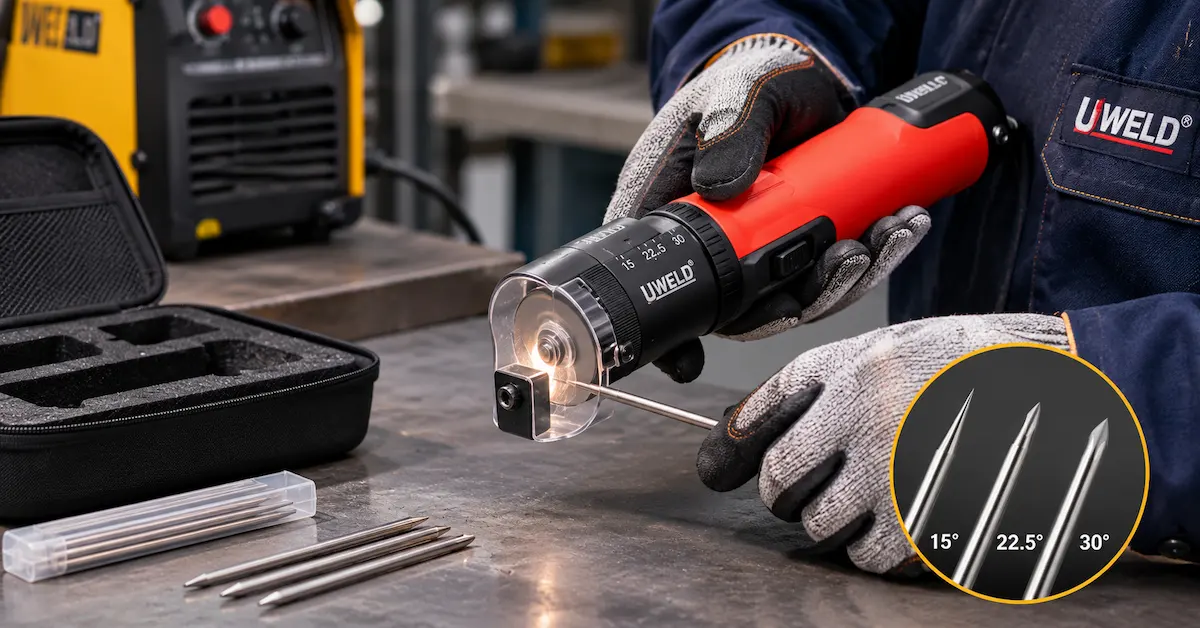
| Tungsten electrode grinder | Electrode tip preparation |
| WP26 air-cooled TIG torch | Compatible air-cooled TIG welding |
| WP18 water-cooled TIG torch | Compatible liquid-cooled TIG welding |
Buyers sourcing TIG equipment can also evaluate the UWELD WP26 Air-Cooled TIG Torch and UWELD WP18 Water-Cooled TIG Torch.
These products serve distinct functions but may form part of a broader professional welding equipment offering.
What Quality-Control Checks Matter for Wholesale Rod Storage Tubes?
For industrial distributors and OEM brands, incoming product inspection should evaluate the complete container rather than exterior appearance alone.
The internal divider, cap, sealing components, and body construction all influence product usability.
Recommended Quality Inspection Checklist
| Inspection Item | Buyer Acceptance Requirement |
|---|---|
| Product identification | Correct 5P001-0027 model |
| Usable internal length | Meets agreed rod dimensions |
| Container body | No unacceptable cracks or deformation |
| Internal divider | Correct three-bay arrangement |
| Compartment condition | No unacceptable obstruction or damage |
| Cap threads | Suitable mating and closure |
| Sealing components | Correct assembly and condition |
| Color | Matches the ordered configuration |
| Surface finish | Suitable workmanship |
| Product labeling | Correct identification |
| Packaging | Agreed quantity and suitable protection |
| Batch consistency | Matches approved sample and specifications |
These are recommended purchasing acceptance checks, not claims that every inspection has been independently verified for the product.
Why Should Buyers Evaluate the Internal Divider?
The divider is central to the product's organization function.
Incorrect dimensions or damaged compartments may affect the separation and storage of filler rods.
Sample inspection should establish whether the compartment arrangement matches the intended use.
How Should Sealing Quality Be Evaluated?
Industrial buyers should inspect the cap, threads, and sealing components.
Where a specific environmental protection rating is required, appropriate product-specific test evidence should be requested rather than inferred from a general sealing description.
Why Is Sample Approval Important for Repeat Orders?
An approved sample provides a physical reference for the container's dimensions, color, divider arrangement, and closure quality.
For wholesale or private-label programs, this reference helps maintain consistent purchasing requirements across later orders.
Practical Procurement Scenario: Organizing Filler Rods Across Multiple Welding Stations
Consider a fabrication workshop operating several TIG welding stations that use stainless steel and aluminum filler metals.
This is an illustrative purchasing scenario rather than a documented UWELD customer project.
The Purchasing Challenge
The workshop stores different filler rod diameters in shared containers.
Operators must repeatedly inspect rods and packaging to identify the required materials.
The purchasing manager wants to establish a clearer storage system without changing the welding equipment.
Recommended Organization Approach
-
Assign separate containers to defined filler metal classifications.
-
Use internal compartments to separate approved rod diameters.
-
Retain the manufacturer's original alloy and batch information.
-
Assign a defined color to each material group.
-
Establish separate handling for unidentified or contaminated remnants.
-
Inspect container condition and labeling during routine inventory checks.
This approach can make material identification more straightforward and support organized preparation across multiple welding stations.
Any actual improvement in preparation time, material waste, or operating costs should be measured using the workshop's own production records.
What Affects the Wholesale Cost of TIG Filler Rod Storage Tubes?
The wholesale cost of a TIG filler rod storage tube depends on construction, compartment arrangement, sealing components, packaging, order quantity, and logistics.
For distributors, the unit price is only one part of the purchasing decision.
Total Sourcing Cost
Total Sourcing Cost = Product Cost + Packaging + Inspection + Freight + Inventory + Expected After-Sales Costs
| Cost Factor | Purchasing Consideration |
|---|---|
| Container body | Agreed construction requirements |
| Internal divider | Compartment geometry and consistency |
| Cap and sealing components | Assembly and protection requirements |
| Color assortment | Required product quantities by color |
| Packaging | Individual, bulk or private-label packaging |
| OEM branding | Labels, artwork and cartons |
| Order quantity | Minimum order requirements |
| Transportation | Carton dimensions and destination |
| Quality inspection | Sample and production acceptance requirements |
Why Does Packaging Matter for Long Storage Tubes?
Long-format products may create different shipping and warehouse requirements from compact welding accessories.
For wholesale buyers, carton dimensions, packing quantity, and transport protection can influence total logistics costs.
Requesting complete packing information makes it easier to compare quotations on an equivalent basis.
Should Distributors Stock All Available Colors?
The appropriate inventory mix depends on customer demand.
A distributor may initially evaluate the most requested colors and adjust future purchasing according to actual sales.
There is no need to assume that every market requires equal quantities of each color.
OEM and Wholesale Welding Rod Storage Tube Supply
UWELD supports international wholesale and OEM inquiries for welding equipment and accessories.
The 5P001-0027 can be considered by industrial distributors, welding consumable suppliers, professional tool retailers, and private-label brands.
Potential OEM Requirements
-
Private-label product identification.
-
Customized packaging artwork.
-
Distributor barcode labels.
-
Agreed color assortments.
-
Product identification and carton markings.
-
Sample approval and inspection requirements.
-
Market-specific packaging arrangements.
Available customization options depend on technical feasibility and commercial requirements.
Buyers can explore UWELD OEM and Manufacturing Solutions for broader cooperation information.
MOQ, Samples and Lead Times
Minimum order quantities vary according to the selected product and customization scope.
Sample arrangements, production schedules, color availability, and delivery conditions should be discussed for the intended order.
For additional purchasing information, review the UWELD Frequently Asked Questions.
What Should Buyers Include in a Wholesale RFQ?
A complete quotation request helps establish the intended storage configuration and commercial requirements.
| RFQ Field | Information to Provide |
|---|---|
| Product | TIG filler rod storage tube |
| Model | UWELD 5P001-0027 |
| Intended application | TIG filler metal storage |
| Rod length | Actual filler rod dimensions |
| Rod diameter | Required storage sizes |
| Internal organization | Three-bay divider |
| Colors | Required colors and quantities |
| Sealing requirements | Intended storage conditions |
| Packaging | Standard or OEM packaging |
| Branding | Logo, labels and artwork |
| Sample quantity | Required evaluation units |
| Bulk quantity | Initial and projected repeat orders |
| Destination market | Country or region |
| Delivery requirements | Requested schedule and shipping terms |
Looking for TIG rod storage containers for industrial distribution? Contact UWELD to discuss product specifications, available colors, samples, OEM packaging options, and wholesale pricing.
Frequently Asked Questions About TIG Filler Rod Storage Tubes
1. What is a TIG filler rod storage tube?
It is a protective container designed to organize and store filler rods used in TIG welding. Compartmentalized designs help separate different rod sizes and approved material groups.
2. What is the UWELD 5P001-0027 designed for?
The UWELD 5P001-0027 is a nominal 36-inch storage tube featuring a three-bay divider and protective sealing arrangement for long welding filler rods.
3. What is the advantage of a three-bay divider?
The divider provides separate storage sections that can help users organize rod diameters or defined material groups while keeping suitable remnants separately identified.
4. Can stainless steel and aluminum filler rods be stored together?
Separate dedicated containers are preferable where material identification or contamination control is important. The compartments do not eliminate the need for proper labeling and material segregation.
5. Does the UWELD storage tube have a moisture-protection seal?
Yes. UWELD describes a neoprene sealing arrangement and an O-ring-protected cap. These features help limit environmental exposure during normal storage, but they do not establish a certified waterproof rating.
6. What colors are available?
UWELD's product literature identifies green, blue, and red color options. These can support workshop-defined identification systems.
7. Can the container be used for tungsten electrodes?
The 5P001-0027 is primarily intended for long welding filler rods. UWELD offers the separate 5P001-0026 model for shorter tungsten electrode storage.
8. How many welding rods can the storage tube hold?
The supplied specifications do not establish a fixed rod capacity. Actual capacity depends on the rod diameter and usable compartment dimensions.
9. What should industrial buyers inspect before purchasing in bulk?
Buyers should evaluate the internal dimensions, divider arrangement, container body, cap threads, sealing components, color consistency, product labeling, and packaging.
10. Does UWELD offer wholesale and OEM storage tube services?
UWELD supports wholesale and OEM inquiries. Buyers can discuss available configurations, branding, packaging, samples, order quantities, and delivery requirements directly with the company.
Conclusion
Choosing a reliable TIG filler rod storage tube is a practical step toward better welding consumable organization, material identification, and workshop inventory management.
The UWELD 5P001-0027 combines a nominal 36-inch product design, three-bay internal divider, threaded cap, and protective sealing arrangement.
Its green, blue, and red color options allow fabrication workshops to establish their own visual storage systems while maintaining clear filler metal classifications and diameter identification.
For industrial distributors, welding accessory importers, and OEM brands, the product provides a complementary sourcing opportunity alongside TIG torches, tungsten electrode holders, electrode grinders, and other welding accessories.
Reliable purchasing should focus on usable dimensions, material segregation, construction quality, sealing components, packaging, and consistent repeat-order specifications.
Explore the UWELD 5P001-0027 TIG Rod Storage Tube, browse UWELD's Latest Welding Products, or contact UWELD to request product samples, technical specifications, OEM customization information, and wholesale quotations.