

TL;DR: A reliable acetylene regulator supplier should provide gas-specific pressure regulators with verified cylinder connections, suitable pressure and flow ratings, documented quality checks, and consistent product configurations. For industrial importers and distributors, confirming whether a regulator uses CGA 510, another approved inlet connection, or a market-specific fitting is essential. UWELD offers several acetylene regulator configurations, including the 1C008-0005, 1C008-0008, 1C008-0044, and 1C008-0080. The best sourcing decision depends on technical compatibility, product documentation, sample approval, and repeat-order requirements.
Industrial gas regulators are small components with significant responsibility. They reduce cylinder supply pressure to a controlled level suitable for downstream equipment used in oxy-acetylene welding, cutting, brazing, and related industrial processes.
For B2B buyers, selecting a regulator involves more than choosing a brass body or comparing gauge sizes. An incompatible cylinder inlet, unsuitable outlet pressure range, insufficient flow capability, or undocumented component substitution can create serious equipment and procurement problems.
This guide explains how to evaluate acetylene regulator specifications, compare UWELD models, verify quality requirements, and prepare a complete wholesale purchasing request.
Explore UWELD gas cutting equipment and regulators for available sourcing options.
How Should Industrial Buyers Compare Acetylene Regulators?
A purchasing comparison should begin with the regulator's intended gas service, pressure-control characteristics, connection standards, and manufacturing documentation.
The following table summarizes the main decision factors.
| Comparison Dimension | Critical Technical Requirement | Procurement Risk | Recommended Buyer Action |
|---|---|---|---|
| Gas compatibility | Regulator specifically approved for acetylene | Incorrect fuel-gas equipment | Verify gas marking and approved service |
| Pressure and flow | Suitable inlet rating, outlet range, flow capacity | Unstable delivery or unsuitable operating conditions | Request a model-specific datasheet |
| Connections | Correct cylinder inlet, outlet thread, and sealing system | Installation incompatibility | Match exact connection standards |
| Construction | Appropriate body, diaphragm, valve, and seat design | Leakage, damage, premature maintenance | Review construction and inspection evidence |
| Quality and documentation | Defined tests, traceability, conformity documents | Inconsistent batches and import problems | Approve samples and inspection criteria |
| Commercial supply | Stable SKU, MOQ, lead time, accessories | Repeat-order and inventory disruption | Confirm a controlled BOM and quotation |
The main purchasing principle: A regulator should be approved for the actual gas system and customer application before its price, appearance, or packaging becomes the deciding factor.
Key Takeaways
-
Acetylene-specific equipment is essential. An oxygen regulator or another fuel-gas regulator should not be substituted without explicit manufacturer approval.
-
CGA 510 is a connection designation, not a universal compatibility guarantee. Buyers must also verify outlet fittings, gas ratings, and downstream equipment requirements.
-
Pressure ratings require careful interpretation. A regulator's maximum rated outlet pressure is not the recommended operating pressure for a torch.
-
Manufacturing quality must be documented. Sample inspection and controlled specifications are more useful than unverified claims of superior durability.
-
Wholesale value depends on consistency. Product traceability, current technical documents, after-sales arrangements, and repeat-order accuracy are important to distributors.
Why Does Acetylene Need a Dedicated Pressure Regulator?
Acetylene has distinct characteristics that make correct equipment selection particularly important.
In oxy-acetylene systems, the gas is commonly supplied from cylinders containing acetylene dissolved in a suitable solvent. The regulator reduces the supply pressure and controls the gas delivered to the torch.
The exact regulator must be suitable for the gas, pressure range, cylinder arrangement, and intended application.
Acetylene vs Oxygen vs Propane Regulators
| Factor | Acetylene Regulator | Oxygen Regulator | Propane Regulator |
|---|---|---|---|
| Intended gas | Acetylene | Oxygen | Propane or specified LPG service |
| Main function | Controls acetylene delivery | Controls oxygen delivery | Controls approved fuel-gas delivery |
| Pressure requirements | Specific acetylene operating limits | Different oxygen system ratings | Depends on propane system and equipment |
| Inlet connection | Approved acetylene cylinder connection | Approved oxygen cylinder connection | Approved propane cylinder connection |
| Component compatibility | Acetylene-approved materials and seals | Oxygen-clean and oxygen-compatible construction | Components approved for specified fuel |
| Interchangeability | Not automatically interchangeable | Not interchangeable without specific approval | Not interchangeable without specific approval |
A regulator that physically fits a connection should not automatically be considered suitable for that gas.
For B2B distributors, incorrect product identification can create additional risks when warehouse personnel, dealers, or end users rely on catalog descriptions.
The 15 PSIG Acetylene Safety Limit
For workplaces subject to U.S. OSHA requirements, 29 CFR 1910.253 states that acetylene must not be used at pressures exceeding 15 psig (approximately 103 kPa gauge), subject to the specific exceptions described in the regulation.
This is a regulatory ceiling—not an instruction to set a torch at 15 psig.
The correct operating pressure may be lower and must follow the equipment manufacturer's requirements.
Purchasers should also distinguish among:
-
Maximum regulator inlet pressure.
-
Regulator outlet adjustment range.
-
Gauge measurement range.
-
Actual approved working pressure.
-
Gas flow required by the torch or nozzle.
These values describe different technical characteristics.
A large gauge scale or high inlet-pressure rating does not make a regulator suitable for high-pressure acetylene use.
CGA 510 vs Other Acetylene Connections: What Should Buyers Verify?
Connection compatibility is one of the most practical sourcing challenges for industrial gas regulators.
UWELD offers acetylene regulator configurations intended for different equipment and purchasing requirements.
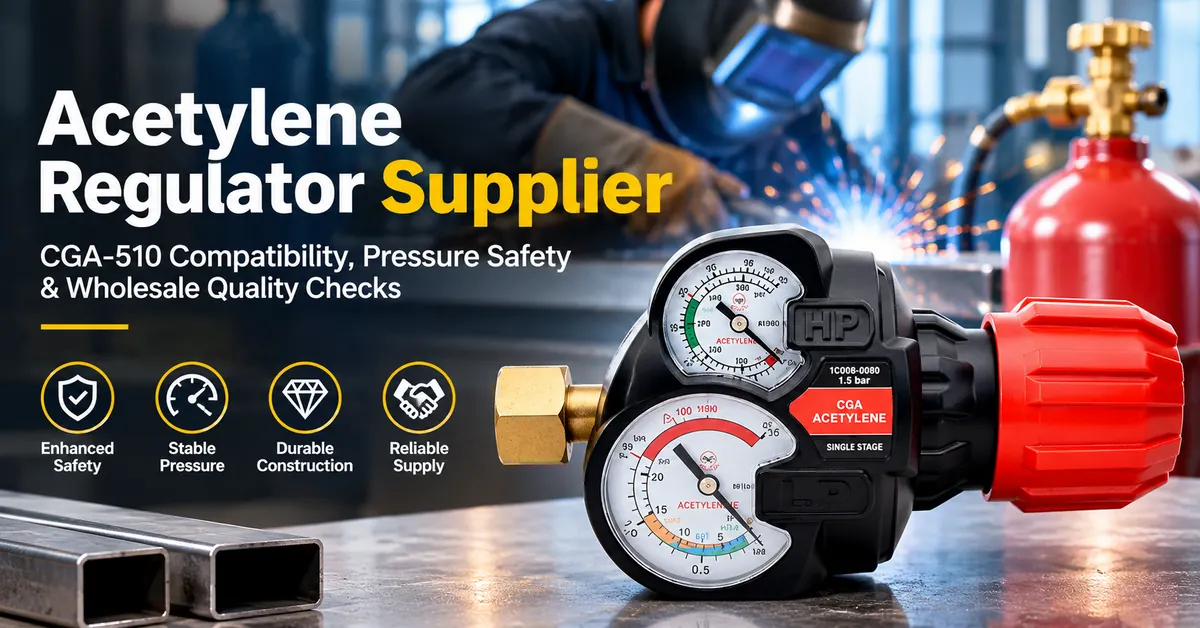
One relevant example is the company's 1C008-0080 medium-duty acetylene regulator, identified with a CGA-510 inlet.
However, buyers should verify every connection in the complete gas system rather than specify only a regulator's inlet code.
Understanding CGA 510
CGA 510 is a cylinder valve connection designation used for certain fuel-gas applications in markets that follow relevant Compressed Gas Association connection practices.
It is not a regulator performance rating.
When comparing acetylene regulator quotations, buyers should confirm the actual cylinder valve connection required in the destination market.
Some acetylene equipment configurations may use CGA 300 or other approved connection arrangements.
These connections must not be assumed interchangeable.
Regulator Connection Checklist
| Connection Detail | What to Specify | Why It Matters |
|---|---|---|
| Cylinder inlet | CGA 510, CGA 300, or another approved fitting | Correct cylinder compatibility |
| Regulator outlet | Thread diameter, pitch, handedness, sealing design | Compatible downstream connection |
| Hose fitting | Gas-service rating and approved connection | Correct gas delivery arrangement |
| Flashback protection | Gas type, intended mounting position, connection | Proper protective-device selection |
| Torch connection | Approved hose or equipment interface | Complete system compatibility |
| Destination market | Applicable connection and regulatory requirements | Reduces import and installation problems |
A left-hand threaded connection is common in certain fuel-gas systems, but thread handedness alone is not sufficient to establish compatibility.
The purchaser should record the exact thread and sealing arrangement.
Why Regional Compatibility Matters for Distributors
A distributor importing acetylene regulators for multiple countries may require several connection configurations.
Treating all regulators as one interchangeable SKU can create stock identification and customer-service problems.
A better approach is to assign separate product references to configurations with different inlet fittings, outlets, pressure ranges, or approved gas service.
This also makes product labeling, packaging, technical documentation, and repeat orders easier to control.
Which Pressure and Flow Specifications Matter Most?
Pressure control is the central function of an acetylene regulator.
However, a regulator must also supply the required gas flow under its approved conditions.
1. Maximum Inlet Pressure
The maximum inlet pressure describes the regulator's rated supply-side capability.
Buyers must ensure that the regulator is suitable for the specified acetylene cylinder arrangement.
Do not confuse cylinder supply pressure with the permitted pressure delivered to downstream equipment.
2. Outlet Pressure Control
The outlet range defines the regulator's adjustment capability.
For industrial purchasing, the correct range should match the approved torch, tip, and application requirements.
A wider adjustment range is not automatically better.
Precise matching is more important than selecting the regulator with the highest available rating.
3. Flow Capacity and Pressure Stability
A regulator should be able to supply the gas flow required by the connected equipment within its approved operating conditions.
A small welding tip and a larger industrial heating or cutting arrangement may place different demands on the fuel-gas supply.
Buyers should request relevant performance information when approving regulators for demanding applications.
4. Single-Stage vs Two-Stage Pressure Regulation
| Feature | Single-Stage Regulator | Two-Stage Regulator |
|---|---|---|
| Pressure reduction | One regulating stage | Two regulating stages |
| Typical selection factor | Suitable for many conventional gas applications | Useful where tighter control against supply-pressure variation is needed |
| Equipment complexity | Generally simpler arrangement | Additional regulating stage |
| Application suitability | Depends on approved specification | Depends on approved specification |
| Purchasing priority | Correct pressure/flow rating and compatibility | Required stability, rating, and compatibility |
The presence of two gauges does not mean a regulator has two pressure-reduction stages.
UWELD identifies several acetylene products as single-stage designs. Buyers requiring a particular pressure-control performance should request the current technical data rather than infer it from the product appearance.
UWELD Acetylene Regulator Models: Technical Comparison
UWELD, operated by Ningbo United Tools Co., Ltd., supplies welding, cutting, heating, and gas-control equipment for international industrial buyers.
Its acetylene regulator range includes medium-duty and industrial configurations with different construction and adjustment features.
The following comparison is based on published UWELD product descriptions.
UWELD Acetylene Regulator Model Comparison
| UWELD Model | Published Features | Main Buyer Interest | Details to Confirm |
|---|---|---|---|
| 1C008-0005 UW-1402 | Medium-duty regulator, forged brass body, dual gauges | General industrial welding, brazing, cutting | Connections, inlet/outlet ratings, flow performance |
| 1C008-0008 G350 | Industrial acetylene pressure control, rugged brass body | Industrial cutting and brazing channels | Exact configuration, pressure range, fittings |
| 1C008-0044 TA90 | Single-stage reduction, safety relief valve, forged brass body | Buyers evaluating relief-valve configuration | Valve specifications, operating limits, connections |
| 1C008-0080 | Medium-duty single-stage design, CGA-510 inlet, high-contrast gauges, impact-absorbing adjustment knob | Buyers seeking specified CGA-510 configuration | Outlet fitting, gauge scales, model documentation |
These products should not be ranked by assumed pressure stability, durability, or price without comparable test data.
UWELD 1C008-0005: Medium-Duty Acetylene Regulator
The UWELD 1C008-0005 Medium Duty Acetylene Pressure Regulator is positioned for industrial welding, brazing, and cutting applications.
Its published description highlights forged brass construction and a dual-gauge arrangement.
For wholesale buyers, this model is relevant when evaluating a medium-duty regulator line for professional users.
The purchasing review should confirm the exact gas-service version, regulator connections, rated pressure range, and applicable documentation.
UWELD 1C008-0008: G350 Industrial Regulator
The UWELD 1C008-0008 G350 Acetylene Regulator is presented as an industrial gas-control product for welding, cutting, and brazing.
The product page describes a robust brass body and acetylene pressure-regulation capability.
Buyers serving industrial fabrication and equipment distribution markets can evaluate this model against their required pressure range, connections, and component quality expectations.
UWELD 1C008-0044: TA90 Single-Stage Regulator
The UWELD 1C008-0044 TA90 Acetylene Regulator features a single-stage pressure-reduction design.
The published description identifies a forged brass body and a safety relief valve.
A relief valve and a flashback arrestor serve different purposes.
Before approving the product, buyers should confirm the relief-valve function, specifications, and whether the intended system requires additional protective equipment.
UWELD 1C008-0080: CGA-510 Medium-Duty Regulator
The UWELD 1C008-0080 Medium Acetylene Regulator is listed as a single-stage CGA-510 configuration.
The product description highlights high-contrast gauges and impact-absorbing adjustment features.
This makes it a useful product to evaluate when a buyer specifically needs to investigate a CGA-510 cylinder connection.
However, cylinder compatibility must still be checked against the exact gas supply, outlet connection, and regional requirements.
Need a model-specific quotation? Contact UWELD with your acetylene cylinder connection, operating requirements, destination market, and expected order volume.
How Do Materials and Manufacturing Affect Regulator Quality?
An acetylene regulator must combine appropriate materials, precise components, and controlled assembly.
Its outward appearance does not establish actual performance.
Brass Body Construction
Brass is commonly used for industrial gas-regulator bodies because suitable brass alloys can provide useful mechanical and manufacturing properties.
UWELD identifies forged brass construction on certain acetylene regulator models.
However, body material alone does not guarantee a regulator's safety, service life, or pressure-control performance.
The complete assembly must be evaluated.
Internal Components
Important components may include:
-
Pressure-regulating diaphragm.
-
Valve and seat assembly.
-
Adjustment mechanism.
-
Inlet filtration where provided.
-
Pressure gauges.
-
Sealing components.
-
Relief devices where included.
Materials and component designs should be suitable for the approved gas and operating conditions.
For industrial distributors, these construction details help identify which technical documents should accompany a product sample.
Quality-Control Requirements
| Inspection Item | What the Buyer Should Request |
|---|---|
| Component identity | Approved drawing or bill of materials |
| Material verification | Relevant material specifications |
| Connection dimensions | Thread and fitting inspection |
| Assembly integrity | Defined assembly inspection criteria |
| Gas-tightness | Approved leakage-test method and results |
| Pressure regulation | Functional test under specified conditions |
| Gauge performance | Appropriate gauge verification records |
| Relief-device function | Applicable verification, if fitted |
| Final inspection | Product identification and inspection records |
| Batch traceability | Order, model, and production identification |
A supplier should be evaluated according to the evidence available for the exact purchased model.
What Certification and Safety Documents Should Buyers Request?
Acetylene pressure regulators are safety-related industrial gas components.
For international purchasers, compliance requirements depend on the product type, destination market, and intended installation.
ISO 2503 and Product Requirements
ISO 2503:2009, including its applicable amendment, addresses pressure regulators and certain regulators with flow-metering devices for gas cylinders used in welding, cutting, and related processes.
Its scope includes equipment for dissolved acetylene.
However, the existence of an international standard does not mean that every regulator on the market has been independently certified to it.
Buyers should verify whether the supplied model has relevant conformity documentation and whether the documentation covers the actual ordered configuration.
Why ISO 9001 Is Not Enough by Itself
UWELD states that it holds ISO 9001:2015 quality management system certification.
This provides information about the company's quality-management framework, but it should not be presented as proof that every individual regulator carries a particular product certification.
For professional importers, product-specific technical documentation remains essential.
Flashback Protection Is a Separate Decision
Pressure regulators and flashback arrestors perform different functions.
A regulator reduces and controls gas pressure.
A flashback arrestor is intended to prevent flame propagation under its rated conditions, while some devices also provide a non-return function.
For compatible protective-device selection, see the UWELD oxy-fuel safety equipment guide.
What Should Be Checked Before Approving a Wholesale Batch?
For industrial equipment importers, a regulator sample should establish the approved configuration for subsequent orders.
The following inspection approach helps buyers reduce configuration mistakes.
Three-Stage Supplier Qualification
Stage 1 — Technical review
Confirm the intended gas, inlet and outlet connections, pressure ranges, flow requirements, gauge configuration, and applicable standards.
Stage 2 — Sample approval
Evaluate the product against the approved specification. Request qualified inspection and testing for the relevant functions, including gas-tightness and pressure regulation where applicable.
Stage 3 — Batch verification
Confirm that the supplied regulators match the approved product identification, component configuration, packaging, and required inspection records.
Common Wholesale Risks
| Purchasing Risk | Possible Consequence | Recommended Prevention |
|---|---|---|
| Incorrect cylinder inlet | Product cannot connect to local cylinders | Verify inlet standard before ordering |
| Incorrect outlet fitting | Hose or safety accessory incompatibility | Approve complete connection drawing |
| Wrong gas version | Unsafe or unsuitable equipment | Control gas marking and SKU |
| Unverified pressure range | Incorrect application matching | Request current datasheet |
| Unapproved component change | Inconsistent repeat-order quality | Establish revision control |
| Incomplete documentation | Import or distributor approval delay | Confirm requirements before production |
| Missing spare parts support | Increased customer downtime | Review service arrangements |
Safety-critical nonconformities should be resolved through qualified technical review before affected products are released.
How Do Acetylene Regulator Wholesale Costs Compare?
The lowest quoted regulator price may not represent the best total purchasing value.
Importers should compare technically equivalent products with the same gas service, connection configuration, documentation requirements, packaging, and inspection scope.
Total Purchasing Cost
A useful evaluation includes:
Total Sourcing Cost = Product Cost + Freight and Import Costs + Inspection Costs + Required Accessories + Expected Support Costs
| Cost Factor | Impact on B2B Purchasing |
|---|---|
| Regulator construction | Influences material and manufacturing requirements |
| Gauge configuration | Affects component and packaging specification |
| Inlet and outlet connection | May require market-specific versions |
| Inspection requirements | Influences testing and approval costs |
| OEM packaging | May add artwork and setup requirements |
| Order quantity | Affects quotation and inventory planning |
| Freight | Depends on shipment size and destination |
| After-sales support | Influences long-term service costs |
No universal quantity threshold makes one model automatically cheaper than another.
Accurate comparison requires current quotations and matching technical configurations.
How Can Buyers Select an Acetylene Regulator Supplier in Three Steps?
Step 1: Define the Gas-System Requirements
Identify the intended process, acetylene supply arrangement, cylinder connection, required pressure and flow conditions, and destination market.
Decision rule: Exclude any regulator that lacks confirmed compatibility with the intended gas service.
Step 2: Compare Technical Documentation and Samples
Review the model-specific specifications, construction information, connection drawings, inspection evidence, and relevant safety documentation.
Decision rule: Approve only configurations that satisfy the required technical and acceptance criteria.
Step 3: Evaluate Commercial Terms and Repeat Supply
Compare quotations, MOQ, sample arrangements, packaging, lead times, product identification, and after-sales support.
Decision rule: Select the supplier configuration offering an appropriate balance of technical suitability, documented quality, and commercial value.
For UWELD product evaluation, buyers can compare the 1C008-0005 Medium-Duty Regulator with the 1C008-0008 G350 Industrial Regulator.
Practical Sourcing Scenario: Standardizing Acetylene Regulators for Distributors
Consider an equipment importer supplying welding and cutting products to two markets.
The first market requires a specified CGA-510 acetylene cylinder inlet. The second uses a different approved cylinder connection arrangement.
The importer initially considers supplying one regulator SKU to both markets.
However, the technical review identifies differences in cylinder interfaces and downstream fitting requirements.
This is an illustrative purchasing scenario, not a claimed UWELD customer case study.
Engineering and Procurement Response
The importer separates the required configurations into distinct product references.
Each SKU records its gas service, inlet, outlet, pressure requirements, product label, packaging, and approved technical documentation.
Representative samples are then evaluated against their individual specifications.
Expected Purchasing Benefits
The approach can help reduce product identification errors, prevent inappropriate substitution, and simplify repeat-order verification.
It also provides distributors with more accurate product information for customers.
No specific defect reduction or cost saving is claimed without actual project data.
The key lesson is that regional compatibility should be established before committing to wholesale inventory.
OEM/ODM Acetylene Regulator Supply for Industrial Brands
Private-label industrial equipment brands may need customized labels, packaging, product identification, and approved connection configurations.
UWELD supports OEM/ODM inquiries for welding and cutting products, subject to technical feasibility and purchasing requirements.
Recommended OEM Procurement Workflow
-
Define the target application and destination market.
-
Select an approved regulator model and gas configuration.
-
Confirm technical specifications and sample requirements.
-
Approve product markings, labels, and packaging.
-
Establish inspection criteria and component-change controls.
-
Confirm MOQ, production terms, and delivery conditions.
-
Arrange repeat-order identification and after-sales support.
Changes to pressure-control components, gas compatibility, protective devices, or connection specifications should undergo qualified technical review.
MOQ, Samples, and Lead Times
According to UWELD's purchasing FAQs, minimum order quantities depend on the specific product and customization requirements.
Samples may be arranged, with sample and shipping costs generally borne by the requesting buyer.
UWELD indicates that stock items normally take one to two weeks, while custom-order schedules depend on the project.
These general statements should not be treated as guaranteed delivery terms for a particular acetylene regulator SKU.
What Should Be Included in an Acetylene Regulator RFQ?
A clear request for quotation helps both the buyer and supplier identify the correct configuration.
| RFQ Field | Information to Provide |
|---|---|
| Product | Acetylene pressure regulator |
| Preferred model | 1C008-0005, 1C008-0008, 1C008-0044, or 1C008-0080 |
| Gas service | Acetylene |
| Application | Welding, cutting, brazing, or industrial maintenance |
| Cylinder inlet | Exact required connection standard |
| Regulator outlet | Thread, size, handedness, and sealing requirements |
| Pressure requirements | Approved inlet and outlet specifications |
| Flow requirements | Expected equipment demand |
| Quality documentation | Inspection reports and applicable conformity documents |
| Branding | UWELD or approved private label |
| Packaging | Standard or customized |
| Quantity | Sample and expected bulk order |
| Target market | Destination country or region |
| Delivery | Requested schedule and trade terms |
Including these details allows the supplier to provide a more meaningful technical response and commercial quotation.
Contact UWELD to request current acetylene regulator specifications, available configurations, samples, and wholesale pricing.
Frequently Asked Questions About Acetylene Regulator Suppliers
1. What does an acetylene regulator supplier provide?
An acetylene regulator supplier provides pressure regulators designed for approved acetylene gas systems. For B2B customers, relevant services may include model selection, technical information, samples, bulk quotations, OEM customization, and after-sales support.
2. What is the difference between an acetylene regulator and an oxygen regulator?
They are designed for different gas services, operating requirements, and connection arrangements. Buyers must use equipment approved for the intended gas rather than assume that regulators are interchangeable.
3. What is a CGA 510 acetylene regulator?
It is a regulator with a CGA-510 inlet configuration for a compatible cylinder valve. Buyers must also verify the regulator's gas approval, outlet connection, pressure ratings, and application.
4. What is the maximum permitted acetylene working pressure?
Under U.S. OSHA 29 CFR 1910.253, acetylene must not be used above 15 psig, subject to the regulation's stated exceptions. Actual equipment operating pressure must follow the applicable manufacturer instructions and may be substantially lower.
5. Is a single-stage acetylene regulator suitable for industrial welding?
A properly specified single-stage regulator can be suitable for many approved industrial applications. Selection depends on required outlet pressure, gas flow, pressure-control performance, and connected equipment.
6. Which UWELD models are available for acetylene applications?
Relevant UWELD models include 1C008-0005, 1C008-0008, 1C008-0044, and 1C008-0080. Their exact specifications and available configurations should be verified before ordering.
7. What quality tests should acetylene regulators undergo?
Buyers should request applicable inspection evidence for gas-tightness, pressure regulation, gauge performance, component integrity, and other model-specific requirements. The test method and acceptance criteria should be established for the actual product.
8. Does ISO 9001 mean every regulator is individually certified?
No. ISO 9001 relates to quality management systems. Individual regulators may require separate product-specific documentation, depending on their design and destination market.
9. Does UWELD support OEM acetylene regulator orders?
UWELD supports OEM/ODM inquiries involving branding, packaging, appearance, and feasible specification adjustments. Final options, MOQ, and technical approval requirements depend on the selected project.
10. How can I request a wholesale quotation from UWELD?
Submit the intended application, preferred model, cylinder connection, outlet specification, operating requirements, quantity, destination market, and packaging needs through the UWELD contact page.
Conclusion
Choosing an acetylene regulator supplier requires more than evaluating regulator appearance or unit price. For professional industrial buyers, the purchasing decision should begin with gas compatibility, approved pressure limits, connection standards, flow requirements, and model-specific technical documentation.
For importers and distributors, verifying CGA connections and controlling product configurations are essential steps toward reducing sourcing mistakes and maintaining consistent repeat orders.
UWELD supplies acetylene pressure regulators and related welding and cutting equipment for international industrial markets, with options for wholesale sourcing and OEM/ODM cooperation.
Buyers can explore the UWELD 1C008-0005 Medium-Duty Acetylene Regulator, compare the 1C008-0008 G350 Industrial Regulator, or review the complete gas cutting product range.
To discuss technical specifications, connection compatibility, sample approval, private-label options, or bulk purchasing requirements, contact UWELD for a model-specific quotation.