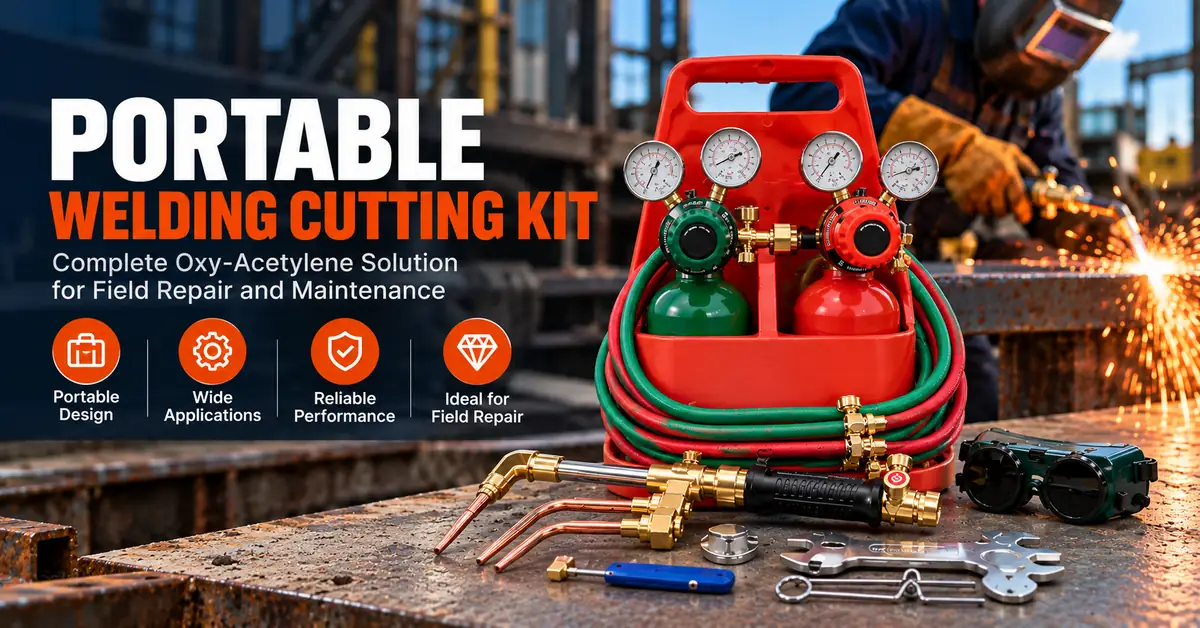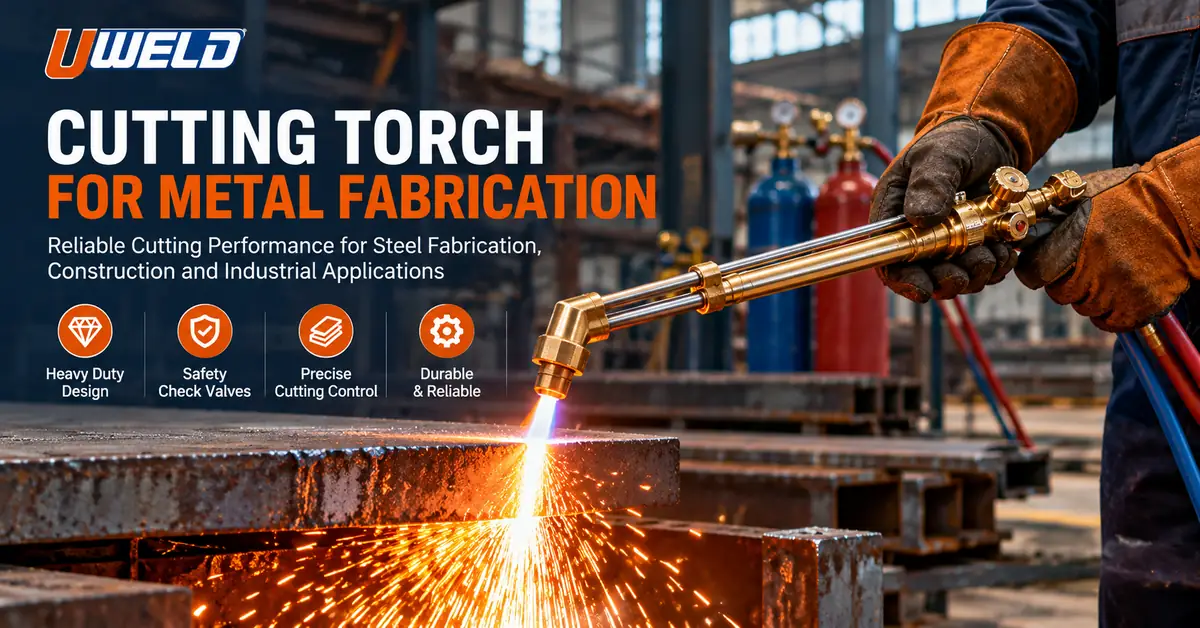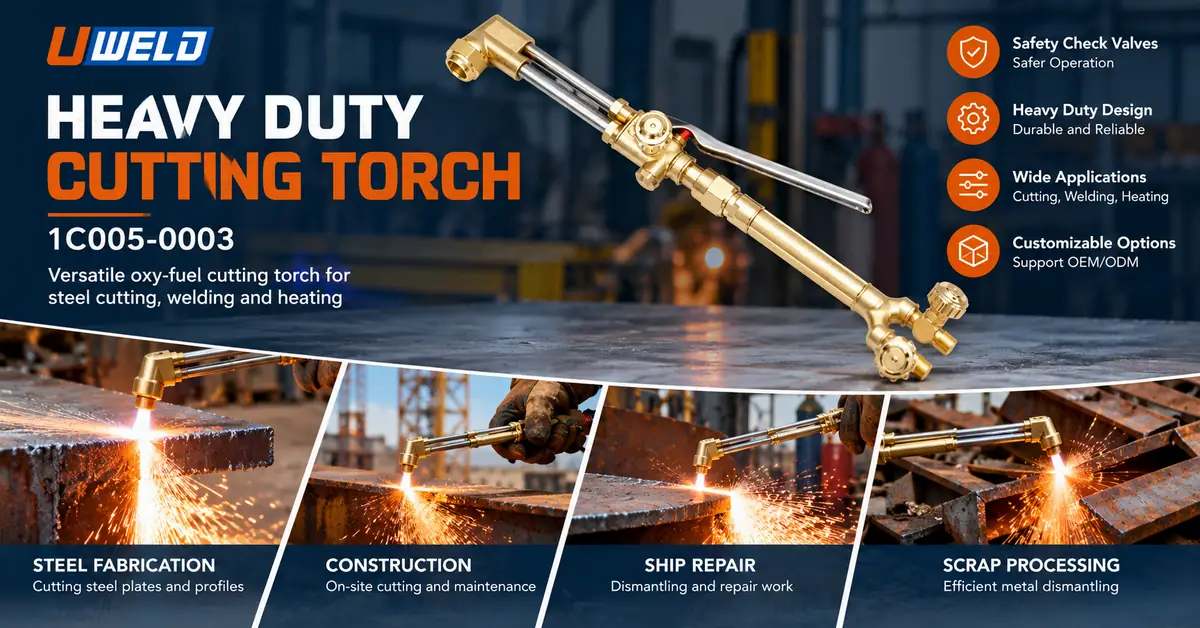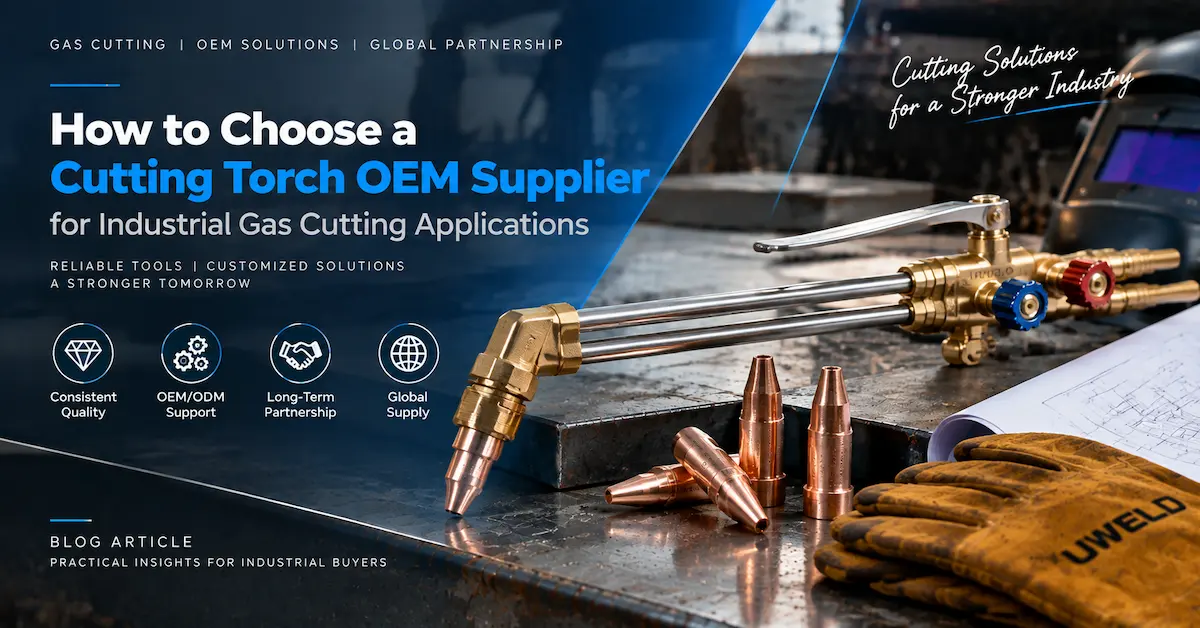


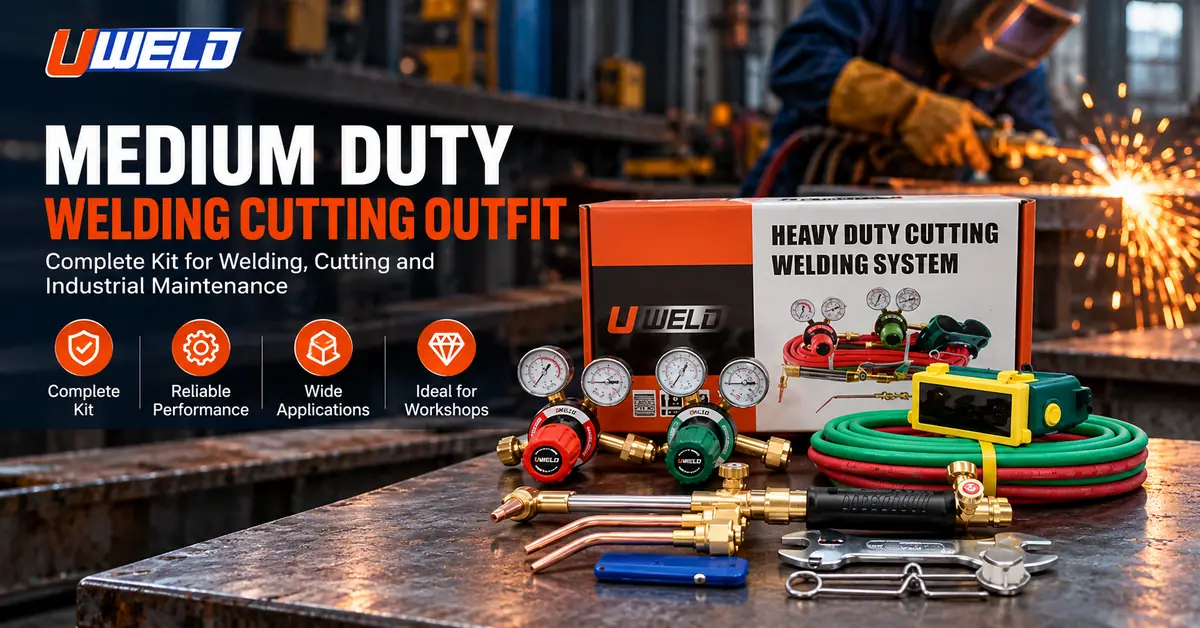
A medium duty welding cutting outfit is a coordinated oxy-fuel equipment kit designed for gas welding, carbon steel cutting, and selected heating applications. It generally combines a torch handle, cutting attachment, welding tips, oxygen and fuel-gas regulators, hoses, and supporting accessories.
For metal fabrication workshops, industrial maintenance teams, and equipment distributors, purchasing a complete outfit can simplify equipment selection and reduce the risk of mismatched components.
However, not all medium-duty outfits offer identical cutting capacities, gas compatibility, regulator connections, or accessory configurations.
UWELD supplies professional welding and cutting tools, including medium-duty outfit configurations and related gas-control equipment.
This guide explains the differences between medium-duty and heavy-duty kits, important technical specifications, equipment safety considerations, common operating problems, and wholesale purchasing requirements.
Buyers can explore UWELD gas cutting equipment and accessories when evaluating suitable products.
What Is a Medium Duty Welding Cutting Outfit?
A medium duty welding cutting outfit is an integrated set of tools intended to support oxy-fuel welding and cutting operations within a defined equipment capacity.
In a conventional oxy-acetylene system, oxygen and acetylene are supplied separately through gas-specific regulators and hoses.
The torch combines the gases to produce a controlled flame for welding or heating. When configured with an appropriate cutting attachment and nozzle, the system can also cut suitable steel through an oxidation reaction.
Unlike a standalone cutting torch, a welding and cutting outfit is intended to provide multiple functions through compatible equipment and accessories.
Who Should Use a Medium-Duty Outfit?
This equipment category can be suitable for:
-
Metal fabrication workshops cutting and welding carbon steel components.
-
Industrial maintenance teams performing repair and heating operations.
-
Construction contractors requiring versatile oxy-fuel tools.
-
Agricultural machinery and equipment repair workshops.
-
Welding supply distributors developing complete tool packages.
-
Importers and private-label brands sourcing welding and cutting kits.
A medium-duty outfit is not automatically the best solution for continuous heavy industrial cutting, specialized high-productivity production, or welding applications that exceed its rated capacity.
The correct selection depends on the specific kit configuration and the intended working conditions.
What Comes in a Medium Duty Welding Cutting Outfit?
A complete outfit contains several components that perform different functions.
Understanding these components helps purchasing managers confirm accessory completeness and avoid compatibility problems.
Essential Components and Functions
| Component | Primary Function | Purchasing Considerations |
|---|---|---|
| Torch handle | Controls gases used for welding and cutting | Valve construction, design, compatibility |
| Cutting attachment | Converts a compatible torch configuration for cutting | Torch connection, operating mechanism |
| Welding tips | Produce flames for gas welding | Tip sizes, fuel compatibility, material |
| Cutting tip | Directs preheat flames and cutting oxygen | Tip series, thickness range, fuel type |
| Oxygen regulator | Controls oxygen pressure | Inlet/outlet range, gas service, connections |
| Acetylene regulator | Controls acetylene pressure | Gas-specific compatibility, pressure rating |
| Twin gas hose | Delivers oxygen and fuel gas | Hose length, service rating, fittings |
| Flashback protection | Provides specified protection against flame propagation | Gas type, installation point, protective functions |
| Welding goggles | Help protect the operator's eyes | Suitable filter shade and applicable standards |
| Tip cleaner | Supports nozzle maintenance | Correct cleaning tool and tip size |
| Spark lighter | Provides an approved ignition method | Compatibility with operating procedure |
| Carrying case or bag | Organizes and protects equipment | Durability, packaging requirements |
The exact contents vary by model.
For example, some UWELD medium-duty configurations include multiple welding tips, whereas others use different cutting attachments and torch handles.
Gas cylinders should not be assumed to be included unless explicitly stated in the quotation.
UWELD Medium Duty Welding Cutting Outfit Specifications
UWELD has published several medium-duty welding and cutting configurations, including the 1C016-0039A, 1C016-0035, and 1C016-0057A series.
Its catalog identifies these as oxygen-acetylene configurations for welding and cutting applications.
Reference Technical Specifications
| Specification | UWELD Medium-Duty Catalog Configuration |
|---|---|
| Equipment type | Welding and cutting outfit |
| Fuel system | Oxygen and acetylene |
| Welding capacity | Up to 3/8 inch (approximately 9 mm) steel plate |
| Cutting capacity | Up to 6 inches (approximately 150 mm) steel plate |
| Oxygen regulator connection options | CGA540 / CGA992; specified 9/16"-18 connections |
| Acetylene regulator connection options | CGA510 / CGA300 / CGA993; specified 9/16"-18 connections |
| Twin hose length | 4.5 m |
| Welding tips | Vary by model |
| Cutting tip | Varies by model |
| Packaging | Bag, color box, or other model-specific packaging |
These figures represent particular published catalog configurations, not guaranteed performance for every UWELD kit.
Actual welding and cutting capability depends on the selected torch, nozzle, gas supply, material, operating conditions, and current product specification.
Buyers should confirm the required configuration with UWELD before ordering.
Why Welding and Cutting Capacities Are Different
Gas welding uses the oxy-acetylene flame to melt and join suitable metal.
Oxy-fuel cutting follows a different process: the flame preheats the steel, while a concentrated oxygen stream creates an oxidation reaction that removes material.
Consequently, the maximum cutting thickness of an outfit may be substantially greater than its welding thickness rating.
Buyers should never interpret a cutting capacity of 150 mm as meaning the equipment can gas-weld material of the same thickness.
UWELD Medium-Duty Model Comparison
Different torch handles, cutting attachments, tip combinations, and packaging arrangements can influence how an outfit fits the end user's requirements.
Comparing UWELD Welding and Cutting Outfits
| Model | Published Configuration | Included Tip Information | Suitable Purchasing Direction |
|---|---|---|---|
| 1C016-0039A | Torch handle 85; cutting attachment 72-3 | Welding tips #1, #3, #5; cutting tip 6290 #2 | Distributors needing multiple welding tip sizes |
| 1C016-0035 | Medium-duty oxygen-acetylene kit | Welding tips #1, #2; cutting tip 1-1-101 | General workshop and professional repair supply |
| 1C016-0057A | Torch handle 100C; cutting attachment CA1350 | Welding tips #1, #2; cutting tip 1-3-101 | Buyers seeking a specific torch and attachment configuration |
| 1C016-0045 | Heavy-duty welding and cutting kit | Different heavy-duty torch and tip arrangement | Buyers requiring a higher-duty product category |
The 1C016-0039A, 1C016-0035, and 1C016-0057A configurations are listed in UWELD's medium-duty product catalog. The 1C016-0045 represents a separate heavy-duty category.
Model availability and current component combinations should be reconfirmed before ordering.
Featured Product: UWELD 1C016-0035
The UWELD 1C016-0035 Cutting and Welding Kit is a relevant product for buyers evaluating a complete gas welding and cutting solution.
The current product listing describes forged brass construction, stainless steel needle valves, and flashback-protection features.
When comparing this kit with its catalog configuration, buyers should verify the exact regulator arrangement, protective devices, torch handle, cutting attachment, and included accessories.
This is particularly important for wholesale and OEM orders where component consistency affects distributor inventory and after-sales service.
Explore the UWELD 1C016-0035 product or request configuration details.
Medium Duty vs Heavy Duty Welding Cutting Outfits
The distinction between medium-duty and heavy-duty outfits is not simply the physical size of the carrying case.
It relates to the equipment's intended workload, rated capacity, component configuration, and operating demands.
| Evaluation Factor | Medium-Duty Outfit | Heavy-Duty Outfit |
|---|---|---|
| Typical users | General fabrication and repair workshops | Heavy fabrication and industrial maintenance |
| Welding capacity | Model-specific medium-duty range | Potentially higher, depending on model |
| Cutting capacity | Suitable for the published medium-duty range | Potentially higher, depending on model |
| Torch configuration | Medium-duty handles and attachments | Heavy-duty handles and attachments |
| Portability | Often suitable for general service work | May involve larger or heavier components |
| Initial purchasing cost | Depends on configuration and accessories | Depends on capacity and included components |
| Key selection criterion | Match normal daily work requirements | Match higher-demand applications |
UWELD catalog examples include medium-duty configurations with published cutting capacities up to 150 mm and heavy-duty configurations with higher catalog ratings.
However, these figures should be assessed as model-specific ratings rather than universal limits.
For distributors, stocking both categories may help serve workshops with different workload requirements.
The UWELD 1C016-0045 Heavy Duty Cutting and Welding Kit provides a separate product option for comparison.
How to Evaluate Safe Setup and Operation
Oxy-acetylene equipment involves flammable gas, pressurized oxygen, high temperatures, and potential flashback hazards.
Proper equipment installation and operation require competent personnel, manufacturer-approved procedures, and suitable workplace controls.
The following guidance outlines the main safety assessment stages. It is not a substitute for the operating manual, gas supplier instructions, or practical operator training.
1. Inspect Gas Cylinders and the Work Area
Before the system is commissioned, verify that cylinders are correctly identified, secured, and appropriate for the intended service.
Acetylene cylinders require suitable upright handling and storage.
Keep oxygen equipment free from oil, grease, and incompatible contaminants.
The work area should be assessed for combustible materials, ventilation, fire prevention, and the risks associated with hot work.
2. Confirm Regulator and Hose Compatibility
Oxygen and acetylene require correctly specified regulators.
Connection threads, inlet pressure ratings, outlet adjustment ranges, and gas service must match the actual supply arrangement.
Hose color conventions can differ between markets. Gas labels and equipment specifications should take priority over assumptions based on color alone.
For importers, regional connection compatibility is a critical purchasing requirement.
3. Verify Flashback and Backflow Protection
Flashback and reverse gas flow are different hazards.
A non-return valve is designed to restrict reverse flow under its specified conditions. A flashback arrestor is designed to prevent flame propagation under its rated conditions.
An assembly may incorporate multiple protective functions, but a generic description such as "safety valve" is not sufficient to establish the complete protection provided.
Buyers should confirm the required protective devices on both gas lines, their installation positions, gas compatibility, and relevant technical documents.
For additional component-selection considerations, see the UWELD oxy-fuel safety equipment guide.
4. Follow Manufacturer-Approved Operating Procedures
Qualified operators should follow the prescribed procedures for leak checks, gas supply adjustment, purging, ignition, flame regulation, cutting, welding, and shutdown.
There is no universal pressure setting or valve sequence suitable for every medium-duty outfit.
Settings must be determined from the exact torch, tip, regulator, and fuel-gas combination.
If a leak, flashback, abnormal flame, or equipment defect is suspected, work should stop and the system should be evaluated by appropriately trained personnel.
5. Inspect the Equipment After Use
Equipment maintenance should include inspection of hoses, fittings, regulators, valves, tips, and protective accessories.
Damaged components must be replaced or serviced according to the manufacturer's instructions.
Regular inspection helps identify deterioration before it develops into an operating problem.
Common Applications for Medium-Duty Welding and Cutting Kits
A medium-duty outfit can support several industrial activities when the work falls within the equipment's approved capabilities.
Metal Fabrication Workshops
Fabrication workshops may use oxy-acetylene equipment for steel cutting, component preparation, and suitable gas welding operations.
Relevant buying factors include tip availability, torch compatibility, equipment handling, and the ability to replace worn accessories.
Industrial Maintenance
Maintenance teams may need to remove damaged steel components, perform repair welding, or apply localized heating.
A complete outfit can support equipment organization and transport between maintenance locations.
Construction and Field Repair
Portable gas equipment may be useful for selected field operations where an electrically powered cutting process is impractical.
Site safety requirements, cylinder transport, gas supply, and operator access remain critical.
Agricultural Machinery Repair
Repair workshops may use oxy-fuel tools for cutting suitable steel sections, heating seized components, and carrying out appropriate metal repairs.
The selected welding or cutting operation must remain within the kit's rated limits.
Industrial Tool Distribution
For distributors, complete outfits offer opportunities to package compatible components into clearly defined product lines.
An effective product range should distinguish standard medium-duty configurations from portable and heavy-duty alternatives.
What Determines Welding and Cutting Performance?
Equipment performance depends on the complete gas system and the work being performed.
Key Technical Factors
| Technical Factor | Why It Matters | Buyer Evaluation |
|---|---|---|
| Regulator performance | Supports controlled gas delivery | Verify rated pressure range and gas service |
| Torch construction | Affects handling and durability | Examine materials, valves, and connections |
| Welding tip selection | Influences flame characteristics and heat input | Match tip size to welding application |
| Cutting tip selection | Influences oxygen jet and preheating | Match gas type and steel thickness |
| Hose condition | Affects safe gas delivery | Confirm hose ratings and fittings |
| Flashback protection | Addresses specified gas-system hazards | Verify approved protective functions |
| Operator technique | Affects weld and cut quality | Ensure training and approved procedures |
| Material properties | Determines process suitability | Confirm steel grade and thickness |
Welding Performance Considerations
For gas welding, the operator must establish a suitable flame and control heat input to form a sound joint.
Potential problems include excessive heat, unsuitable flame characteristics, surface contamination, and poor joint preparation.
An outfit's maximum published welding thickness does not guarantee satisfactory weld quality under all conditions.
Cutting Performance Considerations
During oxy-fuel cutting, preheating prepares the steel for oxidation, while the cutting oxygen stream removes oxides from the cutting path.
Poor nozzle condition, insufficient oxygen delivery, incorrect equipment selection, or unsuitable operating conditions may result in incomplete cuts, excess slag, or irregular edges.
Buyers should evaluate actual sample performance in the intended material range before approving a large order.
How to Assess Materials, Manufacturing, and Quality Control
For industrial distributors, a complete kit should be assessed as an integrated assembly rather than a group of individually attractive components.
Materials and Component Construction
Depending on the model, relevant construction materials may include brass bodies, copper-alloy tips, metal tubing, stainless steel valve components, and suitable sealing materials.
These components perform different functions.
Torch construction affects durability and handling, while precision in valves and connections is important for proper gas control and assembly compatibility.
The exact material specifications should be confirmed for each approved SKU.
Recommended Quality Inspection Checklist
| Inspection Stage | Items to Verify |
|---|---|
| Incoming inspection | Component identity, materials, appearance |
| Dimensional inspection | Threads, connections, mating components |
| Assembly inspection | Correct component selection and installation |
| Functional inspection | Torch valve operation and regulator performance |
| Gas-tightness verification | Applicable leakage test requirements |
| Protective-device verification | Approved specifications and documentation |
| Final kit inspection | Correct tips, hoses, tools, and accessories |
| Packaging inspection | Labels, instructions, model identification, quantities |
UWELD describes manufacturing and quality-management capabilities through its industrial solutions page.
For a particular medium-duty outfit, buyers should request the actual inspection plan and available product-specific records.
Certification and Compliance Considerations
International buyers should review the standards relevant to each part of the outfit.
For example, EN ISO 5172 relates to gas welding equipment blowpipes, while EN ISO 2503 relates to certain pressure regulators and associated equipment.
These references do not automatically mean every product or configuration has a corresponding certification.
Buyers must confirm the applicable standard, current edition, test documentation, certification scope, and destination-market requirements.
Common Equipment Problems and Maintenance Priorities
A professional maintenance plan helps reduce unplanned equipment failures and protects the usability of a welding and cutting outfit.
| Problem | Possible Cause | Recommended Response |
|---|---|---|
| Unstable flame | Gas delivery or tip condition issue | Stop and inspect using approved procedures |
| Reduced cutting quality | Incorrect or deteriorated cutting tip | Inspect compatibility and tip condition |
| Regulator irregularity | Incorrect selection or equipment defect | Arrange qualified regulator inspection |
| Suspected gas leakage | Damaged fittings, seals, or hoses | Remove from service and investigate |
| Flashback event | Abnormal operating or equipment condition | Stop operation and assess the system |
| Difficult valve movement | Wear, contamination, or mechanical damage | Follow approved service procedures |
| Premature tip wear | Damage, incorrect cleaning, unsuitable use | Check operating practices and replacement parts |
Maintenance should not involve unauthorized modifications to regulators, gas passages, safety devices, or pressure-control components.
For wholesale buyers, access to approved spare parts and technical support can be as important as the initial purchase cost.
What Affects the Price of a Medium Duty Welding Cutting Outfit?
The wholesale price of an outfit depends on more than the torch handle.
Different configurations may contain different regulators, welding tips, cutting attachments, protective devices, hoses, tools, and packaging.
Main Cost Factors
| Cost Factor | Impact on Purchasing |
|---|---|
| Torch and regulator configuration | Changes included component types |
| Number of welding tips | Influences application coverage |
| Cutting attachment and tip | Affects compatibility and intended capability |
| Safety accessories | Adds product-specific protective components |
| Carrying case | Influences packaging and handling cost |
| OEM branding | May involve artwork, printing, and setup costs |
| Technical documentation | May require market-specific materials |
| Order volume | Influences manufacturing and quotation arrangements |
| Quality and inspection requirements | Affects approval and documentation work |
| Freight and destination | Influences landed cost |
A low initial price is not necessarily a better purchase if an outfit requires additional accessories before it can meet the customer's needs.
Distributors should compare complete, like-for-like configurations rather than quotations with different component lists.
OEM/ODM and Wholesale Welding Cutting Outfit Solutions
International importers and private-label welding equipment brands often require market-specific outfit configurations.
Common project requirements include brand identification, packaging design, selected accessory combinations, and regional connection specifications.
UWELD supports customized welding and cutting equipment inquiries, including OEM/ODM projects.
Recommended Wholesale Procurement Process
Step 1 — Define the target application. Identify whether the product is intended for fabrication workshops, repair users, contractors, or industrial distributors.
Step 2 — Confirm the required configuration. Specify gas type, torch handle, regulators, connection standard, cutting attachment, tips, hose, and protective devices.
Step 3 — Review samples and technical documents. Confirm compatibility, product identification, quality requirements, and packaging.
Step 4 — Approve the order specification. Agree on the bill of materials, labeling, inspection criteria, MOQ, delivery schedule, and commercial terms.
Step 5 — Arrange repeat supply. Establish a consistent product reference and spare-parts plan for future orders.
What Should Buyers Include in an RFQ?
| RFQ Information | Details to Provide |
|---|---|
| Product category | Medium duty welding cutting outfit |
| Required model | 1C016-0039A, 1C016-0035, 1C016-0057A, or another configuration |
| Gas type | Oxygen and acetylene |
| Welding requirement | Steel type and required thickness |
| Cutting requirement | Steel type and required thickness |
| Connection standard | Destination-market specification |
| Accessories | Required tips, hose, protective devices, tools |
| Packaging | Standard, distributor, or private-label |
| Order volume | Sample quantity and anticipated bulk volume |
| Destination | Country or region |
| Documentation | Product data, testing, compliance requirements |
UWELD confirms that MOQ and delivery schedules vary by model and customization requirements.
For product details and commercial quotations, buyers can contact UWELD with their specifications.
Frequently Asked Questions About Medium Duty Welding Cutting Outfits
1. What is a medium duty welding cutting outfit?
It is an integrated oxy-fuel equipment kit designed for suitable gas welding and metal cutting applications. Typical components include a torch handle, regulators, cutting attachment, tips, hoses, and supporting accessories.
2. What can a medium-duty outfit be used for?
Common applications include carbon steel cutting, suitable gas welding, repair work, maintenance, and selected heating operations. Actual suitability depends on the specific configuration and operating limits.
3. How thick can a medium duty welding cutting outfit cut?
UWELD has catalog-listed configurations rated for cutting steel plate up to approximately 150 mm. This is not a universal rating; the exact capability must be confirmed for the selected torch, tip, gas supply, and application.
4. How thick can a medium-duty oxy-acetylene outfit weld?
Certain UWELD catalog configurations list a welding capacity up to approximately 9 mm. Actual welding suitability depends on joint design, material, tip selection, and the complete approved operating setup.
5. What is the difference between a cutting torch and a welding cutting outfit?
A cutting torch is a specific tool used for oxy-fuel cutting. A welding cutting outfit is a broader equipment set that may support both gas welding and cutting through compatible attachments and accessories.
6. Does a medium-duty kit include gas cylinders?
Not necessarily. Buyers should check the exact packing list and quotation. Gas cylinders, approved gas supplies, and other installation equipment may need to be purchased separately.
7. Are flashback arrestors necessary?
Appropriate gas-system protection is an important safety consideration. The required devices and arrangement depend on equipment design, gas service, manufacturer instructions, and applicable regulations. Built-in check valves should not automatically be treated as equivalent to flashback arrestors.
8. Can medium-duty outfits support different fuel gases?
Some product ranges offer different fuel-gas configurations, but acetylene and LPG components must not be assumed interchangeable. Buyers should verify the intended gas service of the entire outfit, including regulators, torch, tips, hoses, and protective devices.
9. Can UWELD customize medium duty welding cutting outfits for distributors?
UWELD supports OEM/ODM discussions involving product specifications, appearance, branding, and packaging. Available options, quantities, and feasibility should be confirmed for the selected project.
10. How can I request wholesale pricing from UWELD?
Send the intended applications, model requirements, regulator connections, accessory list, quantity, destination market, and branding requirements to the UWELD sales team. Request current technical specifications and a complete packing list before final approval.
Conclusion
Choosing the right medium duty welding cutting outfit requires evaluating the complete equipment configuration, not simply comparing torch prices or advertised cutting capacities.
For fabrication workshops, maintenance teams, and industrial distributors, important considerations include torch compatibility, gas-specific regulators, welding and cutting tips, equipment protection, maintenance requirements, and the actual workload.
For international B2B buyers, reliable sourcing also depends on consistent product specifications, quality documentation, appropriate certifications, accessory availability, and clear order conditions.
UWELD provides welding and cutting equipment solutions for professional applications, including medium-duty outfit configurations and customized wholesale supply.
Explore the UWELD gas cutting product range or contact UWELD for a quotation to discuss equipment specifications, samples, OEM/ODM options, and your purchasing requirements.