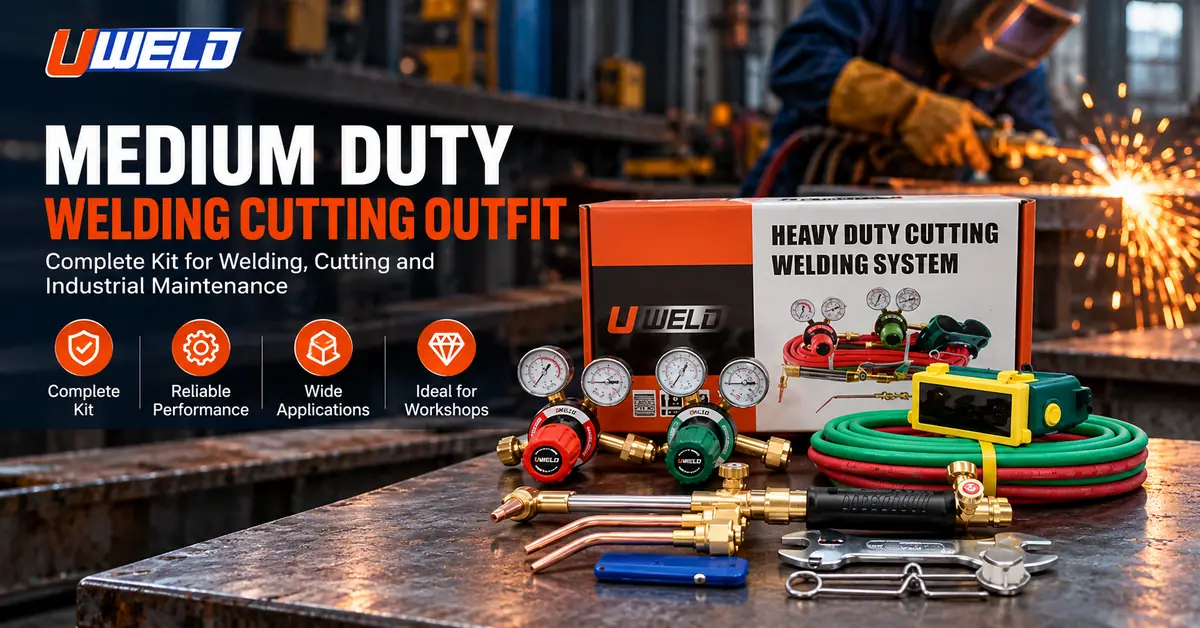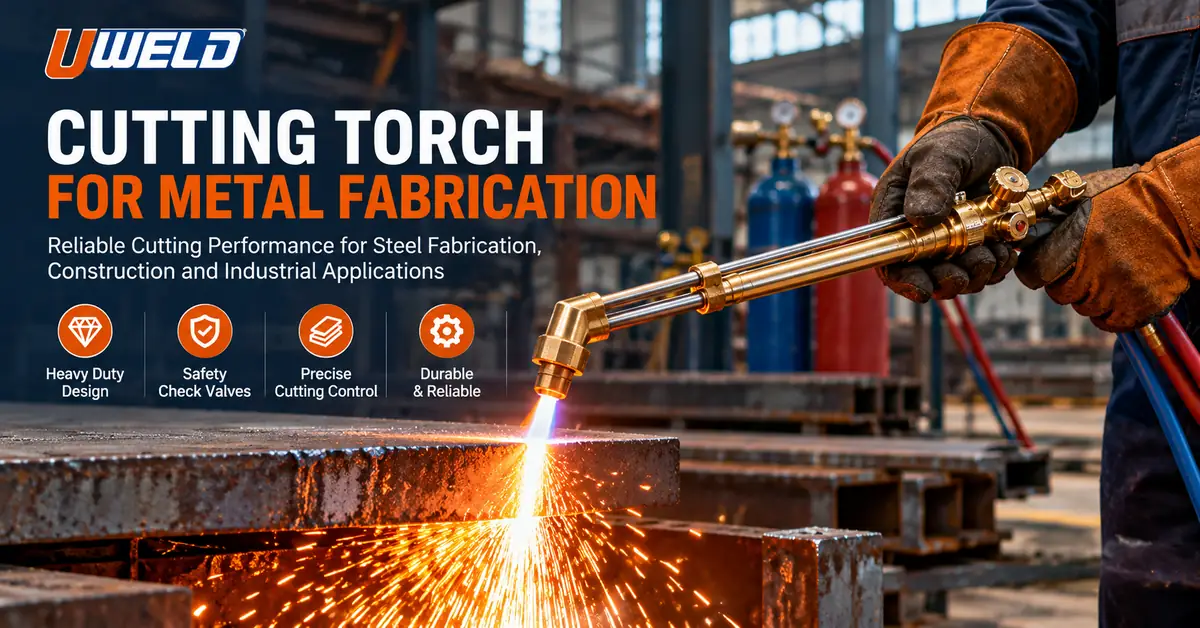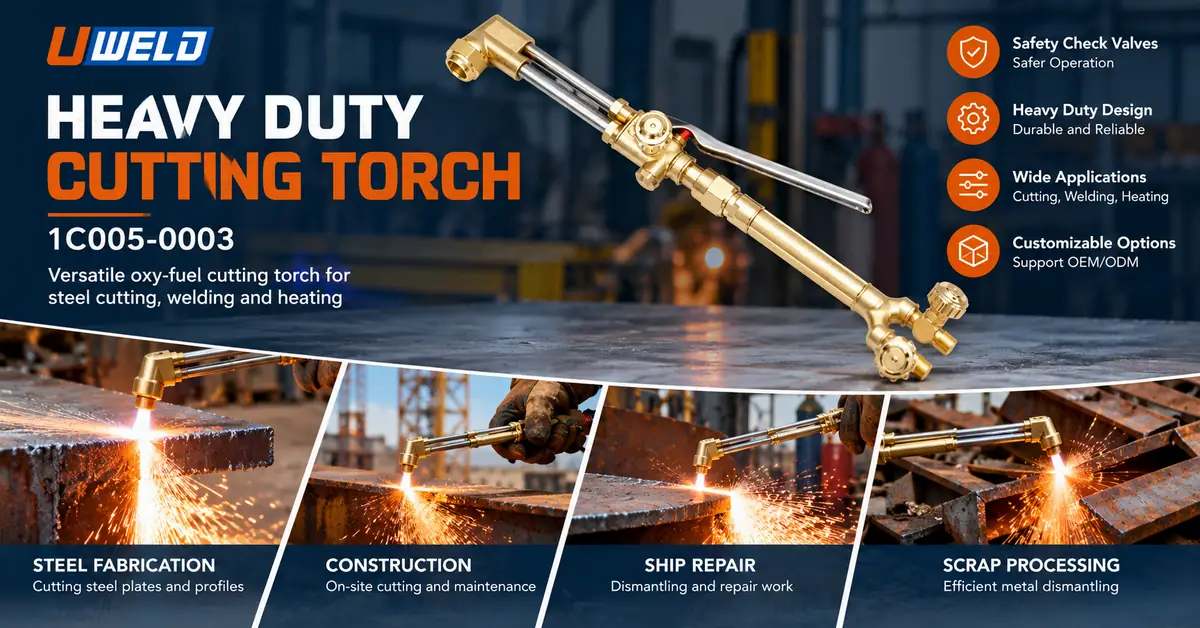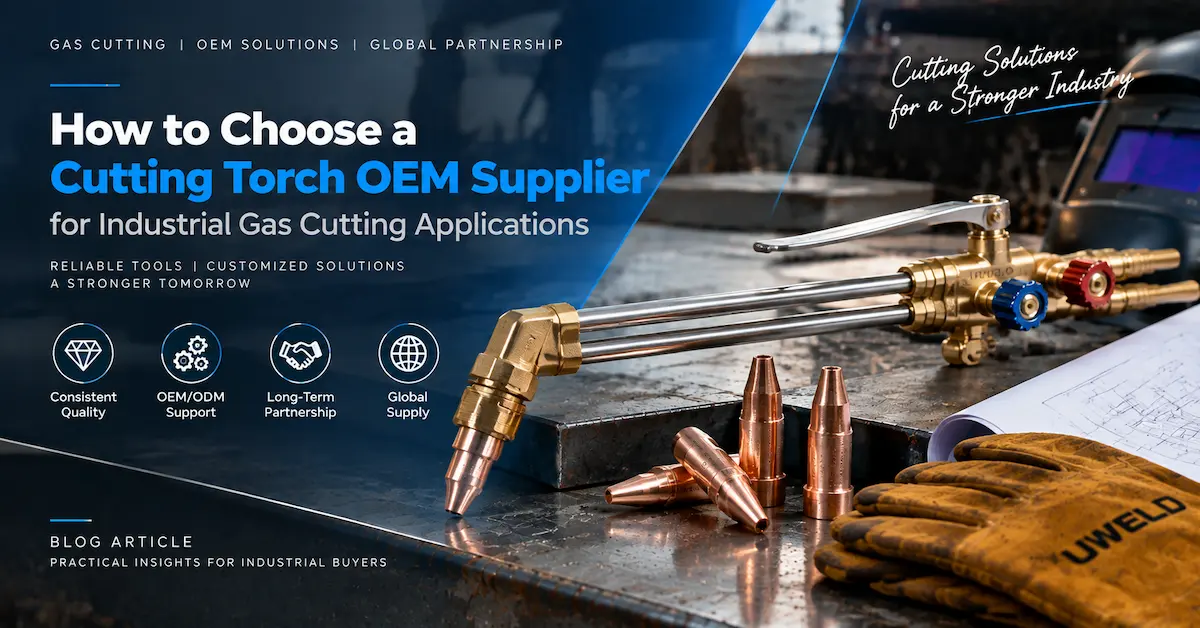


A portable welding cutting kit combines compatible oxy-fuel welding and cutting components in a transportable package for field maintenance, equipment repairs, construction work, and mobile fabrication.
Unlike a fixed workshop installation, a portable system must balance cutting capability, gas cylinder arrangements, equipment weight, protective accessories, and transportation requirements.
For industrial buyers, portability is not simply about purchasing a smaller torch. The complete system must be suitable for the intended work while remaining practical to transport, inspect, maintain, and replenish.
UWELD supplies professional welding and gas cutting equipment, including portable oxy-acetylene kits, gas regulators, torches, and related accessories for international distributors and industrial customers.
This guide explains how to evaluate portable systems for real working environments, compare UWELD product configurations, avoid common purchasing mistakes, and prepare a technically complete wholesale quotation request.
Explore the UWELD gas cutting equipment range for related products and sourcing options.
What Is a Portable Welding Cutting Kit?
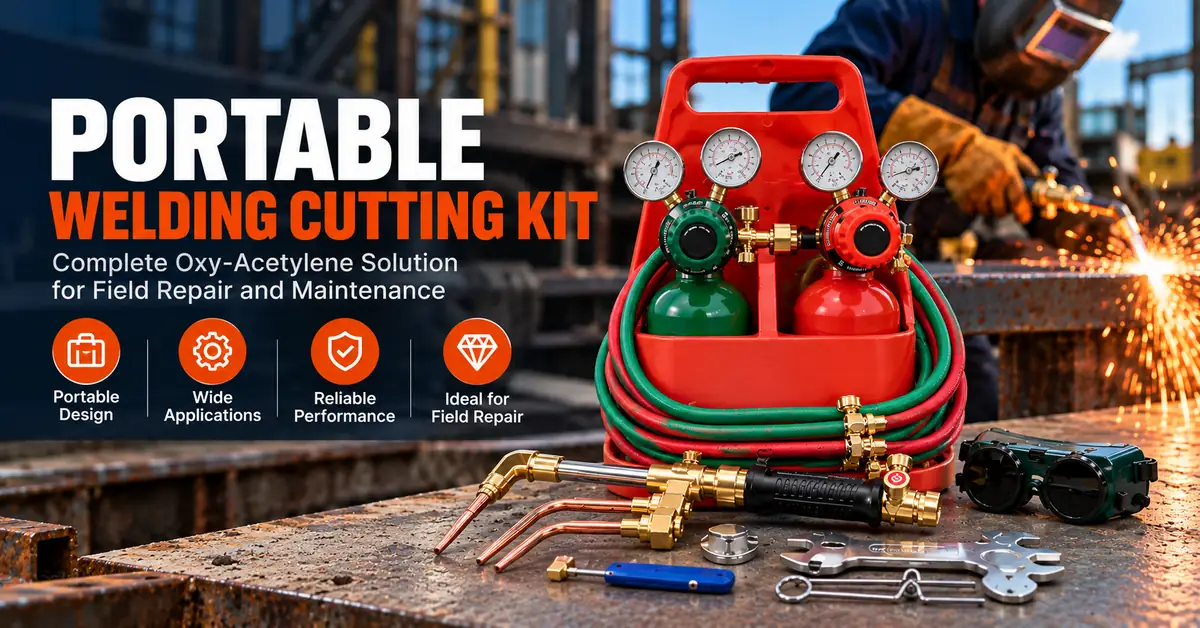
A portable welding cutting kit is a coordinated oxy-fuel equipment package designed for welding, suitable steel cutting, brazing, or heating tasks outside a permanent workstation.
A typical system includes a torch handle, compatible cutting attachment, welding tips, oxygen and fuel-gas regulators, twin hoses, ignition and maintenance accessories, and a carrying case or cylinder support system.
Some configurations also accommodate small gas cylinders.
However, portable does not necessarily mean that cylinders or gas are included. The exact contents must be verified against the product's current packing list.
Who Should Buy a Portable Welding Cutting Kit?
Portable systems are particularly useful for customers who need to move equipment between work locations.
| Customer Type | Typical Application | Main Purchasing Priority |
|---|---|---|
| Industrial maintenance teams | Equipment repair and component removal | Mobility and equipment compatibility |
| Construction contractors | On-site steel cutting and repair | Transportability and working capacity |
| Automotive repair workshops | Suitable metal repair and heating | Compact equipment organization |
| Agricultural equipment repair | Farm machinery maintenance | Field access and replacement parts |
| HVAC/R service businesses | Applicable brazing and heating tasks | Suitable tips, gas system, and portability |
| Welding equipment distributors | Retail and wholesale kit supply | Complete configurations and consistent supply |
| OEM welding tool brands | Private-label portable kits | Branding and configuration control |
These systems may be less suitable for continuous high-volume production, extensive heavy-plate cutting, or applications requiring very long operating periods without cylinder replacement.
What Makes a Welding Cutting Kit Truly Portable?
Two systems may both be advertised as portable while offering different practical advantages.
One may contain a compact carrying case and lightweight tools. Another may include cylinder supports, wheels, or a trolley-style frame.
The best solution depends on where the equipment will be moved and how frequently it will be used.
Carrying Case vs Cylinder Trolley
| Feature | Portable Carry Case | Cylinder Trolley System |
|---|---|---|
| Main advantage | Organized equipment transport | Easier movement of compatible cylinders and tools |
| Typical environment | Service vehicles, workshops, mobile repair | Industrial sites and larger maintenance facilities |
| Storage arrangement | Compact tool organization | Larger equipment support arrangement |
| Portability limitation | Loaded weight and cylinder capacity | Size, terrain, access, and transport requirements |
| Ideal buyer | Mobile service technician or repair contractor | Maintenance department or industrial contractor |
A carrying case may make tools easier to organize, but it does not eliminate compressed-gas transportation requirements.
A trolley may improve handling on suitable surfaces, but it may be inconvenient in confined locations or where stairs and uneven terrain are common.
Why Gas Capacity Matters
Cylinder capacity affects the amount of work possible between gas replacements.
Smaller cylinders may improve mobility, but their available gas supply can limit the duration or intensity of the operation.
A buyer should evaluate the normal work cycle rather than assume that a compact cylinder can support every cutting requirement.
For example, occasional repair cutting and extended steel fabrication involve different gas demands.
The correct decision requires considering oxygen consumption, fuel-gas withdrawal limits, nozzle requirements, and approved cylinder arrangements.
What Components Should Be Included in a Portable Welding Cutting Kit?
Before buying, request a detailed bill of materials rather than relying only on a product photograph.
A complete configuration should identify every major gas-control and working component.
Technical Component Checklist
| Component | Function | Key Details to Confirm |
|---|---|---|
| Torch handle | Controls welding and heating flames | Model, valve design, connections |
| Cutting attachment | Enables suitable steel cutting | Torch compatibility and configuration |
| Welding tips | Provide different flame and heat characteristics | Tip sizes and gas compatibility |
| Cutting nozzle | Controls preheating and cutting oxygen delivery | Fuel type, seat, size, rated cutting range |
| Oxygen regulator | Controls oxygen supply pressure | Inlet/outlet range, connections |
| Acetylene regulator | Controls acetylene supply | Approved gas service and pressure range |
| Twin hose | Delivers oxygen and fuel gas | Hose length, ratings, fittings |
| Flashback protection | Provides specified protective functions | Gas compatibility, mounting position |
| Carrying case | Protects and organizes components | Dimensions, construction, layout |
| Maintenance accessories | Support routine inspection and upkeep | Approved cleaner, wrench, documentation |
| Cylinder arrangement | Supports the intended gas supply | Cylinder dimensions, fittings, inclusion status |
Every component should be specified for the intended gas and application.
An equipment package should not be described as ready for use unless all necessary supplied and separately required items are clearly identified.
UWELD Portable Welding Cutting Kit: Product Options and Configurations
UWELD's product listings include the 1C016-0001 Oxy-ACE Portable Cutting and Welding Kit, along with portable welding and brazing configurations.
These products serve different application needs and should not automatically be treated as interchangeable.
Featured Product: UWELD 1C016-0001 Oxy-ACE Portable Cutting and Welding Kit
The UWELD 1C016-0001 Portable Cutting and Welding Kit is a relevant option for buyers seeking a compact oxy-acetylene cutting and welding package.
UWELD's published product information identifies this series as a portable arrangement intended for cutting, welding, and related repair work.
Older UWELD product documentation describes a carrying arrangement designed for small oxygen and acetylene cylinders, including reference sizes of 4 L oxygen and 2 L acetylene.
Those figures describe a published configuration and should not be interpreted as confirmation that cylinders are included in every current shipment.
Before purchasing, buyers should request confirmation of:
-
The current torch handle and cutting attachment.
-
Oxygen and acetylene regulator specifications.
-
Cutting and welding tip sizes.
-
Hose length and connection types.
-
Cylinder support dimensions and compatibility.
-
Whether cylinders and protective devices are included.
-
Current cutting and welding capacity ratings.
-
Product packing list and operating documentation.
For model-specific configurations and availability, contact UWELD for a technical quotation.
Portable Cutting vs Portable Brazing Systems
Not every portable oxy-fuel kit is designed for the same cutting operations.
A kit primarily intended for brazing may use different torches and tips from a configuration designed to cut steel.
UWELD Portable Equipment Comparison
| UWELD Model | Published Product Positioning | Buyer Considerations |
|---|---|---|
| 1C016-0001 | Oxy-ACE Portable Cutting and Welding Kit | Verify cutting attachment, tips, cylinder arrangement, and operating limits |
| 1C016-0109 | Oxy-ACE Portable Welding & Brazing Kit | Confirm whether cutting capability is required or available |
| 1C016-0002 | Portable Oxy-Acetylene Welding & Brazing Kit | Evaluate welding/brazing equipment configuration and cylinder compatibility |
| 1C016-0035 | Welding and Cutting Kit with additional equipment options | Compare completeness, transport arrangement, and required workload |
This comparison concerns product positioning, not a verified performance ranking.
The UWELD 1C016-0109 Portable Welding and Brazing Kit may be relevant for buyers whose primary tasks involve joining and heating rather than steel cutting.
Buyers should not assume that a welding/brazing kit includes a cutting attachment simply because it belongs to the same general product category.
More configurations can be reviewed in the UWELD product catalog.
How to Select a Portable Kit for Different Field Applications
Portable cutting equipment should be selected according to the actual job, not merely the product's advertised maximum capacity.
1. Construction and Structural Repair
Field contractors may need to cut carbon steel sections, remove damaged components, or prepare suitable repair work.
Important factors include worksite access, rated cutting thickness, torch arrangement, gas supply capacity, and equipment handling.
A compact kit may be useful for intermittent repairs, while repeated heavy cutting may require a larger system.
2. Agricultural Equipment Maintenance
Agricultural maintenance often takes place away from a fixed workshop.
Portable oxy-fuel equipment can support suitable metal repair, removal of damaged steel components, and controlled heating operations.
Buyers should consider transport durability, replacement tips, and availability of approved gas supplies.
3. Mobile Industrial Maintenance
Industrial service teams may travel between machines, facilities, or maintenance locations.
A portable kit should allow equipment to be organized, inspected, and maintained efficiently.
Clear identification of each component also makes it easier for technicians to recognize missing or damaged accessories.
4. HVAC and Refrigeration Service
HVAC applications often involve copper tube brazing and controlled heating rather than conventional steel cutting.
For these tasks, a portable welding and brazing configuration may be more suitable than a full steel-cutting outfit.
Buyers should verify gas compatibility, joining requirements, suitable brazing tips, and applicable workplace procedures.
5. Workshop and Vehicle Repair
Automotive and mechanical repair businesses may need flexible equipment for occasional steel cutting and heating.
However, precision sheet-metal fabrication, stainless steel work, and certain component repairs may require different technologies.
The equipment should be chosen according to the specific material and repair process.
How to Evaluate Gas Cylinder and Regulator Compatibility
Gas compatibility is one of the most important purchasing issues.
An oxy-acetylene cutting and welding system requires correctly specified oxygen and acetylene components.
Other fuel gases require different approved arrangements.
Connection Compatibility Checklist
| Specification | Why It Matters |
|---|---|
| Oxygen cylinder valve connection | Must match the approved oxygen regulator |
| Acetylene cylinder connection | Must match the correct fuel-gas regulator |
| Regulator inlet pressure rating | Must suit the gas supply |
| Regulator outlet adjustment range | Must meet equipment requirements |
| Torch and hose connections | Must match the approved assembly |
| Cutting and welding tips | Must suit the intended fuel and application |
| Flashback protection | Must be rated for the gas and installation |
| Destination-market standards | Determine local product and equipment requirements |
Some UWELD portable oxy-acetylene configurations have been documented with CGA540 oxygen and CGA200 acetylene cylinder connections.
However, these connection formats are not universal worldwide.
Importers serving different countries should confirm the exact regional connection standard before ordering.
Does a Portable Kit Include Oxygen and Acetylene Cylinders?
The answer depends on the specific SKU.
Some products are designed to carry cylinders; others may ship as tool-only kits.
The product photograph, cylinder specifications, and packing list do not necessarily establish whether filled cylinders are supplied.
For B2B procurement, request written confirmation of cylinder inclusion, whether any supplied cylinders are empty, and who is responsible for gas filling and transportation compliance.
Compressed-gas shipping should always be evaluated according to the destination country and chosen transportation method.
Safety Requirements for Portable Oxy-Fuel Equipment
Portability does not reduce the hazards associated with oxygen and fuel gases.
Compressed cylinders, flammable gases, flashback, hot metal, and sparks require appropriate controls regardless of whether equipment is used in a workshop or at a field location.
Operators should be trained and follow the exact manufacturer's instructions.
Field Equipment Safety Assessment
Before work begins, qualified personnel should confirm that:
-
Gas cylinders are properly identified, secured, and suitable for the intended use.
-
Regulators, hoses, valves, and connections are approved and undamaged.
-
Oxygen equipment is free from oil, grease, and incompatible contamination.
-
Appropriate backflow and flashback protection is installed where required.
-
The worksite has suitable ventilation and fire prevention arrangements.
-
The operator has the correct protective equipment.
-
Gas hoses are protected from physical damage and hot material.
-
The system can be isolated, inspected, and transported in accordance with approved procedures.
For U.S. applications, OSHA 29 CFR 1910.253 provides requirements relating to oxygen-fuel welding and cutting equipment, gas cylinders, regulators, hoses, and operating practices.
Requirements differ by market and work environment.
Check Valves vs Flashback Arrestors
These devices should not be treated as identical.
A check valve is designed to restrict reverse gas flow under its specified conditions. A flashback arrestor is designed to stop flame propagation under its rated conditions.
Certain assemblies provide multiple protective functions.
Buyers should request documentation identifying the actual devices supplied and their intended installation positions.
The presence of a check valve does not automatically demonstrate that the complete system meets every flashback-protection requirement.
Materials, Manufacturing Quality, and Service Life
For wholesalers and OEM customers, the quality of a portable kit depends on more than its carrying case.
The torch body, valves, regulators, tips, hoses, and connections must all be suitable for their intended operating conditions.
Component Quality Evaluation
| Component Area | Important Purchasing Checks |
|---|---|
| Torch head and body | Construction, material specification, machining quality |
| Needle valves | Operation, sealing performance, assembly consistency |
| Regulator bodies | Material, rated performance, gas compatibility |
| Pressure gauges | Legibility, specified range, physical protection |
| Cutting and welding tips | Dimensions, gas compatibility, replacement availability |
| Hoses | Gas rating, flexibility, construction, fittings |
| Carrying case | Fasteners, internal supports, handling durability |
| Product identification | Model traceability, labels, component documentation |
UWELD provides industrial welding and cutting equipment and describes manufacturing and quality-management capabilities through its Solutions page.
For purchase approval, request inspection records and technical documentation relevant to the exact kit components.
Certification Verification
Different components may be subject to different standards.
EN ISO 5172 addresses relevant gas welding equipment blowpipes, while EN ISO 2503 concerns applicable pressure regulators and associated equipment.
A manufacturer's ISO 9001 quality management certification does not mean every portable kit has an individual product certification.
Importers should verify the documentation, configuration, standard edition, and market requirements applicable to each SKU.
How to Compare Portable Kit Costs and Long-Term Value
The lowest initial kit price does not always represent the lowest total purchasing cost.
For industrial distributors, the complete landed cost and future support requirements matter.
| Cost Factor | Procurement Question |
|---|---|
| Included accessories | Are all necessary items accounted for? |
| Regulators and connections | Will the kit match the local gas supply? |
| Cylinder arrangement | Are cylinders included or purchased separately? |
| Replacement tips | Are compatible consumables readily available? |
| Safety components | Are the specified protective devices included? |
| Packaging | Will the kit tolerate normal handling and distribution? |
| Spare parts | Can maintenance components be reordered? |
| Shipping | What transportation restrictions or costs apply? |
| OEM branding | Are customization and packaging charges required? |
| Quality verification | What testing and inspection documents are available? |
A supplier quotation should clearly distinguish standard inclusions from optional components.
This helps buyers compare like-for-like offers rather than incorrectly assuming that every portable kit contains the same equipment.
OEM/ODM Portable Welding Cutting Kit Solutions
International welding equipment brands and distributors often need portable kits configured for their own customers.
Relevant customization requirements may include product labels, packaging, accessory combinations, market-specific connections, and branded documentation.
UWELD supports OEM/ODM cooperation for welding and cutting equipment, subject to technical feasibility and individual project requirements.
Recommended OEM Development Process
Requirement review: Define target applications, user groups, fuel gas, regional connections, and required accessories.
Technical confirmation: Establish the approved torch, regulator, tip, hose, and cylinder arrangement.
Sample evaluation: Review fit, workmanship, packaging, labeling, and intended use.
Specification approval: Confirm the final bill of materials, quality requirements, and model identification.
Production and delivery: Agree on quantity, lead time, inspection, packaging, and shipping arrangements.
These are recommended purchasing stages rather than a guaranteed fixed lead-time program.
For a customized solution, buyers can review UWELD's OEM and industrial solutions.
What Should Buyers Include in a Wholesale RFQ?
A clear request for quotation helps prevent technical misunderstandings and unnecessary revisions.
| RFQ Item | Details to Provide |
|---|---|
| Product type | Portable welding cutting kit |
| Preferred model | 1C016-0001 or another identified configuration |
| Intended application | Field repair, maintenance, fabrication, HVAC |
| Gas type | Oxygen-acetylene or another approved system |
| Cutting requirement | Material and required thickness |
| Welding/brazing requirement | Material, joint type, intended process |
| Cylinder requirements | Size, compatibility, included/excluded |
| Regulator connections | Destination-market standards |
| Accessories | Cutting tips, welding tips, hose, protective devices |
| Carrying arrangement | Case, trolley, or custom configuration |
| Branding | UWELD or private label |
| Order quantity | Sample order and estimated bulk quantity |
| Destination | Country and delivery requirements |
| Documentation | Specifications, packing list, applicable test documents |
UWELD states that MOQ varies by product and customization, while lead times depend on stock availability and project requirements.
For an accurate quotation, provide your expected order volume and target market rather than relying on a general published lead-time estimate.
Ready to evaluate a portable welding and cutting equipment range? Contact UWELD to request current product specifications, packing lists, OEM options, and wholesale pricing.
Frequently Asked Questions About Portable Welding Cutting Kits
1. What is a portable welding cutting kit used for?
A portable welding cutting kit supports suitable gas welding, oxy-fuel cutting, and related heating tasks outside fixed workstations. Typical applications include field maintenance, equipment repair, construction, and mobile fabrication.
2. Does a portable oxygen-acetylene kit require electricity?
Conventional oxy-acetylene welding and cutting use compressed gases rather than an electrical welding power source. However, the worksite still requires approved gas supplies, properly specified equipment, and suitable safety controls.
3. Are gas cylinders included in every portable kit?
No. Inclusion varies by product and configuration. Buyers should request a written packing list and verify whether cylinders are included, supplied empty, or purchased separately.
4. How thick can a portable welding cutting kit cut?
Cutting capacity depends on the selected torch, cutting attachment, nozzle, gas supply, and steel grade. Portable equipment has no universal thickness rating; use current model-specific specifications.
5. Can portable oxy-fuel equipment cut stainless steel or aluminum?
Conventional oxy-fuel cutting is generally suited to carbon steel and certain low-alloy steels. Stainless steel and aluminum usually require alternative cutting technologies.
6. What is the difference between a portable cutting kit and a portable brazing kit?
A cutting kit includes equipment intended for oxy-fuel cutting. A brazing-focused kit may be configured for joining and heating without the components required for steel cutting. Always verify the included torch attachments and tips.
7. What should importers check before purchasing portable kits wholesale?
Important factors include component compatibility, cylinder arrangements, gas connections, technical specifications, accessory completeness, applicable standards, packaging, and spare parts availability.
8. Can UWELD provide private-label portable welding kits?
UWELD supports OEM/ODM inquiries involving branding, packaging, and feasible specification changes. Buyers should confirm the available options, MOQ, sample requirements, and quotation conditions.
9. How can distributors reduce after-sales problems?
Distributors should approve a complete bill of materials, verify product identification, test samples, obtain instructions, and establish a supply plan for compatible consumables and replacement components.
10. How do I request a portable welding cutting kit quotation from UWELD?
Submit the intended application, preferred model, fuel gas, required cylinder and regulator connections, accessory list, target market, quantity, and branding requirements through the UWELD contact page.
Conclusion
Selecting the right portable welding cutting kit requires balancing mobility, application capability, gas compatibility, component quality, and safe transportation.
For mobile repair contractors and maintenance teams, a well-matched system can make appropriate welding and cutting equipment easier to organize and move between work locations. For distributors and OEM buyers, the purchasing decision also involves product consistency, accessory completeness, regional connections, documentation, and long-term supply support.
UWELD provides portable oxy-fuel equipment and related welding and cutting products for professional applications, including options for international wholesale and customization.
To identify a suitable configuration for your market, explore UWELD's welding and cutting products or contact UWELD for a technical quotation with your operating requirements, preferred accessories, and expected order quantity.