

Quick Answer: The UWELD 3S011-0004 leather welding hood is a flexible protective welding accessory featuring a heat-resistant cowhide exterior, a solar-powered auto-darkening flip lens, a breathable mesh interior, and an adjustable rear closure. Its extended design covers areas around the head, face, and neck. Industrial buyers should evaluate the actual filter specifications, protective capabilities, fit, material construction, and quality documentation before selecting it for professional welding applications.
Welding environments vary considerably in terms of working positions, available space, radiant heat, sparks, and exposure to hot metal particles.
While conventional rigid-shell welding helmets are widely used in industrial workshops, some applications may benefit from a different head-covering arrangement that extends around the sides and back of the head and neck.
For metal fabrication companies, industrial maintenance contractors, welding equipment distributors, and personal protective equipment importers, selecting the appropriate welding hood requires consideration of both optical protection and physical coverage.
A leather welding hood offers a flexible alternative worth evaluating where conventional helmet geometry does not fully address the user's coverage and fit requirements.
The UWELD 3S011-0004 Leather Welding Helmet Mask combines flexible cowhide construction with an integrated flip-up auto-darkening filter.
This guide examines its construction, lens arrangement, industrial applications, fitting requirements, quality inspection, and wholesale purchasing considerations.
Key Takeaways
-
Cowhide exterior: The manufacturer identifies flexible, heat-resistant cowhide as the outer material.
-
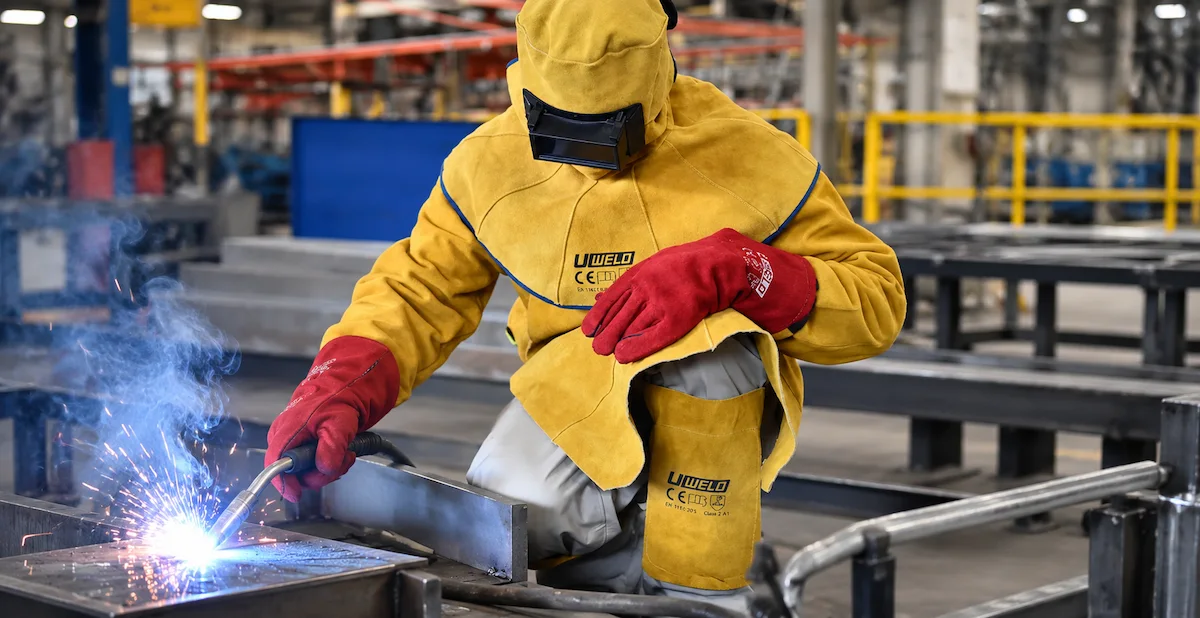
Extended coverage: The hood incorporates a leather covering extending around the head and neck.
-
Flip-up lens: The hinged lens assembly provides a different viewing arrangement from a conventional fixed-front helmet.
-
Automatic darkening: A solar-powered auto-darkening filter is listed in the product description.
-
Breathable interior: The mesh lining is intended to support wearing comfort.
-
Adjustable fit: The rear hook-and-loop closure accommodates different head sizes within the published fitting reference.
-
Wholesale opportunities: The product is relevant to industrial welding accessory distributors, protective equipment suppliers, and OEM purchasing programs.
What Is the UWELD 3S011-0004 Leather Welding Hood?
The UWELD 3S011-0004 is a soft-shell welding hood incorporating a leather outer layer and an integrated welding filter assembly.
Its construction differs from conventional rigid-shell helmets because flexible leather forms much of the head and neck covering.
The product combines a flip-up viewing assembly, breathable interior, and adjustable rear fastening system.
UWELD 3S011-0004 Technical Specifications
| Specification | Manufacturer-Published Information |
|---|---|
| Brand | UWELD |
| Product model | 3S011-0004 |
| Product type | Leather welding helmet mask |
| Outer material | Heat-resistant cowhide |
| Outer construction | Flexible leather |
| Interior material | Breathable mesh |
| Lens design | Flip-up lens assembly |
| Filter type | Auto-darkening filter |
| Power arrangement | Solar-powered |
| Rear closure | Adjustable hook-and-loop fastening |
| Published circumference reference | Up to 26 inches, approximately 66 cm |
| Coverage design | Head, face and extended neck covering |
| Product color | Yellow-brown leather |
| Commercial services | Wholesale and OEM inquiries |
Source: UWELD 3S011-0004 product page and accompanying manufacturer product literature.
The available product specifications do not establish the exact filter shade range, switching speed, optical class, minimum TIG detection current, leather thickness, or independently verified heat-resistance rating.
These characteristics should be evaluated separately when required for a specific purchasing application.
Who Should Consider This Product?
Potential buyers include welding equipment distributors, industrial protective clothing suppliers, metal fabrication workshops, equipment maintenance contractors, professional welding tool retailers, and private-label brands.
The product should only be selected for applications within its documented protective capabilities.
Why Is Cowhide Used in Welding Protective Equipment?
Cowhide is commonly used in industrial protective clothing because suitable leather constructions can offer flexibility, mechanical durability, and thermal shielding.
UWELD identifies heat-resistant cowhide as the exterior material for the 3S011-0004.
The flexible construction allows the hood to extend around different parts of the head and neck.
Cowhide Construction and Purchasing Considerations
| Material Characteristic | Potential Value | Buyer Verification |
|---|---|---|
| Flexible construction | Conforms around the wearer | Fit and material consistency |
| Thermal shielding | Helps limit exposure to certain thermal hazards | Relevant protective test documentation |
| Surface durability | Supports normal industrial handling | Physical condition and material quality |
| Extended leather panels | Provides additional physical coverage | Coverage when worn |
| Sewn construction | Joins the different protective panels | Seam integrity and workmanship |
Is Heat-Resistant Leather the Same as Fireproof Leather?
No.
Heat resistance describes a material's ability to withstand particular thermal conditions. It does not mean unlimited resistance to flames, molten metal, or extreme temperatures.
The protective performance of leather depends on its thickness, treatment, construction, stitching, and applicable testing.
The 3S011-0004 should therefore not be marketed as completely fireproof or suitable for unrestricted thermal exposure without supporting evidence.
How Does the Extended Head and Neck Design Help Welders?
Conventional welding helmets primarily provide coverage through a rigid shell and filter assembly.
A flexible leather hood uses additional material around the sides, back, and lower areas of the head.
The UWELD 3S011-0004 incorporates an extended leather panel that reaches toward the neck and upper shoulder area.
Head and Neck Coverage Considerations
| Coverage Area | Design Consideration |
|---|---|
| Front of the face | Integrated viewing assembly and leather covering |
| Top of the head | Flexible cowhide hood |
| Sides of the head | Extended leather construction |
| Back of the head | Adjustable rear closure and leather covering |
| Neck | Extended lower leather panel |
| Upper shoulder area | Coverage depends on fit and clothing arrangement |
For industrial buyers, actual coverage should be assessed with the product properly fitted and worn alongside the other required protective equipment.
The presence of extended leather panels does not independently establish a certified protection level.
Why Does Neck Coverage Matter?
Welding can expose areas beyond the operator's direct line of sight to radiant energy, sparks, and hot particles.
For U.S. workplaces, OSHA's welding and cutting requirements address protection of the face, neck, and ears against direct radiation from the welding arc.
This makes coverage an important factor in protective equipment selection.
However, a leather hood does not replace suitable welding jackets, gloves, respiratory protection, or other required PPE.
How Does the Flip-Up Auto-Darkening Lens Work?
The flip-up lens assembly is a distinguishing feature of the UWELD 3S011-0004.
Unlike a conventional fixed-front viewing assembly, a hinged design incorporates a lens section that can be raised or lowered.
The manufacturer's product description also identifies an auto-darkening filter powered by solar energy.
Flip-Lens Component Evaluation
| Component | Primary Function | Purchasing Consideration |
|---|---|---|
| Auto-darkening filter | Changes visible-light transmission in response to detected arc conditions | Documented shade and switching performance |
| Hinged lens assembly | Allows movement of the viewing section | Mechanical integrity |
| Inner viewing assembly | Forms part of the optical arrangement | Approved protection and visibility |
| Lens frame | Holds the filter assembly | Secure fit and construction |
| Solar component | Supports electronic filter operation | Power-system requirements |
The exact relationship between the inner lens and hinged filter should be established from the supplied product instructions.
What Is the Advantage of a Flip-Up Lens?
A hinged viewing arrangement may provide additional flexibility during approved non-welding inspection tasks.
For example, operators may need to observe a completed workpiece after the arc has stopped and the surrounding conditions are safe.
The flip-up design can provide an alternative viewing arrangement without necessarily removing the entire hood.
However, the lens must remain in its manufacturer-approved protective position during active welding.
A raised filter must never be assumed to provide sufficient protection against welding radiation.
Does Solar Power Eliminate Maintenance Requirements?
No.
The product description identifies solar-powered automatic darkening, but it does not establish the complete internal power arrangement or expected operating life.
Buyers should obtain the applicable filter instructions and maintenance requirements.
The automatic darkening function must be checked using the manufacturer's approved method before welding.
Why Are Filter Shade and Optical Documentation Important?
The leather covering and electronic welding filter serve different protective functions.
Leather construction provides physical coverage, while the filter controls exposure to relevant optical radiation according to its design and approved performance.
A leather exterior cannot compensate for an unsuitable welding filter.
Welding Filter Purchasing Requirements
| Technical Parameter | Why Buyers Should Check It |
|---|---|
| Dark-state shade | Must match the intended welding process |
| Light-state shade | Influences observation before and after welding |
| Switching speed | Describes filter transition performance |
| Arc detection | Determines suitability for specified arc conditions |
| Optical classification | Supports evaluation of viewing quality |
| UV/IR filtration | Relevant to radiation protection |
| Filter mounting | Establishes compatibility with the hood |
| Power system | Supports electronic operation |
The current product information does not provide complete numerical specifications for these items.
For this reason, buyers should avoid assuming that the 3S011-0004 uses the same filter as another UWELD helmet.
OSHA's eye and face protection standard provides process-specific filter shade requirements for U.S. workplaces.
These requirements illustrate why filter selection must account for the welding process and operating conditions rather than product appearance alone.
How Does the Adjustable Rear Closure Improve Fit?
UWELD's product illustration identifies a rear hook-and-loop fastening arrangement and a circumference reference of up to 26 inches.
This design allows the user to adjust the hood according to its intended fitting range.
Why Is Fit Important?
A protective hood must remain correctly positioned during the intended work.
An unsuitable fit may affect lens alignment, visibility, coverage, and operator comfort.
For workshops employing several welders, fitting requirements should be considered before purchasing equipment in bulk.
Recommended Fit Evaluation
| Fit Requirement | What Buyers Should Evaluate |
|---|---|
| Head circumference | Match the published fitting reference |
| Rear closure | Secure adjustment and fastening condition |
| Lens position | Appropriate alignment with the eyes |
| Neck covering | Adequate coverage for the intended work |
| Movement | Hood remains correctly positioned |
| Other PPE | Compatibility with required eye and respiratory protection |
The published maximum circumference does not establish universal suitability for every wearer.
Representative fitting evaluations are recommended before large-scale deployment.
What Is the Purpose of the Breathable Mesh Interior?
The UWELD 3S011-0004 incorporates a breathable mesh interior according to the product description.
This internal construction is intended to support wearing comfort and provide a different contact surface from the outer leather.
Exterior and Interior Construction
| Product Layer | Main Role |
|---|---|
| Cowhide exterior | Physical covering and thermal shielding design |
| Mesh interior | Intended to support breathability and wearing comfort |
| Lens assembly | Optical viewing and filtration |
| Rear closure | Fit adjustment |
| Extended leather panel | Additional head and neck coverage |
Comfort depends on several factors, including ambient temperature, humidity, physical workload, fit, and other protective clothing.
A breathable lining does not guarantee that the wearer will avoid heat stress during prolonged welding.
Appropriate ventilation and workplace heat-management practices remain necessary.
Leather Welding Hood vs Hard-Shell Welding Helmet
Flexible leather hoods and rigid-shell auto-darkening helmets provide different construction arrangements.
The correct choice depends on the actual workplace hazards, required optical protection, mechanical protection, working position, and fitting requirements.
Welding Helmet Design Comparison
| Selection Factor | Leather Welding Hood | Conventional Hard-Shell Helmet |
|---|---|---|
| Exterior construction | Flexible leather | Rigid shell |
| Head and neck covering | Extended panels on applicable designs | Depends on shell and accessories |
| Viewing arrangement | Flip-up lens on the 3S011-0004 | Fixed-front or other filter configurations |
| Fit adjustment | Rear fastening system | Typically adjustable headgear |
| Mechanical protection | Requires model-specific evidence | Requires model-specific evidence |
| Main purchasing focus | Coverage, fit and filter suitability | Shell, headgear and optical specifications |
A leather welding hood should not automatically be considered superior to a rigid-shell helmet.
Neither design should be used outside its documented protective capabilities.
UWELD Welding Helmet Model Comparison
| UWELD Model | Published Product Features | Main Selection Focus |
|---|---|---|
| 3S011-0004 | Cowhide construction, flip-up auto-darkening lens, adjustable rear closure | Flexible coverage and fitting requirements |
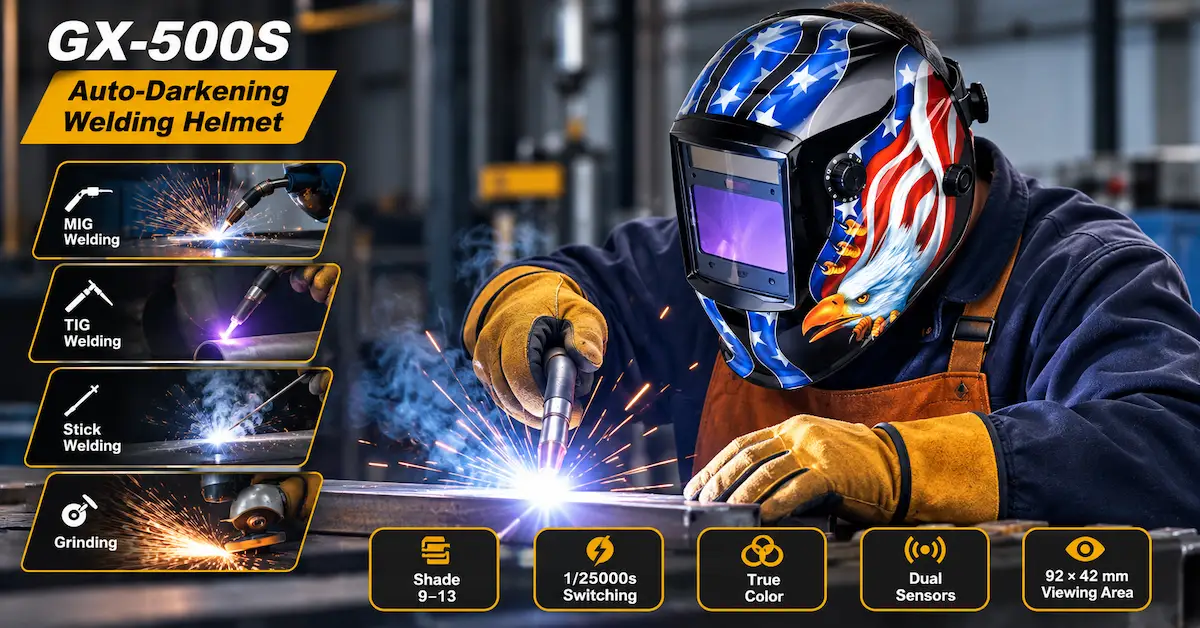
| GX-500S / 3S003-0005 | Shade 9–13, True Color, American Eagle shell graphics | Optical characteristics and graphic design |
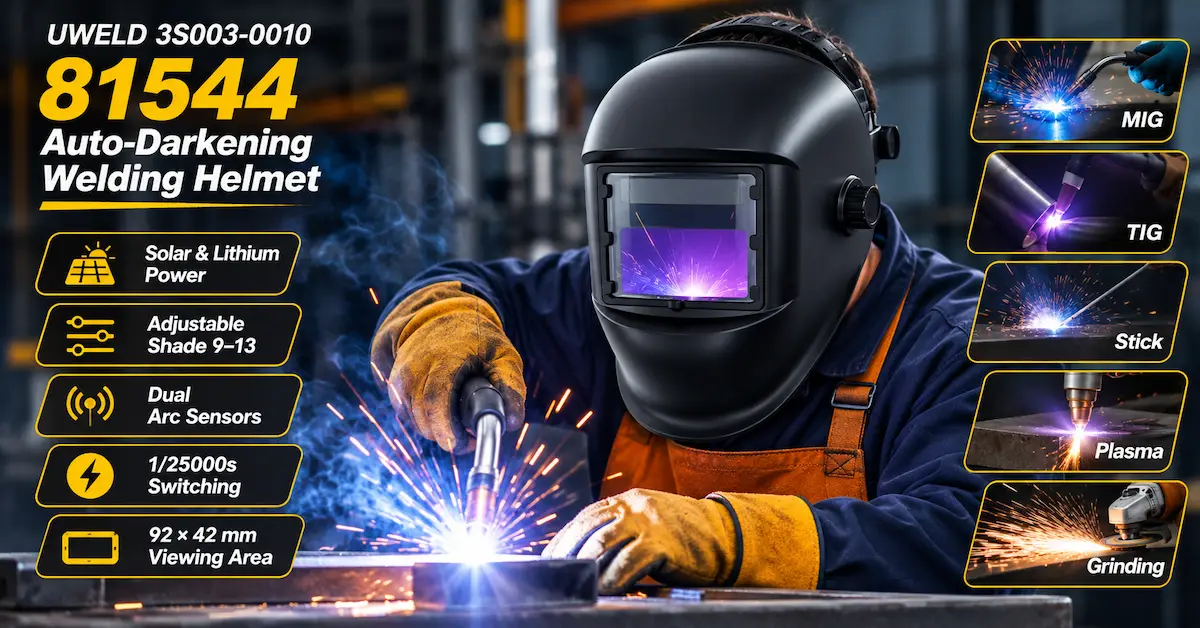
| 81544 / 3S003-0010 | Shade 9–13, solar/lithium power, plain black shell | Conventional helmet configuration and fleet procurement |
For buyers requiring a conventional graphic-patterned helmet, the UWELD GX-500S Auto-Darkening Welding Helmet provides another product reference.
For standardized black helmet procurement, buyers can evaluate the UWELD 3S003-0010 Auto-Darkening Welding Helmet.
The published filter specifications for those models should not be transferred to the 3S011-0004.
Where Can a Leather Welding Hood Be Considered?
The UWELD 3S011-0004 is positioned for professional welding and workshop applications.
Its flexible construction and extended covering may be relevant to buyers evaluating alternative welding protective equipment.
Industrial Application Matrix
| Application | Main Requirement | Purchasing Consideration |
|---|---|---|
| Metal fabrication | Suitable eye, face and neck protection | Coverage and filter specifications |
| Industrial pipe welding | Appropriate equipment fit in different working positions | Visibility and approved protection |
| Steel structure fabrication | Protection against applicable welding hazards | Leather construction and lens suitability |
| Equipment maintenance | Adaptability to different work environments | Fit and complete PPE compatibility |
| Shipyard fabrication | Process-specific protective equipment | Workplace hazard assessment |
| Welding equipment distribution | Additional protective product options | Documentation and batch consistency |
Metal Fabrication Workshops
Fabrication workshops may require several protective equipment configurations depending on the processes performed.
The UWELD leather hood provides a different construction option for buyers evaluating extended head and neck coverage.
Industrial Pipe Welding
Pipe welding can involve changing working positions and variable access around joints.
Equipment should be selected according to the approved welding procedure, operator movement, visibility requirements, and relevant hazards.
A flexible hood may be evaluated where its documented protective characteristics meet those requirements.
Industrial Maintenance
Maintenance personnel may encounter welding tasks in varied industrial environments.
The protective equipment selection should account for nearby structures, hot surfaces, sparks, electrical hazards, and other workplace conditions.
When Is This Product Not Suitable?
The 3S011-0004 should not be treated as a certified hard hat, respiratory protective device, electrical arc-flash suit, or unrestricted fire-resistant enclosure.
Additional protective equipment may be necessary for specific environments.
Restricted-access or confined-space welding requires separate hazard assessment and appropriate controls, regardless of the hood's flexible design.
What Manufacturing and Quality Checks Matter for Leather Welding Hoods?
Industrial buyers should assess both the textile or leather construction and the integrated filter assembly.
A visually acceptable hood does not independently demonstrate optical or thermal protective performance.
Recommended Wholesale Quality Inspection Checklist
| Inspection Item | Buyer Acceptance Requirement |
|---|---|
| Product identification | Correct UWELD 3S011-0004 model |
| Cowhide material | Matches the approved material specification |
| Leather thickness | Meets agreed requirements |
| Surface condition | No unacceptable damage or defects |
| Stitching | Consistent workmanship and intact seams |
| Extended covering | Matches the approved sample |
| Mesh interior | Correct assembly and condition |
| Rear fastening | Secure operation |
| Fit dimensions | Matches the agreed fitting reference |
| Lens hinge | Correct movement and secure positioning |
| Filter assembly | Approved optical configuration |
| Automatic darkening | Appropriate functional verification |
| Product markings | Match applicable documentation |
| Packaging | Correct identification and physical protection |
These are recommended procurement inspection requirements rather than independently verified factory testing procedures.
Why Are Stitching and Seam Quality Important?
The leather panels must remain appropriately joined during normal handling and approved use.
Damaged seams or inconsistent panel assembly may affect the physical coverage provided by the hood.
Buyers should establish acceptable construction requirements during sample approval.
Why Should the Lens Hinge Be Inspected?
The hinged assembly forms part of the product's protective viewing arrangement.
Its movement, fit, and secure positioning should be evaluated according to the approved design.
A loose or damaged assembly should not be accepted for use until properly assessed.
What Documentation Should Buyers Request?
Depending on the destination market and application, relevant purchasing documents may include material specifications, filter test reports, protective equipment conformity documents, user instructions, and product traceability information.
A certification or test report for a different UWELD welding garment or helmet should not automatically be applied to the 3S011-0004.
What Affects the Wholesale Price of Leather Welding Hoods?
The cost of a leather welding hood depends on the material construction, filter configuration, lining, fastening components, manufacturing requirements, packaging, and purchasing volume.
For industrial distributors, the complete sourcing cost is more useful than the unit price alone.
Total Sourcing Cost
Total Sourcing Cost = Product Cost + Inspection + Documentation + Packaging + Freight + Replacement Parts + Expected After-Sales Costs
| Cost Factor | Purchasing Consideration |
|---|---|
| Cowhide construction | Approved material quality and thickness |
| Leather panel design | Coverage and construction requirements |
| Stitching | Assembly quality |
| Mesh lining | Interior construction |
| Auto-darkening filter | Optical and electronic specifications |
| Flip-up mechanism | Approved hinge and frame components |
| Rear fastening | Adjustment and assembly quality |
| Documentation | Destination-market requirements |
| OEM packaging | Branding and identification |
| Order quantity | MOQ and quotation |
| Freight | Shipment size and destination |
Why Should Distributors Compare Equivalent Configurations?
Two visually similar leather hoods may use different materials, filters, lens assemblies, and fastening systems.
Comparing their prices without evaluating these differences can lead to unsuitable purchasing decisions.
A meaningful quotation comparison should use the same technical requirements and agreed protective equipment specifications.
OEM and Wholesale Leather Welding Helmet Supply
UWELD offers wholesale and OEM inquiries for welding equipment and related industrial protective products.
The 3S011-0004 may be considered by welding equipment importers, distributors, professional tool suppliers, and private-label brands seeking to expand their protective equipment assortment.
Recommended OEM Purchasing Workflow
| Stage | Main Requirement |
|---|---|
| Market assessment | Identify customers and intended welding applications |
| Product selection | Confirm model 3S011-0004 |
| Technical review | Evaluate materials, fit and filter specifications |
| Documentation review | Establish applicable protective requirements |
| Sample approval | Inspect construction, assembly and fit |
| Branding approval | Confirm permitted artwork and packaging |
| Quality planning | Define inspection and acceptance criteria |
| Bulk purchasing | Agree on quantity, pricing and delivery |
| Repeat orders | Maintain approved specifications |
Potential customization may include branding, labels, packaging, and other technically feasible requirements.
Changes affecting the protective construction or filter system require appropriate technical review.
Buyers can discuss broader manufacturing cooperation through UWELD OEM Solutions.
MOQ, Samples and Lead Times
Minimum order quantities, sample arrangements, production schedules, and delivery terms depend on the approved product configuration and customization scope.
Industrial buyers should request commercial terms for the specific model rather than assume identical conditions across all UWELD protective equipment products.
What Should Buyers Include in a Leather Welding Hood RFQ?
A complete request for quotation helps the supplier understand the intended application and provide relevant product information.
Recommended RFQ Checklist
| RFQ Field | Information to Provide |
|---|---|
| Product | Leather welding hood |
| Model | UWELD 3S011-0004 |
| Intended application | Welding process and working environment |
| Material requirements | Approved cowhide specification |
| Coverage | Head, face and neck requirements |
| Fit | Required circumference and wearer sizes |
| Filter requirements | Shade, optical performance and switching specifications |
| Protective documentation | Applicable market and application requirements |
| Branding | UWELD or requested private-label arrangement |
| Packaging | Standard or customized packaging |
| Sample quantity | Required evaluation units |
| Bulk quantity | Initial and projected repeat orders |
| Destination market | Country or region |
| Delivery | Requested schedule and commercial terms |
Looking for leather welding hoods for industrial distribution? Contact UWELD to request 3S011-0004 product specifications, filter information, samples, available quality documentation, OEM packaging options, and wholesale pricing.
Frequently Asked Questions
1. What is a leather welding hood?
A leather welding hood is a welding head-covering design that uses flexible leather around the head and face. Models such as the UWELD 3S011-0004 incorporate an extended neck covering and an integrated welding filter assembly.
2. What material is used in the UWELD 3S011-0004?
UWELD identifies heat-resistant cowhide as the outer material and a breathable mesh arrangement as the interior construction.
3. Does the 3S011-0004 have an auto-darkening filter?
Yes. The official product description identifies a solar-powered auto-darkening flip lens. Detailed filter ratings should be obtained for the intended application.
4. What is the purpose of the flip-up lens?
The hinged lens provides an alternative viewing arrangement for appropriate non-welding tasks. It must remain in its approved protective position during active welding.
5. Does the hood provide neck coverage?
The product incorporates an extended leather panel around the neck area. Actual coverage and protective suitability depend on fit, construction, and the complete PPE arrangement.
6. What head circumference does the product accommodate?
UWELD's product illustration lists a circumference reference of up to 26 inches, approximately 66 cm, with an adjustable rear closure.
7. Is the leather hood completely fireproof?
No such performance is established by the available product information. The manufacturer describes the cowhide as heat-resistant, but actual protection depends on its construction, testing, and approved conditions of use.
8. Can the 3S011-0004 be used for TIG and MIG welding?
Suitability depends on whether the supplied filter and hood meet the requirements of the intended welding process. The available information does not establish every process-specific rating.
9. What should distributors inspect before purchasing in bulk?
Buyers should evaluate the cowhide construction, seams, internal lining, rear closure, lens hinge, filter performance documentation, fitting dimensions, packaging, and batch consistency.
10. Does UWELD offer wholesale and OEM welding hood orders?
UWELD supports wholesale and OEM inquiries. Buyers can discuss samples, product specifications, branding, packaging, quantities, and delivery requirements directly with the company.
Conclusion
Choosing the right leather welding hood requires careful consideration of material construction, head and neck coverage, optical filter performance, fitting requirements, and the intended welding environment.
The UWELD 3S011-0004 combines a heat-resistant cowhide exterior, solar-powered auto-darkening flip lens, breathable mesh interior, and adjustable rear closure.
Its flexible design provides an alternative product configuration for professional buyers evaluating welding protective equipment beyond conventional rigid-shell helmets.
For fabrication workshops and maintenance contractors, the most important considerations are appropriate coverage, secure fit, documented filter performance, and compatibility with the complete protective equipment arrangement.
For industrial distributors and OEM brands, sample approval, material consistency, quality documentation, packaging, and controlled repeat-order specifications are equally important.
UWELD supplies welding helmets, welding torches, industrial safety accessories, and related welding equipment for international professional markets.
Explore the UWELD 3S011-0004 Leather Welding Helmet Mask, browse UWELD Safety Products, or contact UWELD to discuss technical requirements, product samples, OEM customization, and wholesale purchasing opportunities.