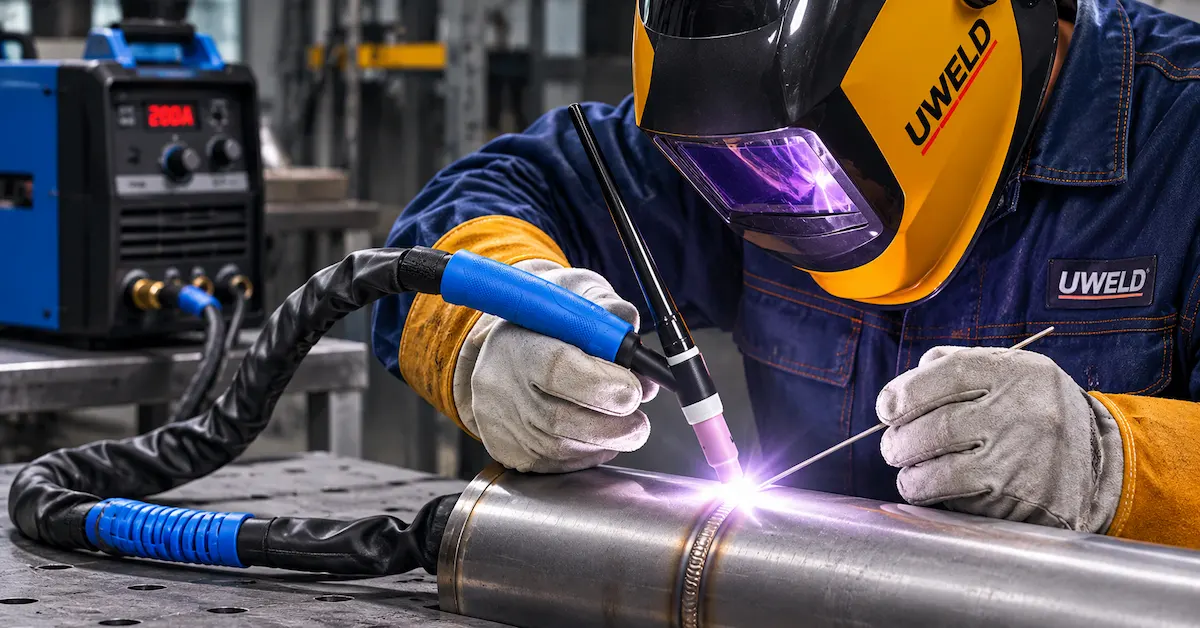


Quick Answer: The UWELD GX-500S auto-darkening welding helmet, model 3S003-0005, features adjustable shade 9–13, True Color viewing technology, two arc sensors, and a published switching speed of 1/25000 second. Its 92 × 42 mm viewing area, adjustable sensitivity, and adjustable delay make it a candidate for compatible industrial welding applications. Buyers should evaluate optical performance, application suitability, protective equipment requirements, and model-specific quality documentation before purchasing.
Choosing a welding helmet involves more than comparing its appearance, switching speed, or advertised shade range.
For metal fabrication companies, industrial equipment distributors, professional welders, and private-label brands, the correct helmet must match the intended welding process, operating environment, visibility requirements, and applicable safety requirements.
An unsuitable helmet may create visibility problems, uncomfortable working conditions, or incorrect protection expectations.
For wholesale distributors, these issues can also lead to product returns, customer complaints, and unnecessary after-sales costs.
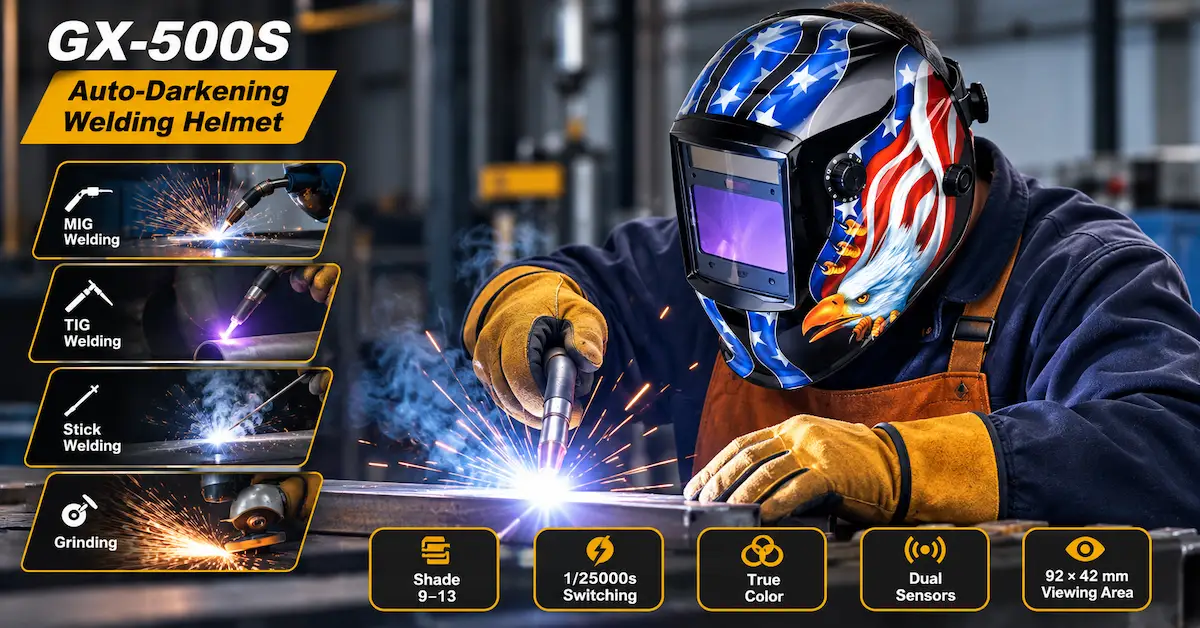
The GX-500S auto-darkening welding helmet from UWELD combines an adjustable auto-darkening filter with an American Eagle shell design, offering a distinctive product configuration for professional welding equipment markets.
This guide explains its technical specifications, optical characteristics, control functions, industrial applications, quality inspection, and OEM wholesale purchasing requirements.
Explore the UWELD GX-500S Welding Helmet for product information and customization inquiries.
Key Takeaways
-
Adjustable shade 9–13: Supports shade selection within the product's published range.
-
Fast automatic switching: The manufacturer lists a light-to-dark switching time of 1/25000 second.
-
True Color technology: Designed to provide a more natural color representation during observation.
-
Optical class 1/1/1/2: Manufacturer-published optical classification for the welding filter.
-
92 × 42 mm viewing area: Provides a defined observation window for welding operations.
-
Two arc sensors: Detect welding arc conditions to support automatic filter switching.
-
Adjustable delay: The published recovery delay ranges from 0.2 to 0.8 seconds.
-
Combined power supply: Solar cells and lithium batteries support the auto-darkening system.
-
American Eagle design: Provides a recognizable appearance for welding equipment distributors.
-
Wholesale and OEM opportunities: Relevant to industrial protective equipment and welding accessory sourcing programs.
What Is the GX-500S Auto-Darkening Welding Helmet?
The UWELD GX-500S is a welding face helmet equipped with an auto-darkening filter, commonly known as an ADF.
An auto-darkening filter changes its visible-light transmission in response to detected welding arc conditions. This allows the operator to observe the work area in the light state and use an appropriately selected dark state during approved welding operations.
Unlike a conventional fixed-shade welding helmet, an auto-darkening model incorporates sensors, electronic control components, and an adjustable filter system.
Its suitability depends on the complete helmet construction, filter performance, operating conditions, and intended welding process.
UWELD GX-500S Technical Specifications
| Specification | Published Product Information |
|---|---|
| Brand | UWELD |
| Product number | 3S003-0005 |
| Model | GX-500S |
| Product category | Auto-darkening welding helmet |
| Filter dimensions | 110 × 90 × 9 mm |
| Viewing area | 92 × 42 mm |
| Light state | FROM 4 |
| Dark state | FROM 9–13 |
| Switching time | 1/25000 second |
| Recovery delay | 0.2–0.8 seconds, adjustable |
| Optical class | 1/1/1/2 |
| Arc sensors | 2 |
| Sensitivity | Adjustable |
| Grinding function | Listed in product literature |
| Shade adjustment | External knob |
| Power supply | Solar cells and lithium batteries |
| Power on/off | Fully automatic |
| Published UV/IR protection | FROM 16 |
| Helmet weight | 420 g |
| Working temperature | −5°C to 55°C |
| Exterior design | American Eagle |
| Commercial services | Wholesale and OEM inquiries |
Source: UWELD GX-500S product listing and manufacturer product illustration. These are manufacturer-published specifications rather than independently verified laboratory results.
Who Should Consider This Welding Helmet?
Potential buyers include:
-
Welding equipment distributors.
-
Industrial personal protective equipment suppliers.
-
Metal fabrication workshops.
-
Industrial maintenance contractors.
-
Welding training centers.
-
Professional tool importers.
-
OEM and private-label welding equipment brands.
The helmet should not be selected for applications outside its approved protective capabilities or operating conditions.
How Does an Auto-Darkening Welding Helmet Work?
An auto-darkening welding helmet uses an electronic filter assembly to respond to welding arc conditions.
The system generally consists of arc sensors, a liquid crystal filter arrangement, electronic controls, optical protection components, and a power supply.
Main Auto-Darkening Filter Components
| Component | Main Function | Buyer Evaluation |
|---|---|---|
| Arc sensors | Detect welding arc conditions | Sensor response and positioning |
| Auto-darkening filter | Changes visible-light transmission | Shade range and optical quality |
| Control circuit | Manages filter operation | Functional consistency |
| Shade adjustment | Selects an available dark-state level | Adjustment range and accuracy |
| Sensitivity control | Adjusts arc-detection responsiveness | Application compatibility |
| Delay control | Manages return to the light state | Recovery behavior |
| Power supply | Supports electronic operation | Approved battery and solar configuration |
| Helmet shell | Provides physical coverage | Construction and applicable protection requirements |
Auto-Darkening vs Fixed-Shade Welding Helmets
| Selection Factor | Auto-Darkening Helmet | Fixed-Shade Helmet |
|---|---|---|
| Filter behavior | Automatically changes between light and dark states | Fixed dark shade |
| Workpiece observation | Light-state observation before welding | May require repositioning for visibility |
| Shade adjustment | Available on compatible adjustable models | Depends on installed lens |
| Electronic components | Required | Generally not required |
| Power supply | Battery, solar, or combined arrangement | Generally unnecessary |
| Purchasing priority | Filter response, controls and optical performance | Lens shade and physical construction |
An auto-darkening model may offer practical workflow advantages where operators repeatedly position and restart welding operations.
However, neither design should be selected without verifying its protective suitability for the intended application.
What Does Shade 9–13 Mean on a Welding Helmet?
The GX-500S auto-darkening welding helmet offers a published adjustable dark-state range of DIN 9–13.
A welding filter shade number describes the level of visible-light attenuation associated with the filter.
Higher shade numbers generally correspond to darker visible-light transmission.
The correct shade depends on the welding process, arc intensity, operating current, and applicable workplace requirements.
Shade Range Interpretation
| Filter Setting | General Description |
|---|---|
| FROM 4 | Published light state for workpiece observation |
| Shade 9 | Lighter setting within the listed dark-state range |
| Shade 10 | Adjustable dark-state setting |
| Shade 11 | Intermediate dark-state setting |
| Shade 12 | Darker setting within the available range |
| Shade 13 | Highest adjustable dark-state shade listed for GX-500S |
These descriptions explain the available settings. They are not recommended operating shades for specific welding currents.
The correct setting must follow the equipment instructions and applicable shade-selection requirements for the welding process.
Is Shade 13 Always Better Than Shade 9?
No.
A darker filter is not automatically the most suitable option for every welding application.
Operators need adequate protection and sufficient visibility to perform the intended work. Both requirements must be considered together.
The appropriate shade should never be selected solely according to personal brightness preference.
Is Shade 9–13 Suitable for Every Welding Process?
No.
Some welding or cutting applications may require filter shades or protective equipment outside this range.
Buyers should establish whether the GX-500S meets the actual application requirements before including it in a professional equipment program.
The DIN 4 light state must not be treated as an appropriate setting for direct observation of an active welding arc.
Why Does 1/25000 Second Switching Speed Matter?
UWELD identifies a switching time of 1/25000 second for the GX-500S, equivalent to 40 microseconds under the stated rating conditions.
Switching speed describes how quickly the auto-darkening filter changes from its light state to its dark state under defined detection and test conditions.
It is an important technical parameter when evaluating an auto-darkening filter.
However, switching time alone cannot establish overall protective performance.
Switching Speed vs Recovery Delay
| Technical Parameter | GX-500S Published Value | Meaning |
|---|---|---|
| Light-to-dark switching | 1/25000 second | Transition to the dark state |
| Dark-to-light recovery delay | 0.2–0.8 seconds | Adjustable return timing |
| Arc detection | Two sensors | Detects relevant arc conditions |
| Sensitivity | Adjustable | Controls detection responsiveness |
These functions should not be confused.
A fast switching time does not mean that the helmet immediately returns to its light state after welding. The delay setting controls a separate part of filter operation.
Does Faster Switching Guarantee Better Protection?
No.
Overall protective performance also depends on optical filtration, sensor detection, electronic reliability, equipment condition, and applicable product testing.
The manufacturer's switching-speed claim should be evaluated alongside the complete filter specifications and relevant documentation.
What Is True Color Technology in a Welding Helmet?
Traditional welding filters can introduce noticeable color distortion when observing a workpiece.
True Color technology is intended to provide a more natural color representation through the filter.
This may help operators distinguish the workpiece, weld area, surrounding components, and relevant visual details.
Potential Advantages of True Color Viewing
-
More natural color perception.
-
Improved visual differentiation of workpiece details.
-
Easier observation of the surrounding welding area.
-
Potentially more comfortable visual conditions during suitable welding operations.
Actual viewing performance depends on the optical filter, lighting conditions, selected shade, and individual operator perception.
True Color is a descriptive product feature, not a substitute for verified protective performance.
When evaluating a GX-500S auto-darkening welding helmet, buyers should examine representative samples under appropriate, approved conditions rather than rely only on promotional photographs.
What Does Optical Class 1/1/1/2 Mean?
UWELD's product illustration lists an optical classification of 1/1/1/2.
In the commonly used four-part optical classification system for auto-darkening welding filters, the numbers describe different optical characteristics.
Understanding the Four Optical Categories
| Optical Category | Published GX-500S Class | General Meaning |
|---|---|---|
| Optical quality | 1 | Image distortion characteristics |
| Light diffusion | 1 | Scattered-light characteristics |
| Luminous transmittance variation | 1 | Uniformity of light transmission |
| Angular dependence | 2 | Variation in transmission with viewing angle |
Within this classification convention, lower class numbers indicate better performance in the corresponding category.
1/1/1/2 vs 1/1/1/1 Optical Class
A 1/1/1/2 classification differs from 1/1/1/1 in its fourth category, which concerns angular dependence.
That distinction may matter when welders view a workpiece from different positions.
However, optical class alone does not establish complete helmet suitability, mechanical protection, switching reliability, or product certification.
The GX-500S classification is a manufacturer-published specification. Buyers requiring documented optical performance should obtain the relevant model-specific test records.
Why Are Arc Sensors, Sensitivity and Delay Important?
The UWELD GX-500S incorporates two arc sensors, adjustable sensitivity, and adjustable recovery delay according to its product literature.
These functions affect how the filter responds to detected arc conditions.
Dual Arc Sensors
Arc sensors detect light conditions associated with welding.
Sensor positioning and visibility can influence detection, particularly in applications involving restricted access or obstructed working positions.
A higher sensor count does not automatically guarantee better performance, but sensor placement and response characteristics are relevant purchasing considerations.
Adjustable Sensitivity
Sensitivity controls influence how the auto-darkening filter responds to relevant light conditions.
Different welding environments may involve varying arc intensity, surrounding illumination, or nearby welding activities.
The correct setting should follow the helmet manufacturer's instructions for the intended process.
Adjustable Recovery Delay
The GX-500S has a published delay range of 0.2–0.8 seconds.
This feature controls how long the filter remains dark before returning to its light state after the detected arc ends.
Suitable recovery behavior depends on the welding application and manufacturer guidance.
Control Function Comparison
| Control | Primary Purpose |
|---|---|
| Shade | Selects the available dark-state level |
| Sensitivity | Adjusts arc-detection responsiveness |
| Delay | Controls return timing after arc detection ends |
| Grinding mode | Provides an alternative operating mode where approved |
| External shade knob | Allows access to shade adjustment |
For distributors, clear operating instructions are important because these functions serve different purposes.
Is a 92 × 42 mm Viewing Area Suitable for Industrial Welding?
The GX-500S has a published viewing area of 92 × 42 mm.
The viewing area is the usable observation window through which the operator sees the workpiece.
It should not be confused with the overall filter dimensions of 110 × 90 × 9 mm.
Viewing Area Selection Considerations
| Evaluation Factor | Purchasing Consideration |
|---|---|
| Viewing width | Horizontal observation coverage |
| Viewing height | Vertical observation coverage |
| Optical quality | Image distortion and visibility |
| Welding position | Access around the workpiece |
| Helmet fit | Filter position relative to the eyes |
| Cover plate condition | Scratches, contamination and visibility |
A larger viewing window may provide broader observation, but it does not automatically guarantee superior welding performance.
For professional buyers, the appropriate viewing area depends on the working position, operator requirements, helmet fit, and optical characteristics.
Why Does Helmet Weight Matter?
The GX-500S has a manufacturer-published weight of 420 g.
Helmet weight can influence operator comfort during repeated welding operations.
However, weight alone does not establish comfort. Balance, headgear adjustment, fit, and weight distribution are also relevant.
Industrial buyers should evaluate these factors through representative sample inspection.
How Does the Solar and Lithium Battery Power System Work?
UWELD describes the GX-500S as using solar cells and lithium batteries.
The combined power arrangement supports the electronic functions of the auto-darkening filter.
The product literature also identifies fully automatic power on/off operation.
Power System Purchasing Checklist
| Evaluation Item | Buyer Requirement |
|---|---|
| Solar cell arrangement | Correct construction and physical condition |
| Lithium battery | Approved battery specification |
| Battery replacement | Confirm whether replacement is supported |
| Electronic controls | Suitable functional response |
| Power management | Verify approved automatic operation |
| Storage instructions | Follow manufacturer requirements |
The published product information does not establish a specific battery life or charging duration.
Buyers should not assume that solar assistance eliminates battery maintenance or replacement requirements.
If the filter fails to function according to the manufacturer's instructions, the helmet should be removed from service until appropriately evaluated.
Which Industrial Applications Are Suitable for the GX-500S?
The GX-500S auto-darkening welding helmet may be considered for a variety of compatible welding and fabrication activities.
UWELD lists ARC, TIG, MIG, spot welding, and plasma-related applications in its product literature.
Actual suitability depends on the approved filter range, process conditions, protective capabilities, and workplace requirements.
Industrial Application Matrix
| Application | Main Requirement | Buyer Evaluation |
|---|---|---|
| MIG welding | Suitable visibility and arc protection | Shade range and sensor response |
| TIG welding | Appropriate detection and optical clarity | Minimum supported TIG current |
| Stick welding | Suitable filter and face coverage | Shade and protection requirements |
| Metal fabrication | Multiple approved welding tasks | Comfort and configuration |
| Industrial maintenance | Protection across repair environments | Application suitability |
| Welding training | Clear and consistent equipment operation | Instructions and inspection |
| Plasma cutting | Appropriate process-specific protection | Required filter shade and equipment rating |
| Grinding | Suitable mechanical eye and face protection | Verified impact rating and operating mode |
MIG Welding and Metal Fabrication
Fabrication workshops performing repeated MIG welding operations may benefit from adjustable filter settings and suitable workpiece visibility.
The helmet should be evaluated against the actual welding process and operating conditions.
TIG Welding
TIG welding can involve relatively low-current applications that place particular demands on arc-detection performance.
Although UWELD lists TIG compatibility, the supplied information does not establish a minimum supported TIG amperage.
Buyers sourcing helmets specifically for low-current TIG welding should request the relevant detection-performance specifications.
Industrial Maintenance
Maintenance contractors frequently work with different equipment and welding processes.
A versatile helmet may be useful where each application falls within the approved protective capabilities of the product.
Grinding Applications
The GX-500S product literature lists a grinding function.
However, the presence of a grinding mode does not establish a verified impact-protection classification.
Grinding work requires appropriate eye and face protection for flying particles and mechanical hazards. Where required, suitable safety glasses or goggles must also be used.
Grinding mode must not remain selected when welding begins.
GX-500S vs Other UWELD Auto-Darkening Welding Helmets
UWELD offers several auto-darkening welding helmet configurations for different purchasing requirements.
UWELD Welding Helmet Model Comparison
| Model | Published Shade Range | Main Published Characteristics | Purchasing Focus |
|---|---|---|---|
| GX-500S / 3S003-0005 | 9–13 | True Color, two sensors, 1/25000s switching, American Eagle design | Optical features and distinctive appearance |
| KD890 / 3S003-0017 | 9–13 | 0.0001s published switching time | Filter performance and approved configuration |
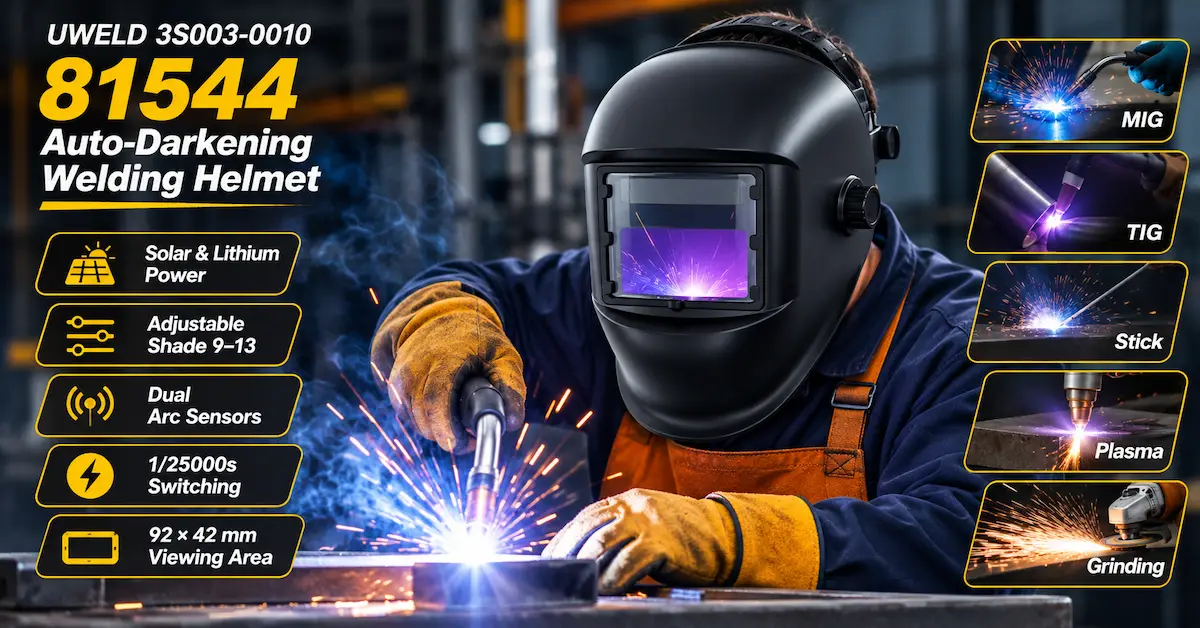
| JEGS 81544 / 3S003-0010 | 9–13 | Solar/lithium power, adjustable sensitivity | Power system and control functions |
| UW-3S003-0001 | 9–13 | Four arc sensors, solar-assisted battery power | Arc-sensor configuration and headgear |
The table compares manufacturer-published product descriptions. It does not establish an independent safety or performance ranking.
When Should Buyers Choose the GX-500S?
The GX-500S is worth evaluating when the required product assortment includes:
-
A shade 9–13 auto-darkening filter.
-
True Color viewing features.
-
Adjustable sensitivity and delay.
-
A 92 × 42 mm viewing area.
-
American Eagle exterior graphics.
When Should Buyers Consider Another Model?
A different helmet may be more appropriate when the application requires another viewing area, different sensor arrangement, extended shade range, or documented protective capabilities unavailable for the GX-500S.
Buyers can compare the UWELD KD890 Auto-Darkening Welding Helmet and the UWELD Auto Welding Mask according to their target market and technical requirements.
What Safety and Compliance Requirements Should Buyers Consider?
Welding helmets are protective equipment. Their suitability cannot be established by appearance or commercial specifications alone.
Industrial buyers should evaluate both the auto-darkening filter and complete helmet assembly.
UV and IR Protection
The GX-500S product literature lists UV/IR protection of DIN 16.
This published value concerns ultraviolet and infrared filtration characteristics.
It should not be confused with the adjustable visible-light shade range of 9–13.
The stated UV/IR value must not be treated as evidence of independently verified protection without appropriate product documentation.
Product Compliance Documentation
Importers and industrial distributors should identify the requirements applicable to their destination markets.
Relevant documentation may include:
-
Model-specific product specifications.
-
Optical and filter performance test reports.
-
Applicable eye and face protection documentation.
-
Mechanical protection test records.
-
Required product markings.
-
Instructions and safety information.
-
Relevant conformity documentation.
A test report or certificate for a different welding helmet model should not automatically be applied to the GX-500S.
Company-level quality management certification is also different from product-specific protective equipment certification.
Pre-Use Equipment Inspection
Professional users should follow the manufacturer's inspection and operating instructions.
Damaged filters, cracked shells, defective sensors, unsuitable cover plates, or malfunctioning controls require appropriate attention before use.
Auto-darkening functionality should be checked using the manufacturer's approved test method, not by intentionally exposing the eyes to an active welding arc.
What Quality-Control Checks Matter for Wholesale Welding Helmets?
A sample of the GX-500S auto-darkening welding helmet should be evaluated before a large-scale purchasing program begins.
For distributors, the approved configuration should establish a reference for later production orders.
Recommended Wholesale Quality Inspection Checklist
| Inspection Item | Buyer Acceptance Requirement |
|---|---|
| Product identity | Correct GX-500S / 3S003-0005 model |
| Exterior shell | Approved American Eagle design and physical condition |
| Filter dimensions | Matches specified configuration |
| Viewing area | Correct usable observation window |
| Optical performance | Relevant documented test results |
| Shade adjustment | Correct range and control operation |
| Arc sensors | Approved sensor configuration |
| Switching response | Applicable functional verification |
| Sensitivity control | Suitable adjustment behavior |
| Delay control | Correct functional response |
| Grinding function | Approved operating behavior |
| Battery and solar components | Correct power configuration |
| Headgear | Suitable adjustment and assembly |
| Cover plates | Correct fit and physical condition |
| Product markings | Matches applicable approved documentation |
| Packaging | Correct product and accessory identification |
| Traceability | Approved model and production records |
These are recommended purchasing acceptance checks rather than a claim that every inspection has been independently verified for UWELD's manufacturing line.
Why Is Sample Approval Important?
Sample approval allows buyers to evaluate the actual product construction, optical characteristics, control functions, appearance, and supporting documentation.
For wholesale programs, the approved sample should be associated with a controlled product specification.
Changes to the filter, electronic components, shell, or protective construction should receive appropriate review.
Replacement Parts and Maintenance
Distributors should also discuss the availability of compatible replacement cover plates, headgear, filters where approved, and other relevant components.
Replacement parts should match the approved helmet configuration. Unverified modifications may affect protective performance.
What Affects the Wholesale Cost of an Auto-Darkening Welding Helmet?
The cost of sourcing welding helmets depends on more than the exterior shell and product price.
Filter technology, electronic components, headgear, documentation, packaging, and replacement-part arrangements can all influence purchasing costs.
Total Sourcing Cost
Total Sourcing Cost = Product Cost + Inspection + Documentation + Packaging + Freight + Replacement Parts + After-Sales Costs
| Cost Factor | Purchasing Consideration |
|---|---|
| Auto-darkening filter | Optical performance and electronic configuration |
| Arc sensors | Detection arrangement |
| Helmet shell | Construction and approved appearance |
| Headgear | Fit, adjustment and durability requirements |
| Battery and solar components | Approved power system |
| Quality testing | Required acceptance and documentation |
| OEM graphics | Artwork and customization requirements |
| Packaging | Retail or wholesale presentation |
| Replacement parts | Long-term customer support |
| Order quantity | MOQ and commercial terms |
| Freight | Shipment size and destination |
Is the Lowest-Priced Welding Helmet the Best Option?
Not necessarily.
A lower-priced product may offer suitable value if its complete protective performance and specifications meet the intended requirements.
However, missing documentation, unsuitable replacement parts, inconsistent controls, or product defects can create additional purchasing and service costs.
Wholesale buyers should compare equivalent configurations and documented protective capabilities rather than unit price alone.
How Should Distributors Position the American Eagle Design?
The GX-500S features an American Eagle exterior design with blue, red, white, and eagle graphics.
This provides a recognizable visual identity that may be suitable for welding equipment assortments and professional tool retail channels.
For distributors, the appearance can help differentiate models with otherwise similar commercial positioning.
Nevertheless, decorative graphics should remain secondary to verified product suitability and protection.
Potential Distribution Channels
| Customer Segment | Product Positioning |
|---|---|
| Welding equipment distributors | Adjustable auto-darkening helmet range |
| Industrial tool wholesalers | Professional welding accessory assortment |
| Welding supply retailers | Distinctive American Eagle design |
| Fabrication equipment suppliers | Complementary protective equipment |
| Private-label brands | Approved customized graphics and packaging |
Any new branding or exterior artwork should be reviewed for technical feasibility, intellectual property rights, and applicable product-marking requirements.
OEM and Wholesale Welding Helmet Supply
UWELD supports wholesale and OEM inquiries for welding and cutting equipment, including protective product categories.
International distributors and industrial brands may require approved product configurations, packaging, labeling, and brand presentation.
Recommended OEM Purchasing Workflow
| Stage | Main Requirement |
|---|---|
| Market review | Identify target customers and applicable requirements |
| Product selection | Choose the GX-500S configuration |
| Technical evaluation | Review optical, electronic and protective specifications |
| Documentation review | Establish required product conformity documents |
| Sample approval | Evaluate construction, controls and appearance |
| Branding approval | Confirm graphics, labels and packaging |
| Quality planning | Establish production acceptance requirements |
| Bulk purchasing | Confirm quantity, price and delivery |
| Repeat orders | Maintain approved components and specifications |
Technical changes affecting the filter, sensors, protective shell, or electrical system require appropriate evaluation.
Buyers can explore UWELD OEM and Manufacturing Solutions for broader manufacturing cooperation information.
MOQ, Samples and Lead Times
Minimum order quantities, sample arrangements, and production schedules should be discussed according to the specific product and customization requirements.
For OEM helmet orders, the selected graphics, packaging, documentation, and product configuration may influence commercial conditions.
Actual quantities and delivery schedules should be established in the quotation.
What Should Buyers Include in a GX-500S Wholesale RFQ?
A complete request for quotation helps identify the intended welding helmet configuration and commercial requirements.
Recommended RFQ Checklist
| RFQ Field | Information to Provide |
|---|---|
| Product | GX-500S auto-darkening welding helmet |
| Model | UWELD 3S003-0005 |
| Intended application | MIG, TIG, ARC or other approved processes |
| Shade range | Required filter shade specifications |
| Optical requirements | Required optical classification |
| Viewing area | Required observation dimensions |
| Switching requirements | Applicable response specifications |
| Arc sensors | Required detection characteristics |
| Product documentation | Market-specific testing and conformity requirements |
| Exterior design | American Eagle or requested approved artwork |
| Packaging | Standard or OEM packaging |
| Branding | Logo, labels and graphics |
| Replacement parts | Required approved accessories |
| Sample quantity | Evaluation units |
| Bulk quantity | Initial and expected repeat orders |
| Destination market | Country or region |
| Delivery | Requested commercial and shipping terms |
Providing the destination market and intended welding processes is particularly important for protective equipment purchasing.
Looking for adjustable auto-darkening welding helmets for industrial distribution? Contact UWELD to request GX-500S product specifications, samples, available technical documentation, OEM packaging options, and wholesale pricing.
Frequently Asked Questions
1. What is the GX-500S auto-darkening welding helmet?
The UWELD GX-500S, model 3S003-0005, is an adjustable auto-darkening welding helmet featuring a published shade range of 9–13, True Color viewing technology, and an American Eagle exterior design.
2. What is the switching speed of the GX-500S?
UWELD lists a switching time of 1/25000 second. This is a manufacturer-published light-to-dark transition specification rather than an independently verified test result.
3. What is the viewing area of the GX-500S?
The product illustration identifies a viewing area of 92 × 42 mm and overall filter dimensions of 110 × 90 × 9 mm.
4. What does True Color mean on a welding helmet?
True Color describes filter technology intended to provide a more natural color representation. Actual visibility depends on filter characteristics, lighting, selected shade, and operating conditions.
5. What does optical class 1/1/1/2 mean?
It describes four categories of optical performance, covering optical quality, light diffusion, transmission uniformity, and angular dependence. The GX-500S has a manufacturer-published classification of 1/1/1/2.
6. How many arc sensors does the GX-500S have?
The published product illustration lists two arc sensors. Actual detection suitability should be evaluated for the intended welding process.
7. Can the GX-500S be used for TIG and MIG welding?
UWELD lists TIG and MIG applications. The helmet must meet the appropriate protective and detection requirements for the actual welding process and current.
8. Does the GX-500S have a grinding mode?
Yes. Grinding is listed in the product literature. However, mechanical impact protection must be established separately, and grinding mode must not be used for active welding.
9. Is the GX-500S independently certified?
The available product information does not establish a specific independent product certification. Buyers should request model-specific compliance documentation for their destination markets.
10. Does UWELD support wholesale and OEM welding helmet orders?
UWELD supports wholesale and OEM inquiries. Buyers can discuss product configurations, samples, artwork, packaging, documentation, order quantities, and commercial requirements directly with the company.
Conclusion
Selecting a reliable GX-500S auto-darkening welding helmet requires careful evaluation of filter performance, shade range, optical characteristics, arc detection, operating controls, and protective equipment requirements.
The UWELD 3S003-0005 combines a published shade range of 9–13, True Color viewing technology, 1/25000-second switching speed, two arc sensors, adjustable sensitivity and delay, and an American Eagle exterior design.
For fabrication workshops and professional welders, appropriate visibility, equipment condition, helmet fit, and documented application suitability are important considerations.
For industrial distributors, equipment importers, and OEM brands, purchasing decisions should also consider sample approval, model-specific documentation, replacement-part availability, packaging, and consistent repeat-order specifications.
UWELD supplies welding helmets, welding torches, protective accessories, and related industrial equipment for international professional markets.
To evaluate the product, visit the UWELD GX-500S Welding Helmet, explore UWELD Industrial Safety Solutions, or contact UWELD to request technical specifications, product samples, OEM customization information, and wholesale quotations.