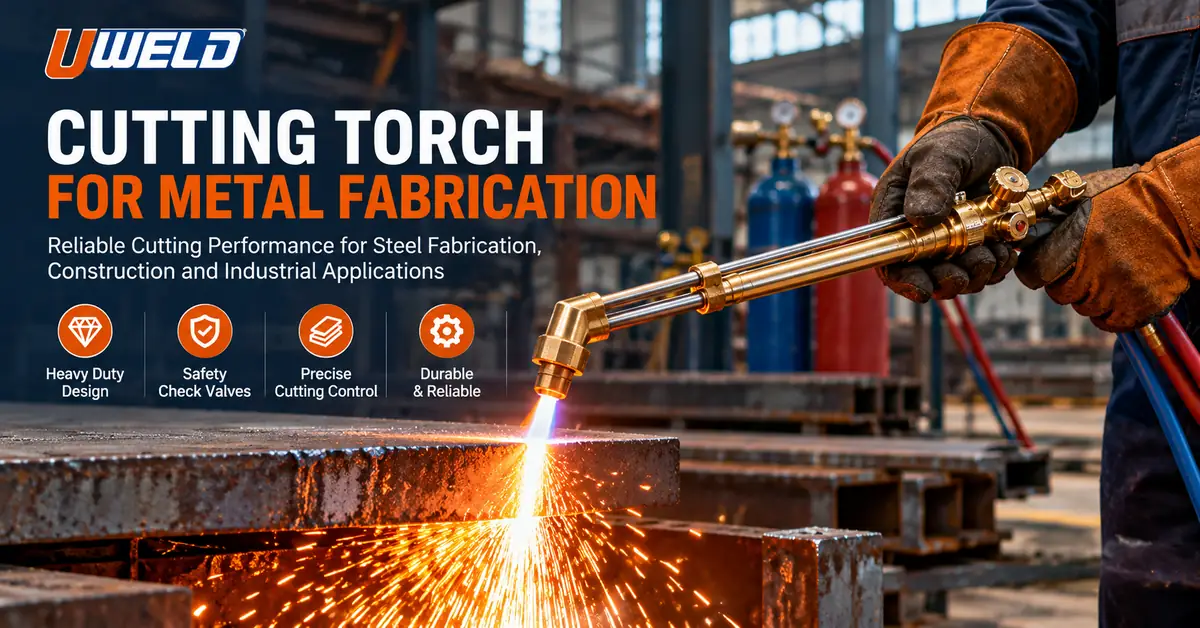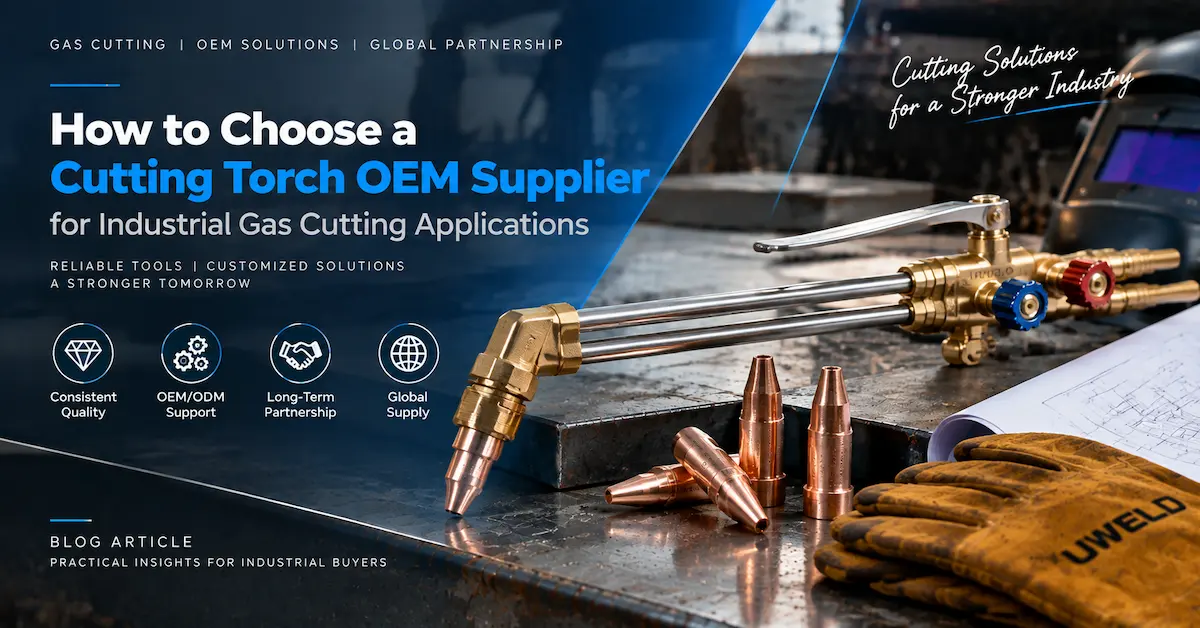


A steel cutting torch uses a fuel-gas flame to preheat steel and a concentrated oxygen stream to cut through the material by controlled oxidation. Unlike processes that rely primarily on melting, oxy-fuel cutting uses the chemical reaction between hot iron and oxygen to separate the metal.
For steel fabricators, industrial maintenance contractors, and equipment distributors, understanding this process is essential for choosing the correct torch, cutting nozzle, regulator, and safety accessories.
A properly specified cutting system can support consistent cut quality, practical maintenance, and long-term equipment reliability. However, performance depends on steel grade, material thickness, fuel gas, nozzle selection, oxygen supply, and operating conditions.
This guide explains the cutting process and provides practical equipment selection criteria for B2B buyers considering UWELD gas cutting products.
What Is a Steel Cutting Torch and Where Is It Used?
A steel cutting torch is a manual or mechanized tool designed primarily for cutting carbon steel and certain low-alloy steels using oxygen and a combustible fuel gas.
The system uses two separate functions:
-
Preheating: A controlled oxygen-fuel flame heats the steel to its ignition temperature.
-
Cutting: A concentrated oxygen jet reacts with the heated steel and removes the resulting oxides from the cutting path.
This technology is commonly used in structural steel fabrication, heavy equipment maintenance, steel plate preparation, ship repair, construction, and scrap processing.
Who Should Consider Oxy-Fuel Steel Cutting?
Oxy-fuel equipment is particularly relevant to:
-
Steel fabrication workshops processing carbon steel plates and structural components.
-
Construction and field-service contractors requiring portable cutting equipment.
-
Industrial maintenance teams removing damaged steel components.
-
Welding and cutting tool distributors serving professional users.
-
Equipment importers and OEM brands seeking wholesale cutting systems.
It is less suitable for applications that primarily involve stainless steel, aluminum, highly intricate thin-sheet profiles, or exceptionally narrow tolerances.
In those cases, plasma, laser, or another cutting process may offer better technical suitability.
How Does the Oxy-Fuel Steel Cutting Process Work?
Oxy-fuel cutting combines heat, oxygen, and the chemical properties of steel.
Its effectiveness depends on whether the metal can oxidize rapidly and whether the resulting oxides can be removed from the cut.
Stage 1: Preheating the Steel
The process begins when oxygen and an approved fuel gas create a preheating flame at the cutting nozzle.
Common fuel gases include acetylene and propane.
The flame heats a localized region of the steel to its ignition temperature, which is below the melting temperature of the base material. For typical steels, the required ignition temperature is often discussed in the approximate range of 700–900°C, although actual conditions depend on composition and surface condition.
During preheating, several factors influence performance:
-
Fuel-gas characteristics and nozzle compatibility.
-
Flame stability and distribution.
-
Steel thickness and thermal condition.
-
Surface rust, mill scale, paint, or contamination.
-
Appropriate nozzle-to-workpiece distance.
The purpose is to establish suitable conditions for rapid oxidation, not simply to melt a large pool of steel.
Stage 2: Initiating the Cutting Reaction
After sufficient preheating, a separate stream of cutting oxygen reaches the heated steel.
The oxygen reacts with iron to form iron oxides. This reaction releases additional heat, helping the process continue into the workpiece.
The cutting oxygen jet also helps expel molten oxides and other material from the kerf—the narrow opening produced by the cut.
The effectiveness of this stage depends on oxygen quality, cutting jet characteristics, nozzle condition, and material thickness.
For industrial users, the important point is that the cutting flame and cutting oxygen jet perform different tasks. A powerful heating flame cannot compensate for an unsuitable or damaged cutting oxygen nozzle.
Stage 3: Maintaining a Continuous Cut
Once the cutting reaction has started, the torch advances along the desired path.
The preheating flames maintain the required thermal conditions ahead of the cut, while the oxygen stream sustains oxidation and removes material.
Straight cuts, curved cuts, bevel preparation, and rough separation cuts can be produced using suitable equipment and operating techniques.
Cut quality depends on maintaining the correct relationship between travel speed, cutting oxygen delivery, preheat conditions, and nozzle alignment.
For repeatable industrial applications, these variables should be checked together rather than adjusted independently without a defined process.
Which Steel Grades Can an Oxy-Fuel Torch Cut?
Not every metal responds to oxy-fuel cutting in the same way.
The process works best when the material can oxidize readily and the oxides can be removed without preventing further cutting.
| Material | Oxy-Fuel Cutting Suitability | Important Considerations |
|---|---|---|
| Mild steel | Generally suitable | Common material for manual and industrial cutting |
| Low-carbon steel plate | Generally suitable | Match nozzle and cutting conditions to thickness |
| Structural carbon steel | Generally suitable | Consider grade, thickness, and subsequent welding |
| Certain low-alloy steels | Conditional | Alloy composition and heat-affected zone behavior matter |
| High-carbon steel | Requires careful evaluation | Edge hardening and cracking risks may increase |
| Stainless steel | Not normally suitable for conventional oxy-fuel cutting | Alternative cutting technology is typically preferred |
| Aluminum | Not suitable for conventional oxy-fuel cutting | Plasma, laser, or mechanical cutting may be appropriate |
For a purchaser, material identification should be the first step before selecting a torch or approving a cutting procedure.
A steel cutting torch should not be marketed as a universal cutter for all metals.
Understanding the Main Components of a Steel Cutting System
Reliable cutting requires compatible components across the entire gas supply and working assembly.
The torch body alone does not determine system performance.
Technical Selection Table
| Component | Main Function | Key Specifications to Verify |
|---|---|---|
| Cutting torch body | Controls fuel gas, preheating oxygen, and cutting oxygen | Design, valve configuration, head angle, length |
| Cutting nozzle | Forms preheat flames and directs cutting oxygen | Fuel type, nozzle series, size, seating design |
| Oxygen regulator | Controls oxygen delivery pressure | Gas service, pressure range, flow capacity, connections |
| Fuel-gas regulator | Controls the fuel supply | Approved gas, pressure range, connections |
| Gas hoses | Carry oxygen and fuel to the torch | Gas rating, hose dimensions, fittings, condition |
| Flashback protection | Provides specified protection against flame propagation | Gas compatibility, mounting position, protective functions |
| Safety equipment | Protects operators and the work environment | Applicable protection requirements and standards |
Why Cutting Nozzle Design Matters
The nozzle is especially important because it influences both preheating and oxygen delivery.
A suitable nozzle should provide the gas distribution required for the intended process while remaining compatible with its torch head and fuel gas.
Different fuels may require different nozzle geometries. For example, an acetylene nozzle should not automatically be substituted for a propane nozzle simply because the two appear similar.
Nozzle selection should account for the actual cutting thickness, equipment series, gas requirements, and manufacturer instructions.
For more information, see UWELD's cutting torch nozzle selection guide.
Oxygen-Acetylene vs Oxygen-Propane Cutting
Fuel selection affects preheating behavior, equipment configuration, operating cost, and gas availability.
Neither option is automatically the best for every application.
| Selection Factor | Oxygen-Acetylene | Oxygen-Propane |
|---|---|---|
| Preheating characteristics | Concentrated, high-temperature flame | Different flame heat distribution |
| Cutting applications | Fabrication, repair, industrial steel cutting | Structural fabrication, maintenance, industrial steel cutting |
| Nozzle requirements | Acetylene-compatible cutting tips | Propane-compatible cutting tips |
| Cost considerations | Depends on local acetylene prices and consumption | Depends on local propane prices and consumption |
| Equipment compatibility | Approved acetylene regulators and accessories | Approved propane regulators and accessories |
| Buyer priority | Preheating performance, compatibility, availability | Supply economics, suitable nozzles, application conditions |
Acetylene may be advantageous where rapid, localized preheating is important. Propane may be attractive where fuel supply and operating economics favor it.
However, cutting performance should be assessed using the entire system rather than fuel price alone.
Distributors offering both configurations should maintain clear product identification, correct nozzle compatibility information, and gas-specific accessory lists.
What Determines Steel Cutting Quality?
A professional cutting system should produce a cut appropriate to the application, with manageable slag, consistent geometry, and acceptable edge condition.
The required standard differs between rough dismantling, fabrication, and weld-edge preparation.
The following diagnostic table helps buyers and production teams evaluate common problems.
| Observed Problem | Possible Contributing Factors | What to Investigate |
|---|---|---|
| Rough, uneven cut face | Incorrect oxygen delivery, nozzle damage, inconsistent travel | Nozzle condition, oxygen supply, operating setup |
| Excessive bottom slag | Insufficient slag removal, unsuitable speed, incorrect conditions | Cutting oxygen flow, nozzle size, process settings |
| Rounded or heavily melted top edge | Excessive preheating or overly slow travel | Flame condition and cutting speed |
| Slanted cut face | Torch misalignment or uneven oxygen delivery | Torch geometry, nozzle alignment |
| Incomplete penetration | Insufficient cutting capability for the material | Steel thickness, nozzle rating, gas supply |
| Irregular drag lines | Unstable travel or oxygen jet | Process consistency and nozzle condition |
| Repeated backfire events | Equipment defects or incorrect operating conditions | Stop work and inspect the approved gas system |
These are diagnostic possibilities, not proof of a single cause. Any unsafe or abnormal operating condition should be investigated by qualified personnel following the equipment instructions.
Why Nozzle Quality Affects Operating Cost
A poorly matched or damaged nozzle can cause more than an unattractive cut.
Potential consequences include increased rework, additional grinding, wasted material, interrupted production, and unnecessary consumable replacement.
For industrial buyers, it is therefore useful to evaluate nozzle replacement availability and consistency alongside the purchase price of the torch.
Choosing the Right UWELD Steel Cutting Torch
UWELD, operated by Ningbo United Tools Co., Ltd., supplies professional welding and gas cutting equipment for international industrial buyers and distribution partners.
Its product range includes cutting torches, nozzles, gas regulators, flashback arrestors, and cutting and welding kits.
Different torch models are intended for different equipment arrangements and application requirements.
UWELD Model Comparison
| UWELD Model | Published Product Features | Purchasing Considerations | Potential Application |
|---|---|---|---|
| NM250 / 1C005-0016 | Heavy-duty hand cutting torch; nozzle-mix design; acetylene or propane configurations | Verify current cutting capacity, length, nozzle series, and exact version | Heavy fabrication and steel plate cutting |
| 1C005-0012 Straight Cutting Torch | Straight design, triangular stainless steel tubes, dual needle valves | Confirm connection specifications and required cutting tip | Industrial oxy-fuel cutting |
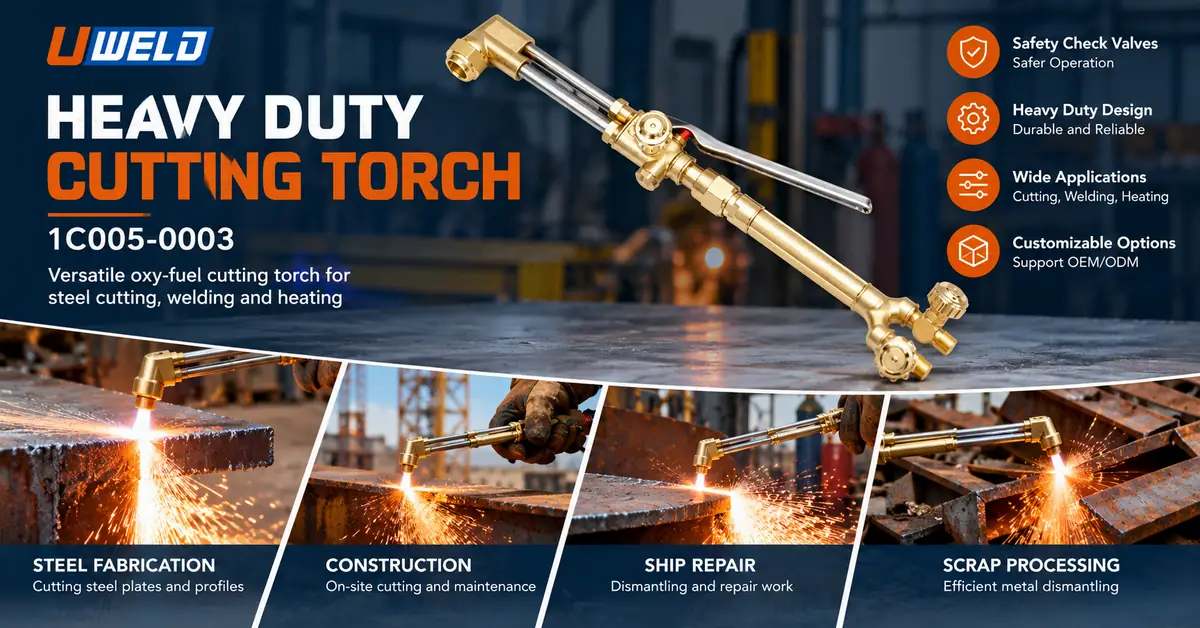
| 1C005-0003 Heavy Duty Cutting Torch | Heavy-duty cutting torch with check-valve features and customizable configurations | Confirm supplied configuration, safety devices, and accessory compatibility | Industrial cutting and maintenance |
These model comparisons identify product configurations rather than guarantee a specific cutting result.
Actual cutting capacity depends on the approved nozzle, fuel gas, pressure conditions, material, and product version.
For example, the NM250 series should be specified using the current manufacturer's technical documentation rather than assuming that every variation shares the same length, nozzle, or cutting limit.
Buyers can examine UWELD's 1C005-0012 straight cutting torch and 1C005-0003 heavy-duty cutting torch for further product details.
How to Evaluate Manufacturing Quality Before Bulk Purchasing
For equipment importers and distributors, appearance alone is not a reliable indicator of product quality.
A structured supplier review should consider the mechanical construction, manufacturing consistency, technical documentation, and verification procedures.
Torch Body and Materials
The material and construction of the cutting torch affect durability and handling.
Depending on the model, relevant components may include forged brass heads, stainless steel tubing, operating levers, gas passages, valves, and seals.
Buyers should request material information for the specific product rather than assume that every torch in a manufacturer's catalog uses identical construction.
Valve and Connection Reliability
Gas valves and connections are important inspection points.
A purchasing review should address:
-
Valve operation and sealing integrity.
-
Connection specifications and tolerances.
-
Torch and nozzle interface compatibility.
-
Gas-path cleanliness and assembly quality.
-
Inspection procedures and available test documentation.
For OEM customers, an approved technical drawing can help prevent differences between samples and subsequent production batches.
Quality Control and Certification
UWELD's website describes quality management and product-specific standards associated with its welding and cutting equipment range.
However, a company's quality management certification does not mean every product has the same independent product certification.
Buyers should request the documents applicable to the specific model and destination market.
For gas welding and cutting blowpipes, EN ISO 5172 is one relevant product standard to investigate where applicable. Buyers should confirm the exact edition, product scope, and supporting conformity evidence rather than rely on a general marketing statement.
Steel Cutting Torch Applications by Industry
Different operating environments place different demands on cutting equipment.
Metal Fabrication Workshops
Fabricators frequently need to cut carbon steel sections, prepare welding edges, or modify components.
Key priorities include appropriate cutting capacity, repeatable cut geometry, nozzle availability, and equipment maintenance.
Construction and Field Service
Portable oxy-fuel equipment can be useful when electrical cutting equipment is inconvenient or site conditions require flexible access.
Buyers should consider handling, hose arrangements, equipment protection, and the suitability of the complete gas system.
Ship Repair and Heavy Industrial Maintenance
Repair teams may cut thick steel components or dismantle damaged assemblies.
Torch reach, suitable cutting capacity, stable gas delivery, and spare parts availability can be important.
Scrap Processing and Equipment Dismantling
Scrap operations often prioritize dependable equipment, serviceability, and manageable operating cost rather than precision edge finishing.
The correct torch selection should reflect normal daily work, not only the maximum thickness quoted in a catalog.
Steel Cutting Torch vs Plasma Cutting: Which Is Better?
Oxy-fuel and plasma cutting solve related but different production problems.
| Factor | Oxy-Fuel Steel Cutting | Plasma Cutting |
|---|---|---|
| Main cutting principle | Oxidation of heated steel | Electrically generated plasma arc |
| Best-suited materials | Carbon steel and certain low-alloy steels | Wider range of electrically conductive metals |
| Power requirements | Gas supply; manual cutting does not require electrical cutting power | Electrical power required |
| Heavy steel sections | Can be suitable with appropriately rated equipment | Depends on plasma system capacity |
| Thin metal cutting | May offer less practical advantage | Often favorable |
| Portability | Useful for field work | Depends on power source and equipment |
| Purchase evaluation | Gas cost, torches, nozzles, regulators, safety devices | Machine cost, power, consumables, air/gas supply |
Neither method is universally more economical.
A useful comparison includes purchase cost, cutting speed, thickness range, edge finishing, consumable expenses, labor, and production volume.
For facilities cutting multiple materials, different cutting technologies may be needed for different operations.
Safety and Flashback Protection in Oxy-Fuel Cutting
Oxygen-fuel systems require trained operators, correct equipment, and suitable workplace controls.
A purchasing evaluation should address:
-
Correct identification of oxygen and fuel-gas equipment.
-
Approved regulators, hoses, and fittings.
-
Gas-compatible flashback protection.
-
Leak inspection and maintenance requirements.
-
Ventilation and control of fumes from coatings or contaminants.
-
Fire prevention and appropriate personal protective equipment.
-
Inspection and replacement procedures for damaged components.
Flashback arrestors and non-return valves perform different protective functions, and the presence of one feature should not be taken as proof that every safety requirement has been met.
For example, UWELD lists gas-specific products such as the H188 oxygen flashback arrestor for torch mounting.
The correct equipment must be selected according to gas type, installation location, flow requirements, and manufacturer instructions.
Independent technical information is available through TWI's Oxyfuel Cutting – Process and Fuel Gases. For U.S. workplaces, OSHA's 29 CFR 1910.253 addresses oxygen-fuel gas welding and cutting requirements. Applicable requirements vary by jurisdiction and should be reviewed for the intended market.
What Should Industrial Buyers Include in a Steel Cutting Torch RFQ?
Before comparing suppliers, buyers should define the application clearly.
A complete request for quotation makes it easier to identify suitable equipment and avoid ordering incompatible parts.
| RFQ Information | Example of What to Specify |
|---|---|
| Steel material | Mild steel, structural carbon steel, or specified grade |
| Typical cutting thickness | Normal working range and maximum requirement |
| Cutting application | Workshop cutting, site repair, plate preparation, dismantling |
| Fuel gas | Acetylene, propane, or other approved gas |
| Torch configuration | Preferred head angle, length, handle, or lever arrangement |
| Nozzle compatibility | Required nozzle series and sizes |
| Connections | Thread specification and existing regulator/hose arrangement |
| Safety requirements | Applicable protections, standards, and documents |
| Purchase volume | Trial order and forecast bulk quantity |
| Branding | UWELD brand, private label, or customized packaging |
| Destination market | Country and relevant purchasing requirements |
Buyers should also request confirmation of lead time, MOQ, packaging, sample availability, and applicable testing documentation.
An effective purchasing decision compares the complete equipment configuration rather than the unit price of an unconfigured torch.
OEM/ODM and Wholesale Steel Cutting Torch Supply
Industrial equipment distributors often need more than a standard product listing.
Depending on the project and technical feasibility, procurement requirements may include private-label packaging, product identification, accessory kits, documentation, and selected configuration changes.
UWELD supports distributor cooperation and customized welding and cutting equipment supply.
For an OEM/ODM project, a practical approval process includes reviewing the technical requirements, confirming available configurations, evaluating samples, approving packaging, and agreeing on inspection and delivery requirements.
MOQ, production schedule, and customization feasibility should be confirmed for the selected model.
Explore UWELD's solutions and manufacturing services or submit an inquiry through the UWELD contact page.
Frequently Asked Questions About Steel Cutting Torches
1. How does a steel cutting torch work?
A steel cutting torch heats a localized section of steel with an oxygen-fuel flame. A separate oxygen stream then reacts with the hot steel, producing oxides that are expelled from the cutting path. The resulting oxidation reaction supports continued cutting.
2. Can a steel cutting torch cut thick steel plate?
Yes, appropriately rated oxy-fuel cutting equipment can cut substantial thicknesses of suitable carbon steel. However, actual capability depends on the torch, nozzle, fuel gas, oxygen supply, and working conditions. Buyers should confirm the rated configuration for their required thickness.
3. Is acetylene or propane better for steel cutting?
Both can be suitable. Acetylene provides concentrated preheating, while propane may offer favorable supply economics in certain markets. Nozzle compatibility and application requirements should determine the final choice.
4. Can an oxy-fuel steel cutting torch cut stainless steel?
Conventional oxy-fuel cutting is generally unsuitable for stainless steel because its oxide behavior interferes with the normal cutting reaction. Plasma or laser cutting is usually more appropriate.
5. What causes excessive slag during steel cutting?
Possible causes include unsuitable travel speed, insufficient or disturbed cutting oxygen flow, incorrect nozzle selection, and poor preheating conditions. The complete process should be evaluated before identifying a single cause.
6. Why is the cutting nozzle important?
The cutting nozzle influences flame distribution, cutting oxygen delivery, and gas-flow characteristics. Incorrect sizing or compatibility can affect cutting quality and equipment operation.
7. What safety accessories are needed for an oxy-fuel cutting system?
The system may require approved gas regulators, hoses, connections, suitable flashback and backflow protection, and appropriate operator protective equipment. Selection must follow the equipment manufacturer's instructions and applicable workplace requirements.
8. What should buyers compare when purchasing industrial cutting torches?
Important factors include material thickness capability, fuel compatibility, nozzle availability, connections, valve construction, handling, safety components, technical documentation, and supplier support.
9. Does UWELD support wholesale and OEM cutting torch orders?
UWELD provides welding and cutting equipment supply and supports distributor and customization inquiries. Available OEM configurations, purchase quantities, samples, and delivery conditions should be confirmed for the specific project.
10. How can I request a quotation for a UWELD steel cutting torch?
Send the required cutting application, steel type, thickness range, fuel gas, desired configuration, connection requirements, order quantity, and destination market to UWELD. Providing existing equipment details or photos can also help with compatibility review.
Conclusion
Choosing the right steel cutting torch requires more than understanding how an oxy-fuel flame heats metal. Effective cutting depends on controlled oxidation, suitable oxygen delivery, correct nozzle selection, material compatibility, and the reliable operation of the complete gas system.
For industrial fabricators, contractors, distributors, and OEM buyers, the most important purchasing considerations are technical suitability, cut quality requirements, safety, compatible accessories, and long-term maintenance.
UWELD offers gas cutting tools and related components for professional industrial applications, with options for wholesale sourcing and customized supply.
To identify a suitable cutting solution, explore UWELD's gas cutting equipment or contact the UWELD team with your application, technical requirements, and expected order quantity.